

Pratzschwitz Jewelry Depot
| Place: | Pratzschwitz (Pirna, Saxon Switzerland-Eastern Ore Mountains) |
|---|---|
| Type: | Deposit Fund |
| Dating: | Early La Tène period | around 430 B.C. |
Description
Between 2016 and 2018, the Saxon State Office for Archaeology conducted three excavation campaigns to investigate a large-scale gravel pit near Pirna-Pratzschwitz. Numerous concentrations of artifacts and findings were discovered there, such as traces of several post-house structures, refuse pits, roasting pits, and farm buildings. All of these sites, located only about 2 km from the center of Pirna, are part of settlements that were inhabited from the Late Bronze Age through the Middle Pre-Roman Iron Age. In October 2018, the excavation yielded what was arguably its most extraordinary find: a hoard of Early La Tène period jewelry, consisting of three bronze brooches, a bronze necklace—the only one of its kind discovered to date—and over 485 amber and glass beads, which were once strung together with a small bone plate to form necklaces. They were found in a ceramic vessel at the edge of the excavation site. What makes them special is that, due to the way they were crafted, these treasures are part of the “Celtic world”“ were classified as such and were therefore imported to the Saxon Elbe.
Ingo Kraft/Wolfgang Ender/Gabriele Wagner/Annemarie ReckLocation of the site
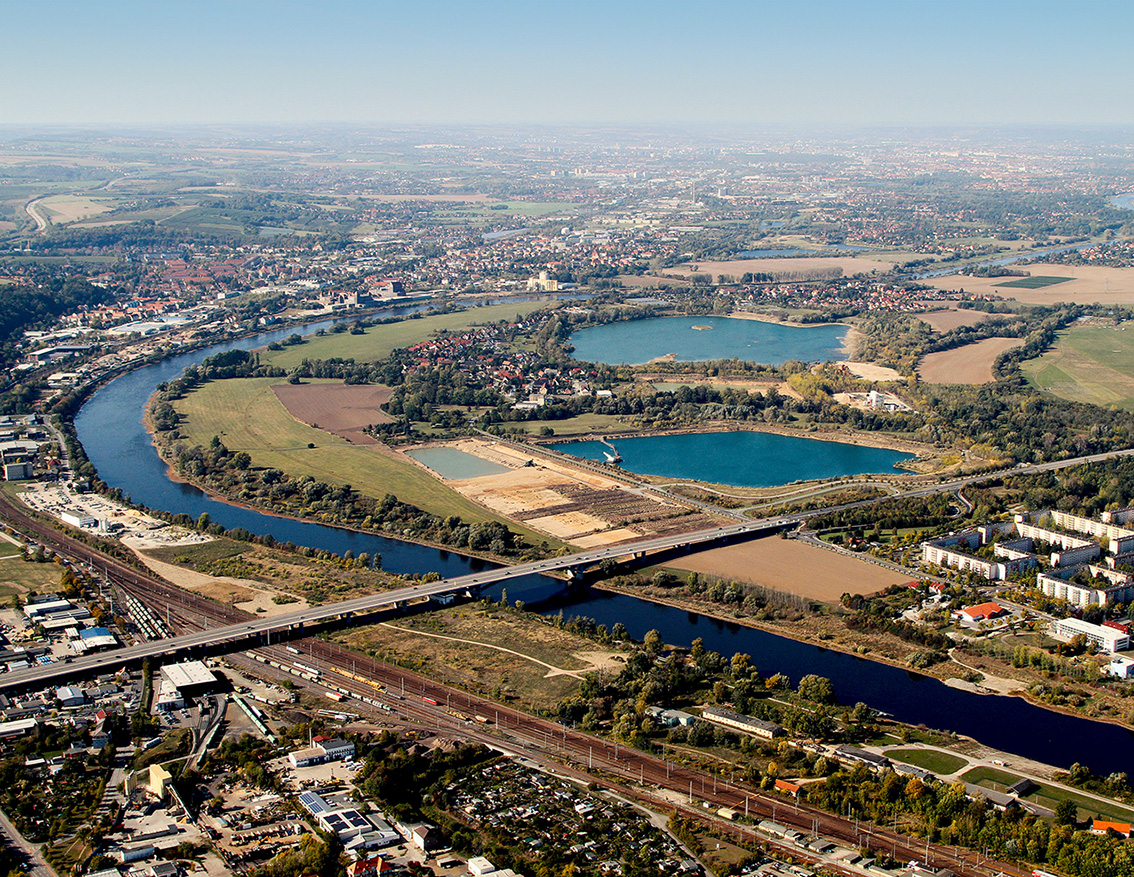
The site is located at the beginning of the Elbe River valley’s widening, on a long, narrow gravel ridge that runs parallel to the Elbe in an east-west direction. It rises steeply up to 5 m above the Elbe floodplain. Even during the preliminary survey in 2015, which was intended to determine the density of finds, the areas rich in finds in the southern part of the site stood out. There, along the edge of the lower terrace sloping down toward the Elbe floodplain, primarily Iron Age artifacts were uncovered. In contrast, the density of finds was sparse in the northern, eastern, and western parts of the excavation site. The areas in the south—which are now highly vulnerable to flooding—were likely protected from flooding on the gravelly lower terrace due to the Elbe’s lower riverbed during the Iron Age and other environmental factors, which explains why a settlement was established at this location. Whether it was located on a shallow branch of the Elbe or, as is the case today, directly above the Elbe, can no longer be determined. Only about 750 m northeast of the excavation site lies a La Tène period cemetery, which was excavated from 1979 to 1980 and may have belonged to the settlement.
Ingo Kraft/Wolfgang Ender/Gabriele Wagner/Annemarie ReckImage Source R. Heynowski, Foto ©LfA 2018.
Discovery of the cache
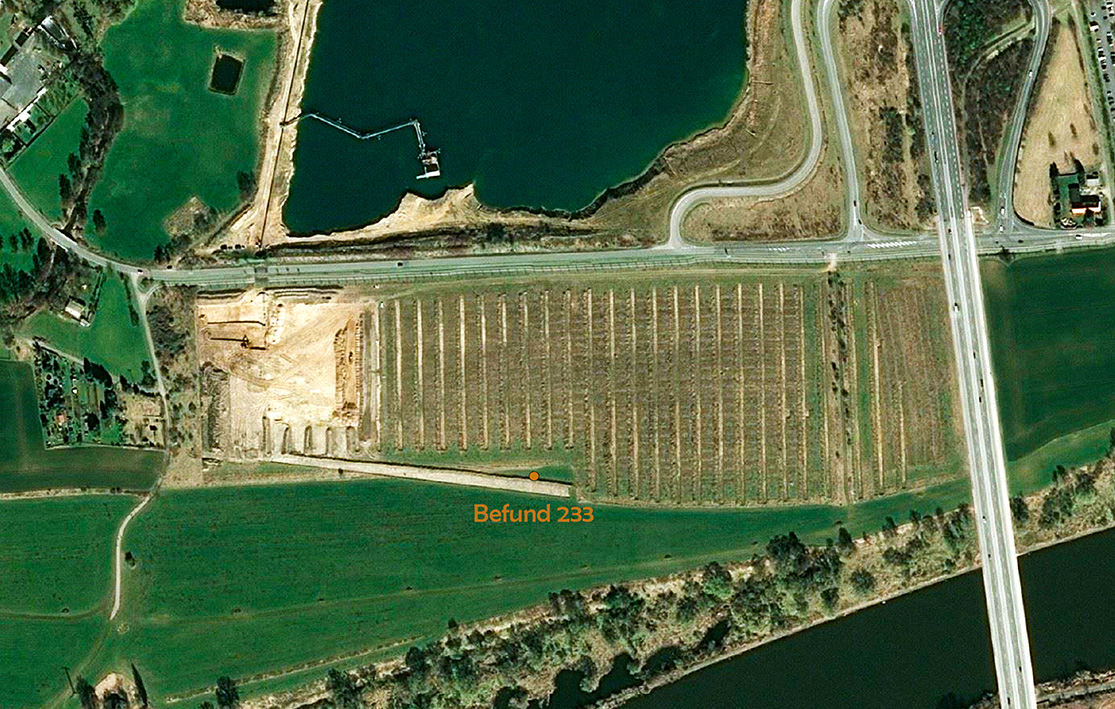
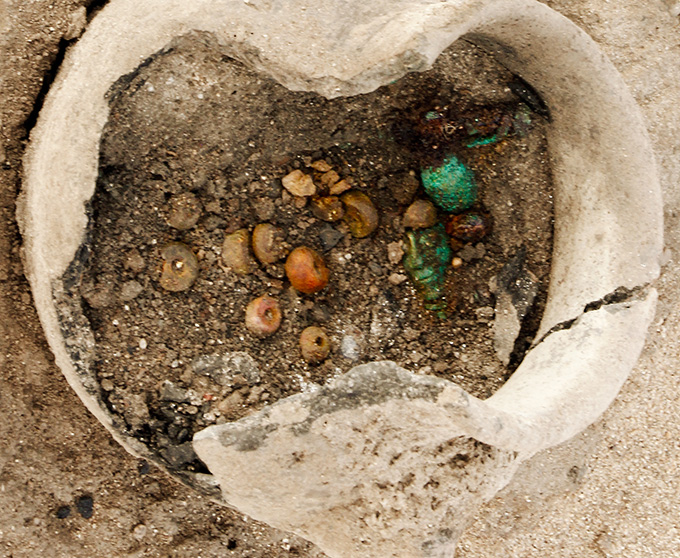
This remarkable find, Find No. 233, was actually discovered just a few days after the excavation officially concluded on October 7, 2018. Unfortunately, the area was situated in an awkward corner next to a 12-meter-wide and 280-meter-long straightening trench that had already been dug by the gravel plant operator in 2017. Following a prior archaeological surface survey, this area had been declared free of artifacts and was therefore no longer a focus of the excavation work. In prior consultation with the excavation director, Andrzej Hoppel, Martin Wittig revisited the excavation site—located not far from his apartment—over the weekend. The reason for the follow-up search was the start of initial excavation work, which had begun the previous Saturday in the area that had already been cleared. The finder first noticed a large rim shard from a ceramic vessel, a damaged bird-head brooch, and several colorful beads. About 0.5 m to the northeast, the outline of a small, two-handled pot was visible; its upper edge had been chipped by the excavator. Together with excavation assistant and volunteer archaeological conservator Mario Steinbach, Wittig secured the find and immediately reported it to the Saxony State Office for Archaeology on Monday morning.
Ingo Kraft/Wolfgang Ender/Gabriele Wagner/Annemarie ReckImage Source Orthofoto ©LfA/GeoSN 2018.
Recovery
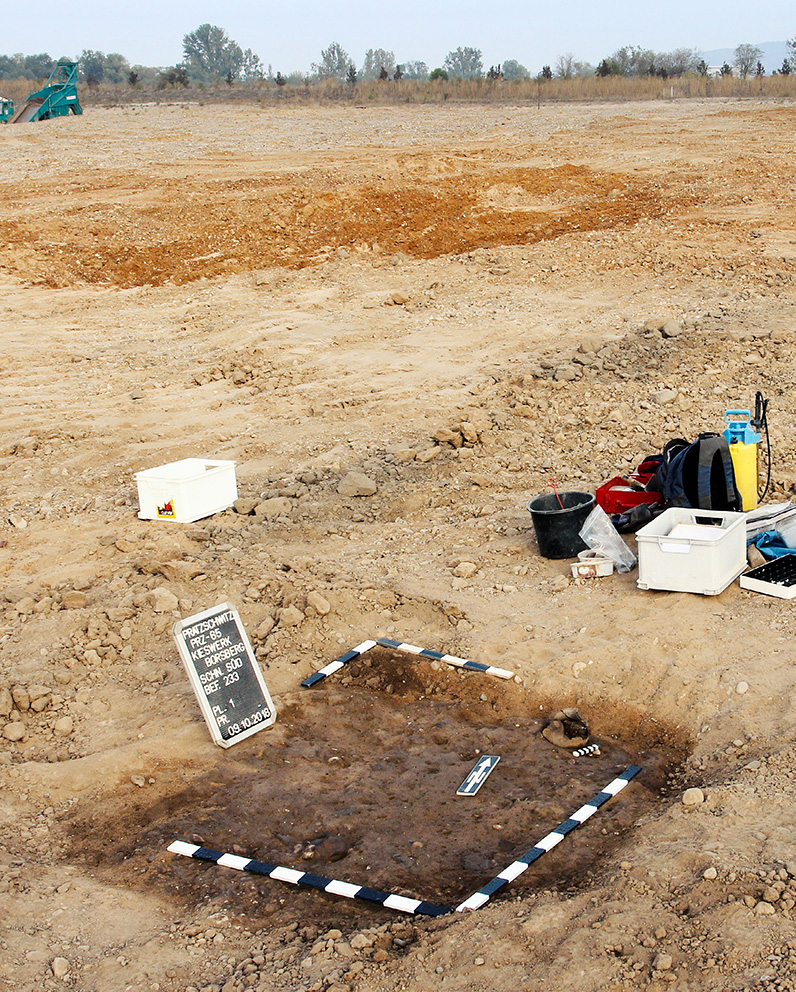
On Tuesday, October 9, 2018, Find No. 233 was documented and recovered by excavation director Hoppel and a small excavation team. First, a level surface was established, and the vessel was exposed down to the level of its base. The cleaned feature appeared roughly rectangular in the sandy coarse gravel and consisted of a grayish, loamy substrate with only a small amount of gravel. It measured 1.30 m by 1.20 m in total. The feature extended approximately 65–75 cm below the ground level exposed by the excavator. This made it one of the deeper features in the entire excavation area, where most were buried only 35–45 cm into the ground. Pottery shards from the immediate vicinity of the vessel likely came from a bowl that may have served as a cover for the deposit. Following the discovery, the immediate surroundings were also thoroughly surveyed once more. However, with the exception of one additional find 5 m to the north, which contained ceramic remains, no other archaeological structures were encountered.
Ingo Kraft/Wolfgang Ender/Gabriele Wagner/Annemarie ReckImage Source A. Hoppel, Foto ©LfA 2018.
Ensemble
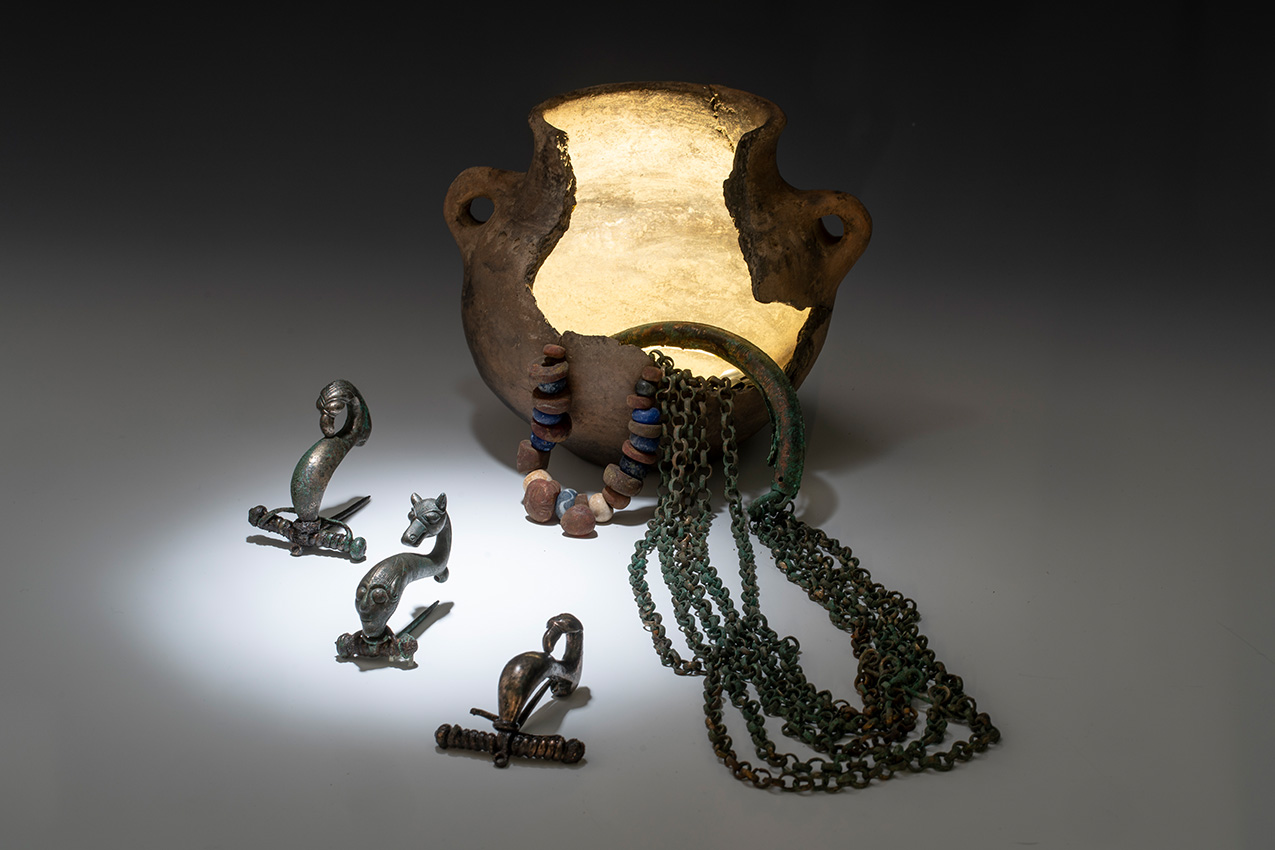
Including the artifacts dislodged from the vessel during dredging operations, the bulbous, two-handled ceramic vessel yielded a total of one bronze mask-shaped brooch with a zoomorphic foot ornament, two bird-headed brooches made of solid bronze, a chain necklace consisting of a decorated, half-ring-shaped “yoke” and a five-strand chain attached to it, made up of 790 small bronze rings and three chain dividers. Two thin, corroded iron rings made of round bar stock, with an outer diameter of 18 mm and a thickness of 2.8 mm, were also attached to the necklace, though they apparently did not belong to it. The majority of the vessel’s contents consisted of one or two bead necklaces totaling 485 beads. The vast majority of the beads were made of amber. The amber beads had cylindrical, wedge-shaped, spherical, and broad-cylindrical forms and exhibited color variations ranging from translucent to opaque orange and rust-red. The glass beads are spherical in shape. Apart from 20 white and one black bead, as well as a few isolated ones that are lighter or darker, the majority of the beads possessed the typical “Celtic blue.” A thin, long, narrow bone pendant, interpreted as an amulet, was also found among the beads. The beaded necklace and the beads were apparently surrounded by fabric—the remnants of a cloth or pouch. Remnants of a thread were also found among the beads.
Ingo Kraft/Wolfgang Ender/Gabriele Wagner/Annemarie ReckImage Source M. Jehnichen, Foto ©LfA 2020.
Link archaeo | 3D
A Guide to Masks
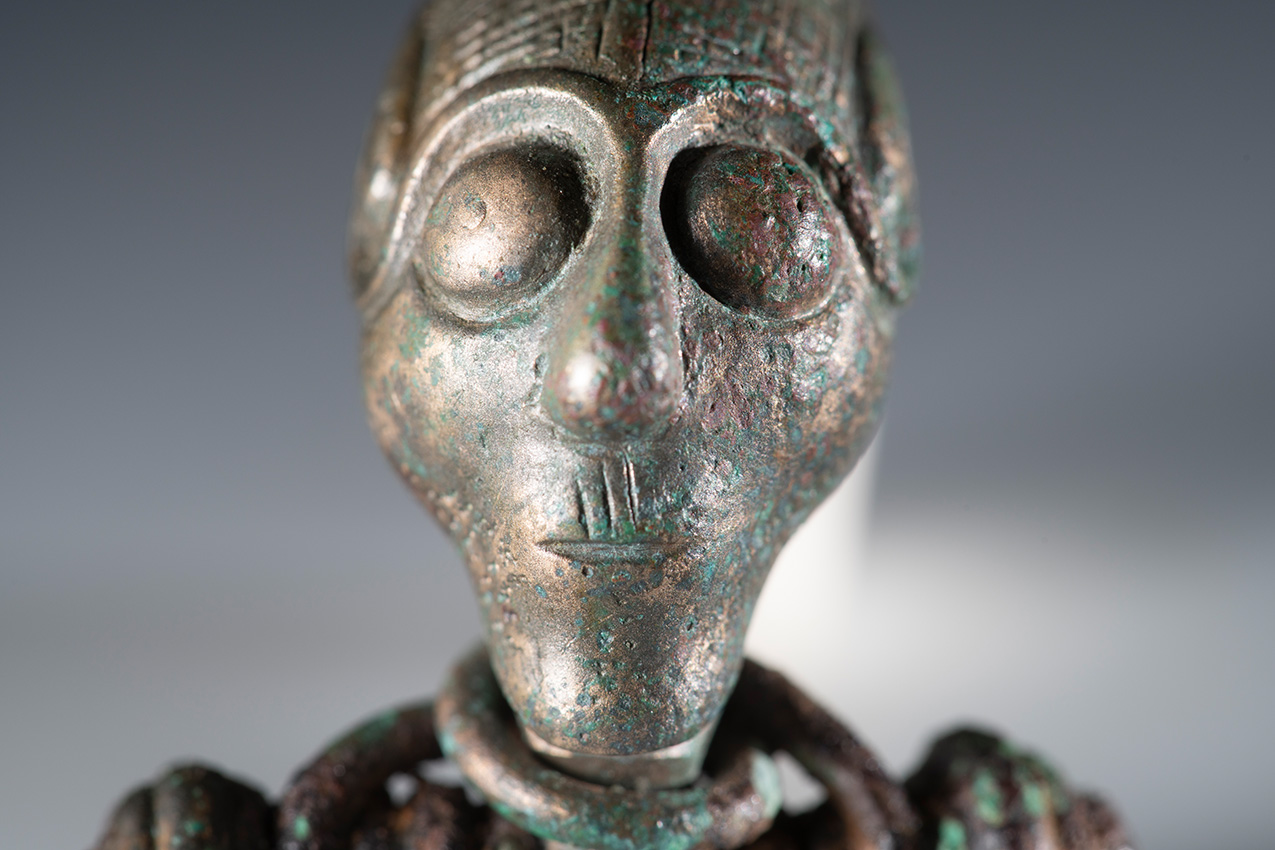
The mask brooch stands out among the artifacts found at the site due to its remarkable artistic and technical craftsmanship. It is 6.2 cm long and, apart from the iron spiral pin, is made of bronze. The head portion of the brooch is sculpted as an elongated, large-scale human face. Particularly striking are the large, round, button-like eyes set in the narrow face with a strong chin. The mouth is rendered as a fine slit. Between the nose and mouth, three vertical lines catch the eye; these may suggest a mustache or scars. Small indentations in the cheek and chin areas suggest a short “stubble beard.” The sinew wrapped around the bow was used to represent a neck ring (torques). Pointed ears are visible on both sides of the head. The forehead and hairline area between the pointed ears are filled with a rectangular, cross-hatched field. The field converges at an acute angle toward the center of the hoop at the level of a central ridge. The pointed cone forming above the face could be interpreted as a “pointed hat.”
Ingo Kraft/Wolfgang Ender/Gabriele Wagner/Annemarie ReckImage Source M. Jehnichen, Foto ©LfA 2020.
Link archaeo | 3D
The Stylistics of the *Maskenfibel*
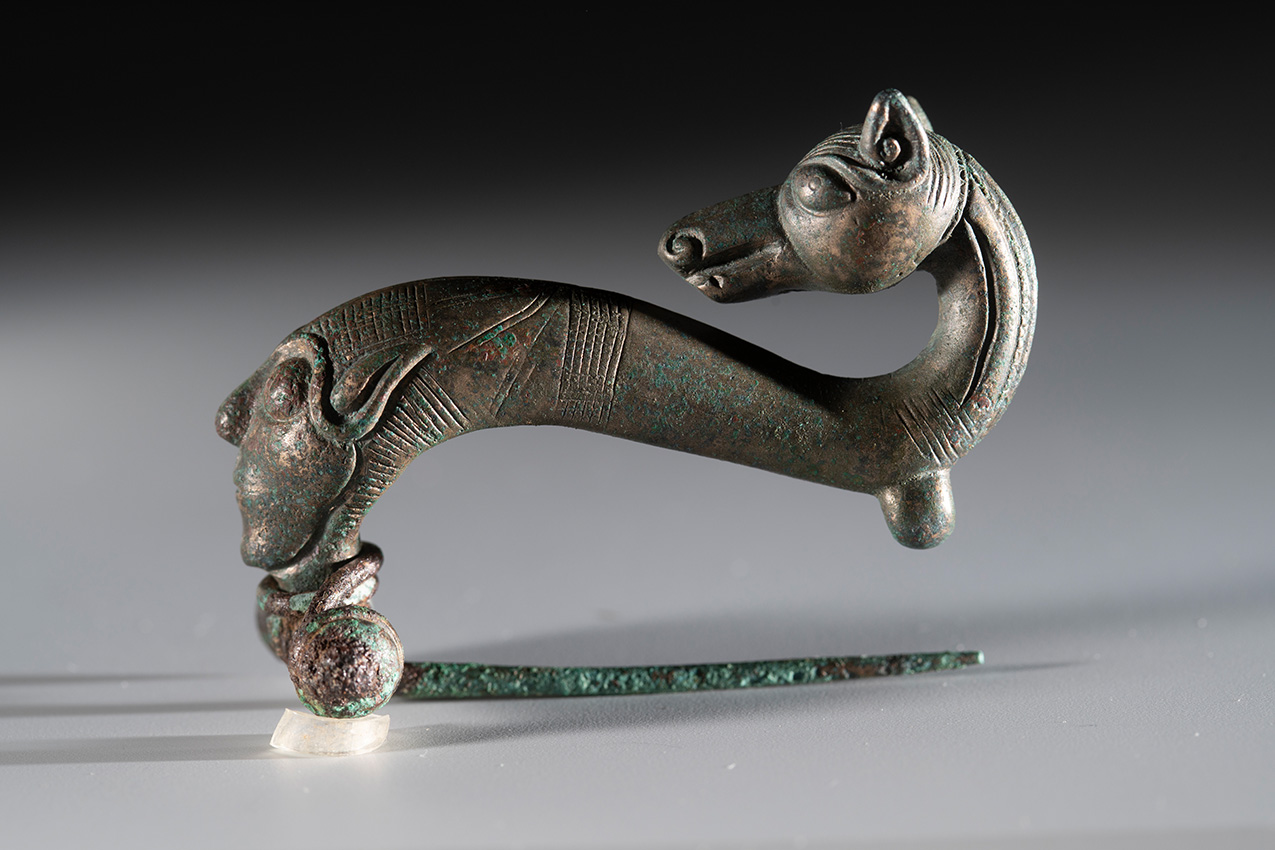
Above the mask, the ornate yoke tapers before curving in a half-loop toward the base of the brooch to mimic the neck and head of a canid. The large wolf or dog head features a naturalistic design with three-dimensional ears formed from the continuous, then protruding ridge of the eye sockets. Two incised spirals represent the nostrils. Additional ornaments, such as spirals, are a popular Celtic motif. The distinctive shape of the ears also points to this stylistic tradition. The fir-branch-like patterns of the “hairstyle” or the cross-hatched fields reflect a Hallstatt-geometric style. In contrast to comparable mask brooches from the Early La Tène period, this garment clasp lacks the playful floral ornamentation, as well as the monstrous, distorted, or hybrid elements typically found in mask depictions. Apparently, the bronze caster skillfully and masterfully combined the Hallstatt tradition with new elements. This high-quality brooch is an outstanding example of Celtic small-scale art from the La Tène A phase. It was likely produced in Celtic centers further south, in Bohemia or Slovakia.
Ingo Kraft/Wolfgang Ender/Gabriele Wagner/Annemarie ReckImage Source M. Jehnichen, Foto ©LfA 2020.
Bird-Head Brooches
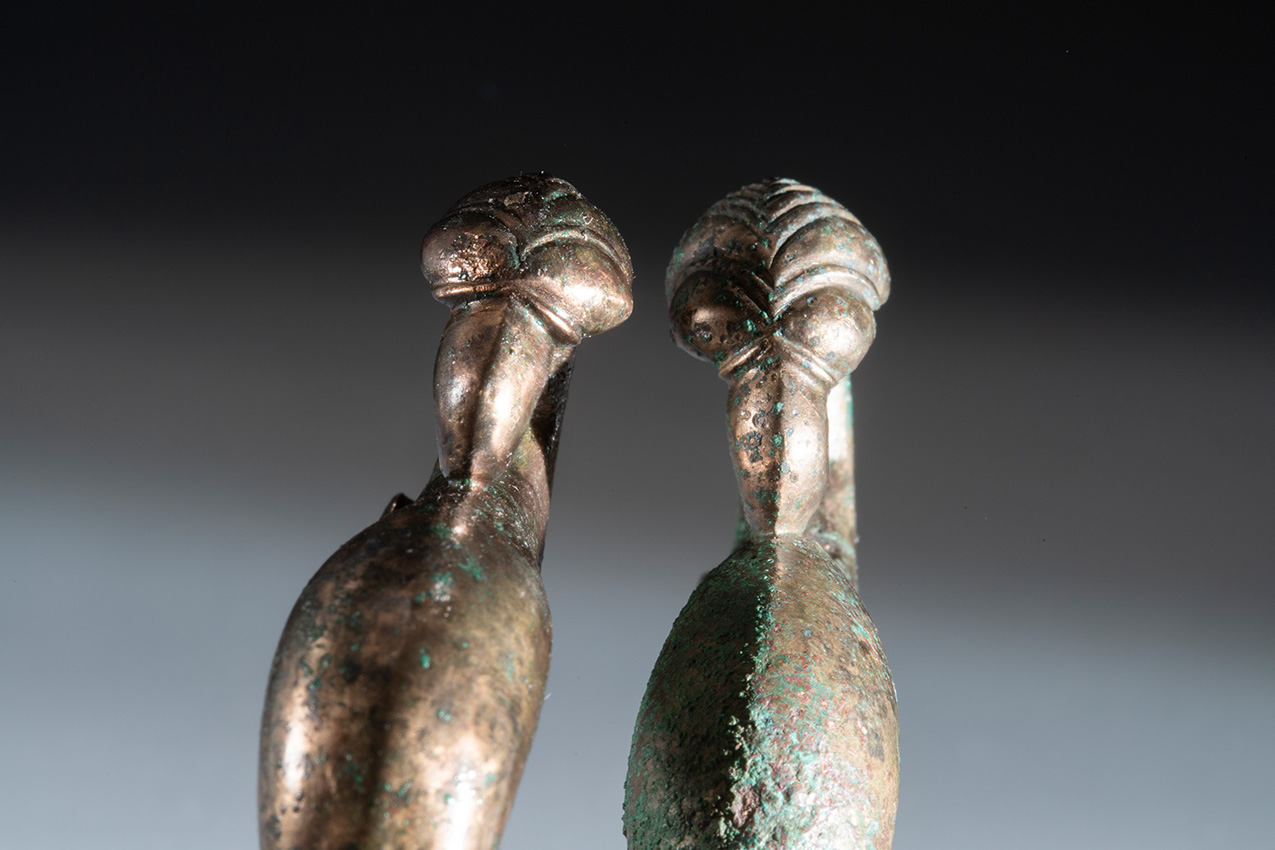
The two bird-head brooches are very similar and were likely made as a pair. They are solid cast and measure 6.5 and 6.6 cm in length, respectively. Aside from an iron pin, they are made of bronze. An eyelet design on both pieces was likely intended to hold a connecting chain. This is suggested by other pairs of brooches from around the same period. Both bird heads are characterized by a relatively broad beak with a central ridge that curves sharply downward, resting on the bow with its blunt tip. The eyes are pointed oval and surrounded by a semi-relief ridge. Starting from the forehead, pine-branch-like lines running parallel on the left and right extend toward the nape, representing the head’s plumage. In the nape area, they are bordered by a three-dimensional band encircling the neck. This pair of brooches belongs to the type of birds-of-prey brooches from the Early La Tène period. All three brooches are handmade. However, the mask brooch stands out as the highest quality piece due to its exceptional craftsmanship.
Ingo Kraft/Wolfgang Ender/Gabriele Wagner/Annemarie ReckImage Source M. Jehnichen, Foto ©LfA 2020.
Link archaeo | 3D
Interpretation
No evidence of human remains—such as bones, teeth, or cremated remains—was found inside the ceramic vessel or in the surrounding fill. For this reason, the find cannot be interpreted as grave goods. The context of the find—in a square pit approximately 1.5 square meters in size and 1 meter deep, located in the center of the settlement area—also rules out the possibility that it could have been an emergency hiding place. It is conceivable that the objects were publicly deposited or that this was a cenotaph (mock grave). However, the subsequent removal of the objects from this carefully chosen, presumably non-secret location within the settlement must have been prevented by a taboo. From a geographical perspective, the site is located in the border region between the Early Germanic and Celtic worlds. There, at the beginning of the Elbe Valley’s widening, lies the northern end of the ancient trade route known as the “Kulmer Steig.” The rich collection of jewelry attests to the fact that trade along this north-south route likely existed as early as prehistoric times. For instance, the exquisite brooches and characteristic blue glass beads originate from the Celtic cultural sphere in the south, while the Baltic amber points to the Baltic Sea.
Ingo Kraft/Wolfgang Ender/Gabriele Wagner/Annemarie ReckImage Source A. Hoppel, Foto ©LfA 2018.
Note on monument protection
Archaeological monuments are protected by the Saxon Monument Protection Act. A permit under monument law is required for ground interventions or construction measures.
Permalink
https://archaeo-sn.de/en/ort/schmuckdepot-von-pratzschwitz/
Citation
Ingo Kraft/Wolfgang Ender/Gabriele Wagner/Annemarie Reck, Pratzschwitz Jewelry Depot. In: Landesamt für Archäologie Sachsen, Website archaeo | SN (09.12.2024). https://archaeo-sn.de/en/ort/schmuckdepot-von-pratzschwitz/ (Stand: 29.09.2026)
