

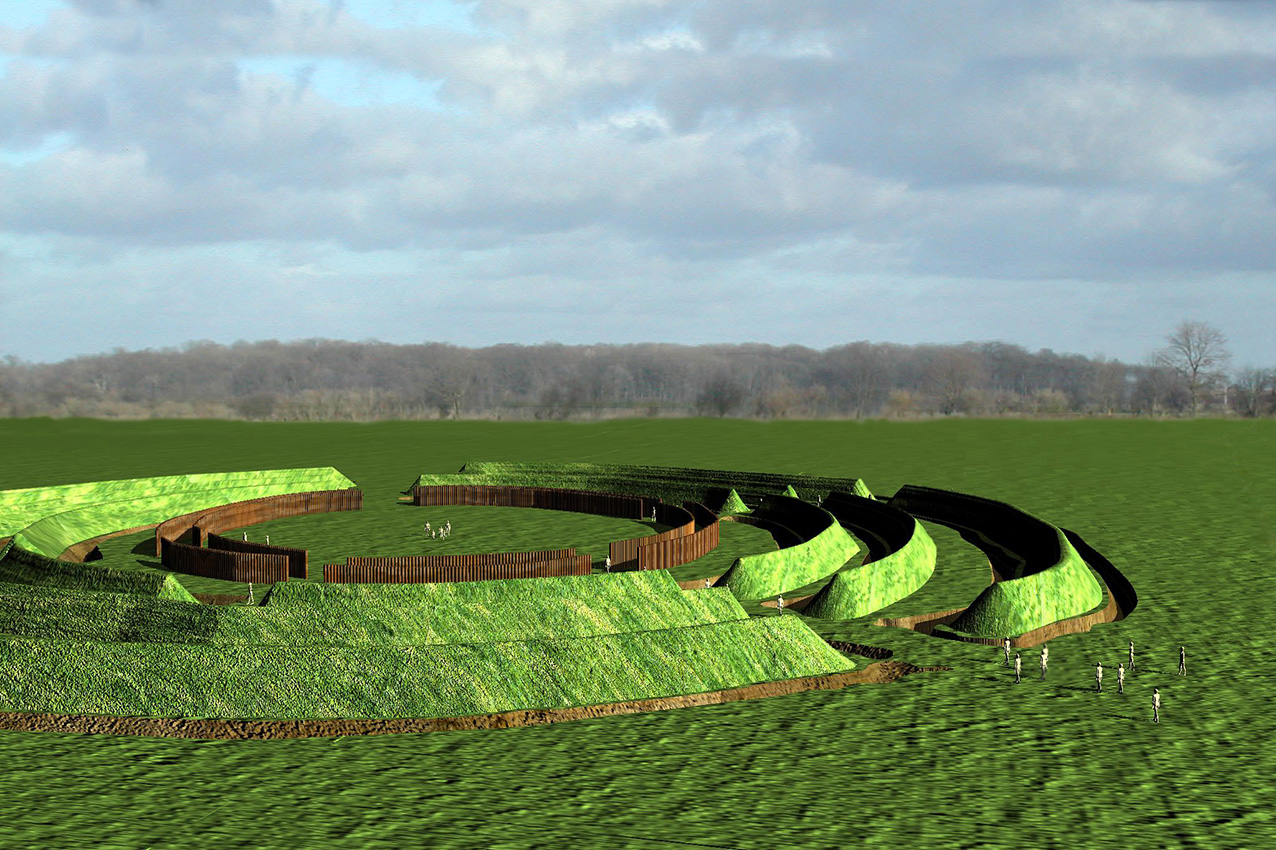
Circular ditches of Dresden-Nickern
| Place: | Nickern (Dresden, Dresden City) |
|---|---|
| Type: | Circular ditch |
| Dating: | Linear Pottery culture | ca. 5000 - 4500 BC. |
Description
In the course of the planned construction of the S 191 feeder road from Dohnaer Straße to the A17 (Dresden - Prague), large-scale excavations were carried out near Nickern and Prohlis in the south of Dresden in 2002. One of the most unusual features uncovered during this excavation campaign in the area of an allotment garden settlement was the quadruple Linear Pottery and Linear Pottery ditch work from Dresden-Nickern NIE-09, which was located in the immediate vicinity of three other earthworks. The circular ditches surrounded a Neolithic settlement area with approx. 21 house foundations and a contemporary cemetery north of the Gerberbach stream. Since 2020, the cultural-historical circular hiking trail along the Gerbersbach stream, the "Archaeo-Pfad Dresden“with eleven information steles in today's urban area through the extraordinary archaeological cultural landscape in the south of Dresden.
Annemarie ReckLink https://www.dresden.de/de/rathaus/stadtbezirksaemter/prohlis/geschichte/archaeo-pfad.php
Research history
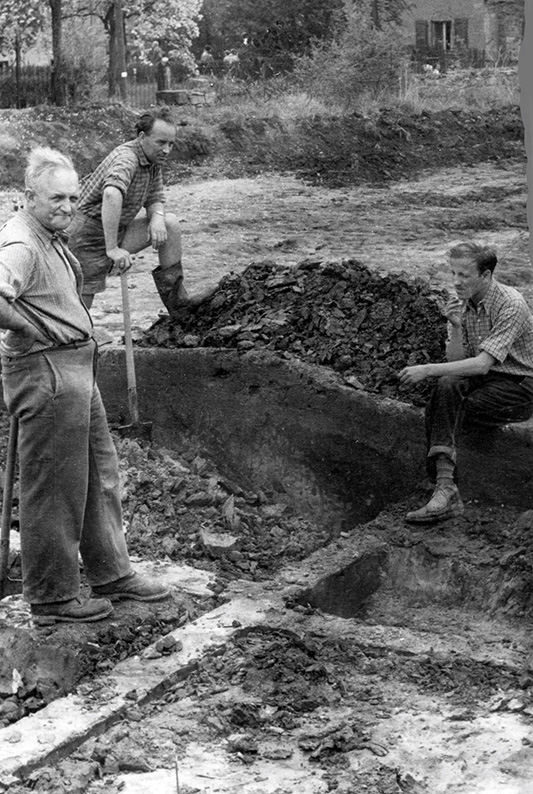
As early as the 1920s and 1930s, prehistoric finds such as mammoth bones were often unearthed in the clay pits there. In addition, the Dresden Elbe valley with its fertile loess soils in the warm, humid climate of the early Neolithic period was an ideal settlement site for the first cultures specializing in agriculture and animal husbandry. Archaeological finds and the first systematic excavations from the 1950s and 1960s onwards confirm the presumed density of finds in these areas. However, it was not until the lively construction activity of the 1990s that a real insight was gained into the rich Neolithic settlement landscape in the south of Dresden and an idea of what must have been lost in the previous decades.
Annemarie ReckImage Source U. Quietzsch-Lappe, Grabung an einer LBK-Siedlung in Nickern ©LfA 1961/62.
Distribution and structure
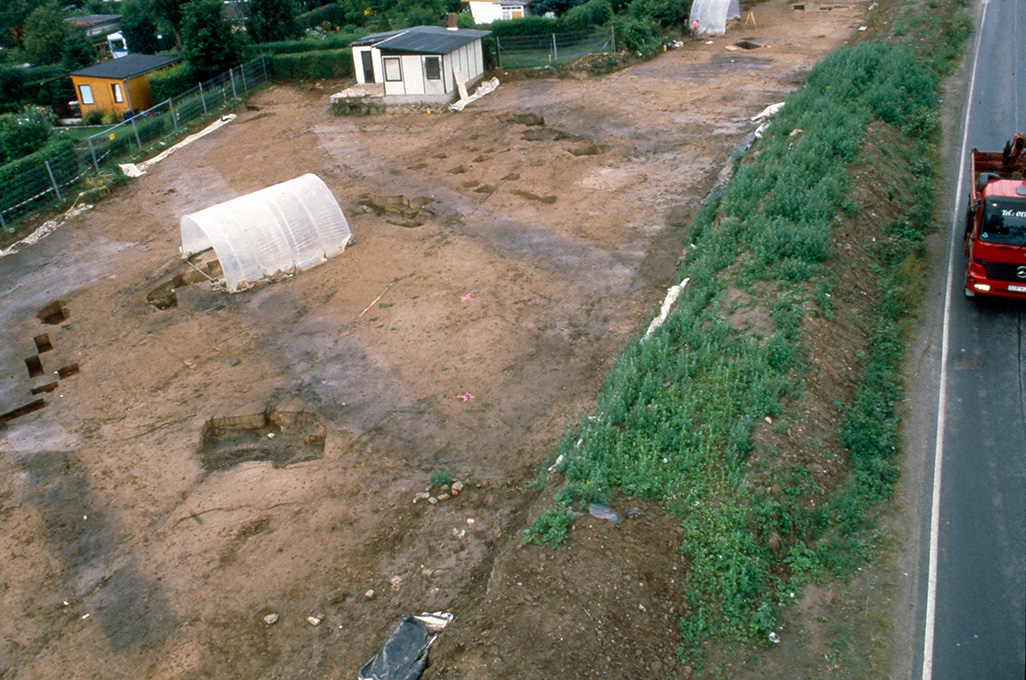
Between 4800-4500 BC, the construction of Linear Pottery circular ditches was widespread around settlements in central and southern Germany as well as in the Czech Republic and Lower Austria. They usually consist of a single or multiple ditch and a varying number of palisade rings. The inner surfaces vary between 50 and 150 m in diameter. The ditches are mostly pointed ditches. In Dresden-Nickern they are only preserved up to 2 m deep. At comparable Austrian sites, the ditches were much deeper. The excavated material was presumably piled up behind the ditches as a kind of rampart structure, which further reduced the view into the interior of the enclosures. There was no evidence of construction within the enclosed areas in Dresden-Nickern.
Annemarie ReckImage Source P. de Vries, Übersichtsfoto 4-fache Kreisgrabenanlage NIE-09 ©LfA 2002.
The circular ditches of Nickern
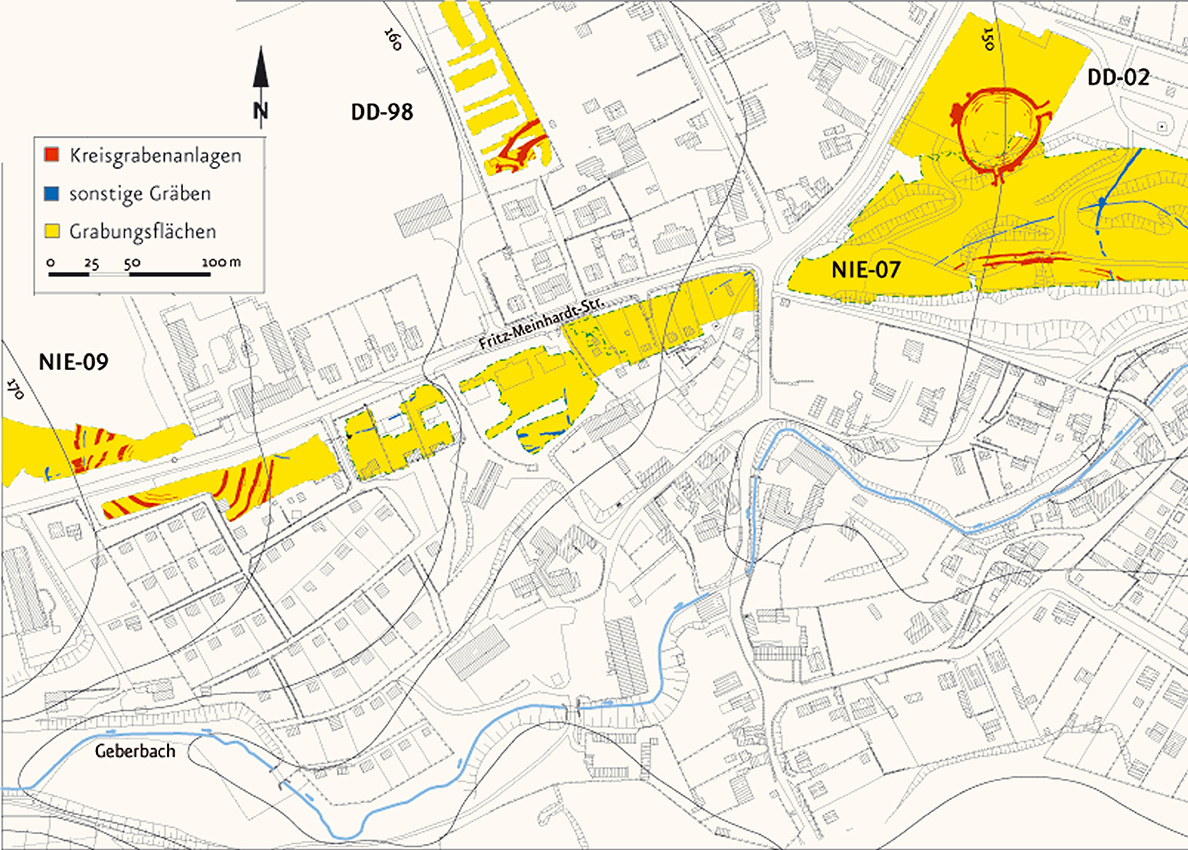
Since the early 1990s, up to four circular ditches have been investigated in Dresden-Nickern. Two of them were built during the period of the Linear Pottery culture, a third presumably somewhat earlier at the time of the latest Linear Pottery. The first is a simple, completely excavated enclosure (DD-02) with an inner surface of up to 52 m in diameter. The trenches of this enclosure bend in the area of the entrances, creating pincer-shaped gate situations. The remains of up to three rows of palisades were recorded behind them. On the other hand, a double (DD-98) and a quadruple circular ditch (NIE-09) were partially excavated. The fourth enclosure was a double ditch with an accompanying palisade. However, as the ditch features intersected Linear Pottery house foundations and the finds recovered in this area were significantly younger, it can be assumed that this fourth ditch was constructed during the Middle Neolithic period (4500-4000 BC).
Annemarie ReckImage Source Plan der Befunde ©LfA 2002.
Link smac 360°
Quadruple trench system NIE-09
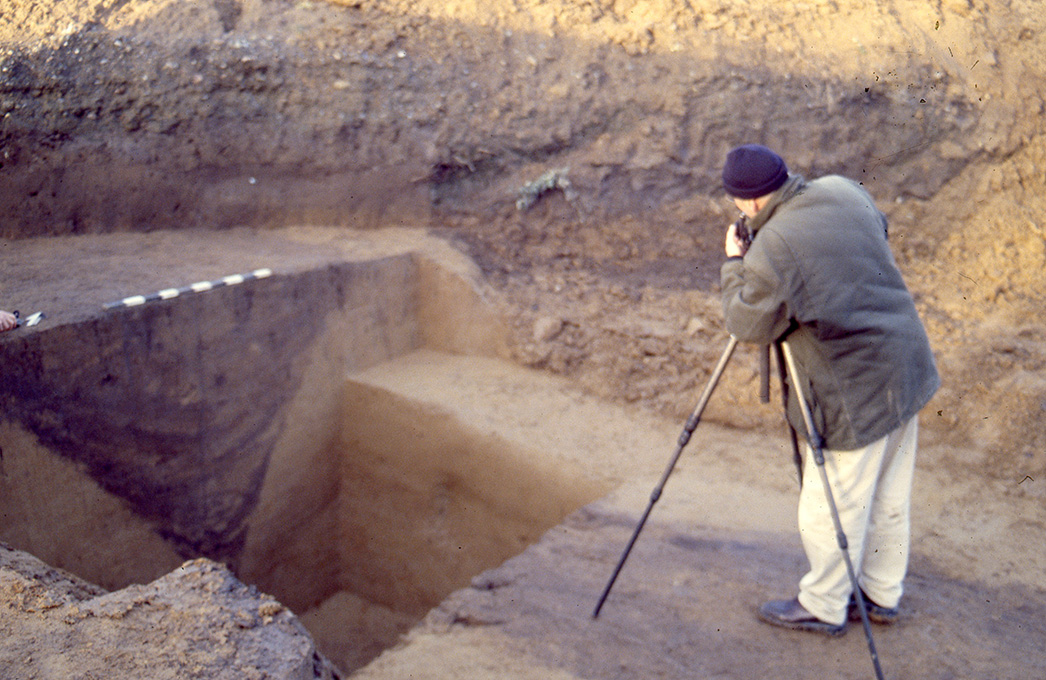
The circular ditch system (NIE-09) stands out clearly with its four rows of ditches (see also Fig. 2). The only parallel in Saxony can be found in the quadruple ditch system Kyhna 3. The NIE-09 earthwork was only investigated in the area required for road construction. In total, this amounted to 208 m of trench length, estimated at up to 1200 m, i.e. just 17 % of the entire structure. The irregularly oval construction is reminiscent of the triple circular ditch system of Zwenkau, which is almost quadrangular with rounded ditch courses. The ditches are all pointed ditches, which were backfilled in a fine layer, presumably naturally, in the lower section, but mostly have a homogeneous backfill in the upper section. The diameters of the four trenches are 124 m, 105 m, 86 m and 68 m from the outside to the inside. In some cases, it was even possible to detect several development phases in the trench profiles. Only one end of the trench could be recorded in the excavation area, which is why no statements can be made about gates or passages. Inside, the remains of two palisades were found, which limited the open area in the heart of the complex to approx. 1140 m².
Annemarie ReckImage Source J. Jansen, Foto Dreiphasiger Kreisgraben NIE-09 ©LfA 2002.
Interpretation
Due to the lack of archaeological finds or structures inside the circular ditches, the function of these buildings is difficult to interpret. In the history of research, it has sometimes been suggested that they were used as cattle kraals, solar observatories or as Stone Age "cathedrals". A multifunctional use as a central location is also often postulated for the circular ditches. It is certain that the construction of such earthworks required the manpower of a larger group, which had to be coordinated from a single location. The reconstruction of such a circular ditch complex in Lower Austria showed that 30 craftsmen had to work for up to 75 days to construct an earthwork the size of structure DD-02.
Annemarie ReckImage Source H. Stäuble/T. Preuss, Rekonstruktion ©LfA 2005.
Literature
Rainer Bartels/Wolfgang Brestrich/Patricia de Vries/Harald Stäuble, Ein neolithisches Siedlungsareal mit Kreisgrabenanlagen bei Dresden-Nickern. Eine Übersicht. Arbeits- und Forschungsberichte zur sächsischen Bodendenkmalpflege 45, 2003, 97–133.
Richard Funke/Margit Georgi/Bettina Heger/Florian Innerhofer/Anja Kaltofen/Peter Neukirch/Thomas Westphalen, Nickern und Prohlis – Archäologie und Geschichte am Gerberbach in Dresden. Archaeonaut 13 (Dresden 2020).
Harald Stäuble, Die vierfache Kreisgrabenanlage bei Dresden-Nickern. Weite Verbreitung von Kreisgrabenanlagen zur Zeit des Neolithikums. In: Andreas Müller (Hrsg.), Auf den Spuren alter Kulturen, Band 2. Nicht nur eine Chronik des Freundeskreises Alte Kulturen e.V. Freiberg (2013) 119–132.
Note on monument protection
Archaeological monuments are protected by the Saxon Monument Protection Act. A permit under monument law is required for ground interventions or construction measures.
Permalink
https://archaeo-sn.de/en/ort/circular-ditches-of-dresden-nickern/
Citation
Annemarie Reck, Circular ditches of Dresden-Nickern. In: Landesamt für Archäologie Sachsen, Website archaeo | SN (15.10.2024). https://archaeo-sn.de/en/ort/circular-ditches-of-dresden-nickern/ (Stand: 29.09.2026)
