

Sieglitz circular ditch
| Place: | Sieglitz (Käbschütztal, Meißen) |
|---|---|
| Type: | Circular trench system 1-fold |
| Dating: | Linear Pottery culture | 4700 - 4600 BC. |
Description
In 1997, an early Neolithic circular ditch was discovered south of the village of Sieglitz in the Lommatzscher Pflege region during an aerial archaeological survey. It was located on a hilltop visible from afar and had a diameter of 53 m. In 2014, under favorable conditions, three palisade trains were also recorded inside the complex for the first time. In the following year, the earthworks were excavated as part of a four-week teaching excavation by the Chair of Prehistory and Early History at Leipzig University in cooperation with the Saxony State Office for Archaeology (LfA) in order to verify the structures observed from the air. The pottery remains found during the excavation in the earthworks area could be assigned to the Neolithic Linear Pottery culture. Vessel remains from the Early Bronze Age Aunjetitz culture were also found in a single pit, indicating that the site was used after the Bronze Age.
Annemarie ReckDiscovery of the plant
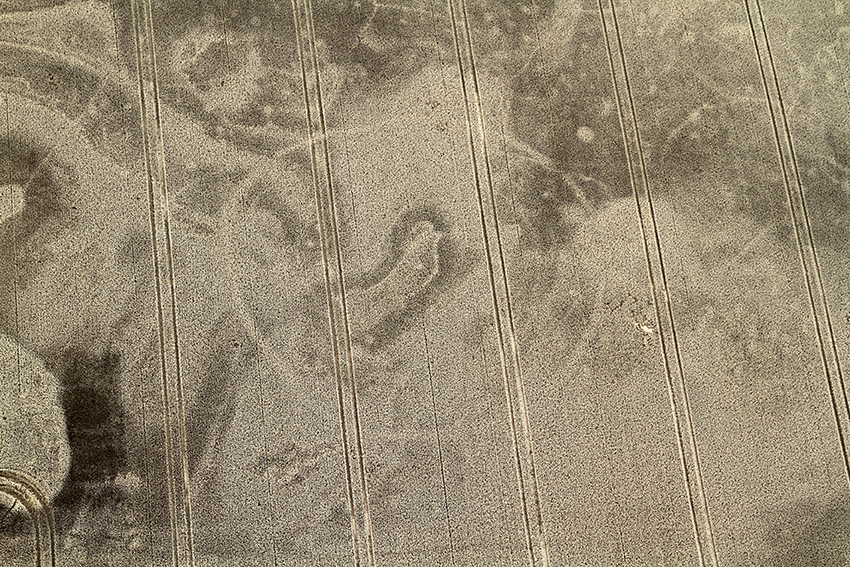
In 1997, Otto Braasch documented the previously unknown earthworks south of Sieglitz in the Lommatzscher Pflege for the first time during an aerial flight. This region, which was heavily used for agriculture due to its fertile loess soils, was already frequented by arable farmers in the Neolithic period. However, due to the soil's ability to store moisture well, growth differences in cereals are only slightly developed, which is why growth characteristics only become apparent in very dry conditions. It was therefore not until 2012 that the circular ditch was photographed a second time. In the summer of 2014, the conditions for aerial archaeology were so favorable that not only the outer ditch, but also three inner palisade ditches could be observed for the first time. Numerous pits were also visible in the immediate vicinity of the circular ditch, which could be the remains of settlement or post pits.
Annemarie ReckImage Source R. Heynowski, Foto ©LfA 2014.
Excavation 2015
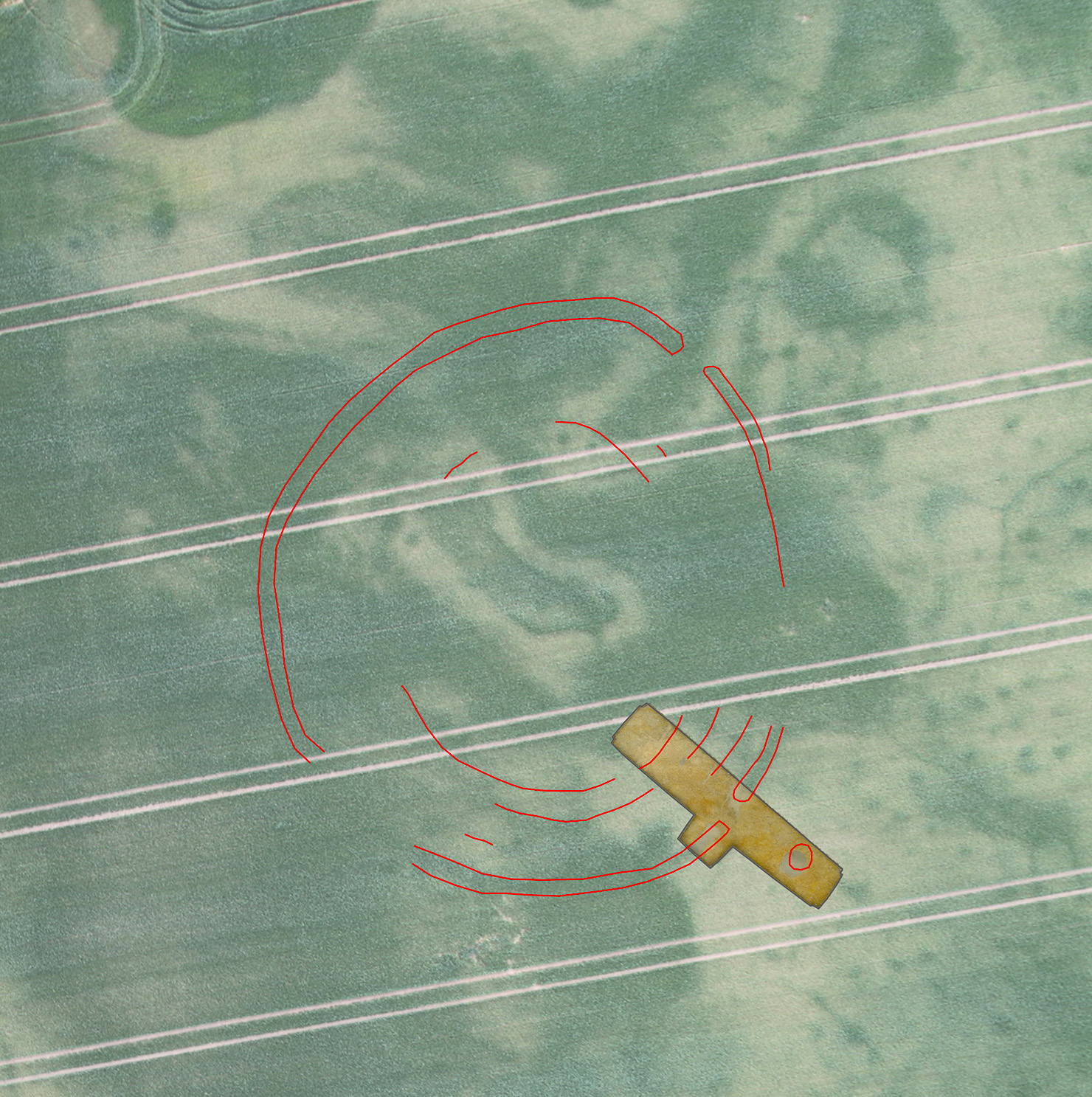
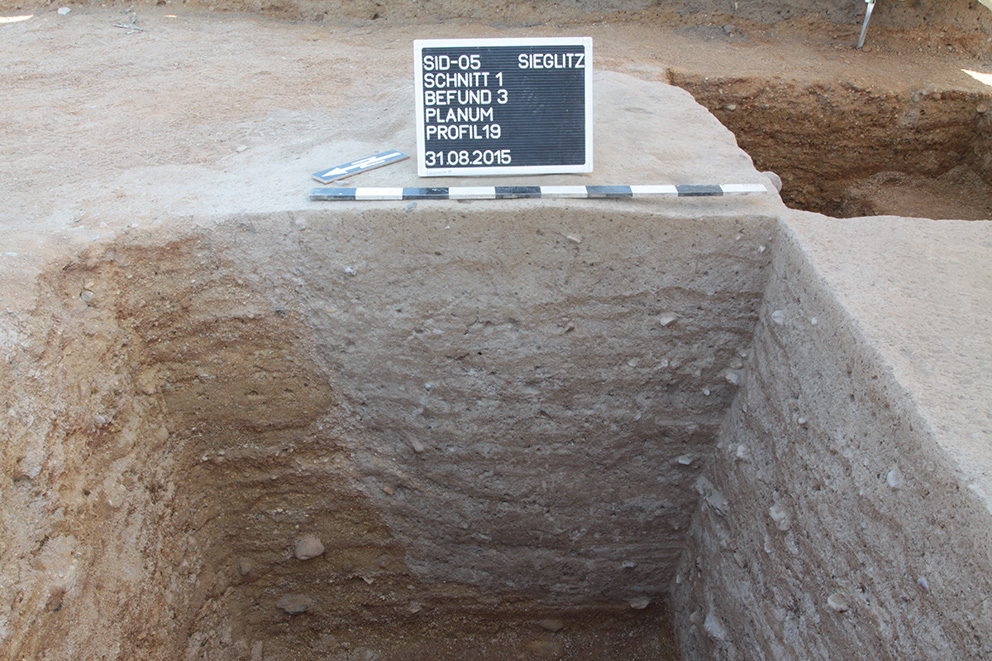
In the summer of 2015, a four-week educational excavation was carried out in cooperation between the LfA Saxony and the Chair of Prehistory and Early History at Leipzig University in order to investigate the site in more detail. The excavation section was located in the north-eastern passage area of the ditch and was 25 m long and 5 m wide. After the topsoil had been removed, the two adjoining ditch heads and the ends and course of the three palisade ditches were already visible. The outer ditch had a slightly varying width of 1.3-1.5 m and a funnel-shaped cross-section, which was still preserved down to a depth of 0.8 m. In contrast to comparable structures, there were hardly any deposits on the ditch floor, which speaks against the ditch being open for a longer period of time. On the other hand, it was probably intentionally backfilled with homogeneous soil.
Annemarie ReckImage Source G. Seifert, entzerrtes Luftbild mit Umzeichnung, M. 1:5000 ©LfA 2015.
The trenches
The outer ditch has a diameter of 53 m, while the innermost of the palisade ditches still encloses an area of 27 m. The palisade trenches were between 0.2 and 0.3 cm wide, with a preserved depth of 0.2-0.4 m. The distance between the individual palisades was between 2 and 4 m. In some places, even individual traces of the posts were visible in the ground. The two entrances visible in the aerial photograph were located in the northwest and northeast. Whether there were further entrances to the south is unclear. Behind the enclosure ditch and in front of the first row of palisades, a shallow rampart could have been heaped up from the ditch excavation, as is known from comparable sites. However, no evidence of this was found during the excavation. If it did exist, it has now been completely leveled.
Annemarie ReckImage Source M. Schönfeld, Foto trichterförmiger Grabenkopf ©LfA 2015.
The finds
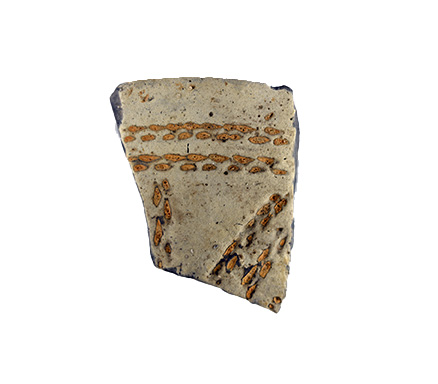
The finds from the ditch areas can be assigned to the Early Neolithic Linear Pottery culture. The palisade ditches, on the other hand, were completely devoid of finds. Directly in front of the entrance examined during the excavation, a round pit was also uncovered containing pottery from the Early Bronze Age Aunjetitz culture (ca. 2200-1600 BC). The numerous pits to the north and east of the site indicate lively settlement activity in the vicinity of the site. However, it is unclear which of the features visible in the aerial photograph are Early Neolithic and which are Early Bronze Age.
Annemarie ReckImage Source Stichbandkeramische Scherbe mit Inkrustationsresten. Maße: 6,5 cm hoch, 5 cm breit ©LfA 2015.
Literature
Jörg Frase /Ronald Heynowski/Gunar Seifert/Michael Strobel/Ulrich Veit, Sondagen in einer neuentdeckten stichbandkeramischen Kreisgrabenanlage bei Sieglitz, Gde. Lommatzsch, Lkr. Meißen (SID-05). In: Regina Smolnik (Hrsg.), Ausgrabungen in Sachsen 6. Arbeits- und Forschungsberichte zur sächsischen Bodendenkmalpflege Beiheft 33 (Dresden 2018) 69–73.
Dana Mikschofsky/Ronald Heynowski, Neu entdeckte Kreisgrabenwerte im Mittelsächsischen Lösshügelland. In: Regina Smolnik (Hrsg.), Ausgrabungen in Sachsen 8. Arbeits- und Forschungsberichte zur sächsischen Bodendenkmalpflege Beiheft 36 (Dresden 2022) 289–296.
Dana Mikschofsky, Ein Kreisgraben in guter Lage. In: Regina Smolnik/Ronny Zienert (Hrsg.), Höhenflüge. Luftbilder und Archäologie in Sachsen (Dresden 2024) 40–41.
Note on monument protection
Archaeological monuments are protected by the Saxon Monument Protection Act. A permit under monument law is required for ground interventions or construction measures.
Permalink
https://archaeo-sn.de/en/ort/sieglitz-circular-ditch/
Citation
Annemarie Reck, Sieglitz circular ditch. In: Landesamt für Archäologie Sachsen, Website archaeo | SN (02.09.2024). https://archaeo-sn.de/en/ort/sieglitz-circular-ditch/ (Stand: 28.09.2026)
