

Nazi forced labor camp and subcamp Lengenfeld
| Place: | Lengenfeld (Lengenfeld, Vogtlandkreis) |
|---|---|
| Type: | Sites of National Socialism |
| Dating: | Second World War | 1943 - 1945 AD. |
Description
Forced laborers were employed in most Saxon craft, industrial and agricultural businesses during the last three years of the war from 1943 to 1945. In Lengenfeld in Vogtland, south of Göltzsch, there are the remains of a forced labor camp from the Nazi era. This special archaeological monument to the recent past is an important reminder of the war years between 1943-1945 and the Nazi terror regime. The former forced labor camp is in an exceptionally good state of preservation.
Michael Strobel/Annemarie ReckLink https://www.gedenkstaette-flossenbuerg.de/de/geschichte/aussenlager/lengenfeld
Accommodation in satellite camps
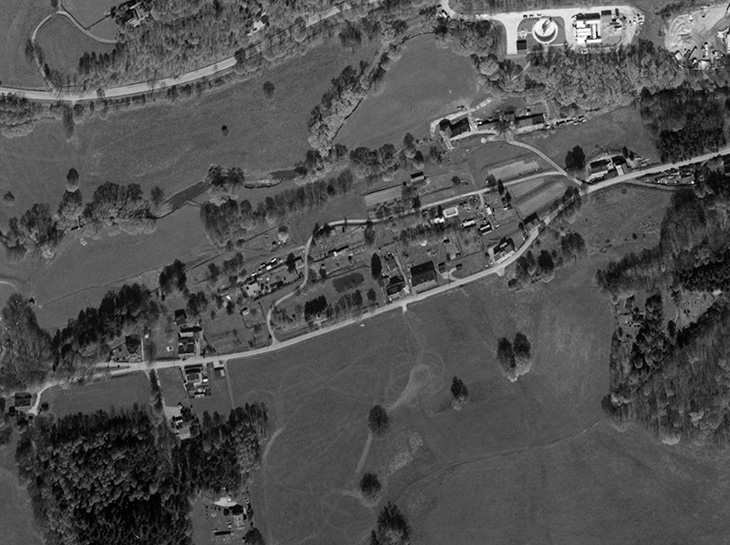
Civilian forced laborers, prisoners of war and concentration camp inmates were housed in factory halls, gymnasiums, restaurants and school buildings as well as in barrack camps, such as in Lengenfeld. The proportion of forced labor was particularly high in the lignite and armaments industries. This was further exacerbated by the relocation of armaments factories to "air raid-proof" sites, some of which were located underground. Added to this were the prisoners of the numerous subcamps, which also became widespread in Saxony from the summer of 1944 at the latest. The Lengenfeld subcamp (pictured) was under the control of the main Flossenbürg concentration camp in Bavaria.
Michael Strobel/Annemarie ReckImage Source Digitales Orthophoto, genordet ©LfA 1999.
Forced encampment in the archaeological findings
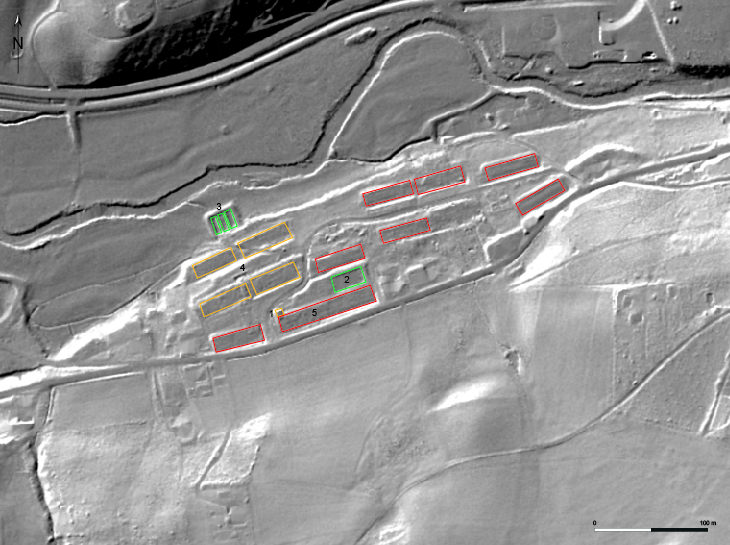
After the end of the war, the permanent accommodation was returned to its original function, while the barrack camps were only used for a short time at best. In most cases, however, they were soon moved or demolished for material extraction, which is why structural remains have often only been preserved in the ground. In the case of the Lengenfeld forced labor camp, the remains of the foundations of the individual barracks have been preserved in the ground, both in the digital terrain model and visible on site on the flat terraced slope in the damp meadow terrain, which makes it possible to reconstruct each location exactly. A concrete bunker or cellar (1), which is still accessible today, as well as extinguishing water (2) and sewage basins (3) are still clearly visible in the terrain.
Michael Strobel/Annemarie ReckImage Source M. Strobel, Bearbeitung, Digitales Geländemodell ©LfA 2020.
The subcamp
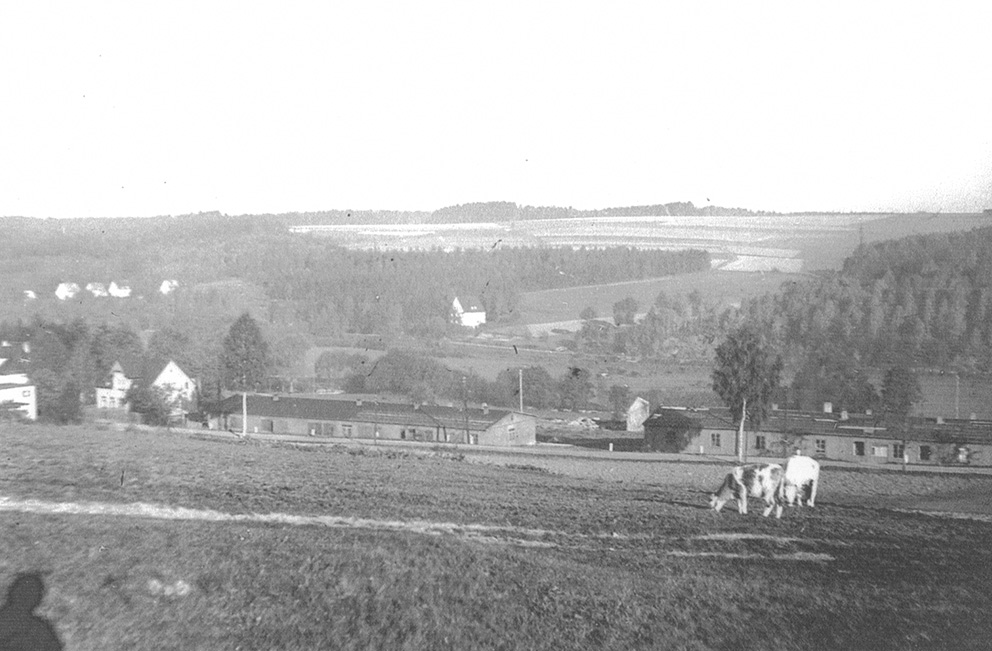
The Lengenfeld forced labor camp was originally set up for civilian forced laborers and Soviet prisoners of war. In October 1944, it was supplemented by a subcamp (Flossenbürg main camp) for around 1000 male prisoners. They were crammed into four barracks in a separate part of the camp (4) in the north-west of the site, which was fenced in with barbed wire and secured by watchtowers. Like the civilian workers and prisoners of war, they had to produce aircraft parts for Junkers Flugzeug- und Motorenwerke AG Dessau in a neighboring tunnel and a former cotton mill building.
Michael Strobel/Annemarie ReckImage Source Außenlager Lengefeld, Foto ©KZ-Gedenkstätte Flossenbürg 1944.
The end of the camp
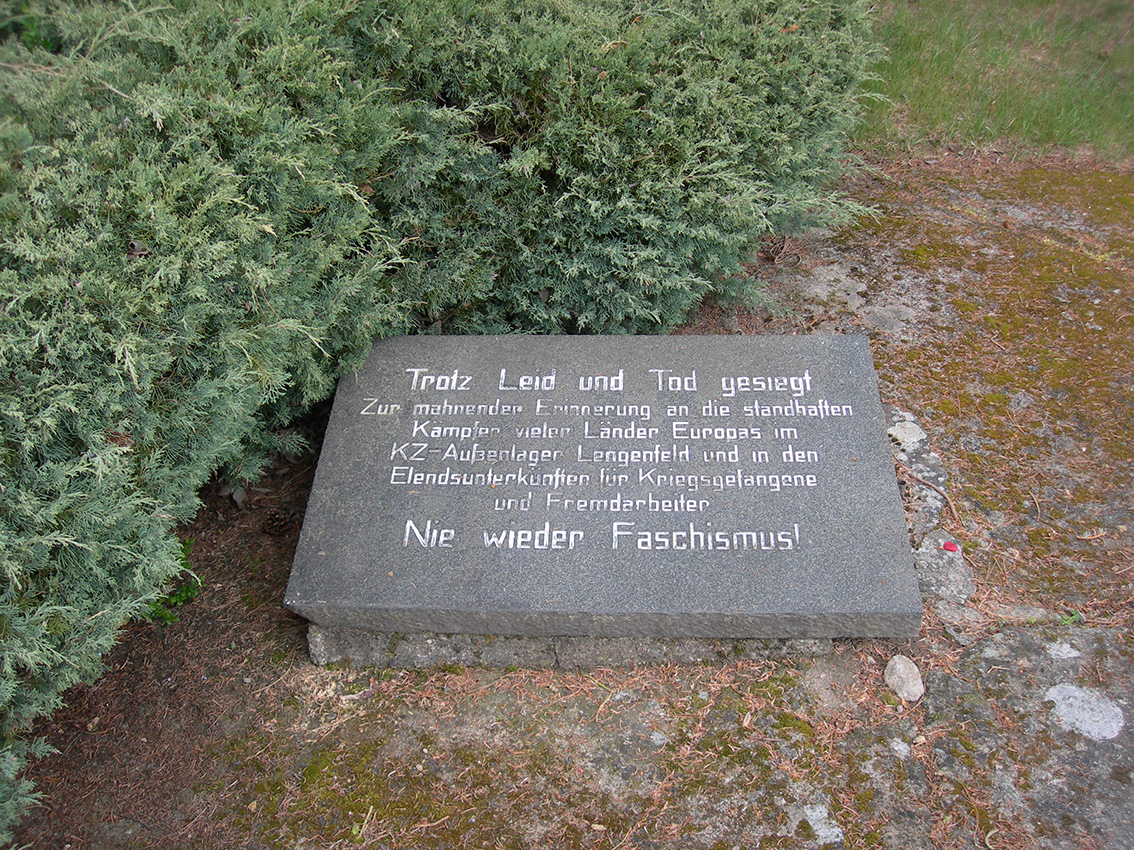
On April 13, 1945, the evacuation of the camp was ordered due to the approaching Allies. The prisoners had to set off on a march towards the main camp in Flossenbürg, which claimed many lives. However, it broke up prematurely near Haid because the guards had deserted. Since 1965, a memorial grove (see: DGM, No. 5) has commemorated the victims, at least 254 of whom died on site and dozens more who died or were murdered on the subsequent death march.
Michael Strobel/Annemarie ReckImage Source M. Strobel, Foto ©LfA 2004.
Literature
Hans Brenner/Wolfgang Heidrich/Klaus-Dieter Müller/ Dietmar Wendler (Hrsg.), NS-Terror und Verfolgung in Sachsen (Dresden 2018).
Michael Strobel, Nationalsozialistische Zwangslager (1943–1945) als archäologische Denkmale – das Beispiel Lengenfeld. In: Regina Smolnik/Ronny Zienert (Hrsg.), Höhenflüge. Luftbilder und Archäologie in Sachsen (Dresden 2024) 100–101.
Michael Strobel, Rüstungsindustrie und Zwangsarbeit. Lagerstandorte als Gegenstand der archäologischen Denkmalpflege. In: Regina Smolnik (Hrsg.), Ausgrabungen in Sachsen 7. Arbeits- und Forschungsberichte der sächsischen Bodendenkmalpflege, Beiheft 34 (Dresden 2020) 415–424.
Michael Strobel/Thomas Westphalen, Rüstungsindustrie und Zwangsarbeitslager im Spiegel zeitgeschichtlicher Archäologie. Mitteilungen des Landesvereins Sächsischer Heimatschutz 2, 2020, 54–65.
Note on monument protection
Archaeological monuments are protected by the Saxon Monument Protection Act. A permit under monument law is required for ground interventions or construction measures.
Permalink
https://archaeo-sn.de/en/ort/nazi-forced-labor-camp-and-subcamp-lengenfeld/
Citation
Michael Strobel/Annemarie Reck, Nazi forced labor camp and subcamp Lengenfeld. In: Landesamt für Archäologie Sachsen, Website archaeo | SN (19.06.2024). https://archaeo-sn.de/en/ort/nazi-forced-labor-camp-and-subcamp-lengenfeld/ (Stand: 29.09.2026)
