

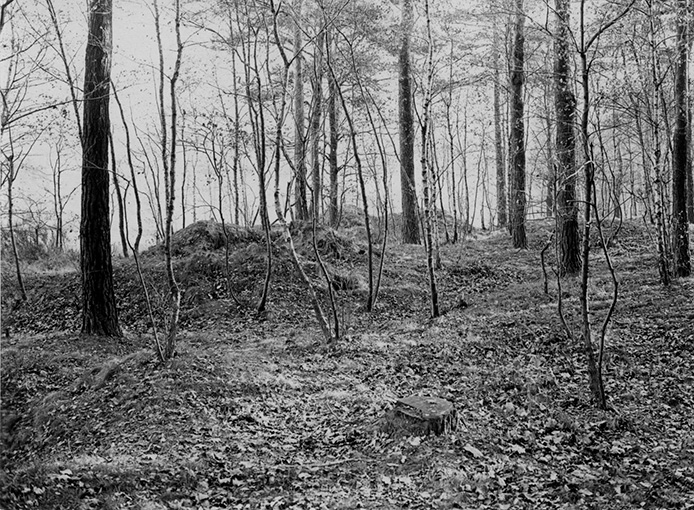
Bloaschütz barrow cemetery
| Place: | Bloaschütz (Bautzen, Bautzen) |
|---|---|
| Type: | Mound grave/mound burial ground with cremation and inhumation graves |
| Dating: | Middle Slavic stage | 800 - 900 AD. |
Description
Between Bloaschütz (Błohašecy) and Döberkitz (Debrikecy), in a small wood on the "Hussitenberg“ a burial mound from the early and high Middle Ages. Today, the cemetery still consists of around 40 mounds that can be seen above ground. Their width varies between 5 and 12 m with heights between 05-2 m. The northern and eastern parts of the cemetery were leveled in the past due to agricultural use, which is why its original dimensions remain unclear. According to estimates, there could once have been almost 100 burial mounds on the Hussitenberg. The few ceramic remains date from the 9th century. and 10. Century.
Annemarie ReckEarly research
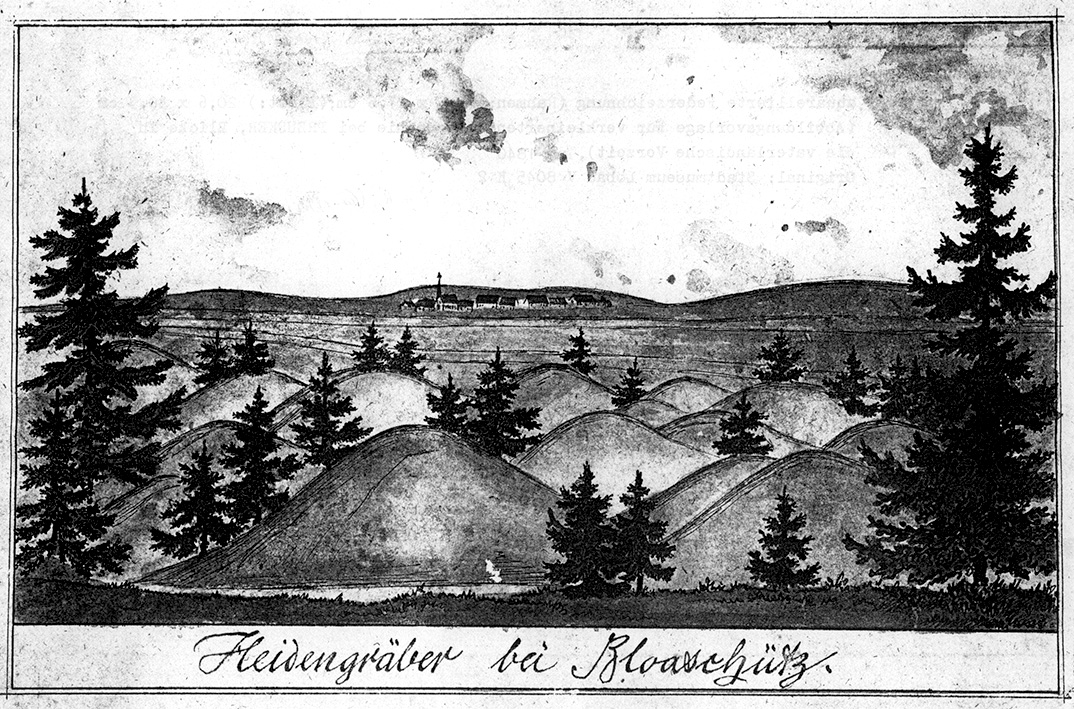
Since the 19th and 20th centuries, the necropolis on the Hussitenberg has repeatedly been the subject of archaeological investigations and excavations, which have not always been carried out professionally in the modern sense. The oldest early historical literature on Upper Lusatia, such as Karl Benjamin Preusker in 1827 and 1844 or Alfred Moschkau in 1876 and 1885, already mentions the Slavic burial mound. The first excavation was carried out as early as 1830 by the head priest Räde from Göda. In 1902, the Society for Anthropology and Prehistory of Upper Lusatia explored three of the burial sites for the first time.
Annemarie ReckImage Source K. Preusker, aquarellierte Federzeichnung ©LfA 1840.
First excavations
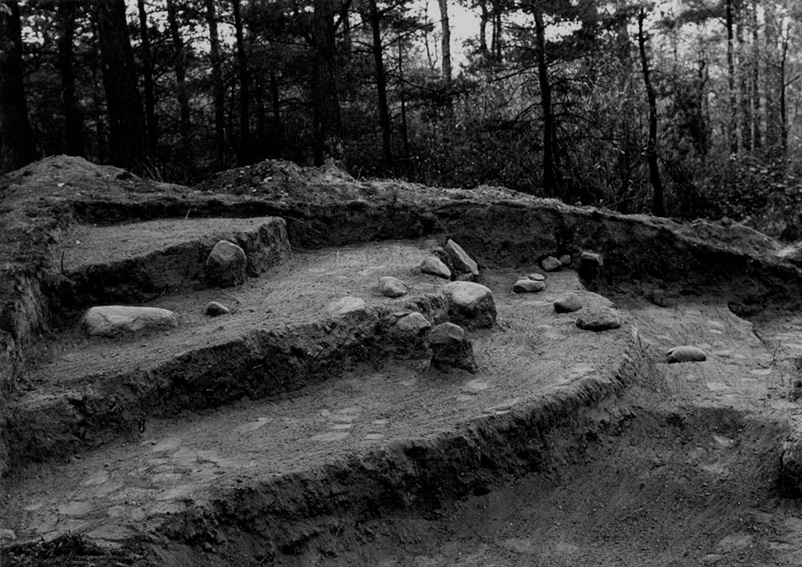
The mounds consisted of heaped-up clay with no recognizable stratification and a stone setting inside. What is striking, but also typical for burial mounds of the Early and High Middle Ages in Upper Lusatia, is the paucity of finds. Only a few ceramic remains of an urn with a wave-like ornament, ashes and bone fragments were found on the side of the mound in 1902. The only iron find was a very rusty, knife-like implement. The company carried out further excavations in 1904 and 1923. The research results of the excavation campaigns were compiled by Walter Frenzel in 1928.
Annemarie ReckImage Source Landesbildstelle Sachsen, Foto ©LfA 1923.
The shell stone
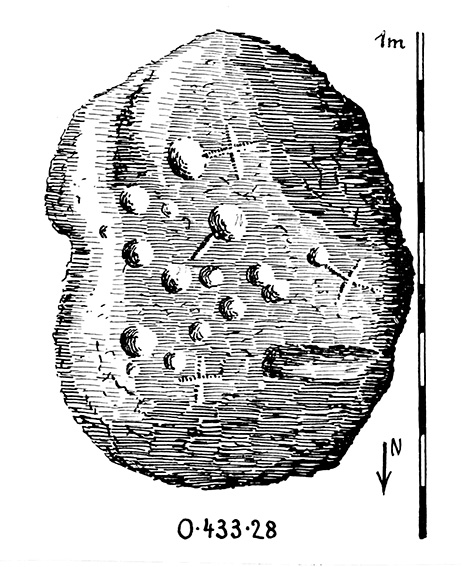
Also noteworthy is the so-called bowl stone, which was found in 1902 in the area of a cairn at the north-eastern corner of the woodland. It is assumed that it was cleared from the field and relocated to this spot secondarily. The oval stone block measures up to 90 cm in length and has several small cups carved into it. At the beginning of the 20th century, it was interpreted as a "sacrificial stone". Three carved crosses could also indicate that it was consecrated in later times, in the course of Christianization. However, its actual function remains unclear.
Annemarie ReckImage Source W. Frenzel, Zeichnung ©LfA 1928.
The burial mounds
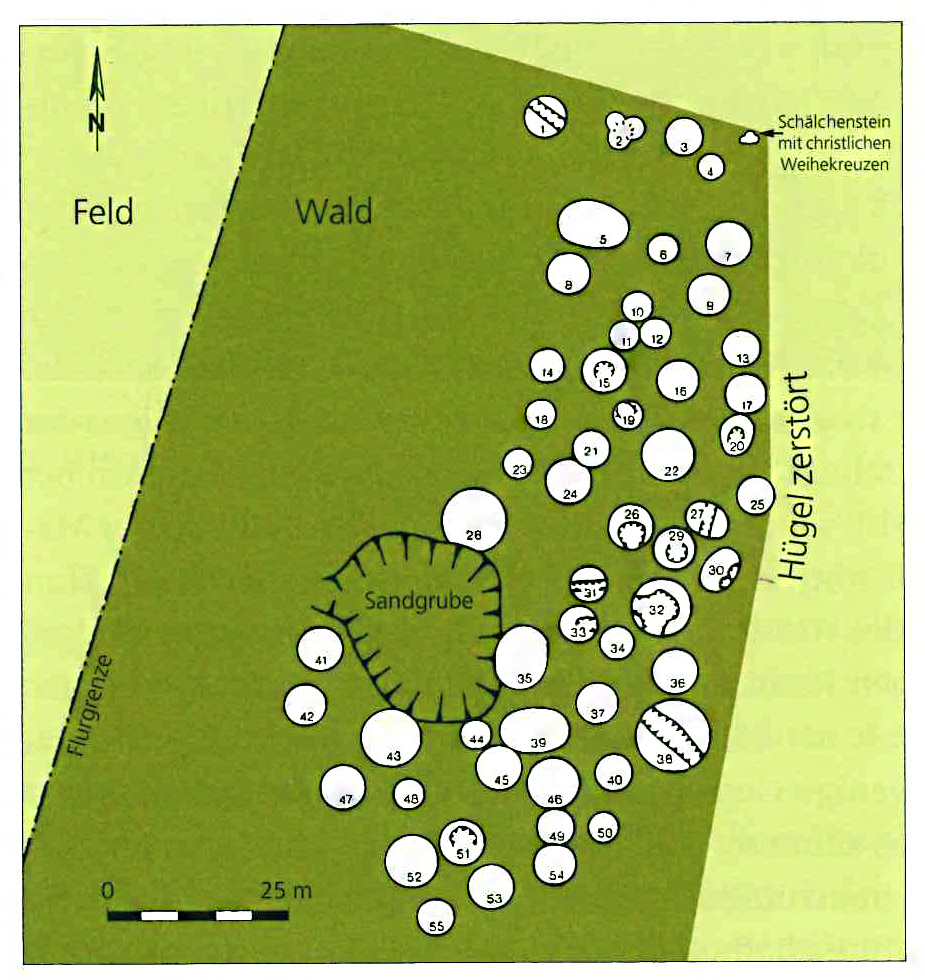
According to the Lausitzer Mitteilungen of 1805, there were still around 100 burial mounds on the Hussitenberg at this time. During an initial survey of the burial ground in 1925 and 1928, 55 of these could still be identified. However, during a re-examination in 1956, only 40 burial mounds were still recognizable and a further 15 were heavily disturbed. During the numerous soil interventions in various excavation campaigns, they were dug up, dug through or pierced. Some were almost completely leveled. In addition, several large trees were felled in the wooded area on the Hussitenberg in 1946/47. Some burial mounds may have been destroyed in the process, possibly out of ignorance. The loss rate in Bloaschütz is therefore comparatively high, which is why there is a strong interest in protecting the burial mound field. At other necropolises, however, only individual graves were usually investigated.
Annemarie ReckImage Source T. Westphalen 2010, 112.
Preservation of the cemeteries
Due to the heavy agricultural and forestry use of the area, the burial mounds of Upper Lusatia have often been destroyed over the centuries. Only eleven are known to archaeologists today, all of which were located within the former settlement area of the Milzen people. At that time, it was customary to cremate the deceased and lay their ashes in urns or as cremated remains on a previously erected burial mound. However, this exposed the urns to the weather and subsequent cultivation. This burial custom, which dates back to Slavic traditions, continued to exist in Upper Lusatia until the 11th century, before it was completely abandoned in the course of progressive Christianization.
Annemarie ReckImage Source Landesbildstelle Sachsen, Foto ©LfA 1923.
Literature
Friedrich Lehmann, Das Hügelgräberfeld in Bloaschütz.- In: Serbska Sala (1956) Nr. 16.
Reinhard Spehr, Die Grabhügel von Marienstern. Die Union, Tageszeitung d. Christlich-Demokratischen Union 33 (1978), (21.10.1978), 249.
Thomas Westphalen, Bloaschütz (Błohašecy): ein slawisches Grabhügelfeld auf dem Hussitenberg. In: Regina Smolnik/Jasper von Richthofen (Hrsg.), Die Oberlausitz. Ausflugsziele zwischen Neiße und Pulsnitz. Ausflüge zu Archäologie, Geschichte und Kultur in Deutschland 51 (Stuttgart 2010) 112–113.
Note on monument protection
Archaeological monuments are protected by the Saxon Monument Protection Act. A permit under monument law is required for ground interventions or construction measures.
Permalink
https://archaeo-sn.de/en/ort/bloaschutz-barrow-cemetery/
Citation
Annemarie Reck, Bloaschütz barrow cemetery. In: Landesamt für Archäologie Sachsen, Website archaeo | SN (24.09.2024). https://archaeo-sn.de/en/ort/bloaschutz-barrow-cemetery/ (Stand: 26.09.2026)
