

Burial mound field on the Annaburger Heide
| Place: | Großtreben (Beilrode, North Saxony) |
|---|---|
| Type: | Mound grave/mound burial ground |
| Dating: | Lusatian culture | 1350 - 900 BC. |
Description
North of the village of Großtreben, on the edge of the Annaburger Heide, there is an extraordinary archaeological monument from the Late Bronze Age. Although there are no visible structures above ground today, the remains of a 3000-year-old burial mound could be observed in the area of Raphübelweg and Bethauer Straße with the help of aerial archaeology. In total, the outlines of at least 66 burial structures can be seen in the ground as vegetation features. Its appearance corresponds to the typical features of Bronze Age burial sites in the Middle Elbe region north of Torgau, as they were built by people of the Bronze Age Lusatian culture.
Ronald Heynowski/Annemarie ReckThe plan
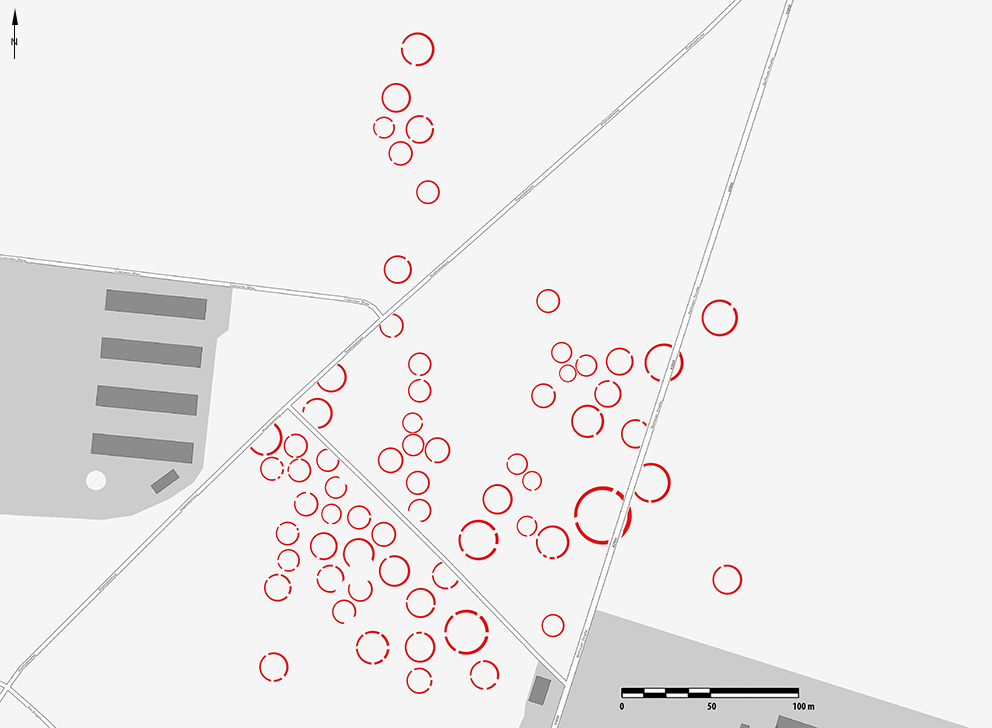
The area directly on the outskirts of Großtreben is now occupied by numerous narrow strips of fields. Due to the small-scale parcelling up of the extensive burial ground in places and the varying cultivation of the fields, it is never possible to observe all the burial mounds at the same time, but only a few in each individual field. A plan of the site was redrawn on the basis of several years of aerial surveys with various observations.
Ronald Heynowski/Annemarie ReckImage Source R. Heynowski, Plan ©LfA 2024.
Fouling characteristics
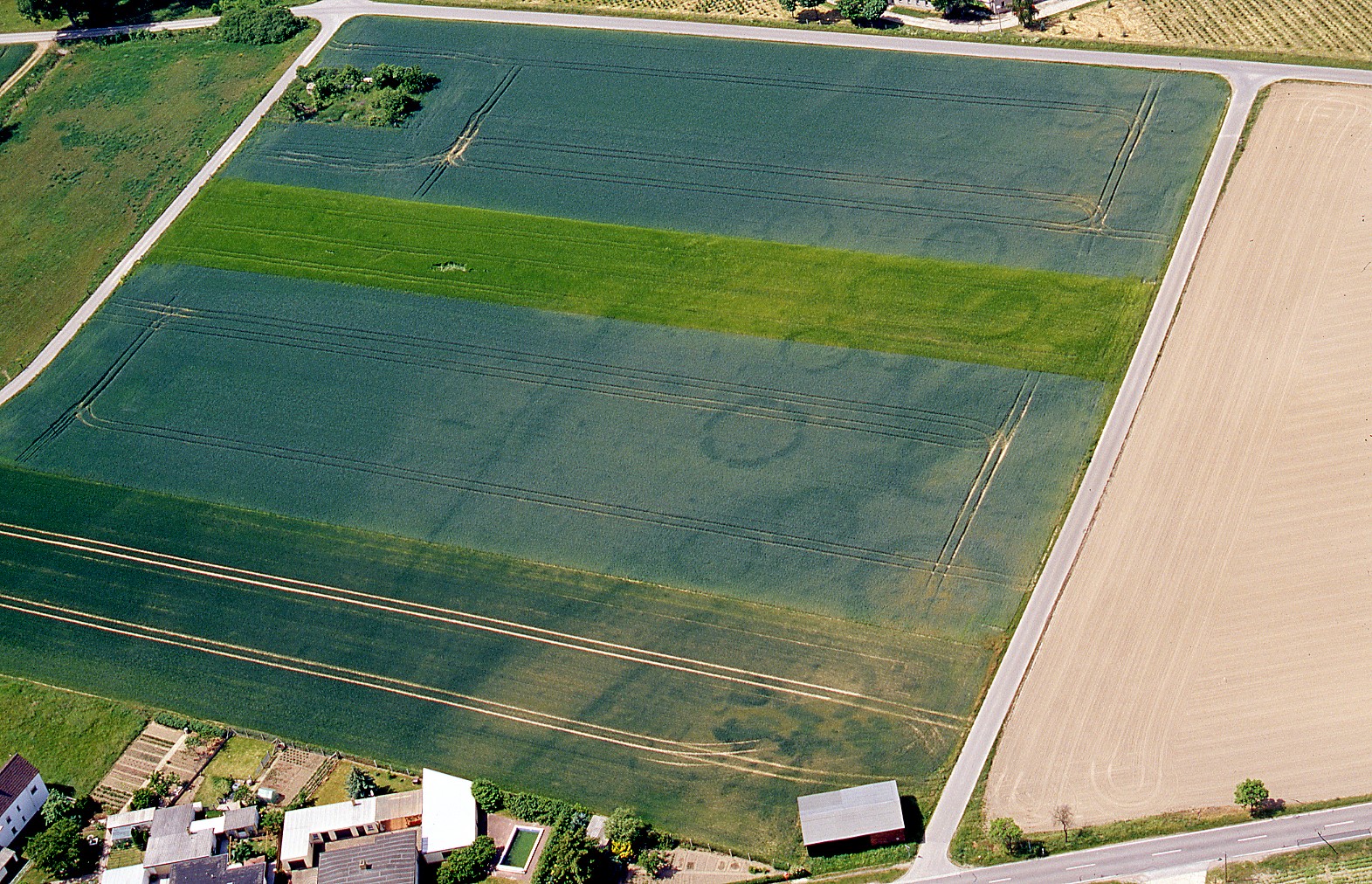
Due to centuries of agricultural use of the area, the burial mounds have now been completely leveled and are no longer visible as elevations in the ground. Only the ring-shaped ditches that once surrounded the base of the hill are still visible today. As moisture accumulates better in the former ditches, they are clearly visible in the vegetation. The remains of old arms of the Elbe can also be seen as broad, dark green strips, which indicate a good supply of groundwater.
Ronald Heynowski/Annemarie ReckImage Source R. Heynowski, Foto ©LfA 2009.
The burial mound field
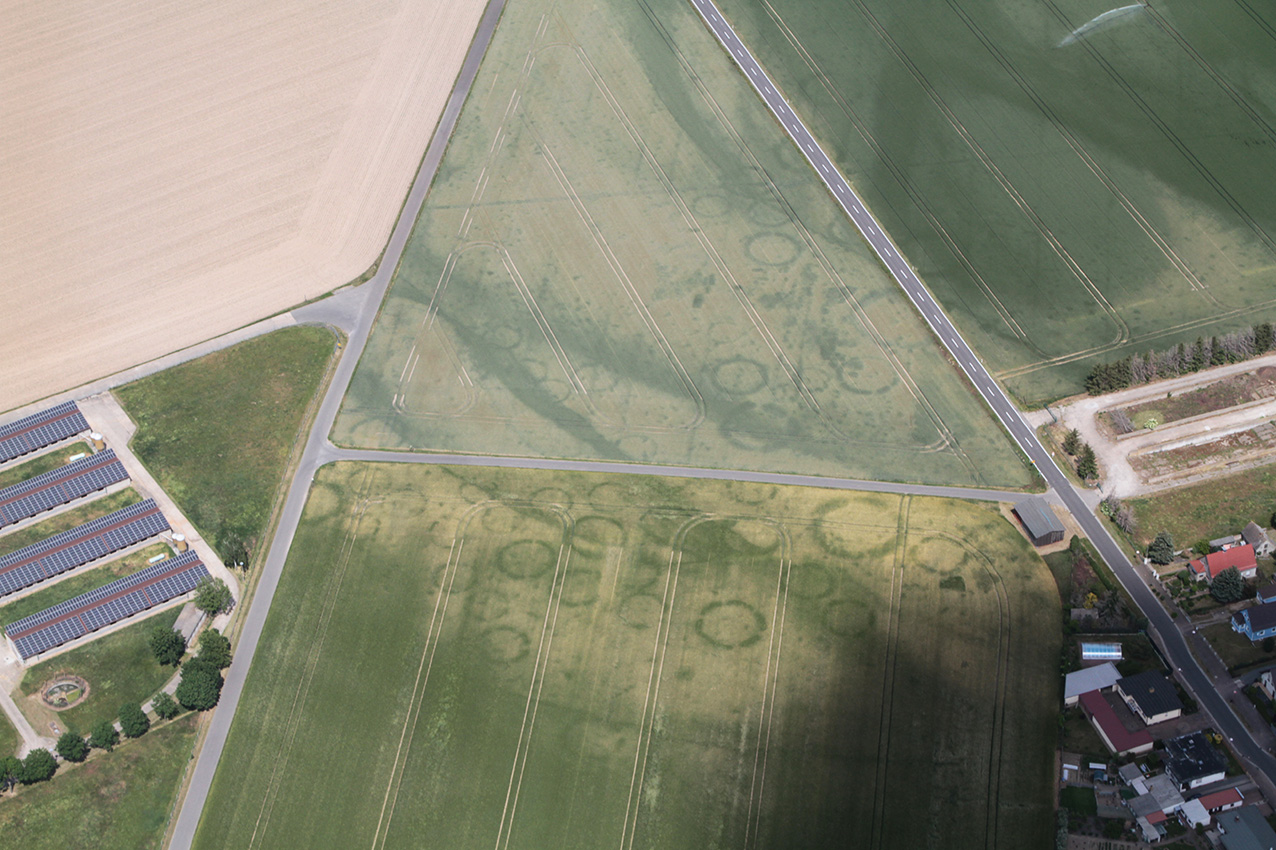
The 66 burial mounds identified so far lie very close together on a sandy hilltop in the area of the Elbe floodplain. The diameter of the mounds varies between 12 and 31 meters. The ring-shaped enclosures of the mounds are not continuous, but in some cases have one or more stone-like interruptions. This structure is typical for barrows of the Lusatian culture in this region. The entire cemetery covers an area of 380 x 250 m, with a clear concentration of burials in the south, while the distribution thins out radially towards the north and northeast.
Ronald Heynowski/Annemarie ReckImage Source R. Heynowski, Foto ©LfA 2020.
The largest system
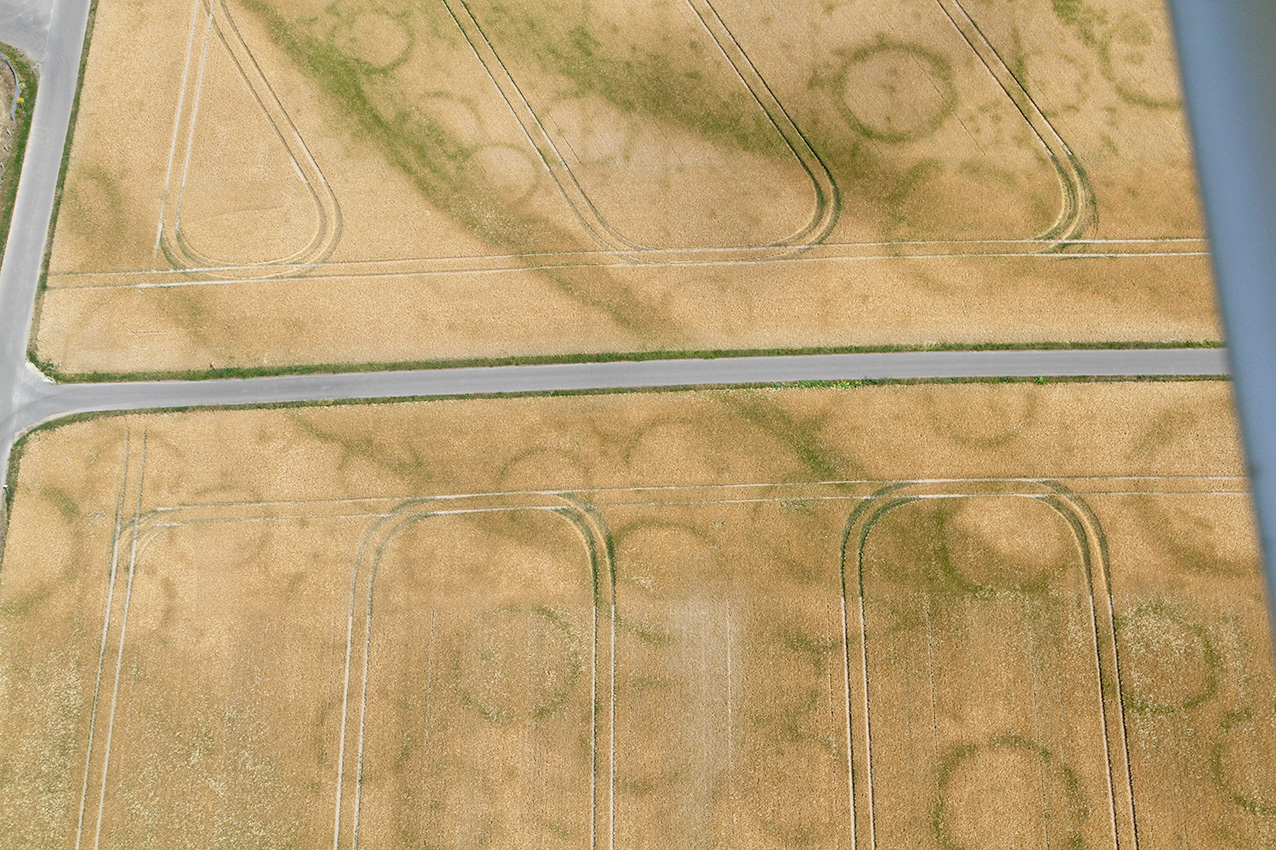
The largest mound (see plan) is located in the eastern part of the cemetery and is cut by Bethauer Straße. With a diameter of 31 m, it has two to possibly three interruptions in the ditch. Not far away are further burial mounds, also with relatively large diameters. In between, there were also several much smaller barrows, which dominate the western part of the cemetery.
Ronald Heynowski/Annemarie ReckImage Source R. Heynowski, Foto ©LfA 2018.
Literature
Ronald Heynowski, Grabhügel am Rande der Annaburger Heide. In: Regina Smolnik/Ronny Zienert (Hrsg.), Höhenflüge. Luftbilder und Archäologie in Sachsen (Dresden 2024) 64–65.
Note on monument protection
Archaeological monuments are protected by the Saxon Monument Protection Act. A permit under monument law is required for ground interventions or construction measures.
Permalink
https://archaeo-sn.de/en/ort/burial-mound-field-on-the-annaburger-heide/
Citation
Ronald Heynowski/Annemarie Reck, Burial mound field on the Annaburger Heide. In: Landesamt für Archäologie Sachsen, Website archaeo | SN (17.06.2024). https://archaeo-sn.de/en/ort/burial-mound-field-on-the-annaburger-heide/ (Stand: 29.09.2026)
