

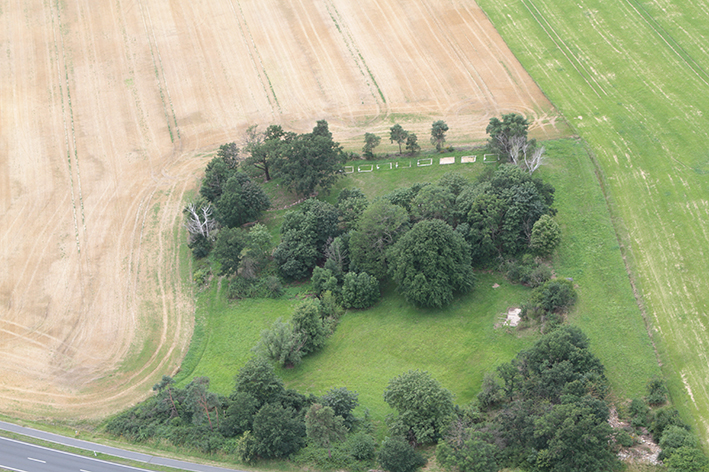
Burial mounds and open-air museum in Gävernitz
| Place: | Gävernitz (Priestewitz, Meissen) |
|---|---|
| Type: | Barrow/mound cemetery with cremation graves | Flat cemetery with barrows |
| Dating: | Lusatian culture | older pre-Roman Iron Age | 1200 - 700 BC. |
Description
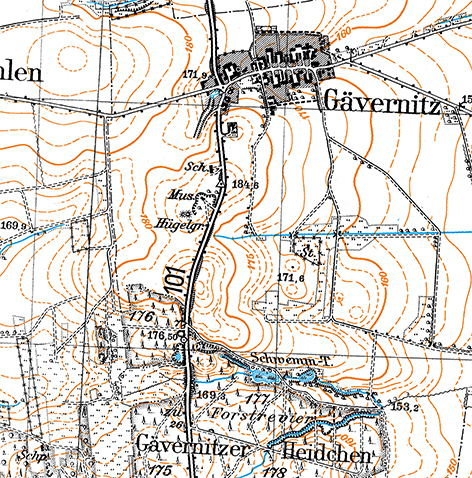
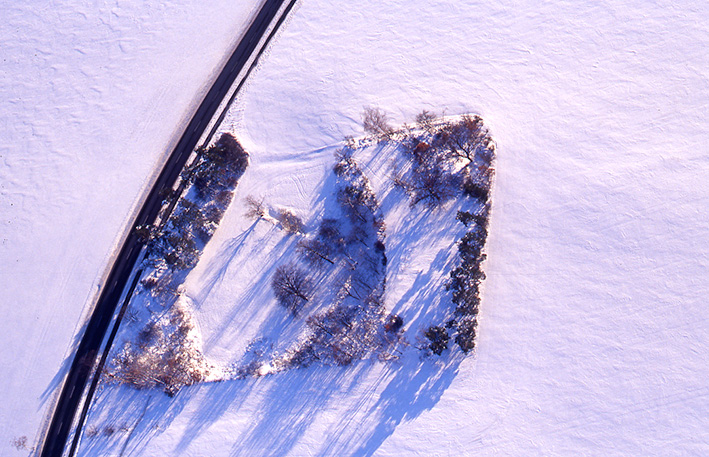
The burial mounds are located on a slight hill south of the Wantewitzer Höhe directly west of the former Reichsstraße 101 (now the B101 federal highway), which was the main route from Saxony to Berlin and was therefore heavily traveled. The mounds probably formed the core of a larger cemetery that extended to the west and southwest across the field area.
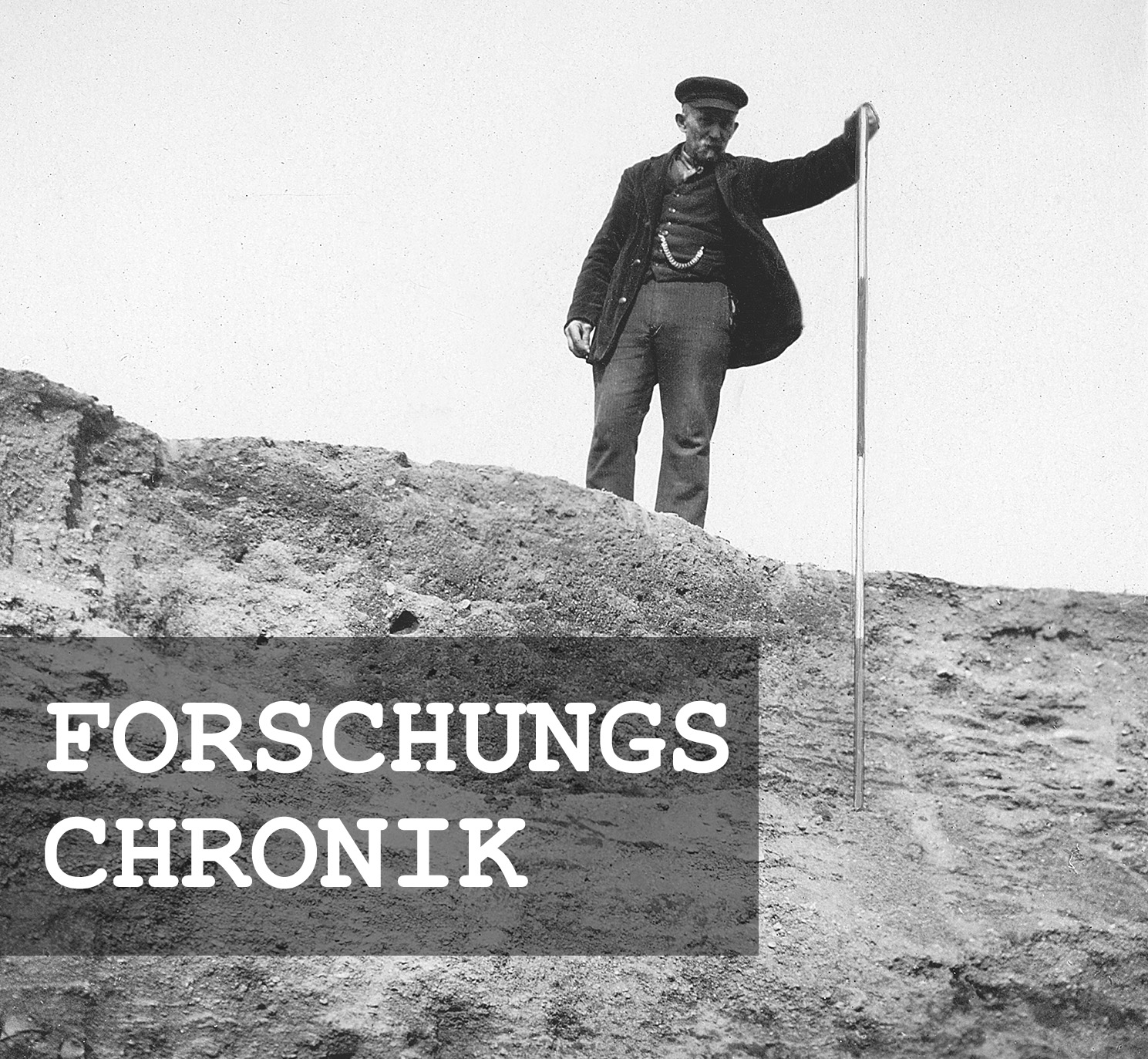
Michael StrobelResearch chronicle
Image Source Foto ©LfA 2024.
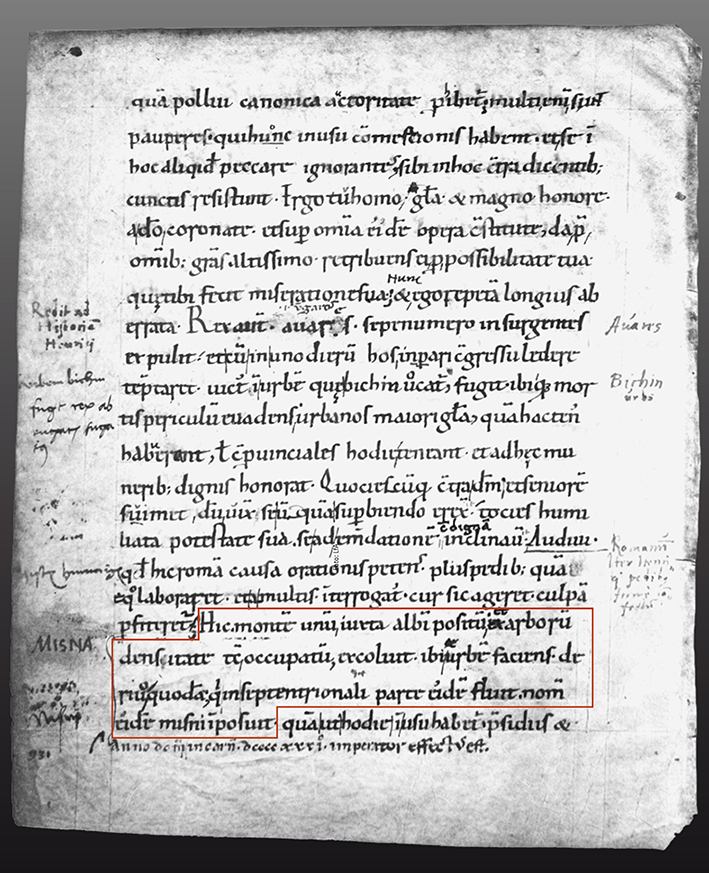
The "founding charter" of the Free State of Saxony?
The star of written tradition rises late over Saxony's history. What is said to have happened in the years 928 and 929 AD in the later "Mark Meissen" is still retold today as if there were no contradictions in the historical sources. So it does not bother anyone that Widukind von Corvey, in his RES GESTAE SAXONIAE, written around 965, describes the conquest of the Daleminzian castle "Gana" in the winter of 928/929 AD in great detail, but does not say a word about the fortification that King Henry I is said to have ordered to be built on the Meissen castle hill in the spring of 929, a few months after the destruction of "Gana". This story, which in turn has only survived in the chronicle written by Thietmar a century after the legendary events, is nevertheless one of the unquestioned founding narratives of Saxon regional history.
Michael StrobelImage Source Dresdner Handschrift der Chronik Thietmars von Merseburg ©SLUB.
The 1000th anniversary celebrations in 1929 under national auspices
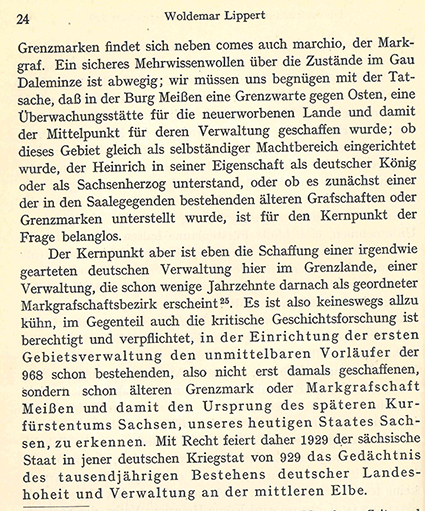
After no great fuss was made of Heinrich's "founding act" in 1879 and the 800th anniversary of the reign of the Wettin royal family was celebrated ten years later instead, the millennium celebrations in 1929 went far beyond a local town anniversary. Of course, the year 1929 was already overshadowed by the looming global economic crisis, which began to manifest itself in rising unemployment figures in the Free State in 1928. The need for historical reassurance and the creation of identity from a "thousand years" of history, which was charged with contemporary border and ethnic rhetoric, seems to have been all the greater, especially in conservative circles. Wherever regional history and archaeology made statements about the 9th-11th centuries AD during these years, they were prone to völkisch-nationalist phrases, e.g. about the "establishment of German rule and re-establishment of state German life in the Mark Meissen" and about the cultural inferiority of the indigenous Slavic population.
Michael StrobelImage Source Lippert 1929, 24.
An opulent commemorative publication
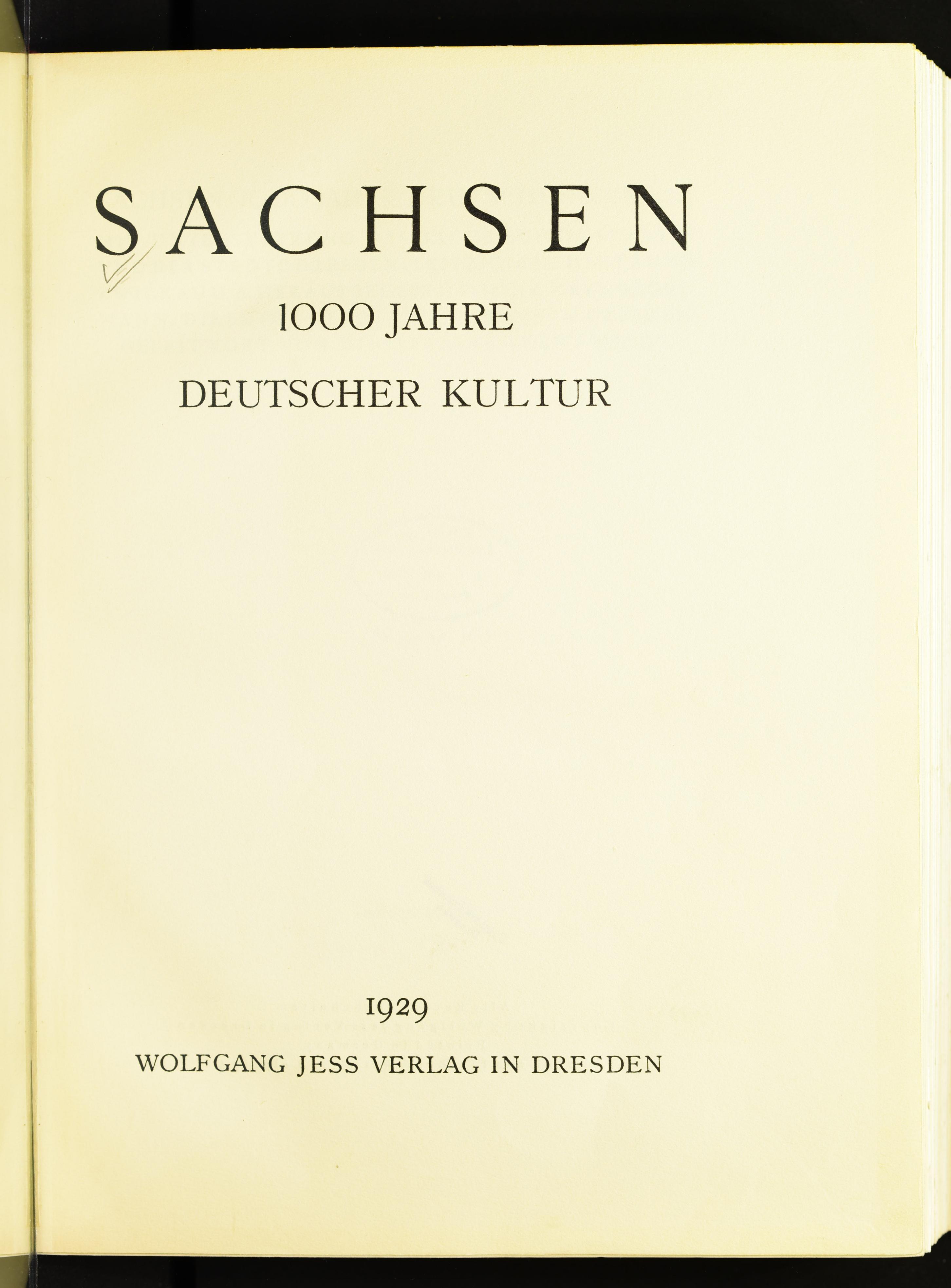
In contrast, it is clear from the official commemorative publication that the editor Karl Grossmann endeavored to present as broad and up-to-date a range of economic, political, historical and cultural topics as possible, ranging from regional history and the cultivation of art to social welfare, transport and industry. However, one searches in vain for an account of the state's prehistoric past in this representative and weighty anthology. The Leipzig regional historian Rudolf Kötzschke (1867-1949) only needed two meagre sentences to deal with the "gray times of prehistory", the "tribes of Germanic blood" and the "Slavs migrating to the region", who had built "protective hill forts" but "no towns".
Michael StrobelImage Source Grossmann 1929.
Notoriously underfunded
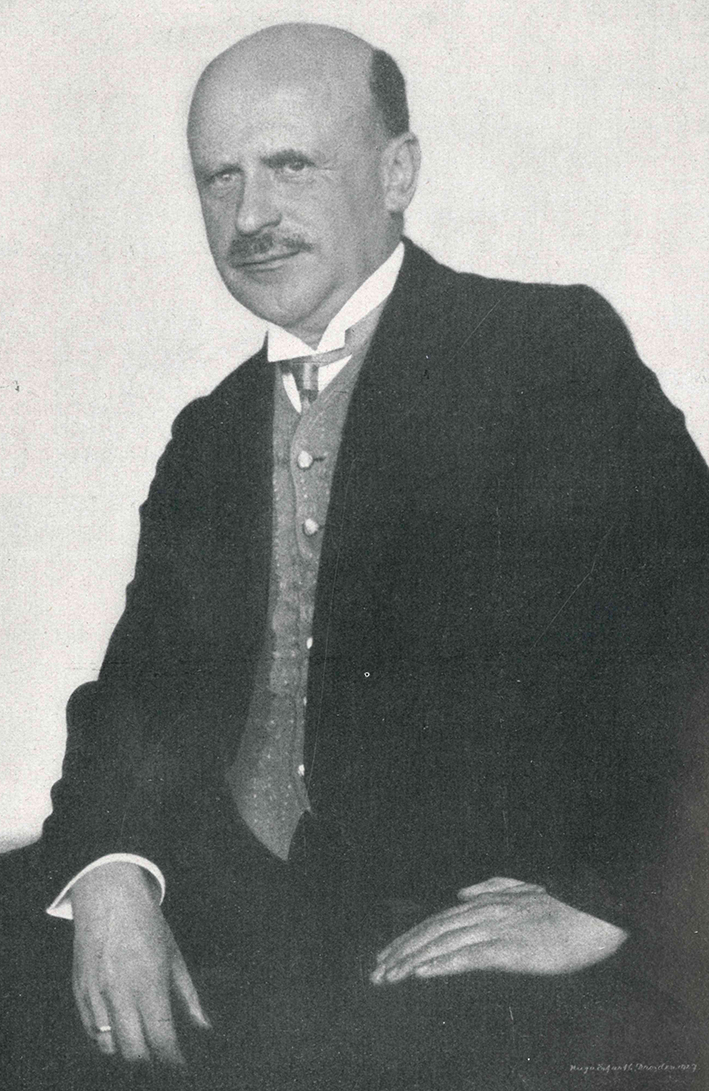
But who could have said more about the fortifications than the official archaeologists? After all, the prehistoric and early historic ramparts in the Free State of Saxony had been systematically recorded and selectively investigated since April 1928. The funds were provided by the "Arbeitsgemeinschaft zur Erforschung vor- und frühgeschichtlicher Wall- und Wehranlagen" (Working Group for the Research of Prehistoric and Early Historic Walls and Fortifications), which was sponsored by the Notgemeinschaft der deutschen Wissenschaft (Emergency Association of German Science) and also financed investigations into the early medieval rampart of Köllmichen (town of Grimma). After Friedrich Kaiser (1877-1956), the Minister of National Education, who had since left office, had visited these excavations with his wife in the autumn of 1928, it would have been only logical, especially in the millennium year, to use the last campaign to mobilize political decision-makers once again. However, this favorable opportunity to once again draw attention to the notorious underfunding of archaeological monument preservation and the lack of a protection law, which had not progressed beyond a draft from January 1926, seems to have passed unused.
Michael StrobelImage Source W. Kersten, OA 42820, 1280, Foto ©LfA 1928.
Monument protection without a legal basis
The poor prospects for a resumption of the legislative process in 1929 were expressed in a prominent place in the anniversary publication by none other than the "uncrowned king of Saxony" - according to the renowned Dresden art historian Fritz Löffler (1899-1988) - by Ministerial Director Robert Alfred Schulze (1878-1929), who headed the Saxon State Chancellery and, in personal union, the Department for the Preservation of Art in the Saxon Ministry of the Interior: Enlightenment work had created such a great reverence among the Saxon people for their art monuments that legal protection was "generally dispensable". The director of the Dresden Museum of Mineralogy, Geology and Prehistory, Eberhard Rimann (1882-1944), and the curator of the Prehistoric Department, Georg Bierbaum (1889-1953), had previously opposed this widespread and one-sided position in vain, in their memoranda, they had called for greater financial resources and calculated in detail to the ministerial bureaucracy how much better the archaeological preservation of monuments was, especially in the neighboring Prussian provinces of Silesia and Saxony, not to mention the lack of "reverence" shown to archaeological monuments in Saxony.
Michael StrobelImage Source Mitteilungen des Landesvereins Sächsischer Heimatschutz 18, 1929, 478.
Within sight of the former Reichsstraße 101
In the general misery, even the Burgwall funds from the German Research Foundation only seemed like a drop in the ocean. No greater gift could have fallen into the laps of the onlookers at the 1000th anniversary celebrations than the discovery of the monumental Bronze Age mound at Gävernitz, which was torn up by a motorized plough during autumn tilling in 1928 south of the edge of the village not far to the west of today's B101 and dutifully reported to the Dresden museum by the manor owner Balduin Pfeil on the advice of his cousin Max Andrä (1866-1946). Andrä, who ran a flourishing agricultural business in Seebschütz on the other side of the Elbe and had already rendered great services to regional archaeology by then, may also have played a role in the background in ensuring that his cousin generously accommodated the archaeologists in the purchase negotiations for the site after the excavations were completed.
Michael StrobelImage Source Kartengrundlage ©GeoSN 2024.
An excavation at the height of its time
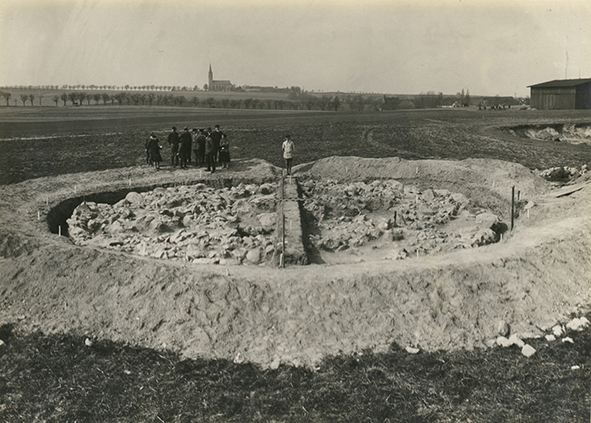
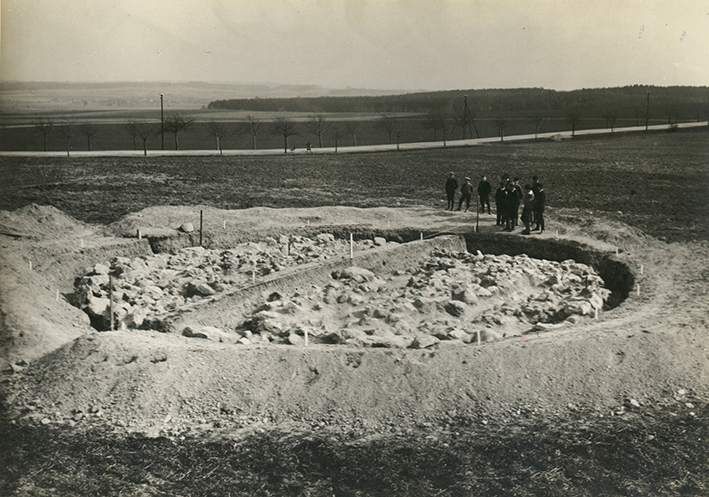
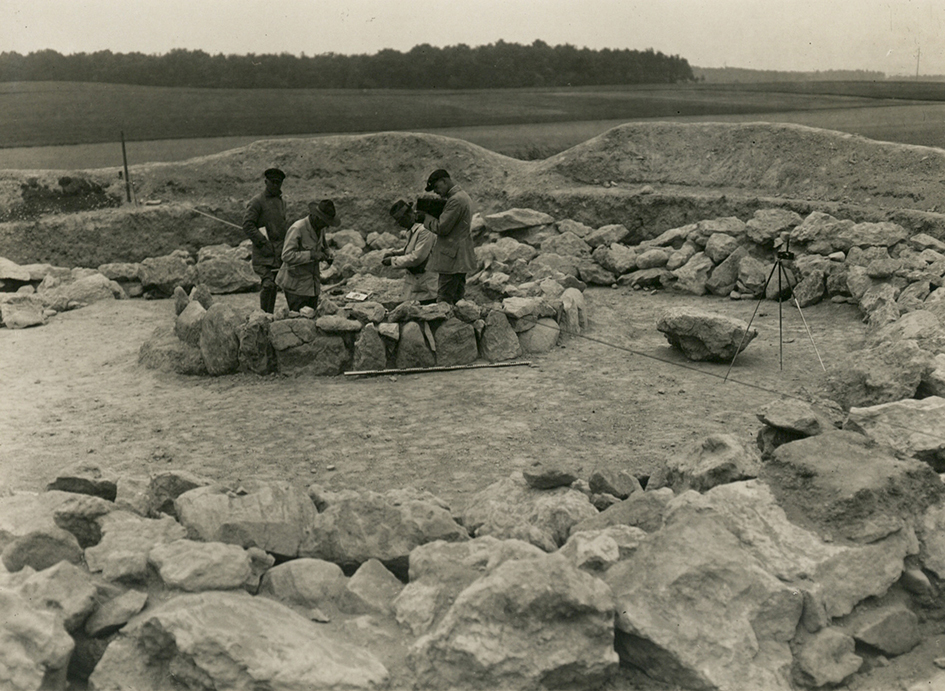
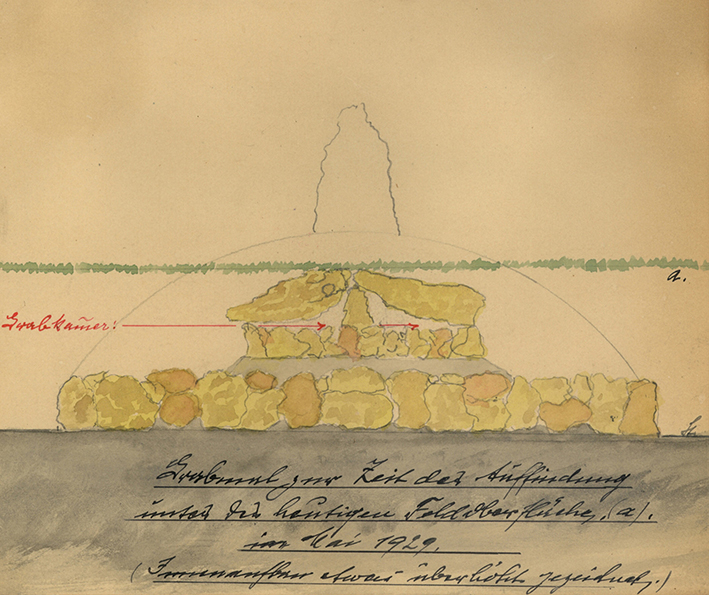
What the archaeologists would have missed if Pfeil had decided to blow up the stone blocks and not report the find carefully only became apparent in the course of the excavation. Gotthard Neumann (1902-1972), who had been employed as a scientific assistant at the Museum of Mineralogy, Geology and Prehistory since 1927 and had gained extensive excavation experience in Köllmichen, among other places, was in charge of the local investigations. The excavation work began in mid-April and lasted around two and a half months until the beginning of July. What came to light was a massive circular stone pack approx. 14 m in diameter, consisting of an outer stone ring, a stepped and concentric core and a central cylinder surrounded by larger orthostats, which was built over an ash pit. According to Neumann's estimates, around 600 quintals of material were moved for the stone construction, which seems to have been painstakingly collected in the area and used according to plan. Technically and methodically, the excavation was completely up to date. However, in order for the fieldwork to become a public event and to develop a dynamic beyond its completion, the excavation manager not only had to have scientific expertise, but also great communication skills.
Michael StrobelImage Source G. Bierbaum, OA 44320, 57, Foto ©LfA 1929.
Lively public response
On the one hand, Neumann very quickly recognized the potential that the site offered for effective public relations work. On the other hand, the young excavation director was not the first to experience how easily archaeologists can lose control of their scientific popularization in a discursive competition to outdo each other. Anyone carrying out excavations 100 m from a busy road is bound to attract public attention. The Reichsstraße 101 between Dresden and Berlin was one of the main traffic arteries of the German Reich at the time, before the construction of the Reichsautobahn. As the first brief notes appeared in the press a few days after the start of the excavation and surrounding schools were specifically invited, over 10,000 onlookers and interested parties were drawn to the excavation site by mid-May alone. At the beginning of the month, after a meeting with the excavation manager, the Grossenhain notary Martin Saupe contacted the Saxon Heritage Society with a request to "preserve the historical monument and secure it for the future" (lawyer Saupe to the Saxon Heritage Society, 1.5.1929, OA Gävernitz), justifying his petition with the great public interest and the lack of prospect of state funding.
Michael StrobelImage Source G. Bierbaum, OA 44320, 48, Foto ©LfA 1929.
High profile visit
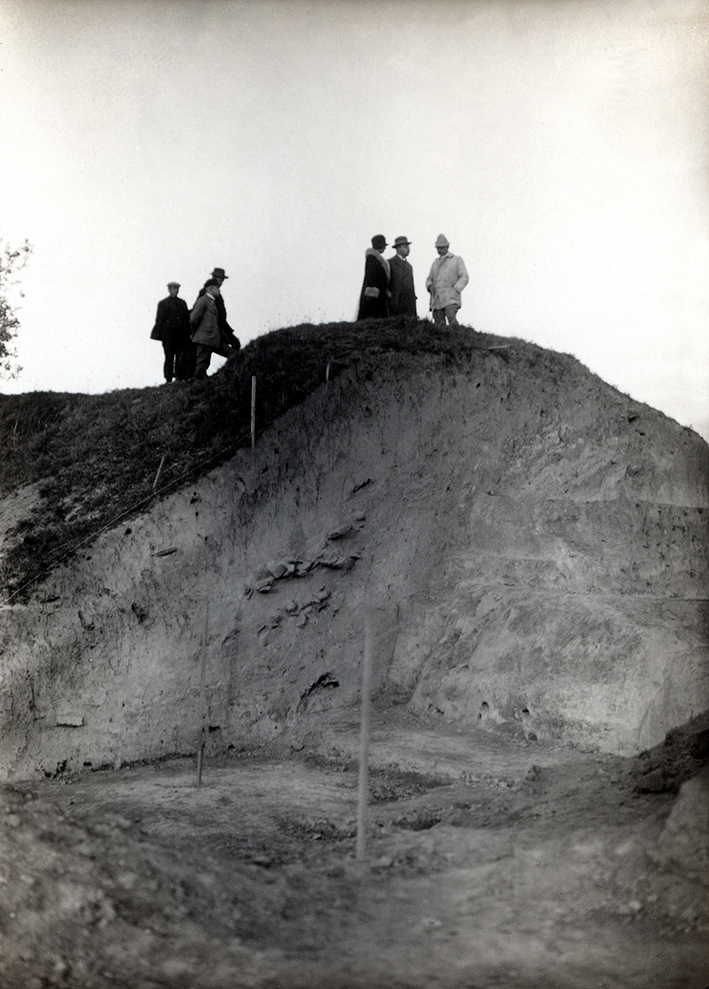
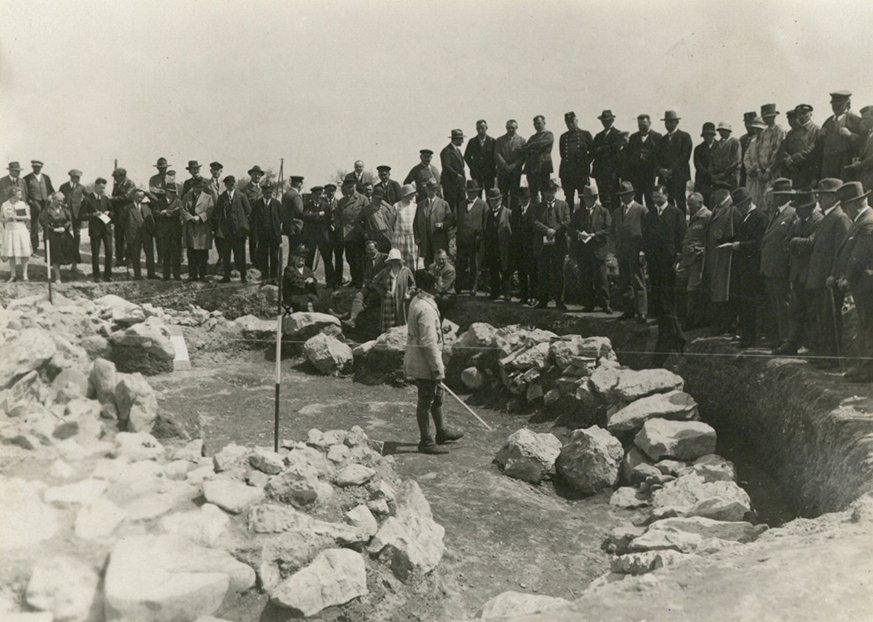
The museum management's invitation to a press conference on May 14, two days after a state election, was accepted not only by the acting DVP Minister of National Education Wilhelm Bünger (1870-1937) accompanied by senior officials from his ministry, including Ministerial Director Konrad Woelker (1875-1945), State Archives Director Hans Oskar Beschorner (1872-1956), the district governors Alfred Fellisch (1884-1973, Großenhain district governorship) and Richard Schmidt (1871-1945, Meissen district governorship), both SPD, District School Inspector Ludwig and several mayors, as well as numerous representatives of the press.
Michael StrobelImage Source W. Radig, OA 44320, 32, Foto ©LfA 1929.
Broad press coverage
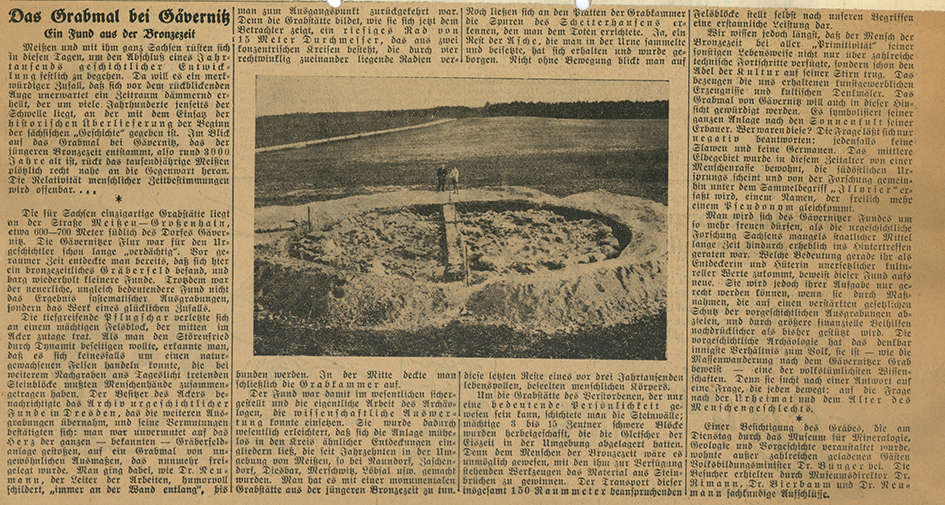
The response in regional and national daily newspapers was overwhelming and lasted from May 14 to 22. There are 15 articles from these days archived in the local files of the Saxony State Office for Archaeology. Although by no means all of them make a connection to the anniversary celebrations, the message seems to have reached some journalists that Saxony's history goes back further than just 1000 years.
Michael StrobelImage Source Dresdner Anzeiger 199, Nr. 225 vom Mittwoch, 15. Mai 1929, S. 5, OA 44320, 200, ©LfA 1929.
Lots of attention - little effect
The press event followed a carefully coordinated internal choreography: museum director Rimann welcomed the guests, paid tribute to the estate owner's achievements and then spoke about what he and Bierbaum had already explained in detail in a submission to the Ministry of National Education two years earlier: The extensive tasks and chronic underfunding of archaeological monument preservation, the lack of a monument protection law and the eminent political significance of prehistoric research in the "defensive struggle" against Polish and Czech territorial claims; of course, it would have been perceived as an affront in the minister's presence if the museum director had not also conceded a certain "improvement" for the "branch of work" in the "care of the Ministry of National Education" (Dresdner Neueste Nachr. of 16.5.1929), despite all the justified complaints. In any case, the actual addressee of the jeremiad was the Ministry of the Interior, which was responsible for the preservation of monuments and thus the Archive of Prehistoric Finds from Saxony, and which, of course, had not sent a representative to the meeting, nor had the Ministry of Finance.
Michael StrobelImage Source W. Radig, OA 44320, 33, Foto ©LfA 1929.
Regional classification
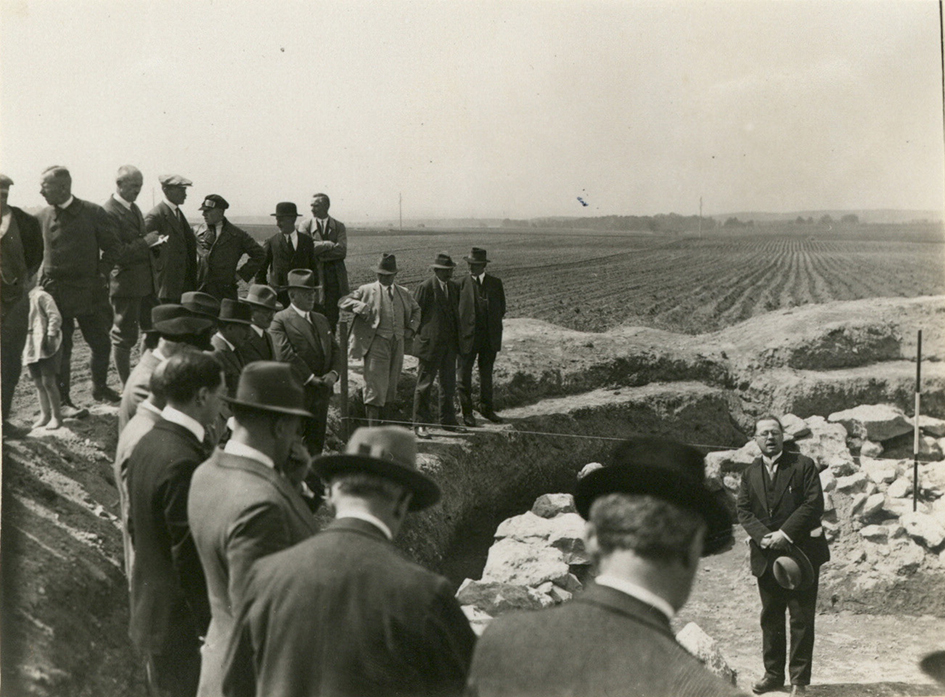
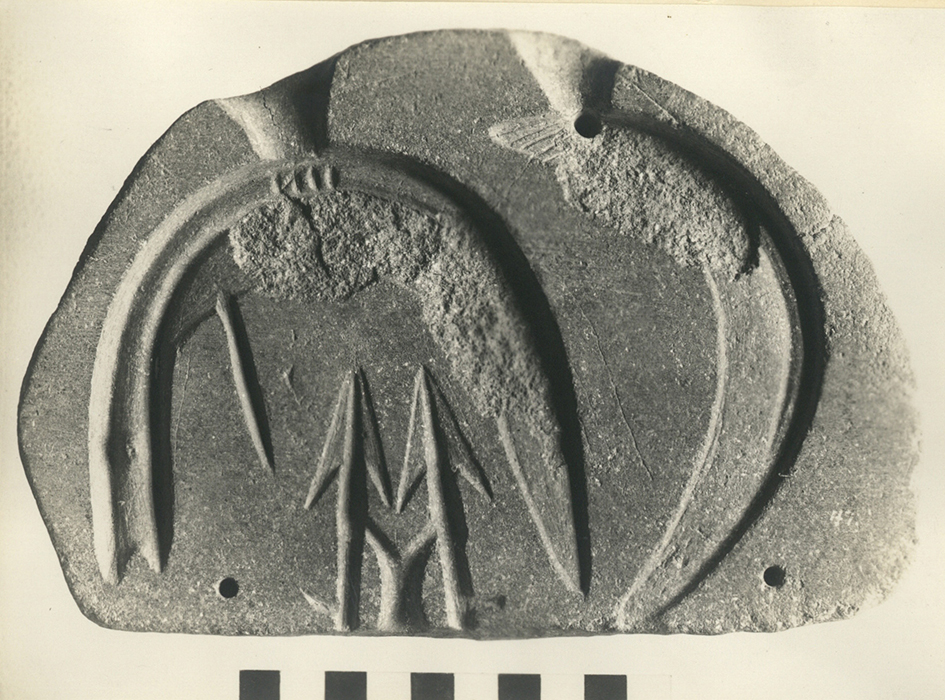
After Bierbaum had then placed the findings in the regional Bronze Age finds context and emphasized the known old finds, in particular the moulds, which had come to light in the area of the burial ground and the gravel pit since 1832, the excavation manager was allowed to explain the structure of the grave and to come up with an interpretation from which he had to partially distance himself a year later.
Michael StrobelImage Source G. Bierbaum, OA 44320, 355, Foto ©LfA 1929.
The publication on the excavation
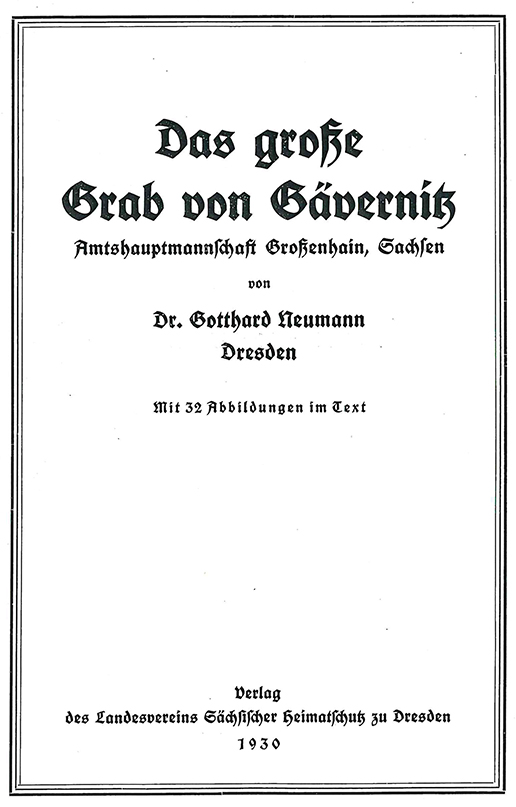
It is to Neumann's credit that he at least abandoned the idea that the radial structure of the mound construction was modeled on the sun wheel in the guide booklet published by the Landesverein in 1930 (Neumann 1930, 15). On the other hand, it was absolutely unthinkable to abandon the fixed idea of a tomb in which only a "great man", the "head of a community" (ibid. 30) could have been buried. If the term "princely tomb" had been mentioned at the press conference, the journalists would certainly have eagerly picked it up.
Michael StrobelImage Source Neumann 1930.
Sober reporting
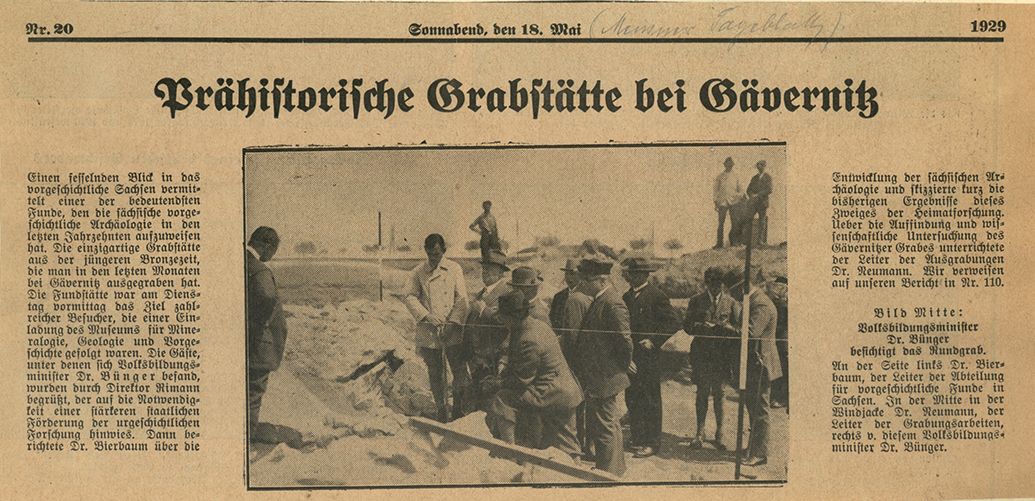
At the halfway point of the excavation, however, the reporting remained with an "illustrious dead man", a "powerful personality of outstanding influence", the "great man" of an "unknown primitive people", the "funerary monument of a great man", a "large round tomb", etc. Even the later comparison between the undisputedly monumental construction of the Gävernitz hill and "the pyramids of Egypt" seems to have shied away from Neumann for the time being (ibid. 21).
Michael StrobelImage Source Meißner Tagblatt vom 18. Mai 1929, OA 44320, 201 ©LfA 1929.
No pyramid
This would have raised visitors' expectations, which could only be disappointed by the actual findings: For there was no trace of a regular burial, let alone a "pharaoh". The meagre inconspicuousness of the finds obviously put the excavator in need of an explanation even during the guided tours and to this day cannot be easily explained away by referring to disturbances or a possible robbery.
Michael StrobelImage Source M. Löhrich, OA 44320, 20, Foto ©LfA 1929.
First reconstruction plans
It was only when questions about the future fate of the hill began to pile up and the museum management approached the Ministry of Education and the local authorities in June with a proposal to restore the site as an exhibit and provide funds for this purpose that the term "princely tomb" was activated from the archaeological arsenal in a press release at the end of the excavations - presumably to give the project particular emphasis. Apparently, those involved did not want to rely on the persuasive power of visitor numbers.
Michael StrobelImage Source OA 44320, 157 ©LfA 1929.
Crowd of visitors
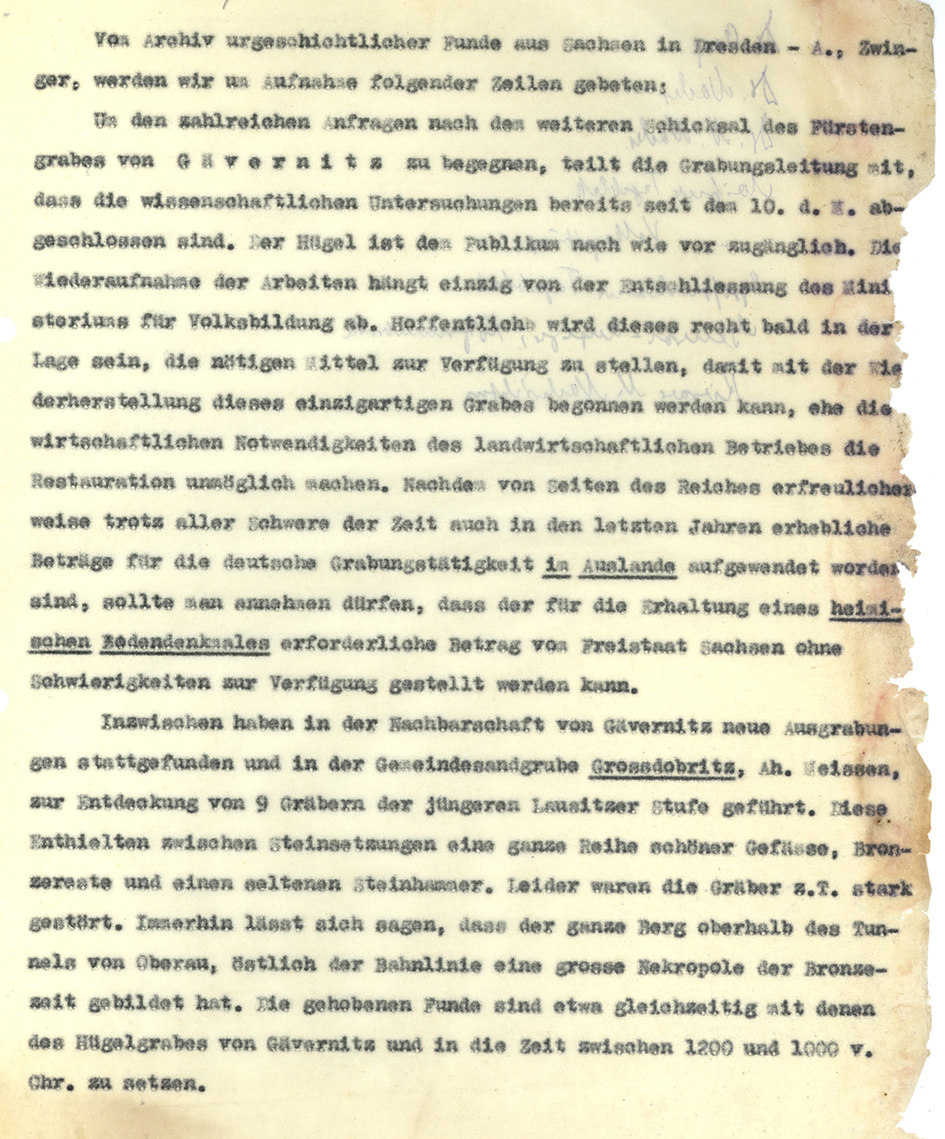
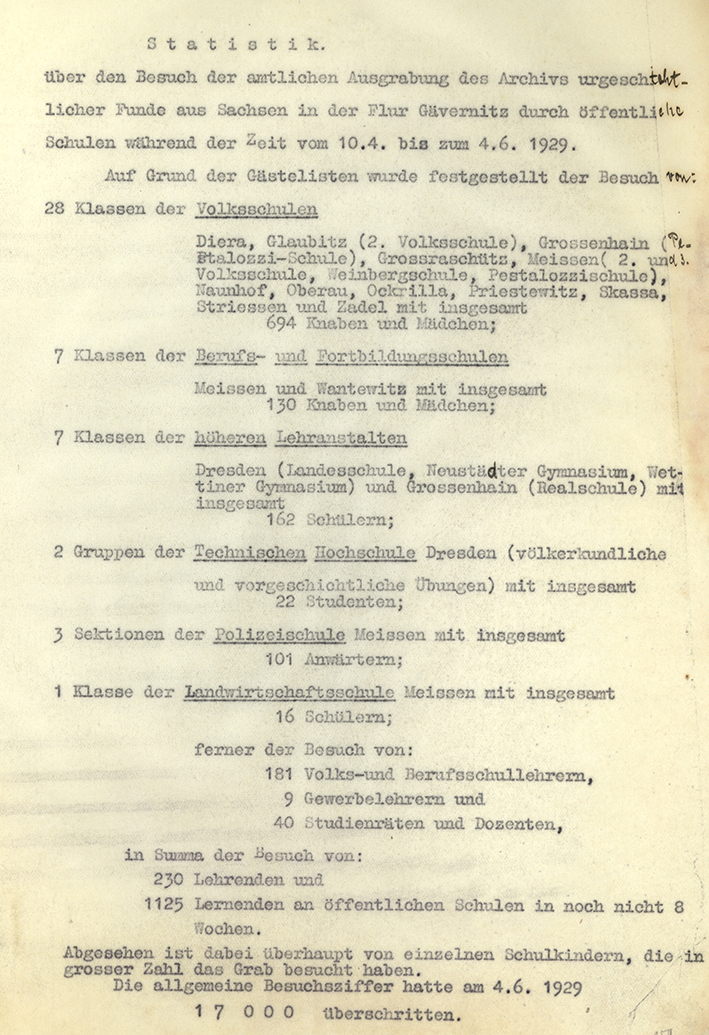
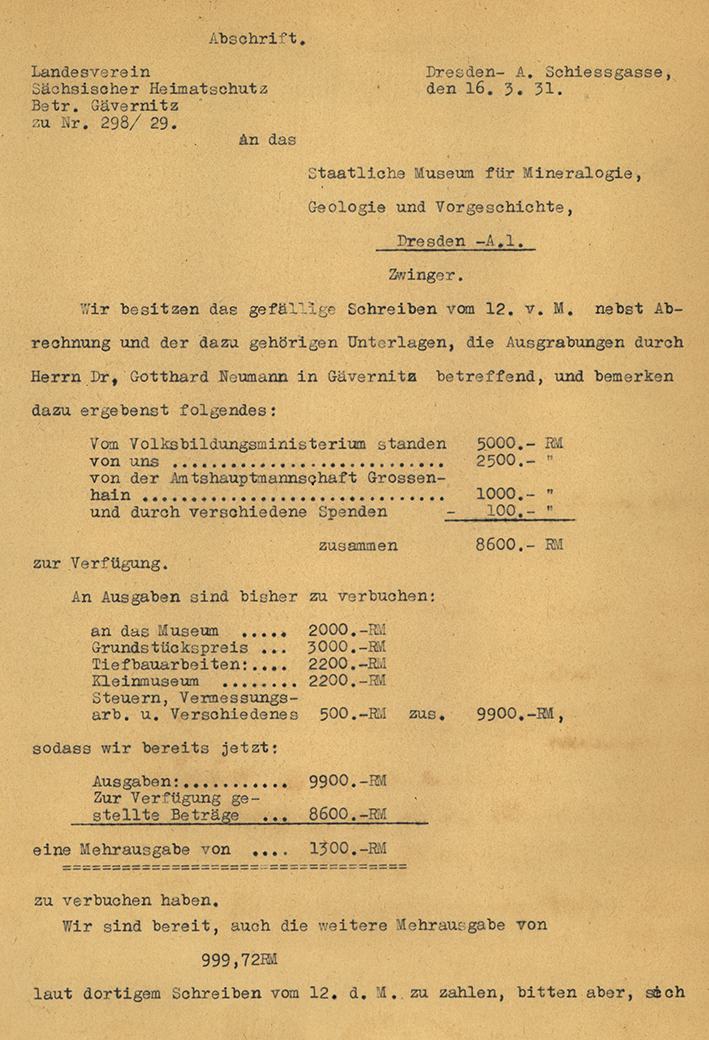
The statistics show that by June 4, 1929, there were over 17,000 people in attendance, which could only be handled by an additional manager. Classes and teachers from all types of schools in particular were among the audience and increased the willingness of the Ministry of Education to actually provide 5000 RM for the reconstruction if sufficient educational requirements were taken into account in the concept and additional funds were raised. As easy as it was for the museum management to upgrade the mound reconstruction to a "place of learning" through a small museum and to fend off the design wishes of the ministry officials, who had probably imagined a walk-in Mycenaean domed tomb under the tomb complex, the co-financing was difficult in view of the economic slump, especially since the excavation alone had cost RM 2600, of which RM 1600 had to be pre-financed from funds from the Burgwall project, i.e. misappropriated Reich funds.
Michael StrobelImage Source OA 44320, 159 ©LfA 1929.
"Sponsoring"
In this precarious situation, the Landesverein once again proved its worth as an emergency helper, with land ownership, lotteries and, above all, around 40,000 members providing it with astonishing financial strength even in times of crisis. In the end, the provision of the association's own vehicle, the secondment of the association's photographer Max Nowak, the printing of Neumann's brochure and the administration of the funds received were also monetary benefits that had to be offset against the financial support or the takeover and maintenance of the property by the association. After the board had approved RM 2,500 at a meeting at the end of February 1930, in 1931 the association also took over additional costs incurred up to that point amounting to a further RM 1,000 as well as financing the model of the hill.
Michael StrobelImage Source OA 44320, 106 ©LfA 1930.
In the shadow of monument preservation
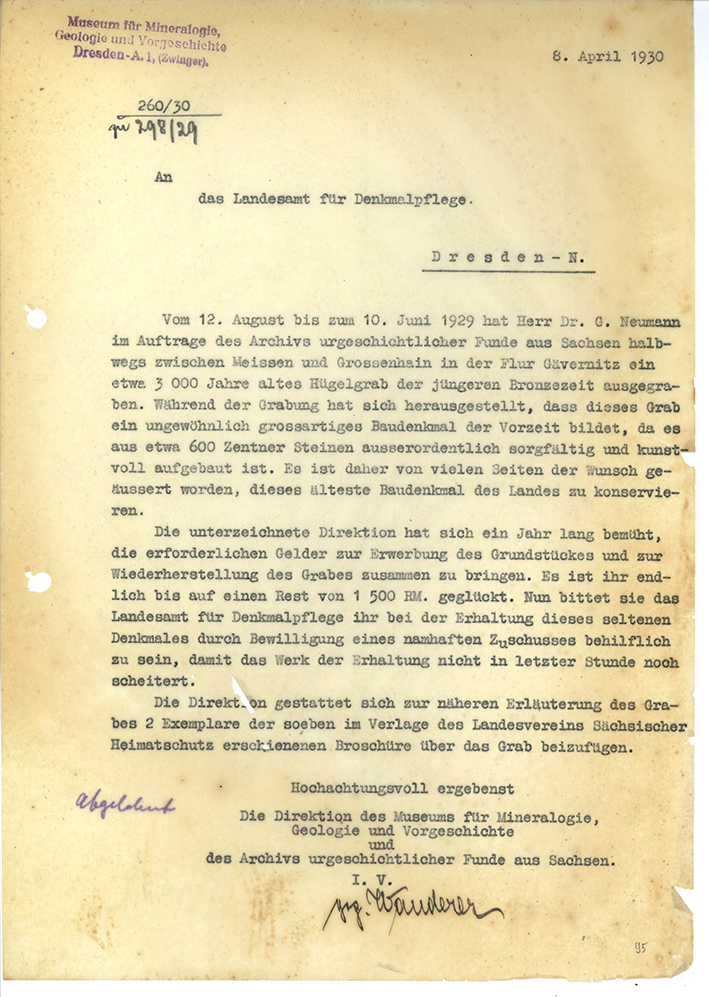
In view of this distribution of the burden, it was difficult to understand why the Ministry of the Interior, which is responsible for the preservation of monuments, was not involved in funding the restoration of the monument. For years, the Archive of Prehistoric Finds had been overshadowed both financially and in terms of personnel by the preservation of architectural and artistic monuments. Nevertheless, the museum management should have known in April 1930 that an application for funding on the grounds that the Gävernitz grave was an "unusually magnificent prehistoric monument" (Wanderer to the State Office for the Preservation of Monuments, 8.4.1930, OA Gävernitz) would hardly be successful. The "application for aid" was coolly rejected by Walter Bachmann (1883-1958), the State Conservator, not least because the Monument Council, on which no archaeologist had a seat or vote, had raised "concerns of a fundamental nature about the use of monument conservation funds" (Bachmann to Museum, 11.6.1930, OA Gävernitz).
Michael StrobelImage Source OA 44320, 95 ©LfA 1930.
Preparatory work for the "open-air museum"
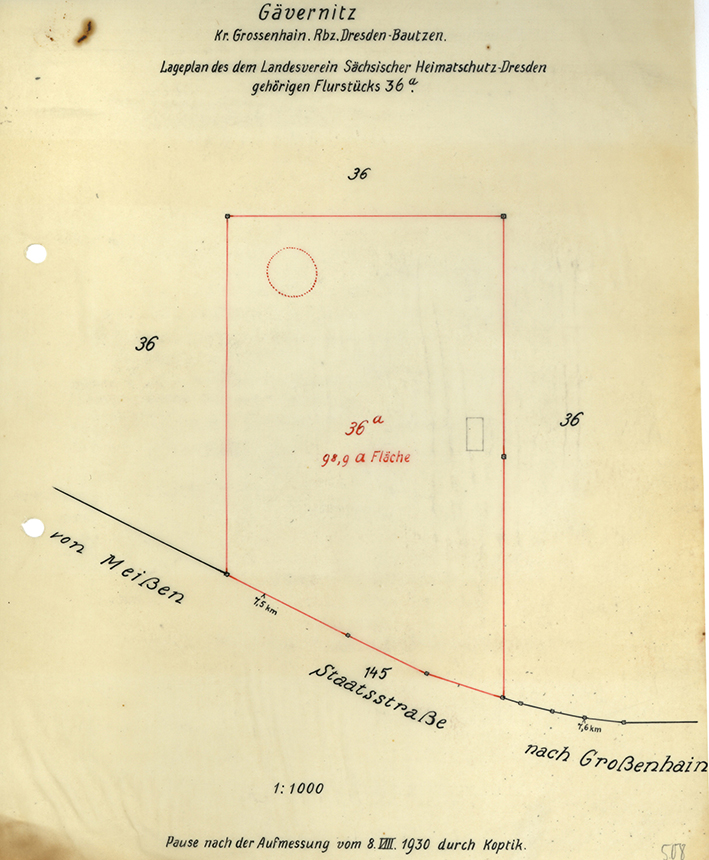
Six precious months passed before the property was finally surveyed in the fall of 1930, the purchase contract between Pfeil and the Landesverein was concluded and the contracts for reconstruction and landscaping as well as the construction of the log cabin could be awarded and carried out by local construction companies according to Neumann's specifications and plans to the general satisfaction of all.
Michael StrobelImage Source OA 44320, 508 ©LfA 1930.
The open-air museum
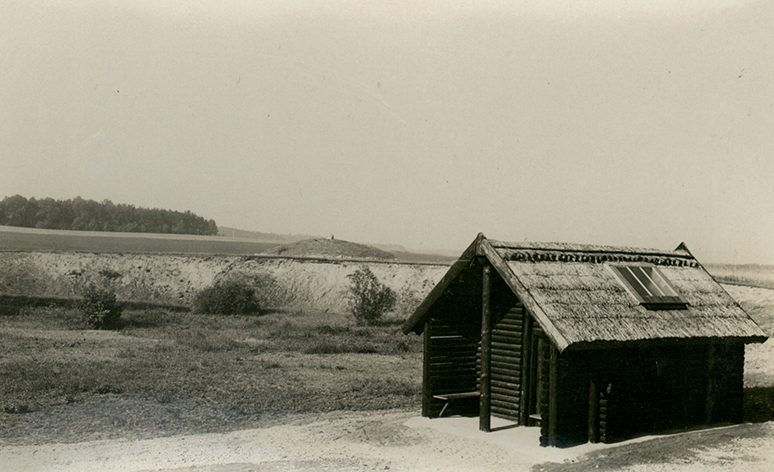
While moving the earth, the workers came across a second, smaller mound, the investigation of which, under Neumann's supervision, actually revealed cremation burials. For archaeology, these results were an additional gain in knowledge, and for the open-air museum, the second mound is still a great visual asset today.
Michael StrobelImage Source E. K. Rühle, OA 44320, 215, Foto ©LfA 1931.
Expensive equipment
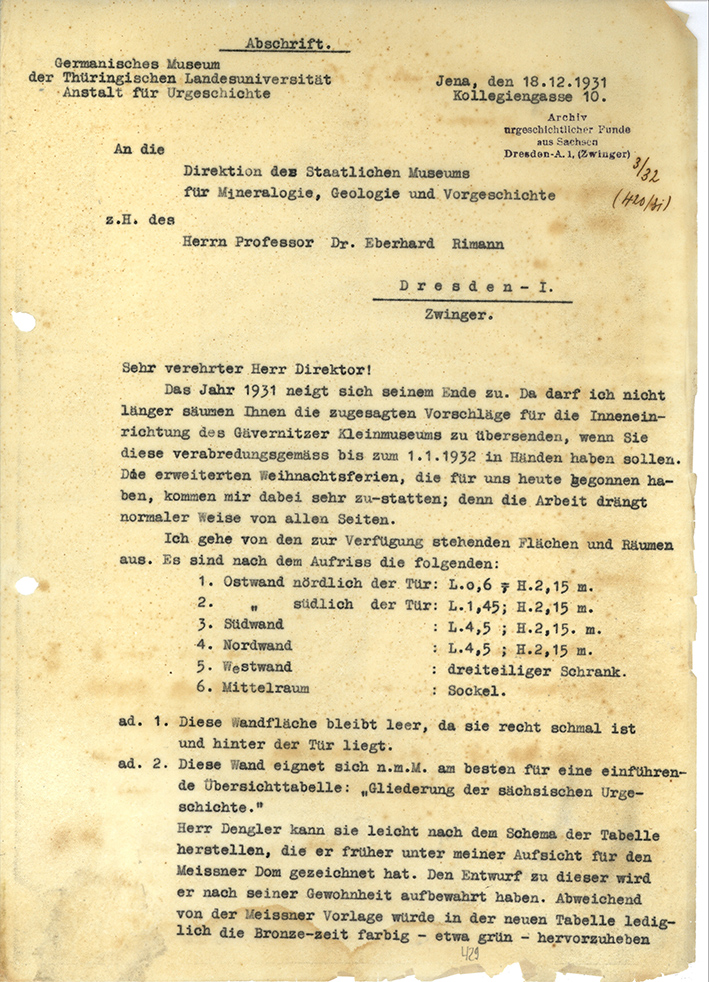
The transfer of ownership was flanked by a third press campaign, which put the museum staff in particular under pressure because it not only provided journalists with the misleading keyword "3000-year-old princely tomb from the Bronze Age" (press release of 20.9.1930, OA Gävernitz), but also raised expectations with a description of the small museum, which became increasingly difficult to fulfill under the current circumstances. On the one hand, Neumann left the museum service in a dispute with Bierbaum to take up a position at the Germanic Museum of the University of Jena on January 1, 1931. The Dresden museum thus lost the driving force behind the project. However, the full-time curator of the collection and archive director was neither able nor willing to take over the detailed conception of the model and exhibition design from his former scientific assistant. Last but not least, the conflicts were probably sparked by Neumann's offensive public relations work, which must always have been a thorn in the side of the cautious Bierbaum. On the other hand, the financial situation of the Free State deteriorated rapidly.
Michael StrobelImage Source OA 44320, 429 ©LfA 1931.
The dismountable hill model
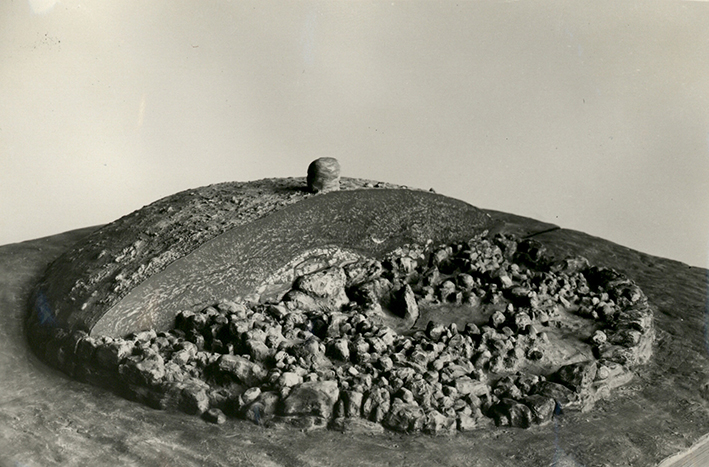
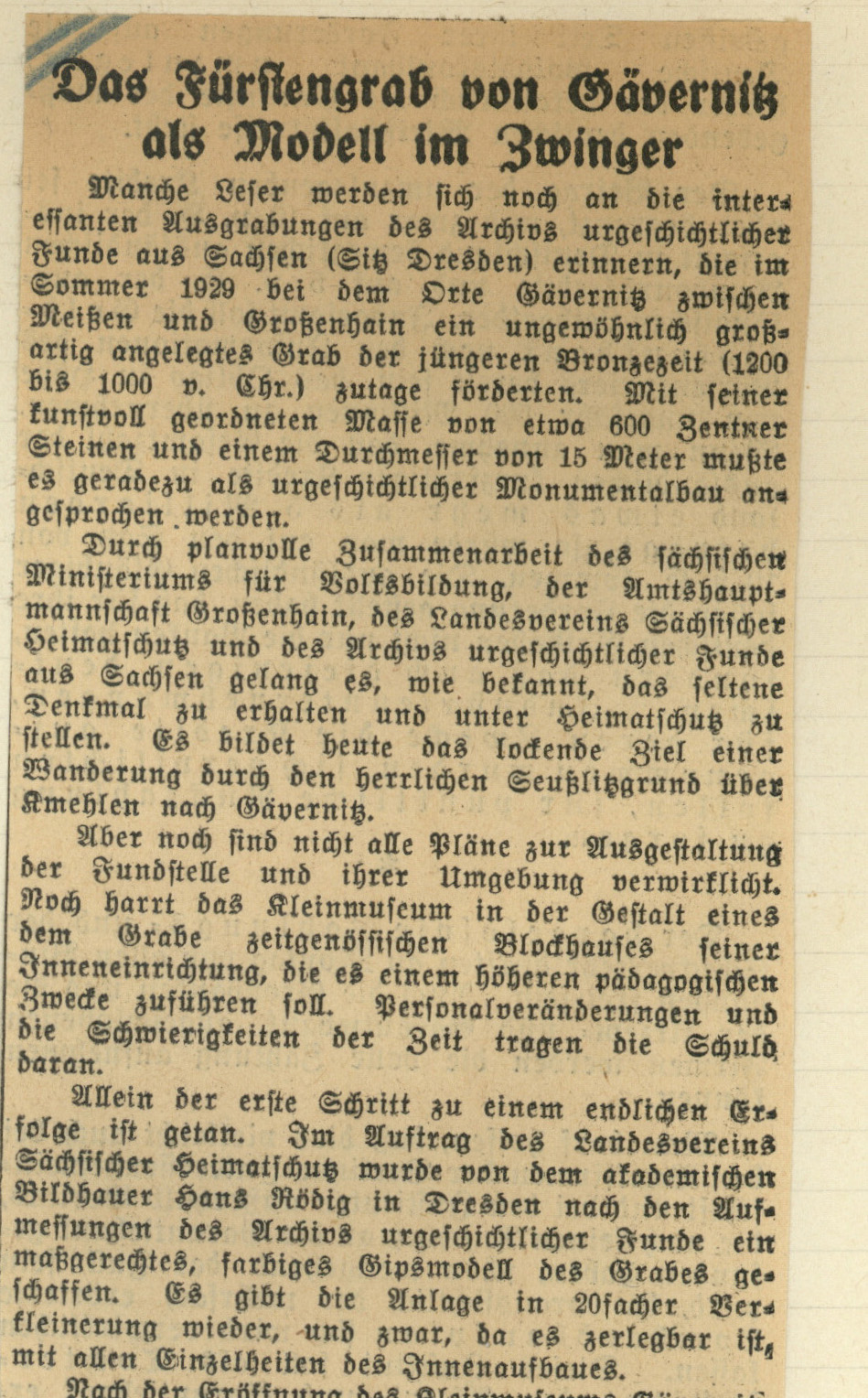
For these reasons, it was possible to have the Dresden sculptor Hans Rödig produce a multi-part, dismountable model of the large mound just in time, which was paid for by the Landesverein and provisionally presented in the Zwinger in the summer of 1931 in the rooms of the prehistoric collection. However, as long as Neumann had not provided any details for the museum furnishings and Rodig had not made any molds of the plaster model, Bierbaum did not even want to consider an early opening for fear of damaging the model in the small museum. In a press release, he had to put off the interested public until better days.
Michael StrobelImage Source M. Nowak, OA 44320, 11, Foto Modell ©LfA 1931.
From the "grave of a great man" to the "tomb of a prince"
In order to attract an audience to the interim installation site, even the otherwise so thoughtful curator sent out the press release under the label "Das Fürstengrab von Gävernitz als Modell im Zwinger" (Bierbaum to four editors, 29.7.1931, OA Gävernitz). In the years that followed, however, he did everything in his power to let the "princely blood" go to seed and to downgrade the supposed "princely mound" to a "large grave" (Bierbaum to Landesverein, 26.3.1941, OA Gävernitz).
Michael StrobelImage Source OA 44320, 210 ©LfA 1931.
Didactically valuable
After almost three years of crisis (1931-1933), in which the archaeological preservation of monuments had reached an all-time low in terms of personnel and finances and the head of the collection and archive had great difficulty holding his position, the small museum was finally furnished and opened in the summer of 1934 - again with the support of the Landesverein - according to Neumann's designs from the winter of 1931/32. While the mound model was placed in a prominent position on a central pedestal, excavation plans and photos, reconstruction drawings, biographies and a chronology table hung on the walls. Replicas of finds were displayed in cabinet showcases, which the museum had to go to considerable lengths to cast because many of the originals were in private collections. However, the molds in particular were indispensable for a vivid exhibition.
Michael StrobelImage Source OA 44320, 225 ©LfA 1929.
Declining interest
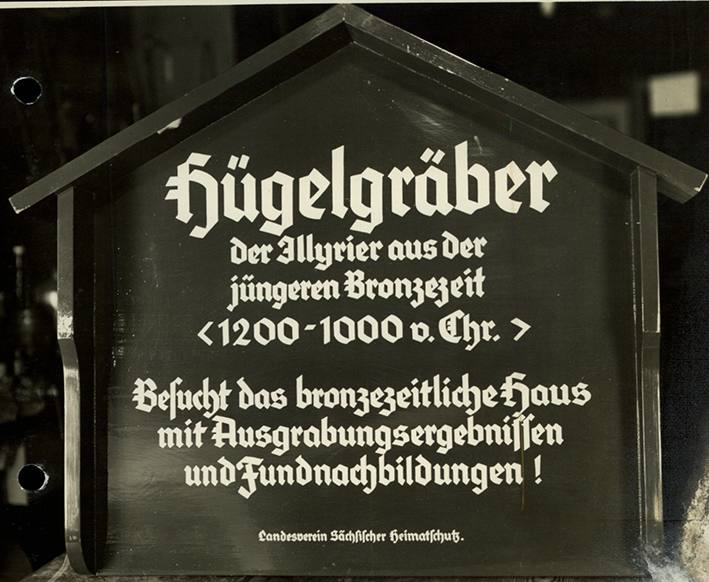
The fact that Bierbaum refrained from an official inauguration or even an announcement in the national press and mainly relied on word-of-mouth propaganda, as "the completion had taken so long" (Bierbaum to Landesverein, 12.7.1934, OA Gävernitz), cannot have exactly promoted public interest. Only the Großenhainer Tagblatt and the NS daily newspaper "Der Freiheitskampf" published brief articles by the Großenhain teacher and honorary shop steward Kurt Schwandt. For the time being, not even a sign at the side of the road was planned. A simple plaque was not erected until a year later in the summer of 1935; by then, there was no longer any talk of a "princely grave".
Michael StrobelImage Source W. Schmidt, OA 44320, 372 ©LfA 1936.
"Reichserntedankfeier" 1934
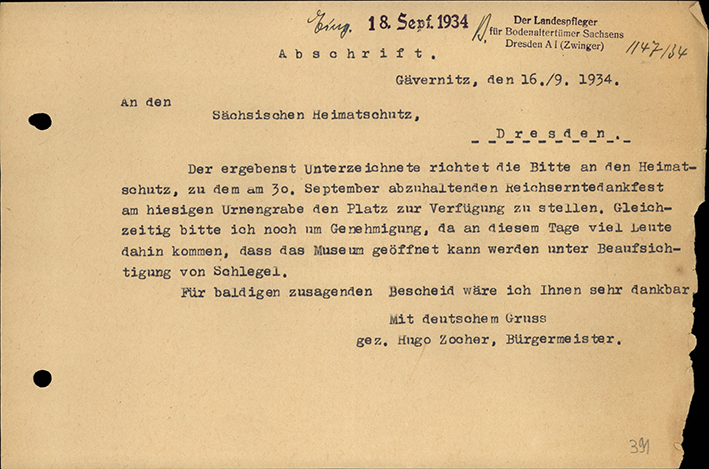
How other archaeologists would have dealt with the "Illyrian burial site" after the transfer of power to the National Socialists in order to gain symbolic capital, political attention and ultimately additional resources remains an idle question. When the mayor of Gävernitz approached the Landesverein with a request to be allowed to use the site on September 30, 1934 for local Reich harvest thanksgiving celebrations, the director of the association, Werner Schmidt, who occasionally signed his correspondence "with a German greeting" as early as 1929, made the forecourt area away from the hills available without any further conditions. On the other hand, there is no documentation anywhere that higher party circles, even the Gauleiter Martin Mutschmann (1879-1947) himself, were ever in Gävernitz.
Michael StrobelImage Source OA 44320, 391 ©LfA 1934.
Sleeping beauty
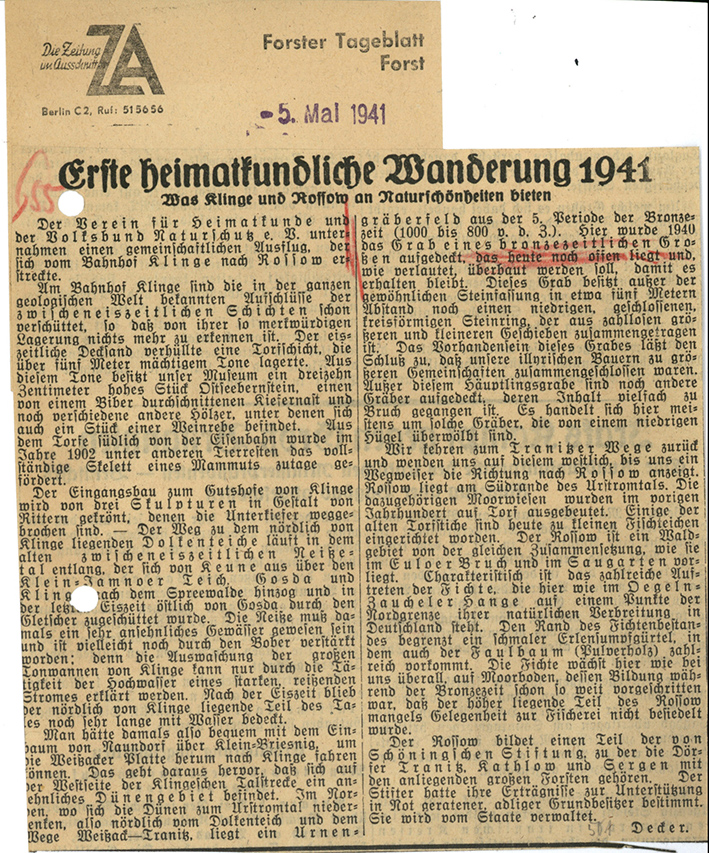
And while the open-air site and small museum may have been the destination of sporadic school trips and specialist excursions or scattered hikers until the outbreak of war, there is nothing to suggest that the site would have been as well frequented within several years as the excavation was within a few weeks in 1929. Even isolated press reports could not prevent the open-air site from sinking into a twilight sleep shortly after its opening. Anyone who decided to pay a spontaneous visit in passing was faced with a locked log cabin because the key was administered by a trusted person in Gävernitz.
Michael StrobelImage Source Forster Tagblatt, 5.5.1941, OA 44320, 501 ©LfA 1941.
The museum building as an emergency shelter
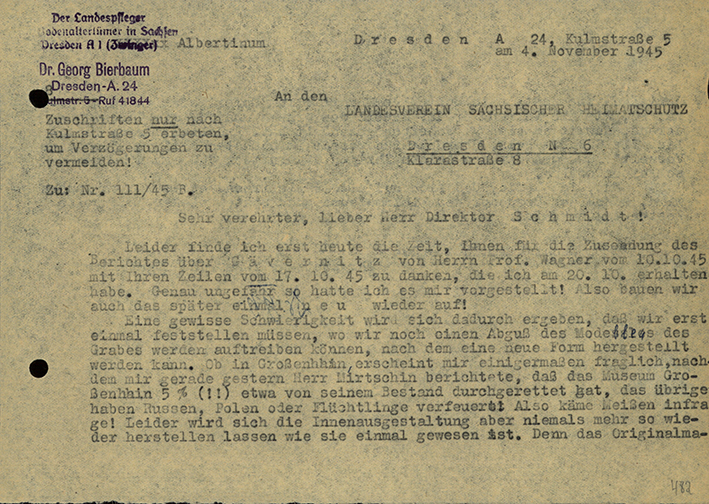
After Wehrmacht soldiers damaged the museum while laying cables, the hut was used as a shelter for displaced persons, refugees and shepherds. In the search for fuel and building materials, the interior was burned, the thatched roof partially torn down and parts of the walls broken out. The longer the decaying wooden building was exposed to dismantling and looting, the more the initial post-war alarm about the "general lack of culture" gave way to sober pragmatism.
Michael StrobelImage Source OA 44320, 483 ©LfA 1945.
Dismantling
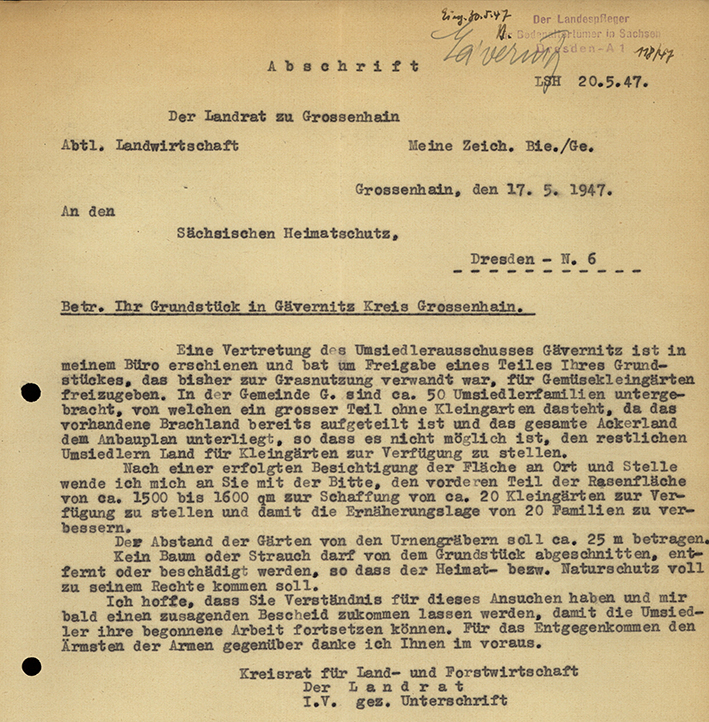
Finally, in 1947, all those involved agreed to demolish the ruins, store the remaining material in the landowner's barn and postpone the reconstruction until "better times". As long as the mounds, base plate and embankments were left untouched, they could object all the less to refugees using the gravel pit site as an allotment garden, especially as the population of the village of Gävernitz had more than doubled by 1947 as a result of the internment. Incidentally, the burial mounds themselves do not appear to have suffered nearly as much from "post-war use" as the log cabin and planting. In the early post-war years, very few people would have been aware of the protected status. Bierbaum had delayed registering the partially reconstructed burial mounds in the list of monuments until 1941, which was a remarkably long time.
Michael StrobelImage Source OA 44320, 469 ©LfA 1947.
Enteignung und Unterhaltung
Vom 1948 enteigneten Landesverein gingen die Verpflichtungen für das Gelände auf die Hauptverwaltung Staatliche Museen, Schlösser und Gärten über, die für die Pflegekosten aufkam. Mit den notwendigen Maßnahmen wurde 1950 der Gävernitzer Schmied Pinkert beauftragt, dem das Landesmuseum für Vorgeschichte eine jährliche Aufwandsentschädigung ausbezahlte. Seitdem ist niemand mehr auf die Idee gekommen, das Kleinmuseum auf der noch vorhandenen Bodenplatte wieder zu errichten. Allein das Gelände, vor allem die Hügel in regelmäßigen Abständen von Wildwuchs zu befreien, erforderte zahllose verdienstreiche Arbeitseinsätze.
Michael StrobelImage Source R. Heynowski, Foto ©LfA 2009.
Der „Archäologiepark Gävernitz"
An das „erste Freilichtmuseum Sachsens“ nach fast 100 Jahren nahtlos anzuknüpfen, ist aufgrund der gebrochenen Entstehungsgeschichte von der Ausgrabung 1929 bis in die Nachkriegszeit schwierig, wenn nicht gar unmöglich. Aus guten Gründen hat sich der Terminus „Fürstengrab“ für den Gävernitzer Hügel weder in der Fachliteratur noch in der Öffentlichkeitsarbeit der 1930er-Jahre durchgesetzt. Umso vielversprechender ist es nunmehr, das Areal mit modernen didaktischen und wissenschaftlichen Methoden („augmented reality“, „experimentelle Archäologie“) zu einem vielschichtigen Lernort der Gegenwart aufzuwerten, ohne in überzeichnende („Fürstengrab“), heimattümelnde oder gar völkisch-nationalistisch aufgeladene Geschichtserzählungen zurückzufallen.
Michael StrobelImage Source R. Heynowski, Foto ©LfA 2021.
Literature
Karl Grossmann (Hrsg.), Sachsen. 1000 Jahre deutscher Kultur (Dresden 1929).
Ursula Lappe, Ein Gräberfeld der Lausitzer Kultur bei Gävernitz, Kr. Großenhain Heinz-Joachim Vogt (Hrsg.), Archäologische Feldforschungen in Sachsen. Arbeits- und Forschungsberichte zur sächsischen Bodendenkmalpflege, Beih. 18 (Berlin 1988) 184–186.
Woldemar Lippert (Hrsg.), Meißnisch-Sächsische Forschungen. Zur Jahrtausenfeier der Mark Meißen und des Sächsischen Staates (Dresden 1929).
Gotthard Neumann, Das große Grab von Gävernitz (Dresden 1930).
Jens Schulze-Forster/Tohmas Westphalen, Vom „Fürstengrab“ zum Archäologiepark: 100 Jahre Archäologie in Gävernitz. Sächsische Heimatblätter 69, 2023, 148-153.
Michael Strobel, Große Not gebar ein „Fürstengrab“. Die Hügel und das Kleinmuseum von Gävernitz, Lkr. Meißen. Archaeo 19, 2022, 36-46.
Note on monument protection
Archaeological monuments are protected by the Saxon Monument Protection Act. A permit under monument law is required for ground interventions or construction measures.
Permalink
https://archaeo-sn.de/en/ort/burial-mounds-and-open-air-museum-in-gavernitz/
Citation
Michael Strobel, Burial mounds and open-air museum in Gävernitz. In: Landesamt für Archäologie Sachsen, Website archaeo | SN (06.11.2024). https://archaeo-sn.de/en/ort/burial-mounds-and-open-air-museum-in-gavernitz/ (Stand: 29.09.2026)
