


Cistercian nunnery Marienthal
| Place: | Marienthal (Ostritz, Görlitz) |
|---|---|
| Type: | Monastery complex |
| Dating: | High Middle Ages | Late Middle Ages | Modern Age | Modernity | since approx. 1200 AD. |
Description
Marienthal Monastery is located south of the small town of Ostritz on the left bank of the Neisse, directly on the border with the Republic of Poland. It is the longest continuously inhabited monastery of the Cistercian order in Germany. The oldest document about the donation of the now deserted village of Syfridistorph (Seifersdorf) to the monastery dates back to 1234. Since the early 1990s, numerous renovation measures and small archaeological investigations have taken place in the monastery, which have allowed a closer look at the centuries of history in Marienthal.
Dana Mikschofsky/Annemarie ReckAtonement?
According to monastic tradition, St. Marienthal was founded in the first half of the 13th century by the Bohemian Queen Kunigunde (1202-1248), the wife of King Wenceslas I (ca. 1205-1253), as atonement for her father, King Philip IV of Swabia (1177-1208), who was murdered in Bamberg in 1208. He was murdered by Count Palatine Otto von Wittelsbach in revenge for the disgrace of marrying Cunegonde, who was actually promised to him, to the son of the Bohemian king when the political situation in the empire changed.
Dana Mikschofsky/Annemarie ReckImage Source Sächs. Weltchronik. Staatsbib. Preußischer Kulturbesitz, Ms. germ. fol. 129, fol. 117v.
New research
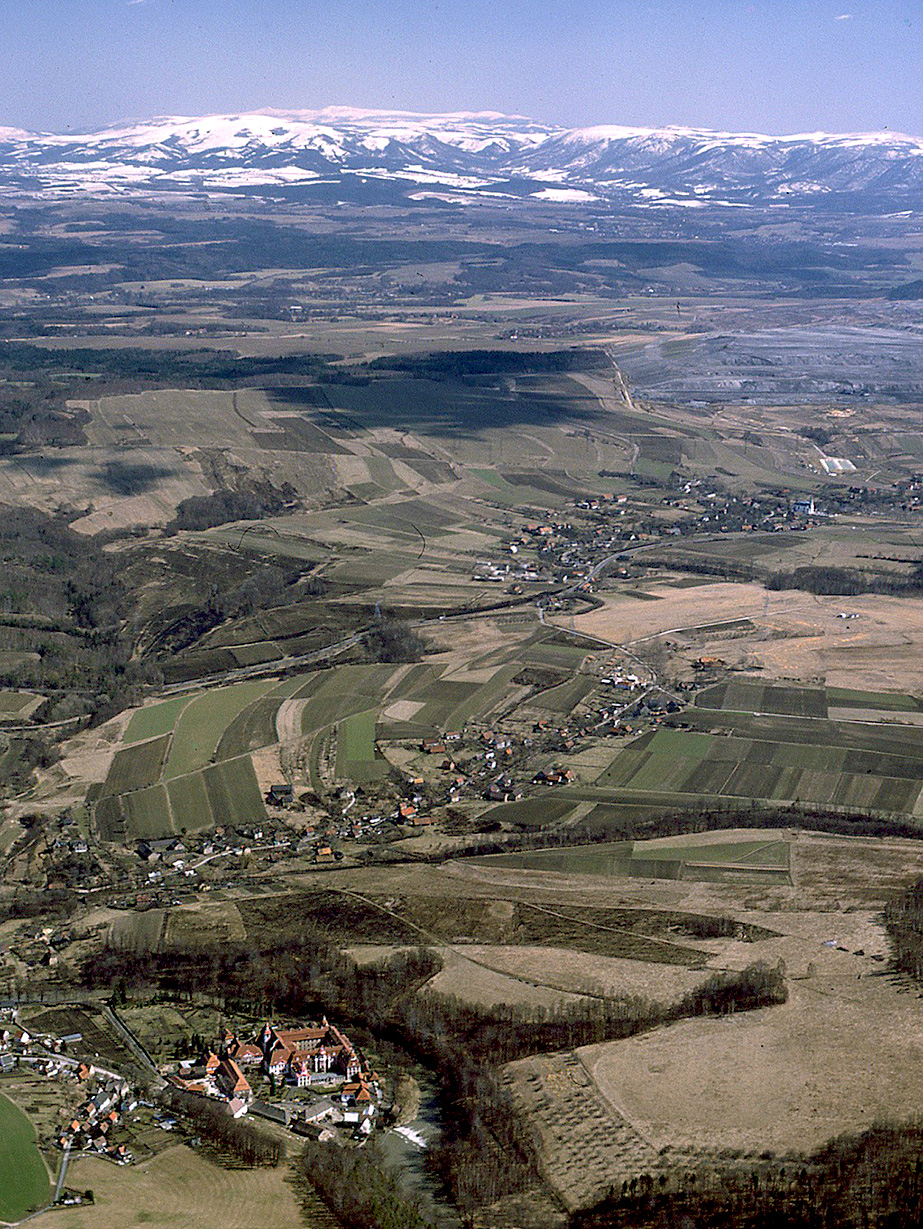
However, more recent research assumes that the document from 1234 is merely a confirmation of the ownership of the monastery and that the actual foundation must have taken place a few years earlier. The foundation project could have been initiated by the burgraves of Dohna, who were involved in the expansion of the eastern part of the country and were trying to establish a dominion in the Neisse valley. Founding monasteries was often the culmination and conclusion of such a project. The foundation of St. Marienthal could have been intended by the burgraves of Dohna to consolidate their claim to power in the Neisse valley.
Dana Mikschofsky/Annemarie ReckImage Source O. Braasch, Foto ©LfA 1996.
Middle Ages and modern times
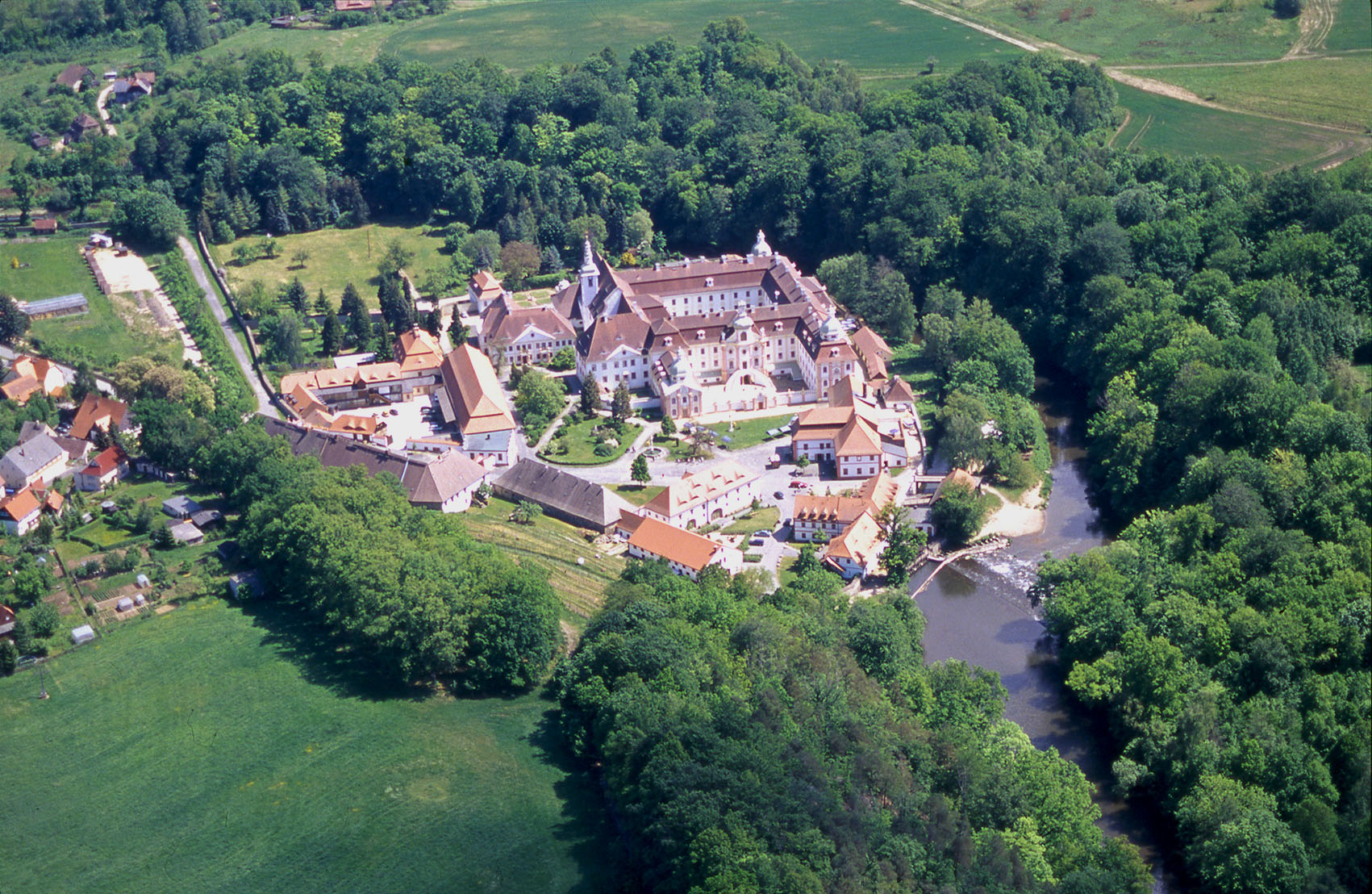
The monastery was incorporated into the Cistercian order in 1237. The monastery, which was initially subordinate to the diocese of Meissen, was assigned to the diocese of Prague just a few years later. In 1244, the monastery church was consecrated by Bishop Nicholas of Prague. The monastery was destroyed during the Hussite Wars in 1427. The convent fled to Görlitz and only returned to the monastery after 30 years of exile. During the Reformation, the sisterhood prevented repeated attempts to convert the convent into a secular convent for ladies and adhered to the Catholic faith. In 1683, the convent was almost completely destroyed by a major fire. Reconstruction in the Baroque style lasted until 1744.
Dana Mikschofsky/Annemarie ReckImage Source J. Wojnicz, Foto ©LfA 2017.
Recent monastery history
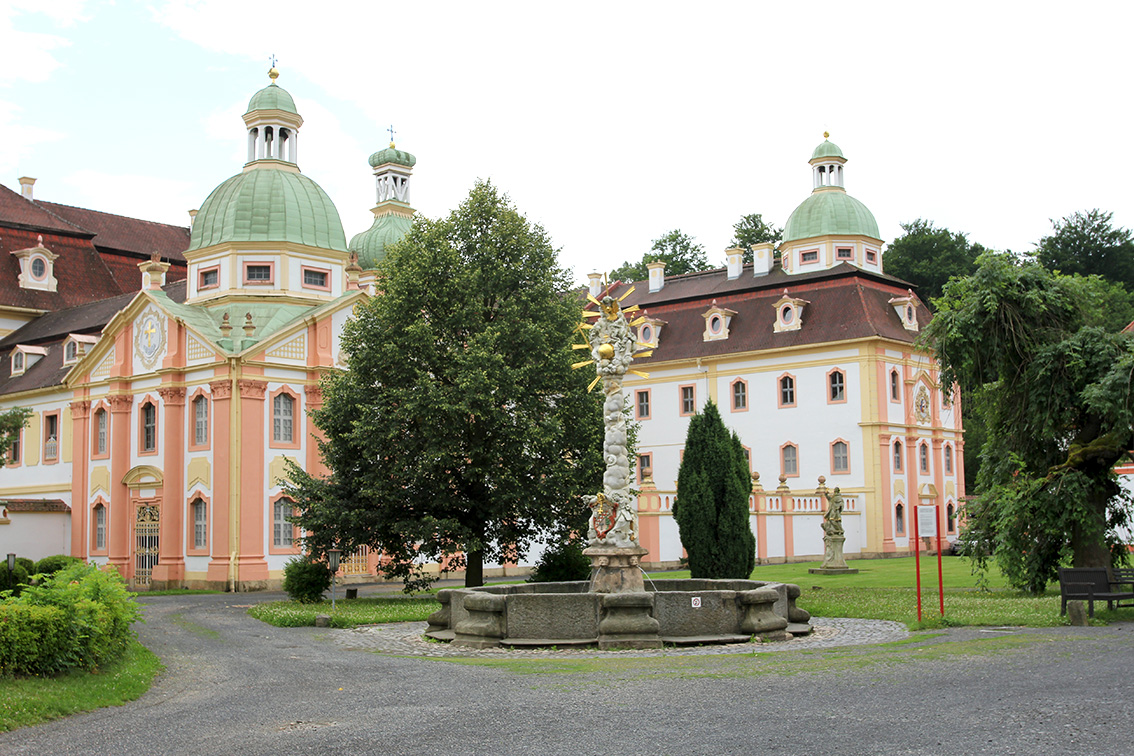
Until 1783, the Marienthal patronage parishes belonged to the diocese of Prague (archbishopric since 1344). Today, the monastery is under the jurisdiction of the diocese of Dresden-Meissen. Thanks to the documented protection of the Saxon royal family, the monastery was saved from dissolution during secularization. In the 19th century, an orphanage and a school were established in the monastery, but both were closed again during the Nazi regime. The SS annexed large parts of the monastery and used it as a camp for the Kinder-Land deportation and later as a military hospital. Towards the end of the war, the abbess at the time refused to evacuate the monastery, thus preventing the planned demolition by the SS. During the GDR era, a home for people with disabilities is set up in the monastery.
Dana Mikschofsky/Annemarie ReckImage Source R. Heynowski, Foto ©LfA 2009.
Renovations from 1990
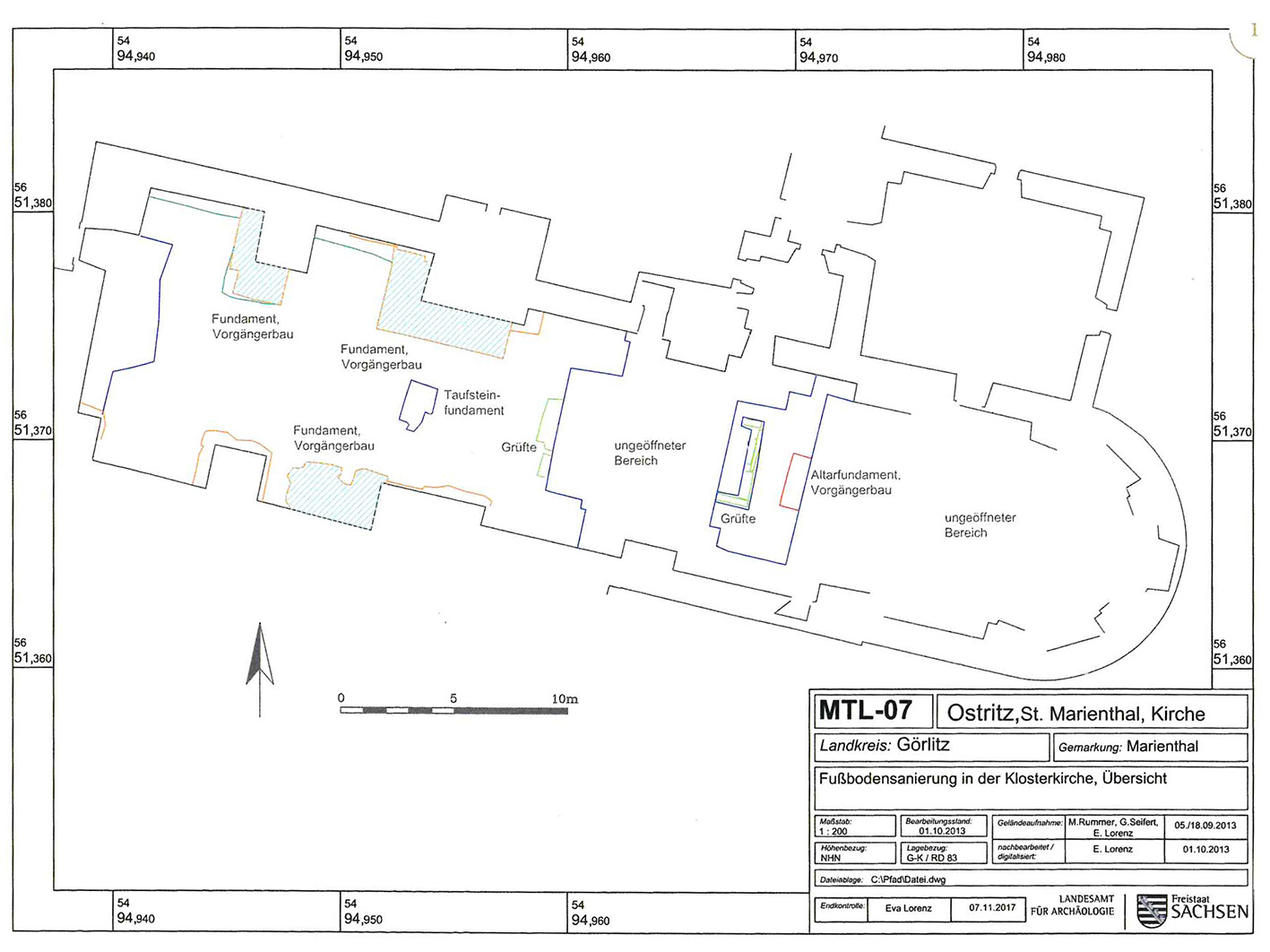
In the 1990s, extensive renovations were carried out on the buildings of St. Marienthal. The construction of flood protection facilities and supply and disposal systems necessitated several small archaeological investigations. It was discovered that parts of the original 13th century building can still be found in the western part of the monastery church. The single-nave Gothic church building is located at the eastern end of the northern wing of the monastery. Inside the nave, the foundations of a baptismal font were uncovered between the central pillars of the north and south walls during excavations. Its quarry stone masonry was filled with clay mortar, which indicates that it dates back to the Middle Ages.
Dana Mikschofsky/Annemarie ReckImage Source E. Lorenz/M. Rummer/G. Seifert, Grabungsplan Klosterkirche ©LfA 2017.
Renovations after 2010
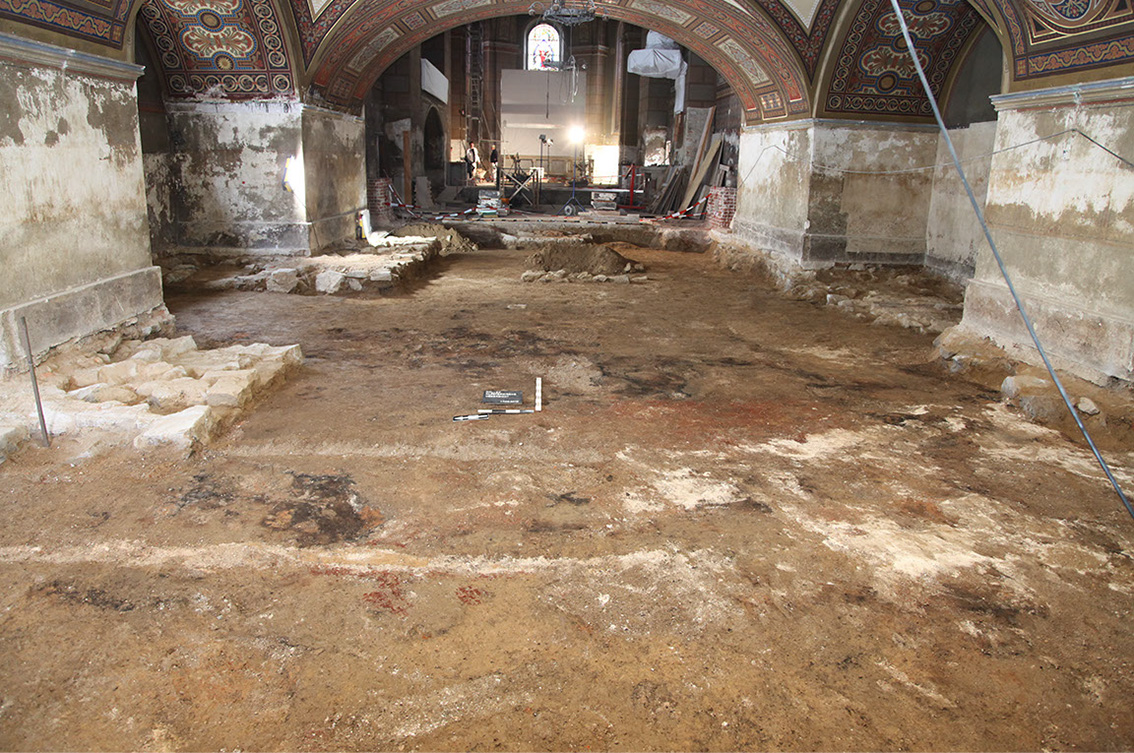
In 2010, the monastery was completely flooded by the Neisse, which necessitated extensive renovation work. During the construction work, the Saxony State Office for Archaeology (LfA) carried out investigations in the monastery church. Several wall fragments and old foundation remains were found. They date back to an extensive rebuilding and redesign phase of the church in the late 17th century, after the church was devastated by a fire in 1683. Not far from the altar foundations of a previous building, the excavation team came across two barrel-vaulted crypts, which probably date back to the 17th/18th century. A church choir was added around 1740. The monastery owes its castle-like appearance and rich decoration primarily to the Bohemian builders, painters and sculptors of the 17th and 18th centuries, who shaped Baroque art in Upper Lusatia.
Dana Mikschofsky/Annemarie ReckImage Source E. Lorenz, Foto ©LfA 2013.
Literature
Lars-Arne Dannenberg, Das Kloster St. Marienthal und die Burggrafen von Dohna. Überlegungen zur Gründung des Zisterzienserinnenklosters an der Neiße. Neues lausitzisches Magazin, N.F. 11, 2008, 89–104.
Christiane Hemker, Archäologische Untersuchungen in der Klosterkirche. Blick in die Geschichte. In: Klosterstift St. Marienthal. Flutschadenbeseitigung 2010–2017 (Freiberg 2017) 52–53.
Stefan Krabath/Marius Winzeler, Marienthal: Die Zisterzienserinnen-Abtei Klosterstift St. Marienthal und die Wüstung Seifersdorf. In: Regina Smolnik/Jasper von Richthofen (Hrsg.), Die Oberlausitz – Ausflugsziele zwischen Neiße und Pulsnitz. Ausflüge zu Archäologie, Geschichte und Kultur in Deutschland 51 (Stuttgart 2010) 187–191.
Dana Mikschofsky, Zisterzienserinnen an der Neiße. In: Regina Smolnik/Ronny Zienert (Hrsg.), Höhenflüge. Luftbilder und Archäologie in Sachsen (Dresden 2024) 202–203.
Note on monument protection
Archaeological monuments are protected by the Saxon Monument Protection Act. A permit under monument law is required for ground interventions or construction measures.
Permalink
https://archaeo-sn.de/en/ort/cistercian-nunnery-marienthal/
Citation
Dana Mikschofsky/Annemarie Reck, Cistercian nunnery Marienthal. In: Landesamt für Archäologie Sachsen, Website archaeo | SN (09.04.2024). https://archaeo-sn.de/en/ort/cistercian-nunnery-marienthal/ (Stand: 29.09.2026)
