

City moat of Görlitz
| Place: | Görlitz (Görlitz, Görlitz) |
|---|---|
| Type: | Irregular trench work |
| Dating: | Late Middle Ages | Modern times | 1474/1477 - 1600 AD. |
Description
Like many medieval towns, Görlitz also had various fortifications that were built to protect the inhabitants. In addition to a city wall, the outer city moat was built between 1474 and 1477, which ran for up to 25 km around the city. In places, the remains of a palisade built in advance or an additional approach obstacle can still be seen today. It is not clear from the sources, the aerial photograph or the digital terrain model (DTM) whether the excavated material resulting from the deepening of the trench had been piled up to form a rampart that accompanied the trench line. The reason for the construction of the outer city moat was the escalating political events of 1474. In addition, troops of plundering robber barons increasingly threatened the city, which is why Görlitz felt compelled to strengthen its defenses.
Ronald Heynowski/Annemarie ReckGörlitz in the late Middle Ages
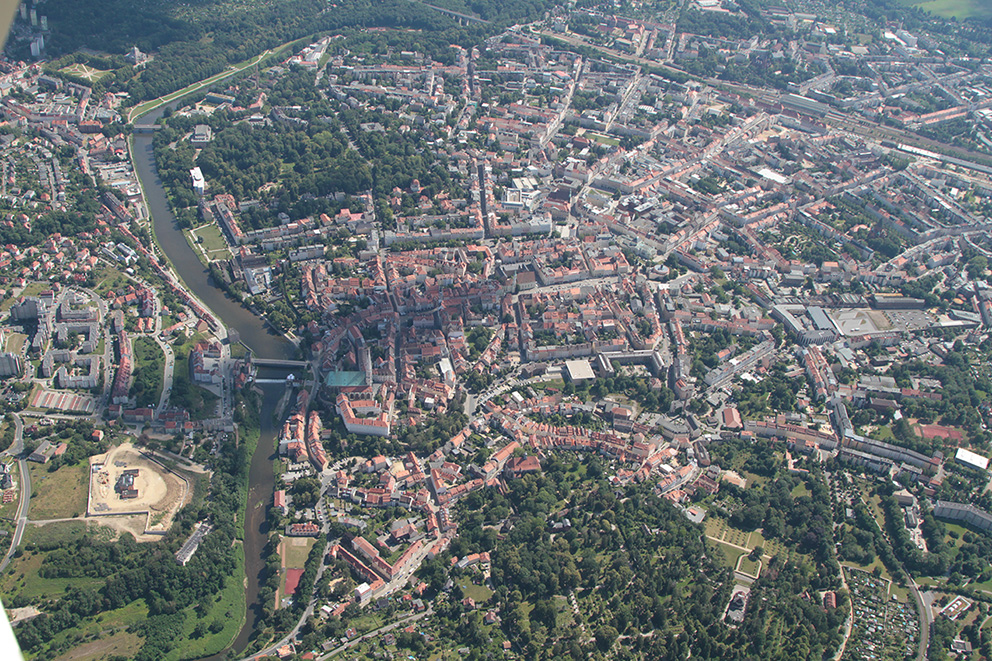
Until around 1250 AD, the old town center, located on a plateau around St. Peter's Church, was only protected by a wooden palisade. As the town expanded, it was replaced and extended by a stone wall. In 1474, Görlitz found itself in the middle of a conflict between the Hungarian King Matthias Corvinus (1443-1490) and an alliance of Bohemia, Poland and Austria under the Bohemian King Georg Prodiebad (1420-1471), who had been declared a heretic by the Pope in 1466 due to his Hussite beliefs. Matthias Corvinus was given the task of carrying out the papal sentence and re-catholicizing Bohemia as the new king. As one of the richest towns in Upper Lusatia, Görlitz was directly affected by the conflict between the two rulers.
Ronald Heynowski/Annemarie ReckImage Source R. Heynowski, Görlitz von Norden ©LfA 2020.
Increase in protective measures
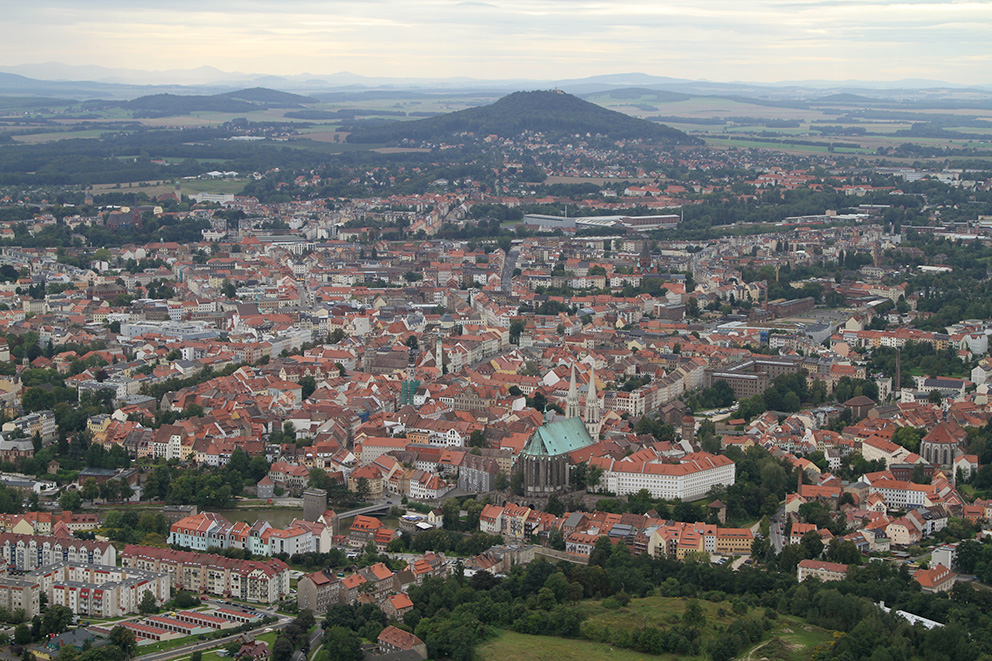
In the midst of these troubled times, raids from the surrounding castles of Talkenstein (Zamek Podskale) and Lähnhaus (Wleń) near Löwenberg (Lwórek Śląski) on the one hand and Lämberg (Lemberk) near Gabel (Jablonné v Podještědí) on the other also caused damage to the town. The responsible bailiff refused to help the town against the marauding and plundering bandits. Görlitz, left to its own devices, therefore decided to increase the protective measures around the town in 1474 and made plans to build an outer moat.
Ronald Heynowski/Annemarie ReckImage Source R. Heynowski, Görlitz mit Blick zur Landeskrone ©LfA 2012.
Construction of the outer moat
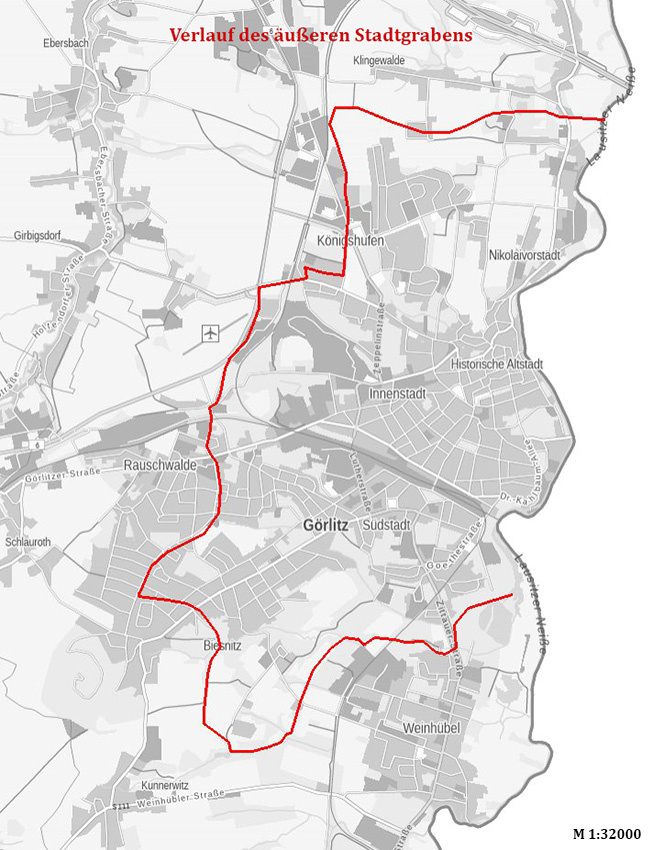
The citizens of Görlitz and the surrounding villages were then obliged to provide services. The work force numbered up to 1000 men in total. Over the course of just three years, a line of fortifications almost 25 km long was built around the town. According to historical records, the moat was around 6 m wide. To the west of the Neisse, its course initially leads south of Ober Ludwigsdorf and Klingewalde to Klingenwalder Mühle, where it bends to the south and touches the grounds of the airfield south of Gibirgsdorfer Straße. South of the B6, its course can be traced in the street name "Stadtgraben", in Groß Biesnitz as "Grenzweg", which reaches as far as Kunnerwitz. It leads back to the banks of the Neisse via the Pomological Garden and the Weinlache. To the east of the river, the railroad station in Jędrzychowice (Hennersdorf), the edge of the village of Jerzmanki (Hermsdorf) and the Winna Góra near Tylice (vineyard near Thielitz) form the cornerstones of the fortification line.
Ronald Heynowski/Annemarie ReckImage Source A. Reck, Karte ©LfA/GeoSN 2024.
The dimensions
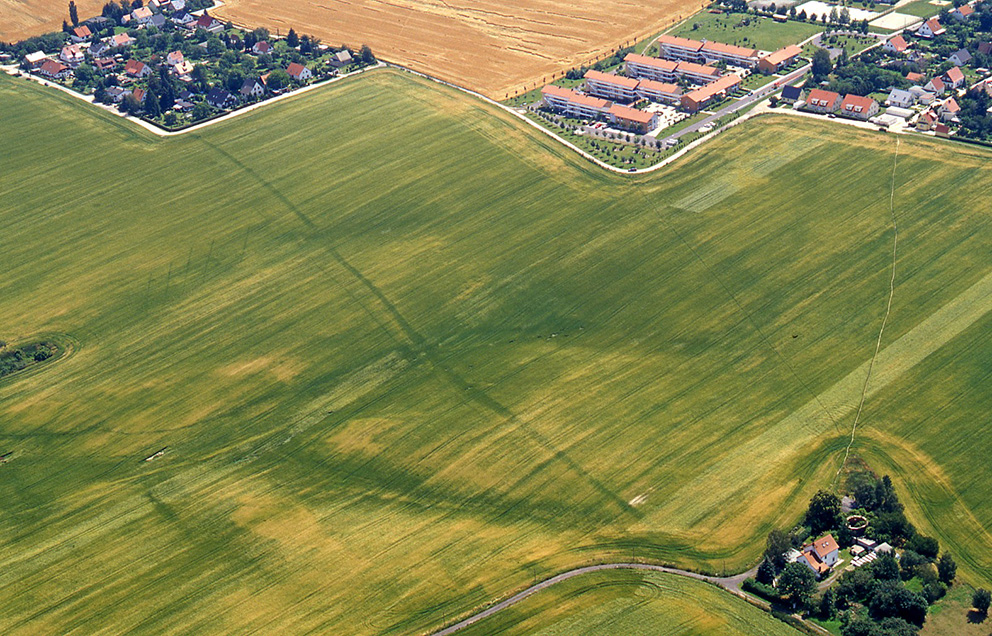
The laboriously constructed defensive structure was used until the 16th century before it was no longer maintained and eventually fell into disrepair. Nowadays, most sections of the former moat have been filled in and built over. The best place to see it today is in the north of the town near Königshufen. The outer moat can still be traced over a distance of several hundred meters here thanks to the vegetation visible from the air. Contrary to written records, the earthworks at this point appear to have been between 3-5 m wide. In addition, a narrow palisade ditch is visible on the side facing away from the town, which runs parallel to the ditch at a distance of 6-10 meters. This could be an additional obstacle to the approach or an upgrade to improve the fortifications. Whether the earth from the ditch was also piled up to form a rampart cannot be determined from the aerial photograph and the DTM.
Ronald Heynowski/Annemarie ReckImage Source R. Heynowski, Foto ©LfA 2004.
Literature
Ronald Heynowski, Verteidigungsbereit in unruhigen Zeiten. In: Regina Smolnik/Ronny Zienert (Hrsg.), Höhenflüge. Luftbilder und Archäologie in Sachsen (Dresden 2024) 90–91.
Richard Jecht, Geschichte der Stadt Görlitz, Band 1,2: Topographie der Stadt Görlitz (Görlitz 1834).
Note on monument protection
Archaeological monuments are protected by the Saxon Monument Protection Act. A permit under monument law is required for ground interventions or construction measures.
Permalink
https://archaeo-sn.de/en/ort/city-moat-of-gorlitz/
Citation
Ronald Heynowski/Annemarie Reck, City moat of Görlitz. In: Landesamt für Archäologie Sachsen, Website archaeo | SN (26.08.2024). https://archaeo-sn.de/en/ort/city-moat-of-gorlitz/ (Stand: 29.09.2026)
