

Early medieval rampart on the Strohmberg
| Place: | Särka (Weißenberg, Bautzen) |
|---|---|
| Type: | Fortified system |
| Dating: | Early Middle Ages | High Middle Ages | 900 - 1100 AD. |
Description
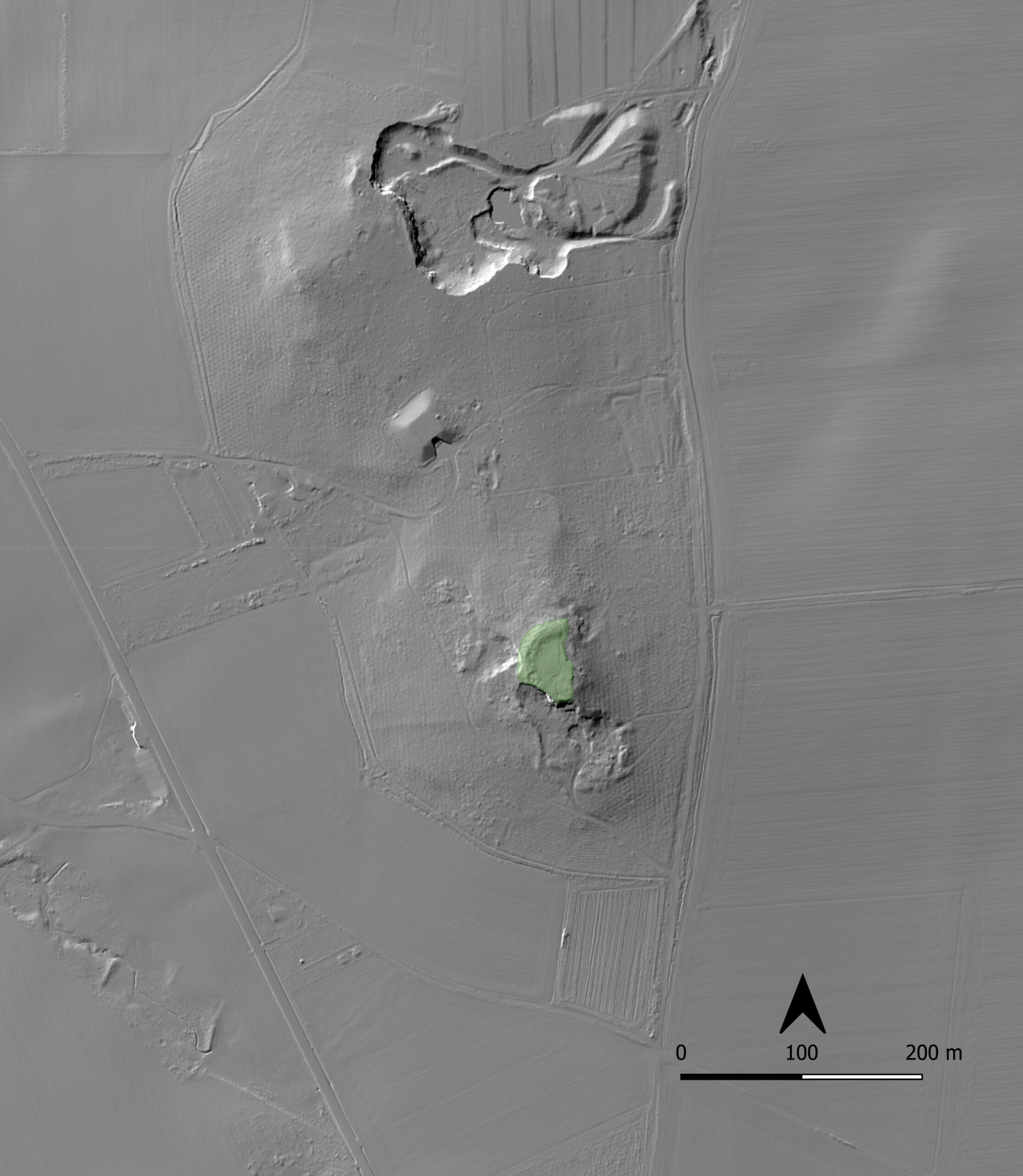
To the south of Weißenberg (Wóspork) rises the 264 m high Strohmberg, whose double summit towers 75 m above the surrounding area and offers a good view in all directions. On the spur-like end of the summit to the south are the remains of a fortification from the early Middle Ages. The curved section wall, which is still preserved today, seals off the elevation's plateau to the north. Significant heat effects on the basalt boulders from the rampart indicate the end of the fortification in the 10th century. or 11. The building was destroyed by a fire.
Michael Strobel/Annemarie ReckLocation and structure
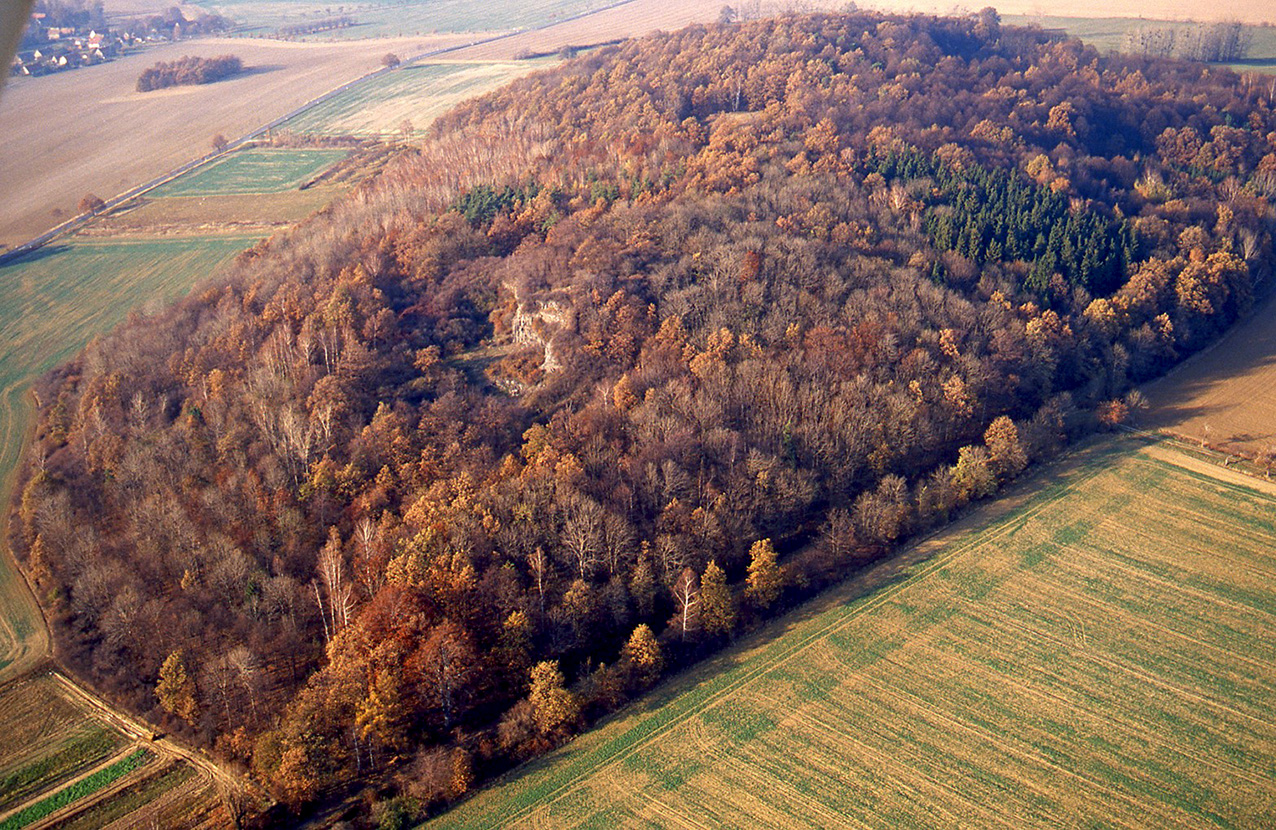
The densely wooded Strohmberg has a striking double peak made of nepheline basalt. The two elevations are connected by a ridge. The southern one formed a plateau, which was probably fortified in the form of a cauldron in the early Middle Ages. There is also said to have been a deep, water-bearing well in the rampart area, which was only sealed with stone slabs after 1850. The section of the rampart, which is now only preserved in the northern part of the elevation, consisted of a construction of basalt boulders, earth and wooden reinforcements. The basalt boulders inside the rampart were slagged due to the effects of intense heat.
Michael Strobel/Annemarie ReckImage Source R. Heynowski, Foto ©LfA 2003.
Cinder slopes
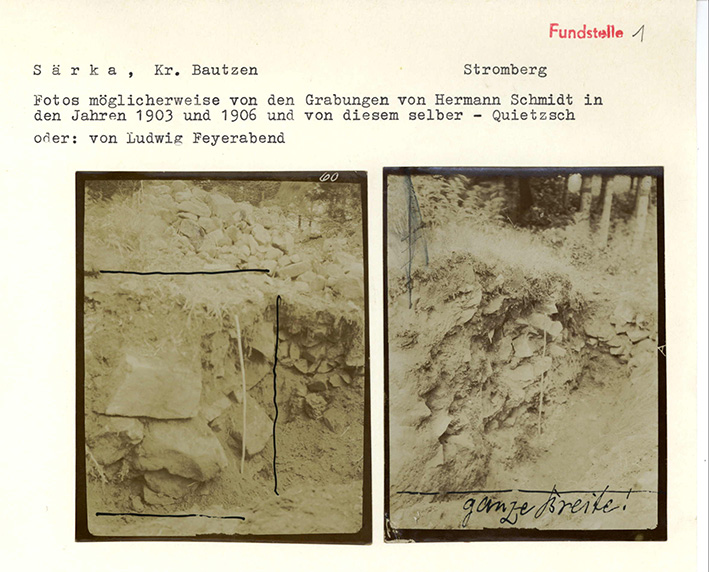
Due to this fact, the Strohmberg attracted the attention of researchers as early as the 19th century. So-called slag ramparts were considered a real phenomenon in early research, which was mainly observed in Slavic fortifications in Lusatia. It was also debated whether they had been deliberately slagged. Today, however, it is assumed that fires and the associated slagging of the ramparts occurred in the course of the conquest and abandonment of the fortifications.
Michael Strobel/Annemarie ReckImage Source OA 15230, 27, Fotos ©LfA 1971.
Early excavations
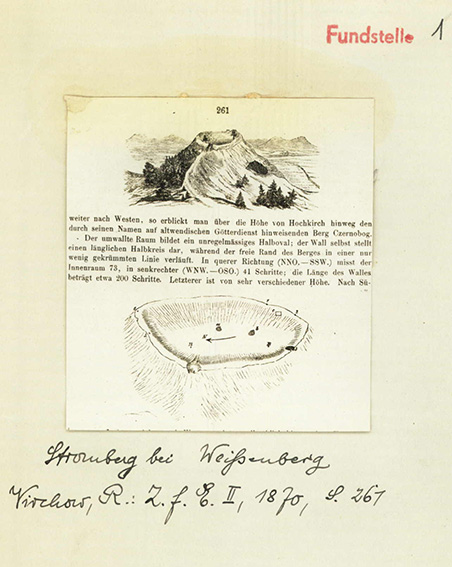
The first excavation was carried out before 1839 by Bergrat von Cotta from Tharandt. In 1870, the well-known Berlin doctor and prehistorian Rudolf Virchow (1821-1902) also carried out investigations at the castle rampart. He recovered characteristic Slavic pottery shards from the 10th and 11th centuries as well as iron finds such as arrowheads, knives and the remains of a hooked sickle. Further excavations were carried out around 1899 and 1906 under the supervision of senior teacher Hermann Schmidt from Löbau, who was primarily concerned with the construction of "slag heaps". Further pottery and iron finds, spindle whorls and lumps of burnt clay underpinned the interpretation of the Strohmberg as a Slavic fortification from the early Middle Ages.
Michael Strobel/Annemarie ReckImage Source OA 15230, 94, Rekonstruktion nach R. Virchow ©LfA 1870.
Quarry work
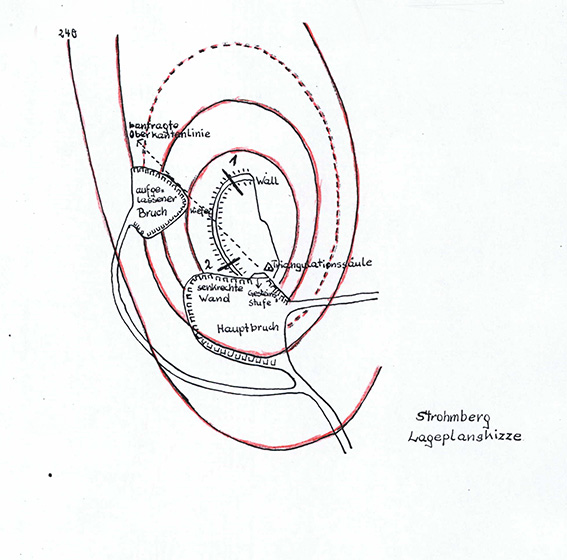
The reason for the eager research efforts was not least the ever-increasing destruction of the castle complex. Basalt had been quarried on the mountain on behalf of the manor in Särka since 1836. The eastern part must have already been destroyed by older quarry work at this time. Another smaller quarry in the west destroyed numerous parts of the early medieval castle complex unobserved in the course of the 19th century. By 1930, the smaller, western quarry had already been closed down, but quarrying continued in the south. As early as 1926, the archaeologist Walter Frenzel, who was digging at the Ostro redoubt at the time, drew attention to the situation at Strohmberg with the article "Volksgut in Not!".
Michael Strobel/Annemarie ReckImage Source OA 15230, 172, geplante Steinbrucherweiterung ©LfA 1936.
Legal dispute over the Strohmberg
After the introduction of the first monument protection law on January 1, 1934, Georg Bierbaum (1889-1959), the state curator for land antiquities, made efforts to have the Strohmberg entered in the list of monuments as quickly as possible. However, the owner of the von Horst manor objected to this. A planned rescue excavation failed at the time due to a lack of financial and human resources for archaeological monument preservation. This led to a legal dispute that went all the way to the highest instance, the then State Ministry of the Interior. In the end, Baron von Horst was permitted to remove material that was already loose and a rock edge that was still protruding. Nevertheless, he had the quarry illegally enlarged by blasting until 1945, as a result of which the entire south-western part of the site was lost. Freiherr von Horst was never held accountable for his violation of the Reich Nature Conservation Act and the Saxon Heritage Protection Act. Today, the Strohmberg is a designated landscape conservation area.
Michael Strobel/Annemarie ReckImage Source M. Strobel, DGM ©LfA/GeoSN 2019.
Literature
Richard Andree, Wendische Wanderstudien. Zur Kunde der Lausitz und der Sorbenwenden (Stuttgart 1874) 130–131.
Michael Strobel/Thomas Westphalen, Steingewinnung und archäologische Denkmalpflege in Sachsen zwischen den Gründerzeitjahren und 1945 – Rückblick und Bilanz. Mitteilungen des Landesvereins Sächsischer Heimatschutz e.V. 2/3, 2018, 27–38.
Michael Strobel, Die frühmittelalterliche Befestigung auf dem Strohmberg (Wósmužowa hora). In: Regina Smolnik/Ronny Zienert (Hrsg.), Höhenflüge. Luftbilder und Archäologie in Sachsen (Dresden 2024) 132–133.
Note on monument protection
Archaeological monuments are protected by the Saxon Monument Protection Act. A permit under monument law is required for ground interventions or construction measures.
Permalink
https://archaeo-sn.de/en/ort/early-medieval-rampart-on-the-strohmberg/
Citation
Michael Strobel/Annemarie Reck, Early medieval rampart on the Strohmberg. In: Landesamt für Archäologie Sachsen, Website archaeo | SN (24.07.2024). https://archaeo-sn.de/en/ort/early-medieval-rampart-on-the-strohmberg/ (Stand: 29.09.2026)
