

Four-part circular ditch complex Kyhna 3
| Place: | Kyhna (Wiedemar, North Saxony) |
|---|---|
| Type: | Circular trench system 4-fold |
| Dating: | Early Neolithic | Linear Pottery | Late Middle Ages | 4900 - 4500 B.C. | 1100 - 1400 A.D. |
Description
During the relocation of a moat southwest of Großkyhna in 1987, several Linear Pottery and Linear Pottery pits with abundant finds came to light, which made an emergency excavation necessary. However, the four-row trench that was cut by the pipeline was not recognized as such at the time. It was only after 1991, during the first aerial archaeological flights in Saxony, that the four-part ditch complex of Kyhna (Kyhna 3) was discovered. It was embedded in an archaeological landscape consisting of settlement pits and other single or multiple ditches. However, it stands out strikingly with its four concentric trenches. Several field inspections in the course of the 1990s already pointed to the construction of the site in the early Neolithic period. A research excavation was carried out in 2007 and 2008 to verify the dating, state of preservation and structure of the complex. Since 2001, the State Office for Archaeology of Saxony has used the outline of the circular ditch as its unofficial logo.
Dana Mikschofsky/Annemarie ReckLink https://www.archaeologie.sachsen.de/kreisgrabenanlagen-des-neolithikums-5588.html
Dimensions and structure
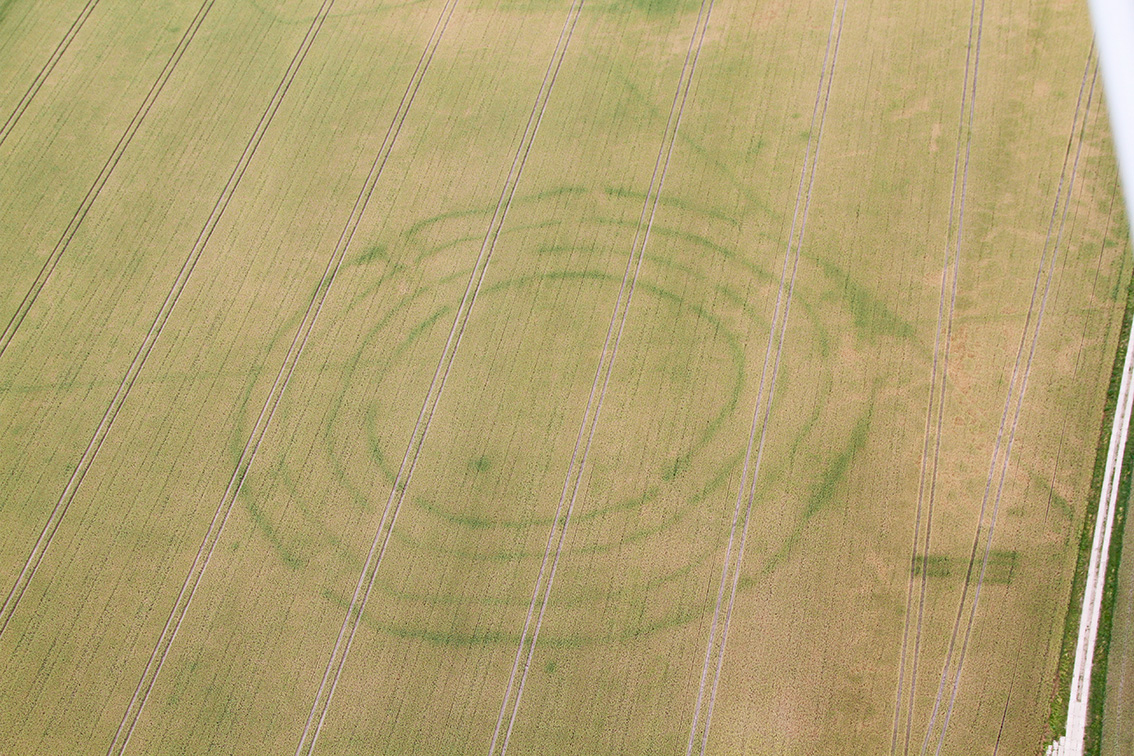
With its quadruple circular ditches, the Kyhna complex is absolutely unique within Saxony and has only one other known quadruple complex near Dresden-Nickern. The almost circular, parallel ditches of the four-part earthwork have diameters of 137 m, 117 m, 96 m and 77 m and cover an internal area of around 2200 m². It is assumed that the excavated material was also piled up between the trenches to form ramparts. Behind the trenches there were also two rows of palisades, with diameters of 60 m and 53 m, which are only faintly visible in the aerial photograph.
Dana Mikschofsky/Annemarie ReckImage Source R. Heynowski, Foto ©LfA 2018.
The 2007 excavation
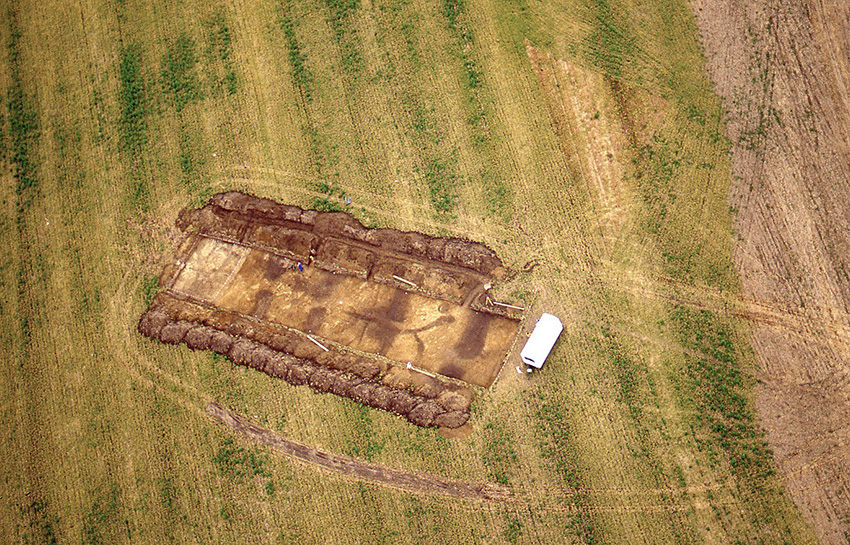
The rows of trenches are interrupted in the north-west, north-east, south-west and south-east for access points. An excavation section measuring 10 x 50 m was opened in the south-eastern gate area in 2007. The trenches there measured widths of 1.7 and 3.5 m with preserved depths of 1.3 to 1.8 m. The three trenches on the inside were pointed trenches. The outer ditch was only cut at the edge of the ditch head. The trench depths tended to decrease towards the outside. It was not possible to determine whether ramparts had actually been built between the ditches. The palisade ditches, in which high wooden posts had once been embedded, were still 0.5 m deep and measured between 0.3 m and 0.4 m wide. There was no visible recess in the outer palisade parallel to the interruption of the ditches. Similarly, no traces of posts could be discovered in the gate area that could also indicate a gate system.
Dana Mikschofsky/Annemarie ReckImage Source R. Heynowski, Foto ©LfA 2007.
Findings landscape Kyhna
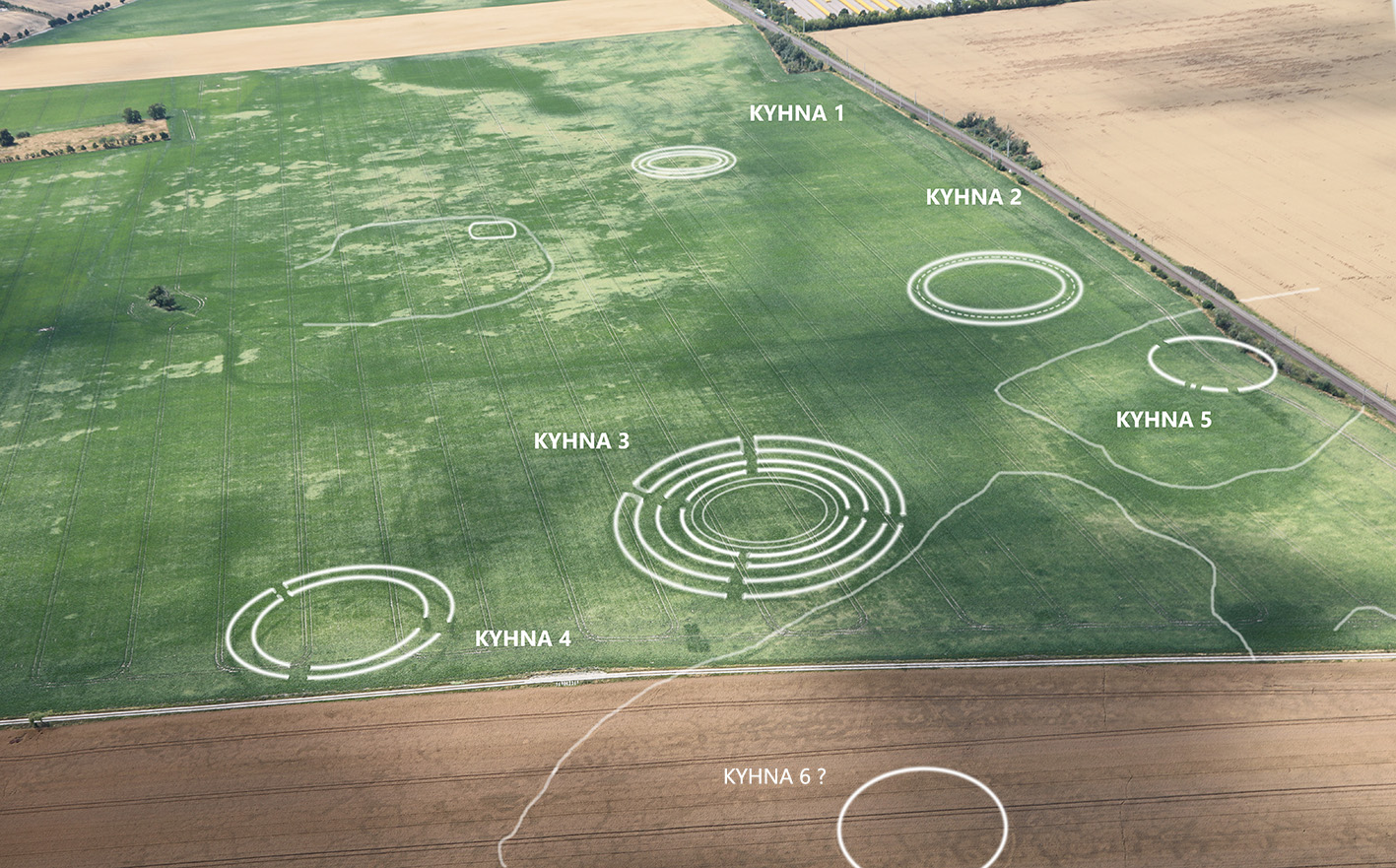
The four-part circular ditch complex Kyhna 3 does not stand in isolation, but in the middle of an early Neolithic landscape. In the immediate vicinity there are at least three, possibly four other circular ditches and other archaeological structures. Kyhna 1 lies to the west of the four-part complex of Kyhna 3 and has three circular ditches with diameters of 71 m, 58 m and 42 m. The ditches of the double ditch system Kyhna 2, located to the northwest, have diameters of 101 m and 88 m. Another double trench, Kyhna 4, located to the south-east, has trench diameters of 87 m and 69 m. Between the two trenches is another trench, rarely visible in the aerial photograph, which could also be a palisade trench. To the north of Kyhna 3 there is a fifth, simple circular ditch complex Kyhna 5 with a diameter of approx. 60 m. To the east of the four-part circular ditch is probably another simple enclosure (Kyhna 6). The two simple circular ditches are surrounded by two irregular ditch structures.
Dana Mikschofsky/Annemarie ReckImage Source R. Heynowski, Foto/A. Reck, Bearbeitung ©LfA 2024.
Function of the circular ditches
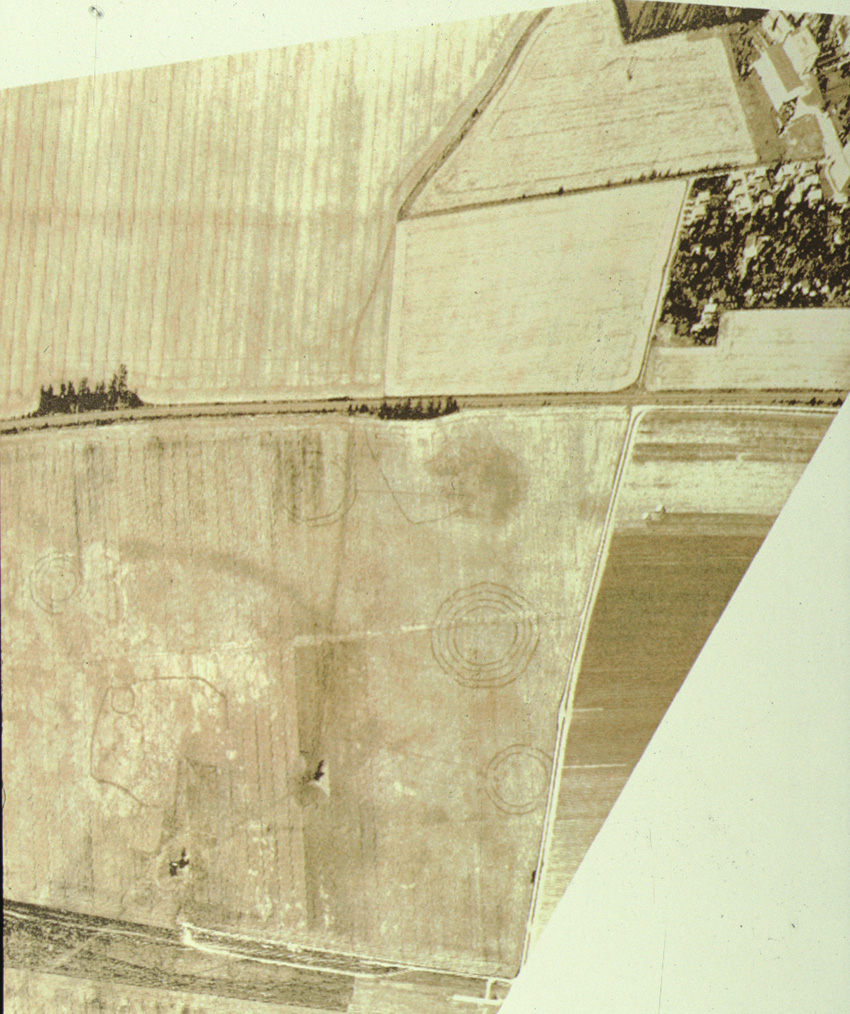
The function of the circular tombs is still being debated by researchers. The variety of interpretations ranges from calendar buildings, astronomical observation centers and sun temples to religious, social or economic meeting places. Multifunctional use for both sacred and profane purposes is entirely conceivable. The interior and exterior areas may have been used for very different purposes. The phenomenon of circular ditches was widespread throughout Central Europe in the early 5th millennium. The circular ditch complex Kyhna 3 was built by the Early Neolithic Linear Pottery culture. A vaguely rectangular structure is located to the southwest of the circular ditches. This is the village ditch of the village of Raitz, which fell into ruin in the 14th century. The oval-rectangular enclosure in the north-west corner could be a fortified manor within the deserted village.
Dana Mikschofsky/Annemarie ReckImage Source U. Wohmann, entzerrtes Luftbild, TK 1:25000 ©LfA 2002.
Literature
Henning Hassmann/Dana Mikschofsky/ Louis Nebelsick, Der heilige Hain. In: Judith Oexle (Hrsg.), Sachsen: archäologisch. 12.000 v. Chr. – 2.000 n. Chr. (Dresden 2000) 48–51.
Ronald Heynowski, Die Landschaft ist voller Geschichte. In: Regina Smolnik/Ronny Zienert (Hrsg.), Höhenflüge. Luftbilder und Archäologie in Sachsen (Dresden 2024) 44–45.
Andreas Kinne/Birgit Schneider/Harald Stäuble/Christian Tinapp, Ein zweiter Schnitt durch Kyhna. In: Regina Smolnik (Hrsg.), Ausgrabungen in Sachsen 3. Arbeits- und Forschungsberichte zur sächsischen Bodendenkmalpflege, Beiheft 24 (Dresden 2012) 18–24.
Dana Mikschofsky, Vierteilige Kreisgrabenanlage. In: Regina Smolnik/Ronny Zienert (Hrsg.), Höhenflüge. Luftbilder und Archäologie in Sachsen (Dresden 2024) 46–47.
Dana Mikschofsky, Archäologische Luftbilderkundung in Kyhna, Lkr. Delitzsch. Archäologie aktuell 5, 1997, 106–111.
Harald Stäuble, Ein gelungener Schnitt. Archæo 4, 2007, 12–13.
Note on monument protection
Archaeological monuments are protected by the Saxon Monument Protection Act. A permit under monument law is required for ground interventions or construction measures.
Permalink
https://archaeo-sn.de/en/ort/four-part-circular-ditch-complex-kyhna-3/
Citation
Dana Mikschofsky/Annemarie Reck, Four-part circular ditch complex Kyhna 3. In: Landesamt für Archäologie Sachsen, Website archaeo | SN (21.02.2024). https://archaeo-sn.de/en/ort/four-part-circular-ditch-complex-kyhna-3/ (Stand: 29.09.2026)
