

Grave of Nadelwitz
| Place: | Nadelwitz (Bautzen, Bautzen) |
|---|---|
| Type: | Shallow grave/flat grave field with inhumation graves |
| Dating: | younger Mesolithic | 6000 - 5000 BC. |
Description
On the Schafberg near Nadelwitz, today a district of Bautzen, a grave from the Mesolithic period was found in a sand pit in 1930. However, this was not recognized at first. It was only many years later that archaeologist Volkmar Geupel was able to re-evaluate the ensemble of finds and recognize it as a burial. What makes it special? The finds, 33 flint artefacts and a perforated axe made of rock, show both the influence of Middle Stone Age hunting communities, which were still living for thousands of years, as well as contacts with the newly immigrated Neolithic groups, who brought with them a farming way of life.
Annemarie ReckDiscovery
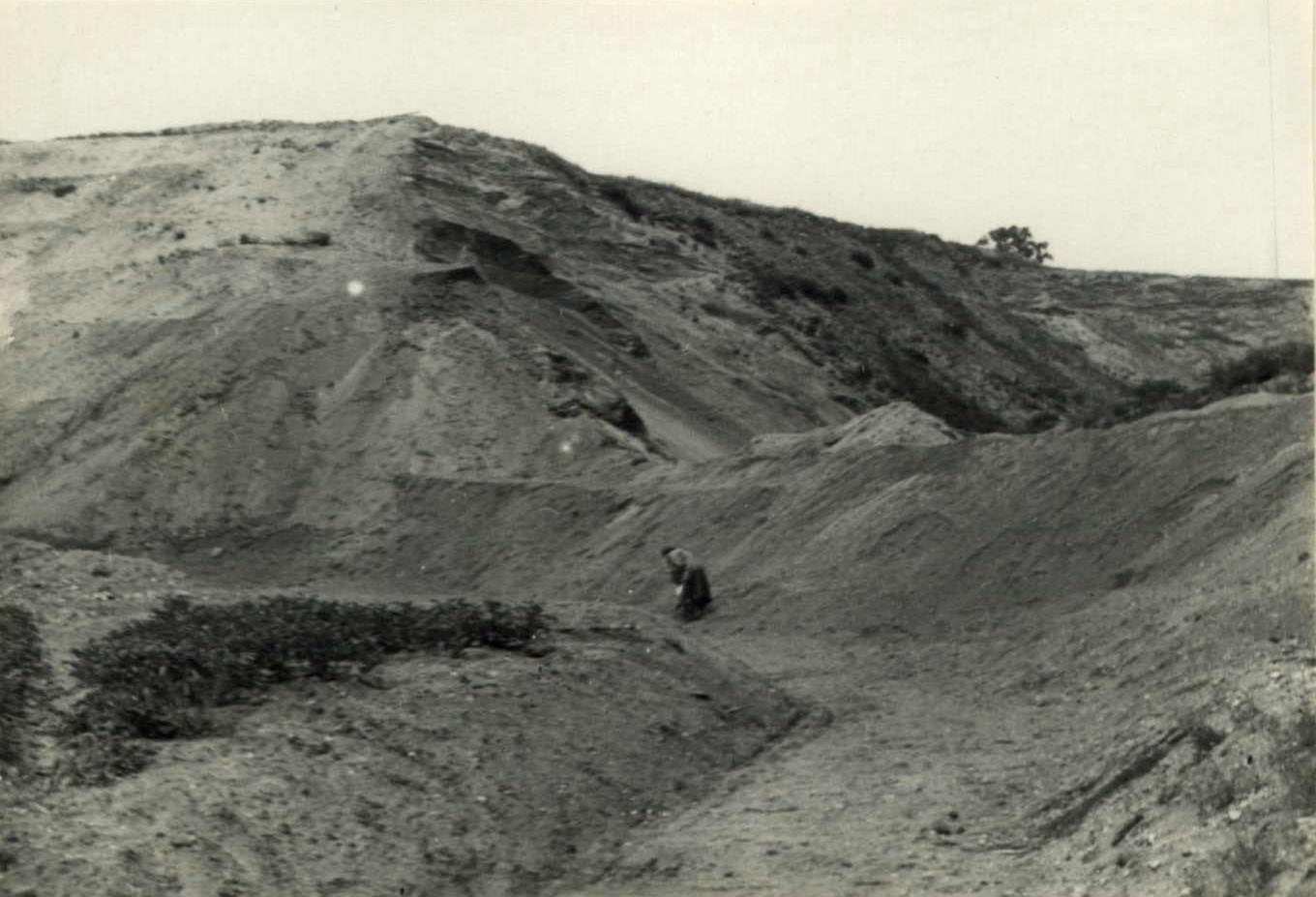
The site is located in the Upper Lusatian loess region, in the area of the Schafberg, an approx. 1 km long elevation in the east of the town of Bautzen. The up to 200 m high, loess-covered sand and gravel hilltop of the Schafberg has been used as a gravel pit since the 1920s and parts of it are still in use. In 1930, while searching the edge of the pit, the archaeologist Erich Schmidt (pictured) noticed a patch of fine, reddish gravel and lighter-colored sand containing several archaeological finds.
Annemarie ReckImage Source G. Bierbaum, Foto ©LfA 1931.
The burial pit
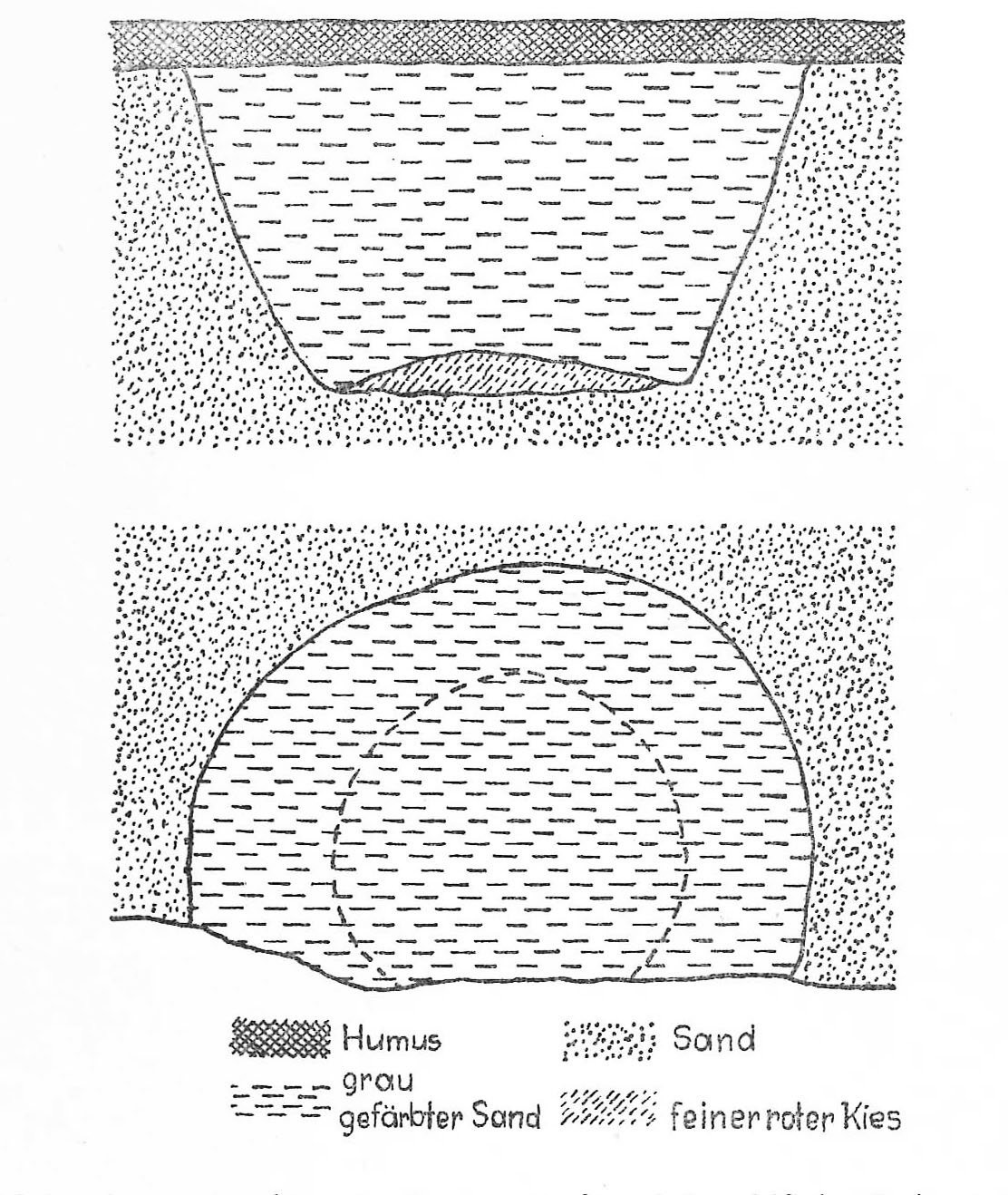
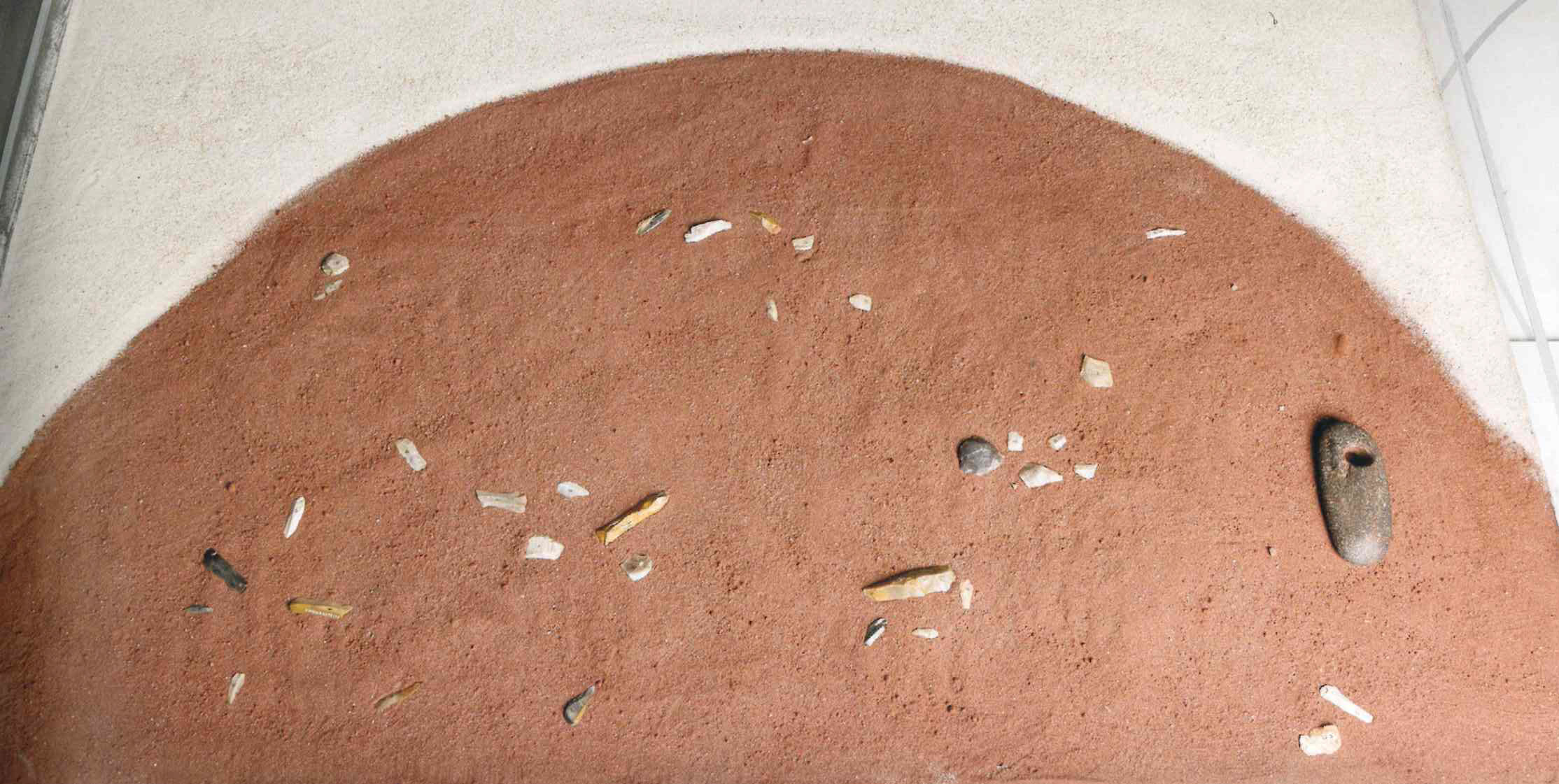
As one edge of the pit had already been excavated, Schmidt excavated the finds and documented the find situation in detail, allowing the feature to be recognized as a burial pit decades later. Due to the discoloration of the sand, the original extent of the pit could still be easily traced. The round pit had a diameter of 2.85 m and was 1.65 m deep. The cross-section shows a steep funnel shape with a flat bottom. The red chalk layer above the floor was up to 0.19 m thick. The overlying fill layer stood out only slightly from the surrounding sand layers and, according to the excavator, was empty.
Annemarie ReckImage Source V. Geupel 1988, 48.
Finds
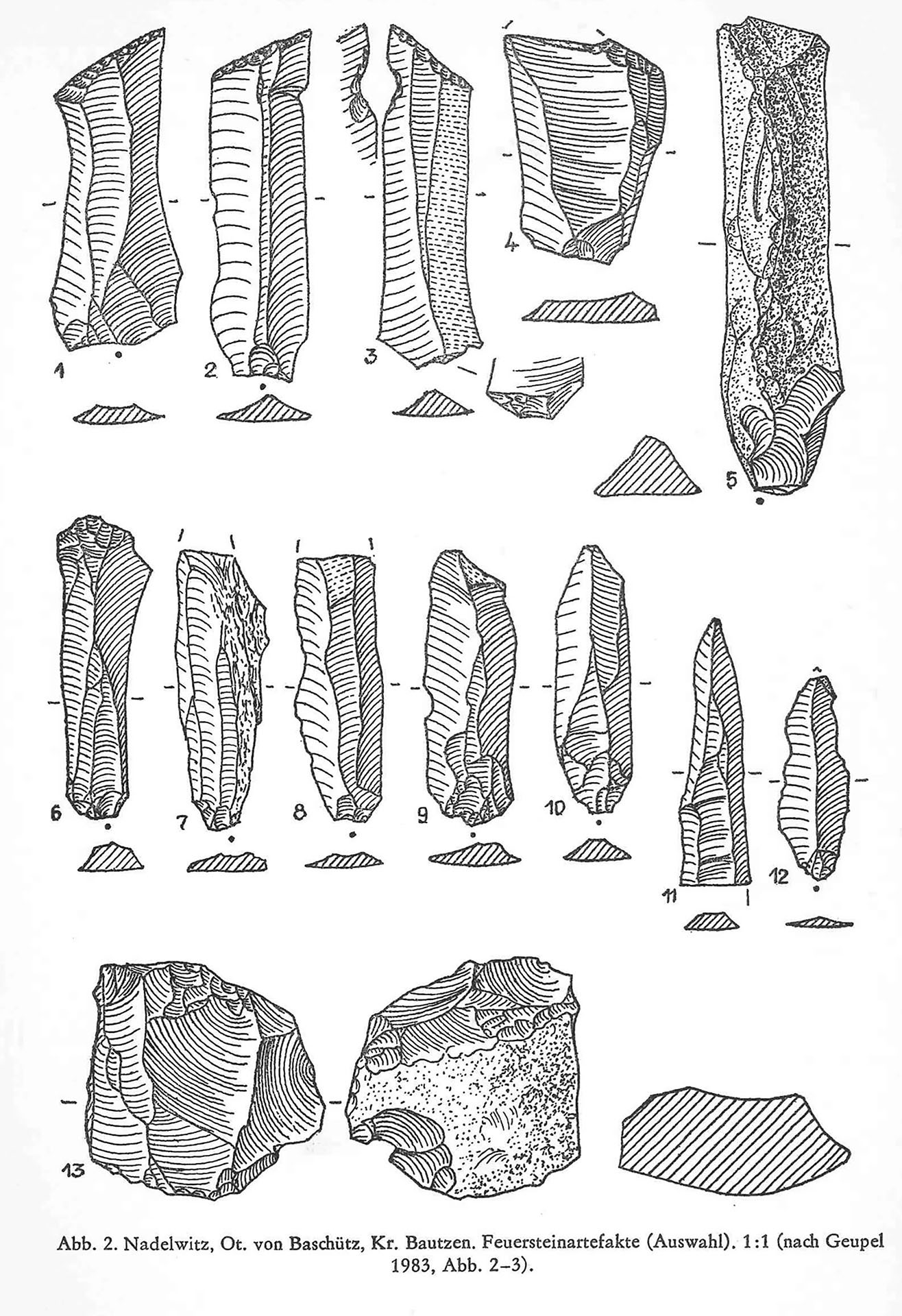
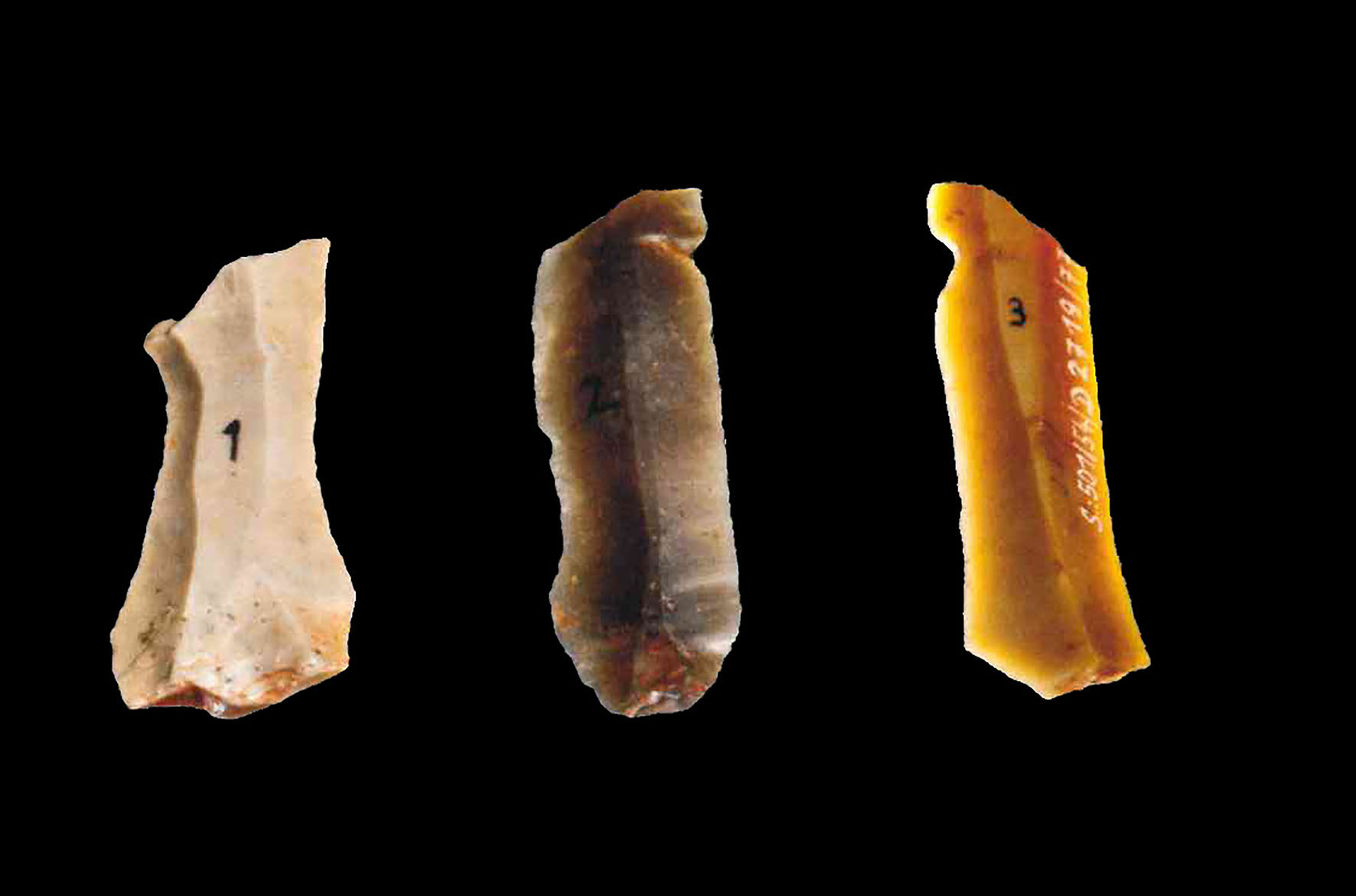
All the finds were embedded in this layer of gravel and sand with a high reddish content. The recovered finds consisted of 33 flint implements, including 22 blades and blade fragments, three blade implements with oblique end retouch, a short blade with retouch, six flakes and a core stone. Of the three blade implements, one piece has a notch in the area of the tip, which could have been used as a thread cutter.
Annemarie ReckImage Source V. Geupel 1988, 49.
Neolithic axe
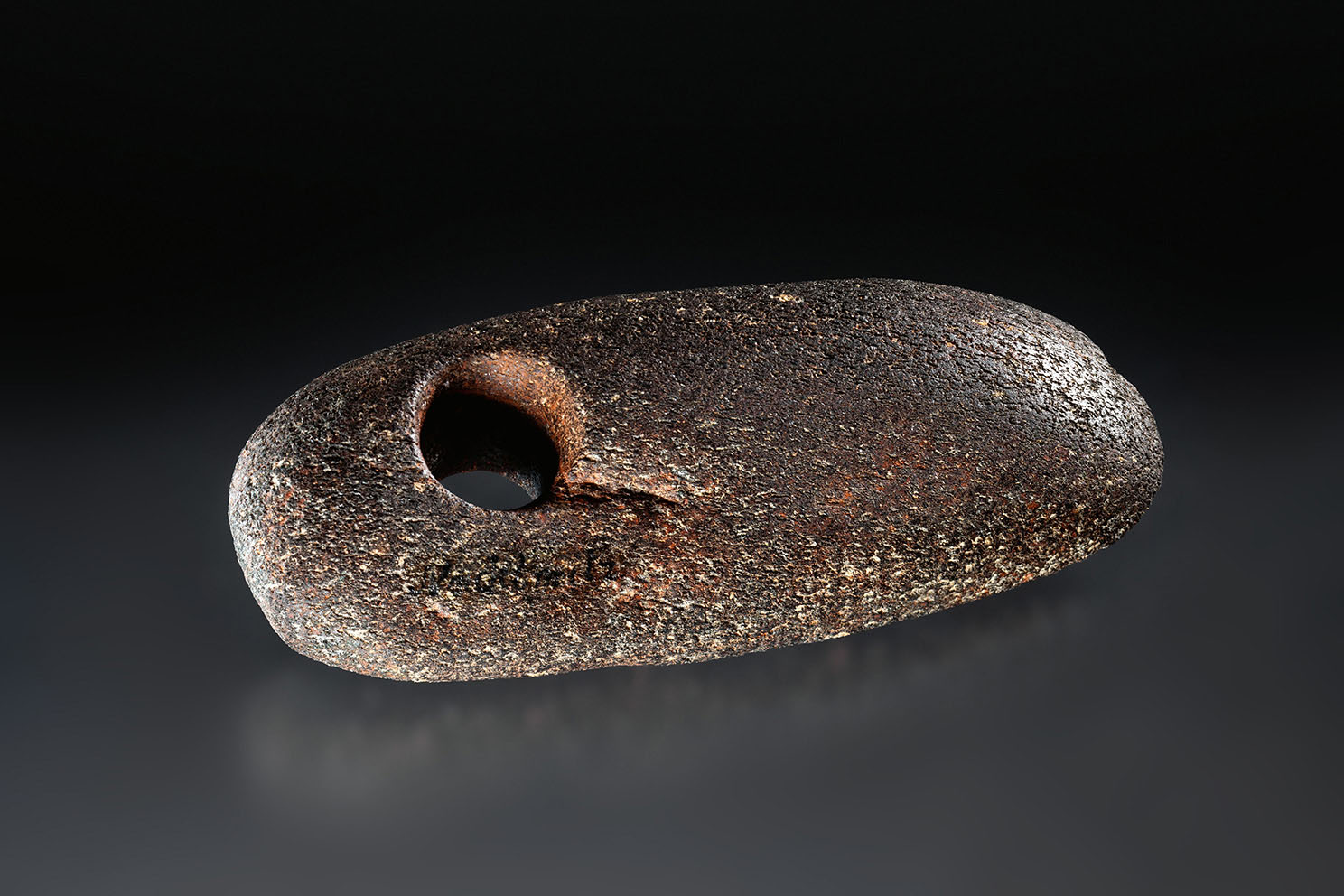
Furthermore, a perforated rock axe, a so-called transverse axe, came to light. It was made from a long oval boulder that had been almost completely ground over. The underside of the tool is flat, the upper side slightly curved. The perforation of the axe is slightly conical. As the find ensemble was recovered in a closed formation, it can be considered to belong together, but it is unclear whether any finds were lost during the excavation of the sand pit.
Annemarie ReckImage Source J. Lösel, Foto ©LfA 2012.
Link archaeo | 3D
Reinterpretation as a grave
Schmidt published his finds report in 1956. In it, he placed the finds at the transition between the Mesolithic and Neolithic periods. However, as there was no bone preservation in the sandy soil, he did not assume that it was a grave, despite the conspicuous red chalk. It was not until 1977, when the finds came to the then State Museum of Prehistory in Dresden, that they could be reinterpreted as a grave from the late Mesolithic period thanks to the good documentation by archaeologist Volkmar Geupel. The dimensions of the pit and the reddish layer are comparable with other burial pits from the late Mesolithic period. Red chalk or red pigments have been used by people in various ways since the Palaeolithic period. Research assumes that the red color was associated with a certain symbolism for Stone Age people, perhaps even a religious one.
Annemarie ReckImage Source Foto ©LfA 2014.
Link smac 360°
Transition to a new era
The flint inventory shows shapes such as obliquely retouched blades, which were common in the Mesolithic period. According to Geupel, however, the cross-cut axe is a special feature. Although pointed axes, cylindrical axes and scree clubs were also found in Middle Stone Age contexts, the conical bore and grinding of the cross-cut axe can be traced back to a Neolithic influence. This indicates contact between the Neolithic people migrating from the south-east, who practiced agriculture and animal husbandry, and the indigenous Middle Stone Age people, who lived in an appropriating economy. The Nadelwitz grave is therefore an important testimony to the transition from the Mesolithic to the Neolithic.
Annemarie ReckImage Source J. Lösel, Foto ©LfA 2012.
Link smac 360° archaeo | 3D
Literature
Volkmar Geupel, Ein mesolithisches Grab vom Schafberg in Niederkaina bei Bautzen? In: Heinz-Joachim Vogt (Hrsg.), Arbeits- und Forschungsberichte zur sächsischen Bodendenkmalpflege 26, 1983, 7–15.
Volkmar Geupel, Mesolithisches Grab von Nadelwitz bei Bautzen. In: Heinz-Joachim Vogt (Hrsg.), Archäologische Feldforschungen in Sachsen. Arbeits- und Forschungsberichte zur sächsischen Bodendenkmalpflege, Beih. 18 (Berlin 1988) 48–51.
Sabine Lienen-Kraft, Nadelwitz. Der Jäger und die Bauern. In: Sabine Wolfram (Hrsg.), In die Tiefe der Zeit, 300.000 Jahre Menschheitsgeschichte in Sachsen. Das Buch zur Dauerausstellung (Dresden 2014) 77–79.
Erich Schmidt, Eine Geröllhaue vom Schafberg bei Niederkaina. Arbeits- und Forschungsberichte zur sächsischen Bodendenkmalpflege 5, 1956, 17–22.
Note on monument protection
Archaeological monuments are protected by the Saxon Monument Protection Act. A permit under monument law is required for ground interventions or construction measures.
Permalink
https://archaeo-sn.de/en/ort/grave-of-nadelwitz/
Citation
Annemarie Reck, Grave of Nadelwitz. In: Landesamt für Archäologie Sachsen, Website archaeo | SN (01.02.2024). https://archaeo-sn.de/en/ort/grave-of-nadelwitz/ (Stand: 29.09.2026)
