

Harmelinquartier Leipzig
| Place: | Leipzig City Center (Leipzig, Leipzig City) |
|---|---|
| Type: | City center |
| Dating: | Late Middle Ages | Modern times | around 1250 - 1945 AD. |
Description
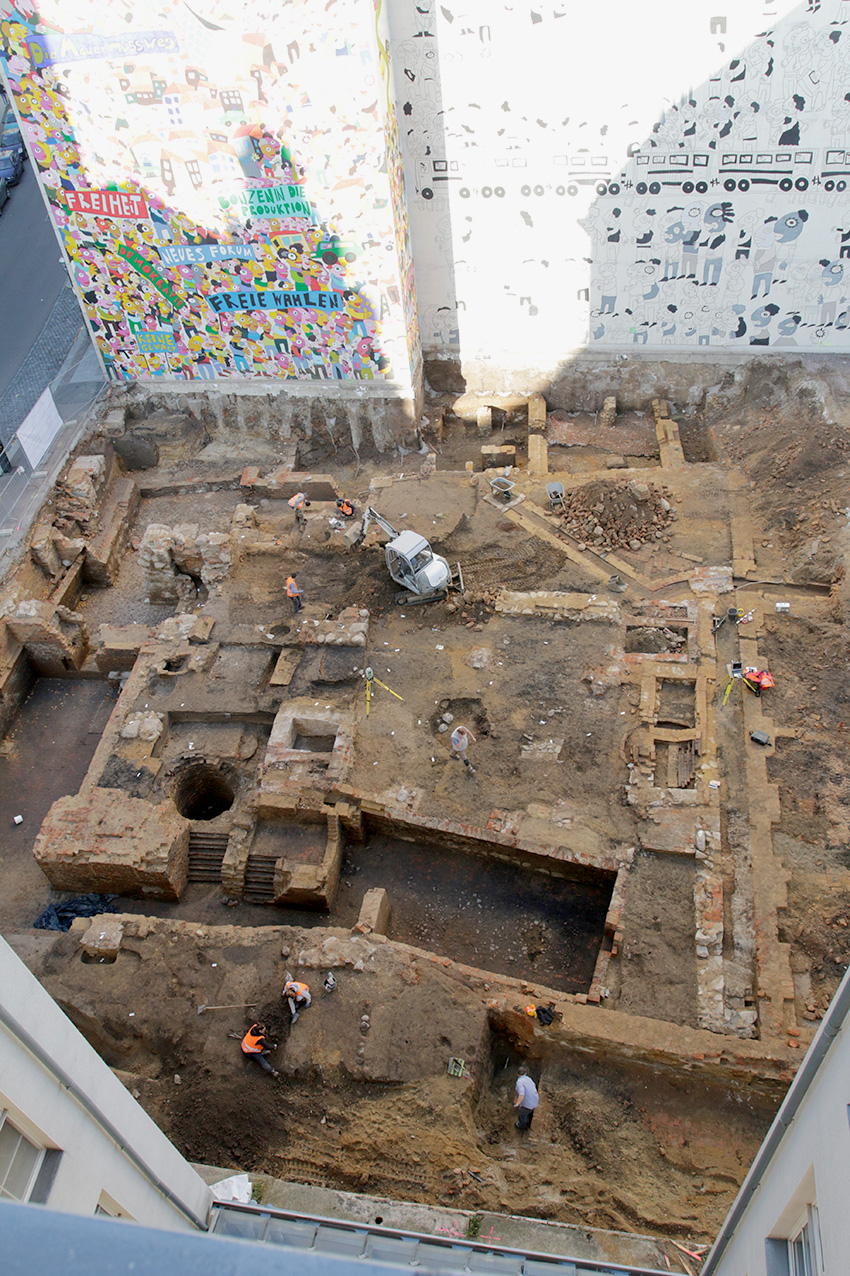
Until the end of 2019, one of the few vacant lots within the city ring road was located not far from Leipzig's main railway station. The area, long used as a parking lot, is bordered to the east by the so-called Harmelinhaus. This is the last remaining building of the Harmelin family's fur trading yard, which consisted of several stores and fur warehouses. The associated buildings were still standing on the excavation site after the company was liquidated by the National Socialists until it was destroyed in the Second World War.
Burkart DähneLocation of the site
The adjacent Brühl to the south is one of the oldest streets in Leipzig and runs parallel to the northern city wall in the city center from west to east. Although not designed as a thoroughfare, this area was settled in the Middle Ages, at the latest with the construction of the city wall in the 13th century. It increasingly developed into a residential and commercial quarter, in which inns are also documented from the early modern period. Just a few meters to the west of the area was the Hallisches Tor, the northern entrance to the city.
Burkart DähneImage Source B. Dähne Fotos © LfA 2019.
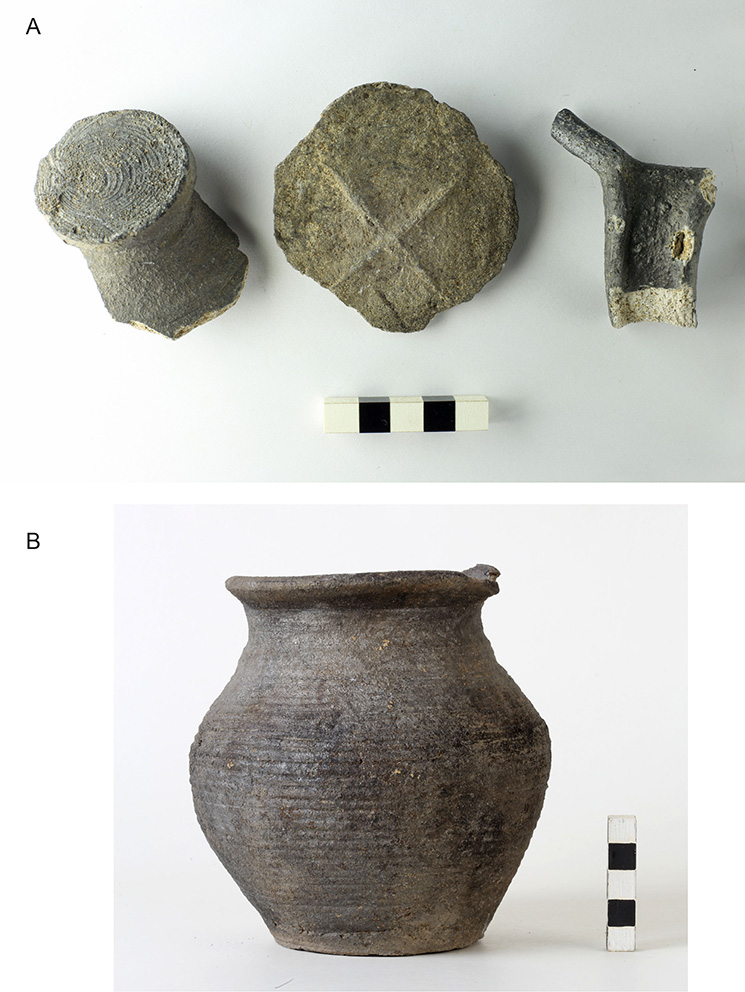
Oldest cultural layer
Remains of an early cultural layer were documented in several places on the construction site directly above the existing sandy loess. It thus marks the oldest layer on this area, which was formed naturally but has been shaped by humans. The approx. 30-40 cm thick horizon contained a lot of blue-grey pottery, mainly finds from the 13th-14th centuries, and was already being used for agriculture.
Burkart DähneImage Source B. Dähne Fotos © LfA 2024.
Building structures
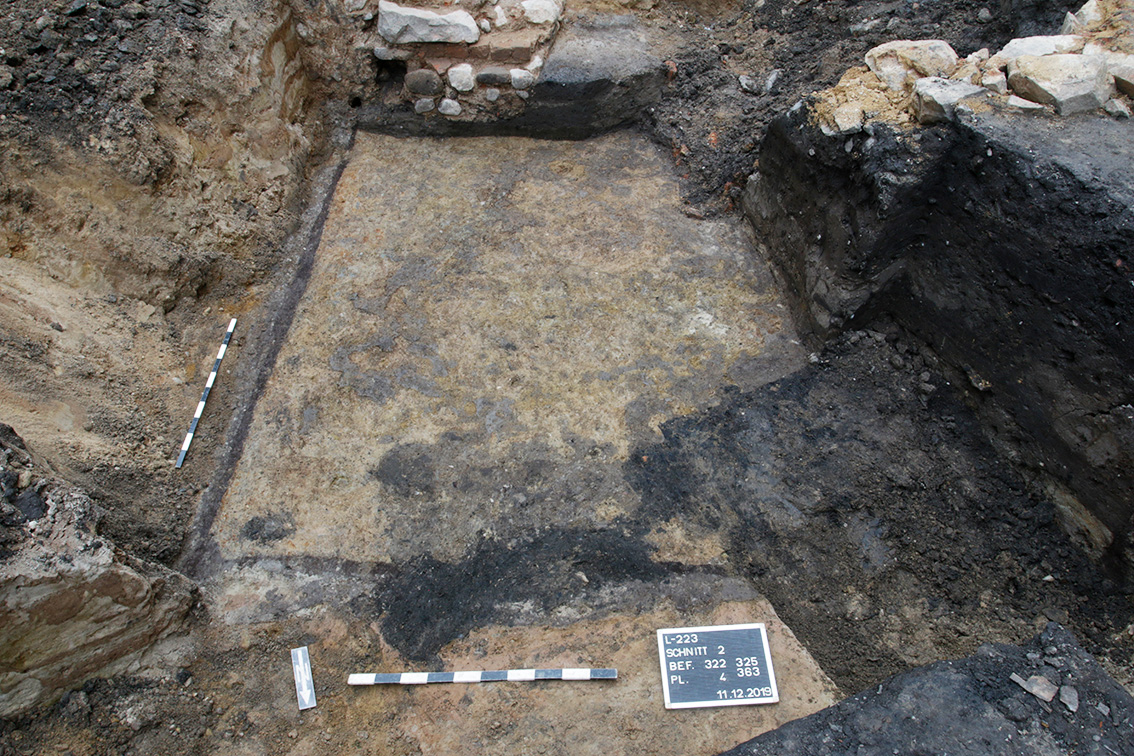
At the beginning of the 14th century, extensive settlement activity began on the plots. The associated running horizons were recorded in several places in undisturbed sections of the southern excavation area. They were found to be 4-6 cm thick on the medieval arable horizons in various profiles directly adjacent to today's Brühl. Several building structures testify to the late medieval development of these plots for a permanent settlement area. These include two earth cellars. The bases, made of rammed earth, were surrounded by frames of wooden sill beams that are now gone.
Burkart DähneImage Source B. Dähne Fotos © LfA 2019.
Leveling layers
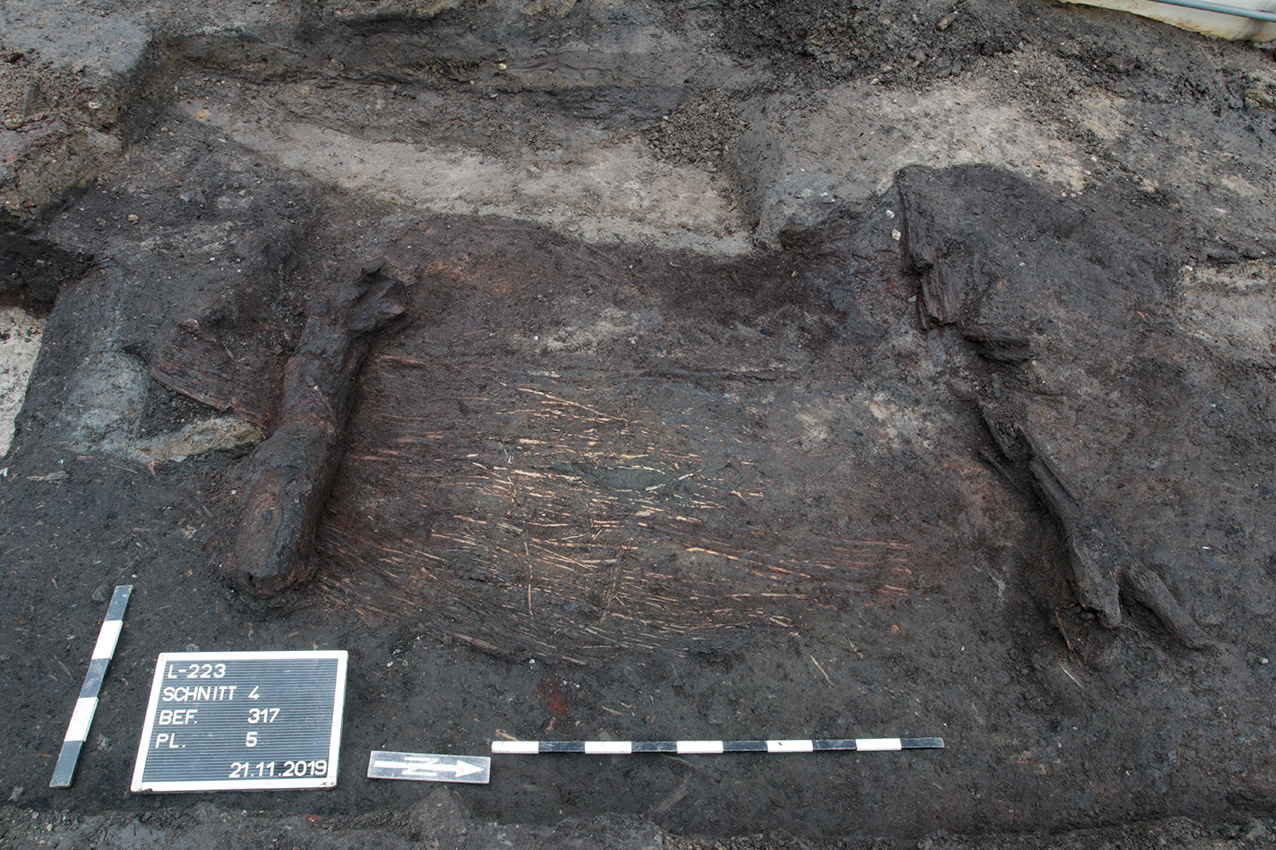
In the late 14th and early 15th centuries, levelling layers were applied, which in places lay on the older running horizons, the medieval arable land or even directly on the Weichselian sandy loess. Locally occurring layers with numerous organic components such as straw, wood remains, dung and bones indicate, among other things, stables, which are already attested in other courtyard situations of parcels of the Brühl.
Burkart DähneImage Source B. Dähne Fotos ©LfA 2019.
Early modern times
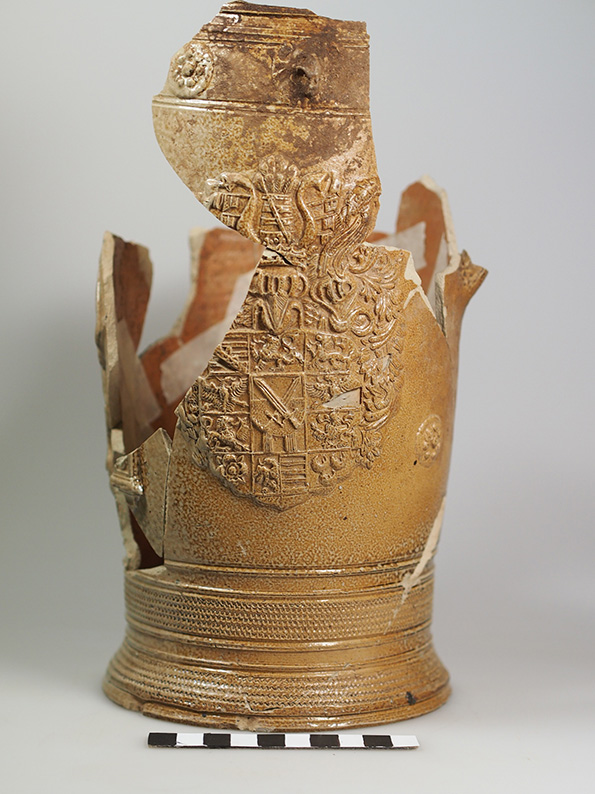
With the transition to the 16th century, the increasing use of stones or bricks as building materials began on the plots and a typical urban early modern plot development emerged. At the same time, a number of unbricked latrines and waste pits were also created, the backfilling of which comprises the typical spectrum of an early modern ceramic ensemble of the 16th century, including green-glazed everyday pottery, graphene pots, tableware and stoneware. Particularly noteworthy is an incomplete fragmentary jug made of West Saxon stoneware, probably Waldenburg style, with a depiction of the full coat of arms of the Electorate of Saxony and other relief applications.
Burkart DähneImage Source B. Dähne Fotos ©LfA 2024.
Link archaeo | 3D
Literature
Burkart Dähne, Vom Acker zum Pelzhandelshof. Die Ausgrabungen im Harmelinquartier am Brühl in Leipzig (L-223). In: Regina Smolnik, Ausgrabungen in Sachsen 9. Arbeits- und Forschungsberichte zur sächsischen Bodendenkmalpflege Beih. 37 (Dresden 2024) 329–345.
Wilhelm Harmelin/Marcus Harmelin: Rauchwaren und Borstenkommission Leipzig: 1830–1930. Zum hundertjährigen Bestehen (Leipzig 1930).
Thomas Westphalen, Thietmar von Merseburg erwähnt im Jahre 1015 die urbs Libzi. Archäologische Forschungen über das frühe Leipzig. Mitteilungen des Landesvereins sächsischer Heimatschutz 2015, 3, 3–9.
Note on monument protection
Archaeological monuments are protected by the Saxon Monument Protection Act. A permit under monument law is required for ground interventions or construction measures.
Permalink
https://archaeo-sn.de/en/ort/harmelinquartier-leipzig/
Citation
Burkart Dähne, Harmelinquartier Leipzig. In: Landesamt für Archäologie Sachsen, Website archaeo | SN (22.11.2024). https://archaeo-sn.de/en/ort/harmelinquartier-leipzig/ (Stand: 29.09.2026)
