

Hohnstein ski jump
| Place: | Hohnstein (Hohnstein, Saxon Switzerland-Eastern Ore Mountains) |
|---|---|
| Type: | Military redoubt |
| Dating: | Modern times | 19th century | 1813 AD. |
Description
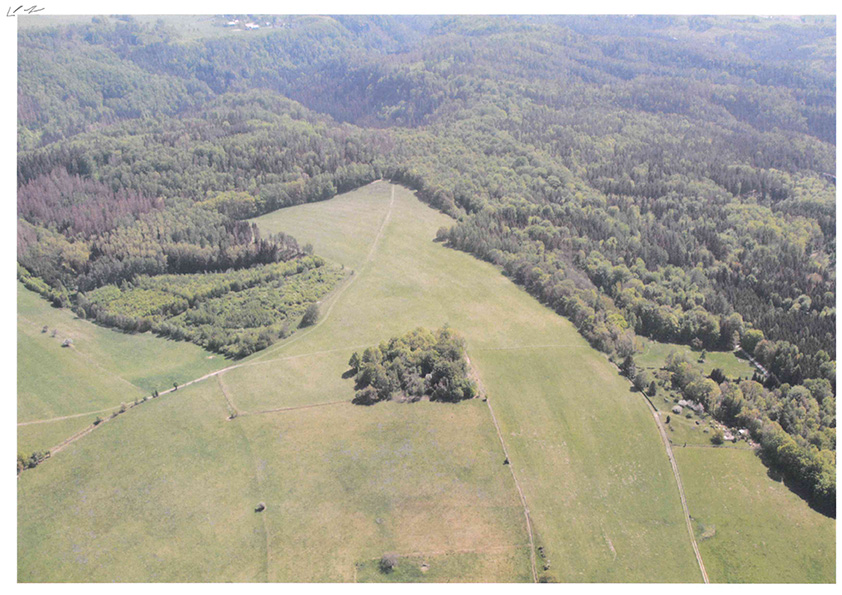
The remains of a redoubt from the Napoleonic Wars of Liberation can be found on a plateau south-east of Hohnstein. In 1813, the year of the Battle of the Nations, huge masses of troops moved across the border between Saxony and Bohemia. At that time, Prussian-Russian and Austrian troops were advancing from northern Bohemia towards Dresden, where the French emperor had made his headquarters. In the late summer and fall of the same year, heavy fighting broke out between Pirna and Dresden. In the summer of 1813, the French soldiers ordered the construction of the defensive structure on the 392 m high hilltop near Hohnstein in the run-up to these clashes. Today, the well-preserved complex is located in a small wooded area. Maps often refer to it as the "Napoleonschanze“ designated.
Michael Strobel/Annemarie ReckStructure of a bezel
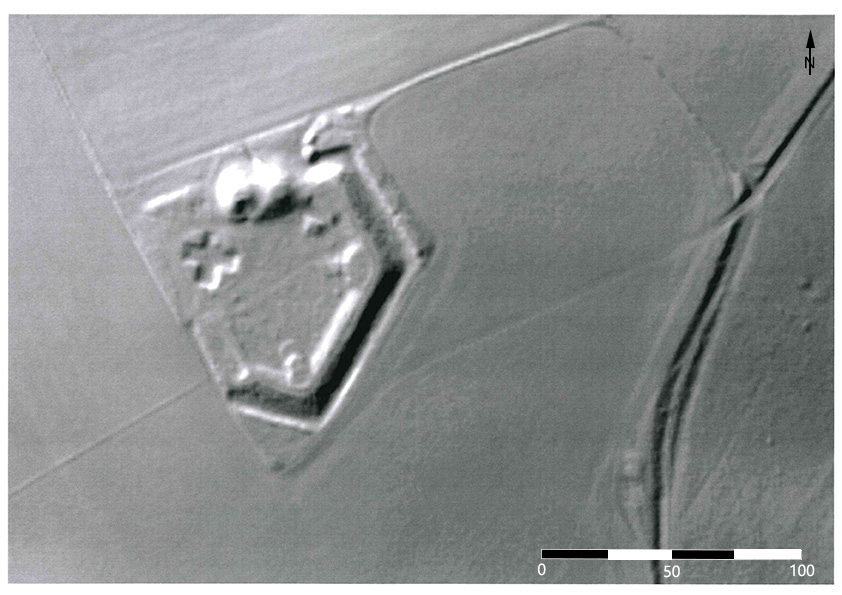
In the summer of 1813, 700 workers from Hohnstein were instructed to build a defensive structure on the rocky outcrop to the south-east of the village. This was to be constructed as a crescent-shaped "lunette" for the French soldiers. For this purpose, a 30 m and a 70 m long rampart were heaped up, which met at an obtuse angle and were each extended on their flanks. Today, the ramparts are still around 2 m high. The earth for this came from a ditch 10 m to 12 m wide and approx. 1.5 m deep in front of the rampart.
Michael Strobel/Annemarie ReckImage Source R. Heynowski, Foto ©LfA 2020.
Defenses of the redoubt
Additional embankments were made in the rampart corners for guns, which could be pushed up onto the rampart via ramps. Their positions faced south and east, from where the enemy troops were expected. The rear western side, on the other hand, was much more weakly fortified. Here the bulwark was probably only protected by a wooden palisade. There is also a roughly cross-shaped depression of approx. 1.5 m in the western part of the inner surface. This was probably a timbered shelter with embrasures. Later, the rampart was only partially removed in the south-west, otherwise the allied troops refrained from the usual grinding of the French defense system. As the rocky outcrop is not used for agriculture today, this testimony to the Wars of Liberation has been preserved.
Michael Strobel/Annemarie ReckImage Source OA 75130, 312, DGM ©LfA 2017.
Literature
Klaus Kroitzsch, Napoleonschanzen und Kanonenkugeln. Erinnerungsstätten und Zeugnisse des Befreiungskrieges 1813 in der Gegend um Pirna. Schriftenreihe des Stadtmuseums Pirna 6 (Pirna 1987).
Klaus Kroitzsch, Als Napoleon in Sachsen war … Schanzwerk bei Hohnstein, Lkr. Sebnitz. Archäologie aktuell 1, 1993, 57–58.
Michael Strobel, Ein Schanzwerk aus dem Völkerschlachtjahr. In: Regina Smolnik/Ronny Zienert (Hrsg.), Höhenflüge. Luftbilder und Archäologie in Sachsen (Dresden 2024) 98–99.
Note on monument protection
Archaeological monuments are protected by the Saxon Monument Protection Act. A permit under monument law is required for ground interventions or construction measures.
Permalink
https://archaeo-sn.de/en/ort/hohnstein-ski-jump/
Citation
Michael Strobel/Annemarie Reck, Hohnstein ski jump. In: Landesamt für Archäologie Sachsen, Website archaeo | SN (22.02.2024). https://archaeo-sn.de/en/ort/hohnstein-ski-jump/ (Stand: 29.09.2026)
