


Huthübel
| Place: | Steudten (Stauchitz, Meissen) |
|---|---|
| Type: | Upright stone/menhir |
| Dating: | Late Neolithic | Spherical amphora culture | 3100 - 2700 BC. |
Description
If you stand on the Huthübel, you can enjoy a wide view of the Jahnatal and across the old moraine plateau and hilly landscape as far as Oschatz and over to the Colm mountain. It is certainly no coincidence that an artificial hill (Dm. ca. 115 m, H. ca. 2 m), on which in turn a ca. 17 m high monolith (menhir) made of quartz porphyry stands.
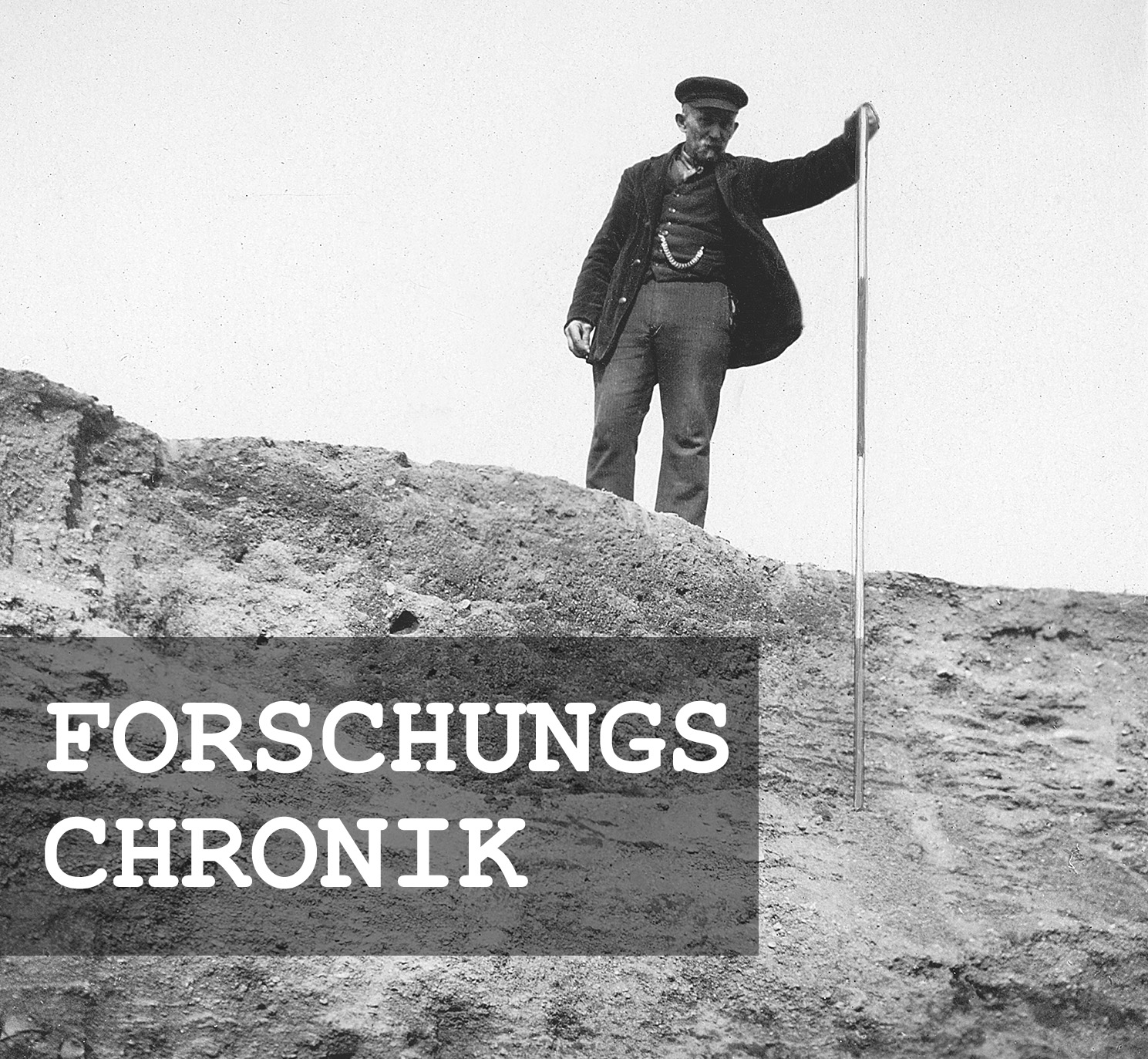
Michael StrobelResearch chronicle
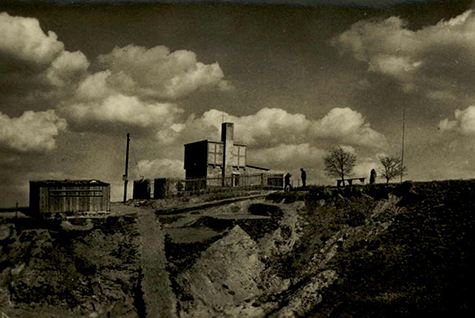
Image Source Foto ©LfA 1929.
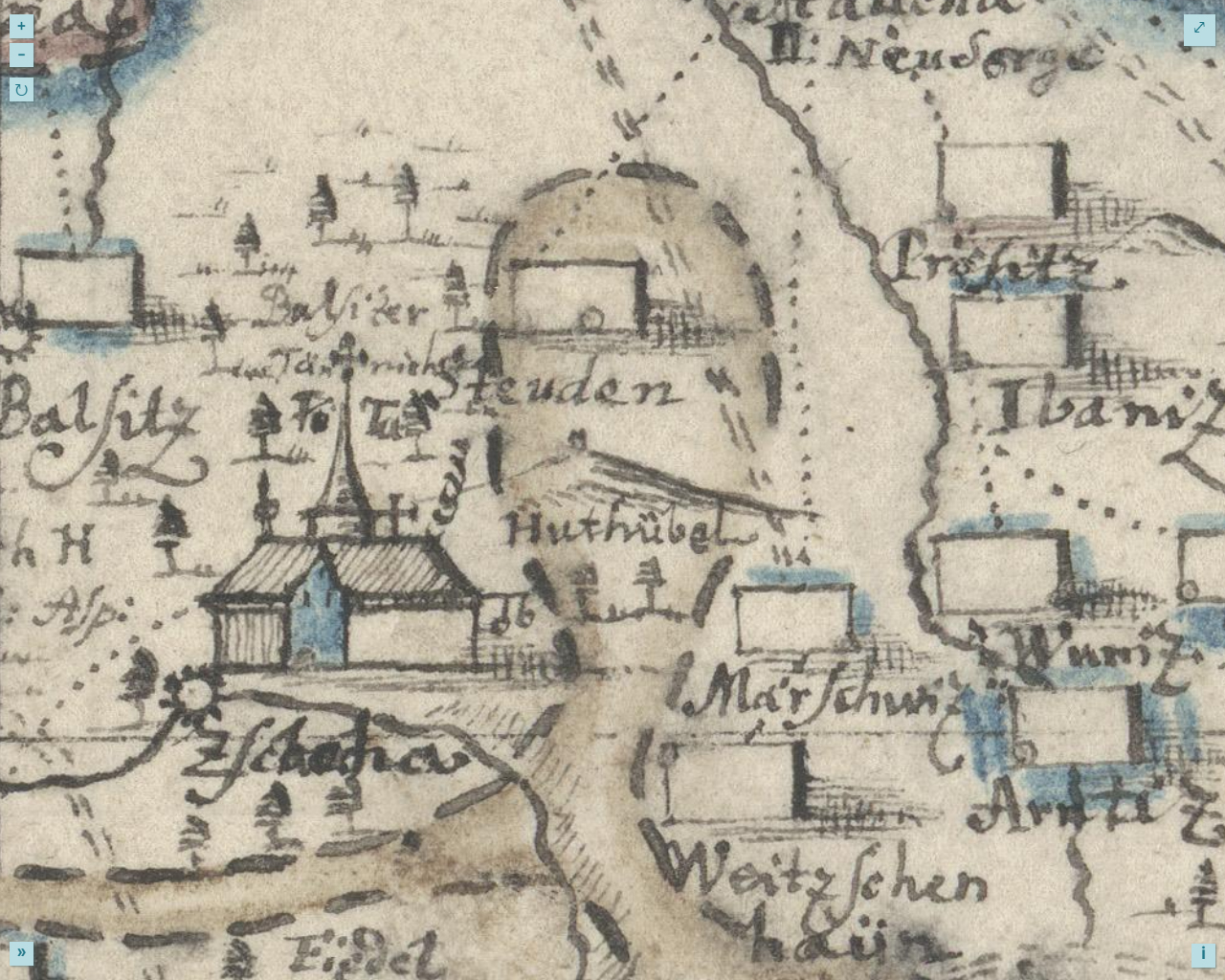
First mapped in 1733
In the sparsely wooded agricultural landscape, the conspicuous monument, visible from afar, must have attracted the attention of the population and cartographers early on. It is not possible to determine exactly when the legend arose that King Henry I was monitoring the siege of the Slavic castle "urbs quae dicitur Gana" from the Huthübel in the winter of 928/929 AD. While the hill is still missing from the maps of the early 17th century (e.g. in the "Ur-Oeder"), the Skassa priest and cartographer Adam Friedrich Zürner (1679-1742) depicted its outline with menhir quite accurately in a colored hand drawing from 1733. The flat-conical silhouette of the hill, which is clearly distinguishable from the steep slope today, is remarkable.
Michael StrobelImage Source ©SLUB Dresden.
The forefather of Saxon antiquity was probably mistaken
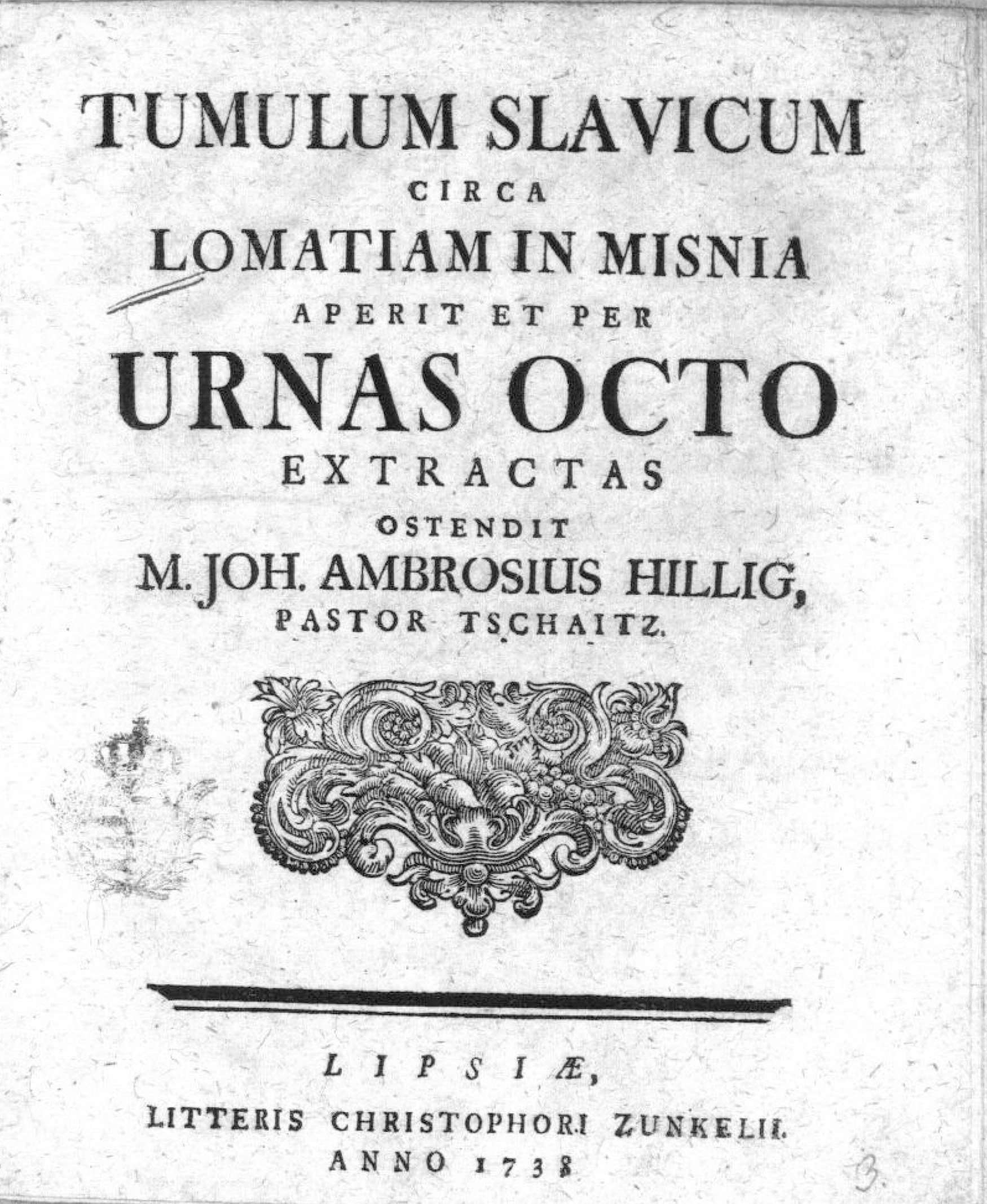
In 1738, the twelve-page treatise "Tumulum slavicum circa Lomatiam in Misnia aperit et per urnas octo extractas" by the Zschaitz pastor and magister Johann Ambrosius Hillig was published in Leipzig, in which the opening of a burial mound in a birch grove near Zunschwitz (Jahnatal district, Central Saxony) by Wolff Rudolph von Holleuffer is described. Eight urns and cremated remains were found. The old master of Saxon antiquity research, Karl Benjamin Preusker (1786-1871), erroneously referred to this early excavation as Huthübel in his 1844 publication "Blicken in die vaterländische Vorzeit" (p. 137). The hill was probably located further south on the road from Zschaitz to Zschochau. However, the Freiberg mileage sheet offers no indication of its former location.
Michael StrobelImage Source ©SLUB Dresden.
The vicissitudes of cartography - Part 1
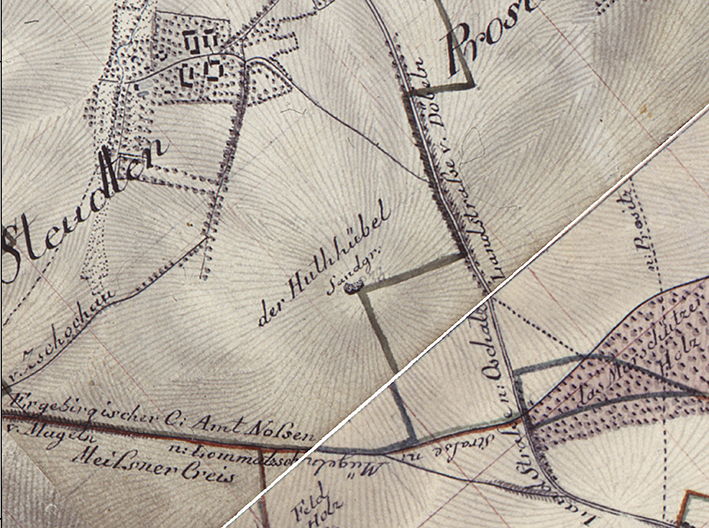
Preusker will have known and used both Zürner's hand drawing and the Saxon mileage sheet. In the Freiberg edition, however, there is no indication of a birch grove on the Huthübel; not even the hill is recorded. Instead, a sand pit appears for the first time. Obviously, mining dates back to the 18th century. The Weichselian loess cover in the lee on the western side of the hilltop is not nearly as thick as in the neighborhood, so that sands and gravels of the Elster glacial ground moraine are present at a shallower depth below the surface.
Michael StrobelImage Source Freiberger Meilenblatt ©Sächsisches Staatsarchiv/LfA Sachsen.
The vicissitudes of cartography - Part 2
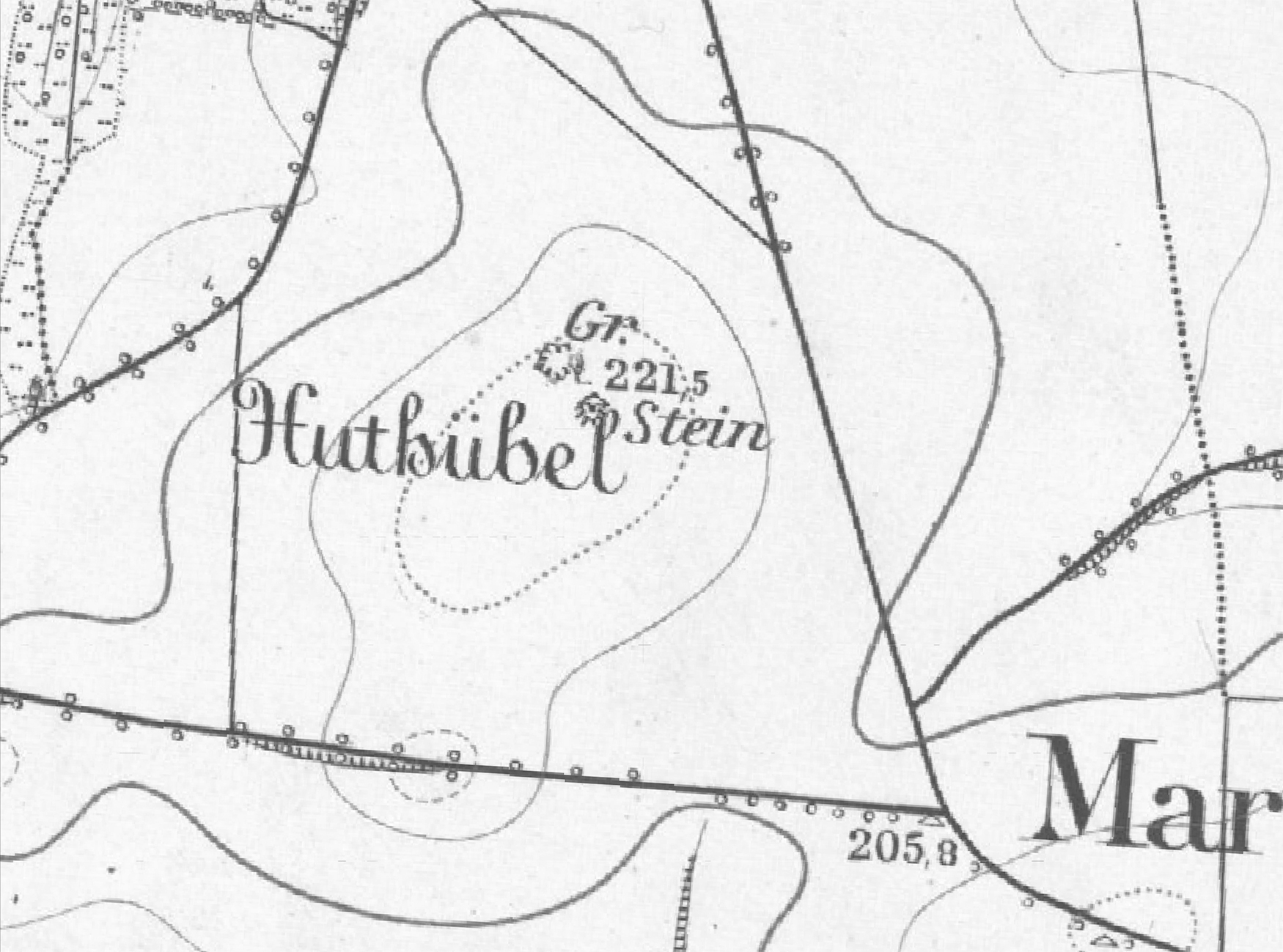
Only in the equidistant map (sheet 31, Stauchitz section, edition of 1896 and 1901) are both the extraction point (Gr.) and the mound and menhir ("stone") specifically identified. The pit seems to have been enlarged more and more over the years, especially to the south and southwest, until in the 1960s the LPG Staucha opened up an even larger one in the southwest. While sand was still mined in one part to the south, the municipality of Staucha began to store garbage in the other, including building rubble in 1986, sometimes right up to the hill. The monument probably only escaped destruction because an important surveying and boundary point would have been removed.
Michael StrobelImage Source ©SLUB Dresden.
Preservation through prominence
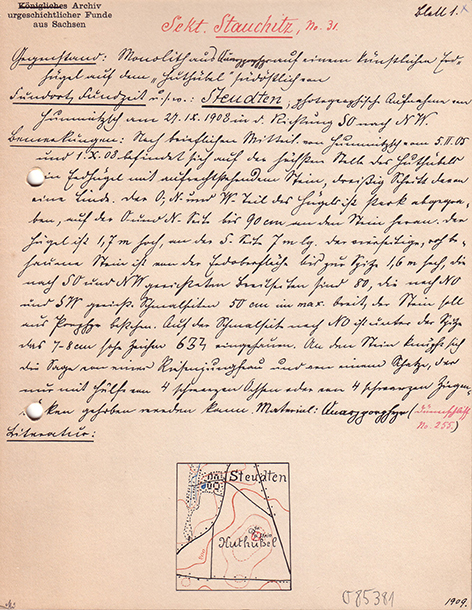
The hill had also become so prominent that its removal would certainly have caused a great stir and outrage among the public. It goes without saying that the monument was described in a questionnaire sent out by the Saxon Heritage Society in 1909. However, the dutiful recording in the files of the "Royal Archive of Prehistoric Finds from Saxony" could not have prevented its destruction. However, the acute danger came less from sand extraction than from continuous "cultivation": On the sides, the mound had already been "severely eroded".
Michael StrobelImage Source OA 71800, 12 ©LfA 1909.
Different interests and perceptions
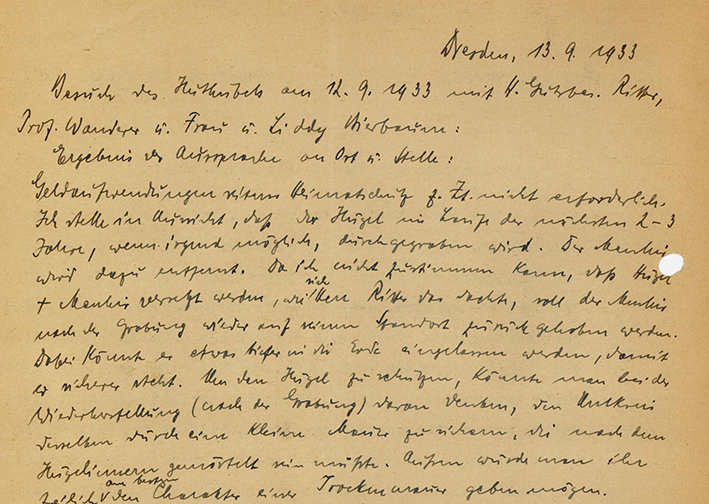
The landowner Arthur Ritter, who farmed 47 hectares in the vicinity of Steudten, repeatedly emphasized his roots in his homeland and his commitment to the monument, but would have preferred to have the mound removed and refilled elsewhere. Georg Bierbaum (1889-1953), the state curator, could not give in to this suggestion; on the other hand, he was not averse to excavation and reconstruction on the site, had he only been able to raise the necessary funds in the late summer of 1933. A low wall was under discussion to protect the reconstruction. Once again, he could be sure of the benevolent support of the Saxon Heritage Society.
Michael StrobelImage Source OA 71800, 33 ©LfA 1933.
The plow "gnaws" at the foot and embankment
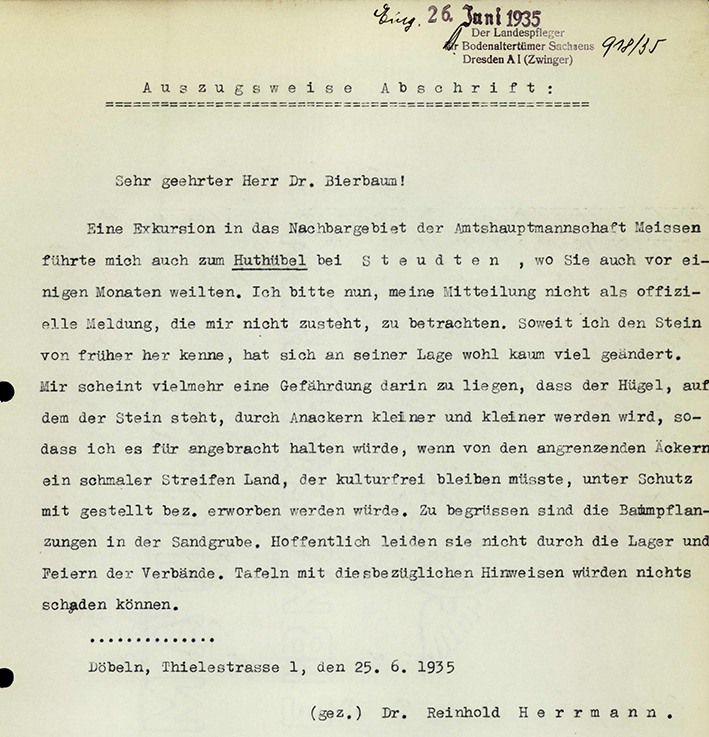
Even the entry of the mound in the monument list B on 30.8.1935 offered no means of restricting the recurring "cultivation" on the edge of the earth fill. Reinhold Herrmann (1886-1953), a grammar school teacher in Döbeln and representative for soil antiquities, noticed several times during visits to the border of his area of responsibility that the mound was becoming "smaller and smaller due to plowing". He therefore proposed the acquisition of land, the establishment of a protective strip and tree planting in the area of the sand pit.
Michael StrobelImage Source OA 71800, 44 ©LfA 1935.
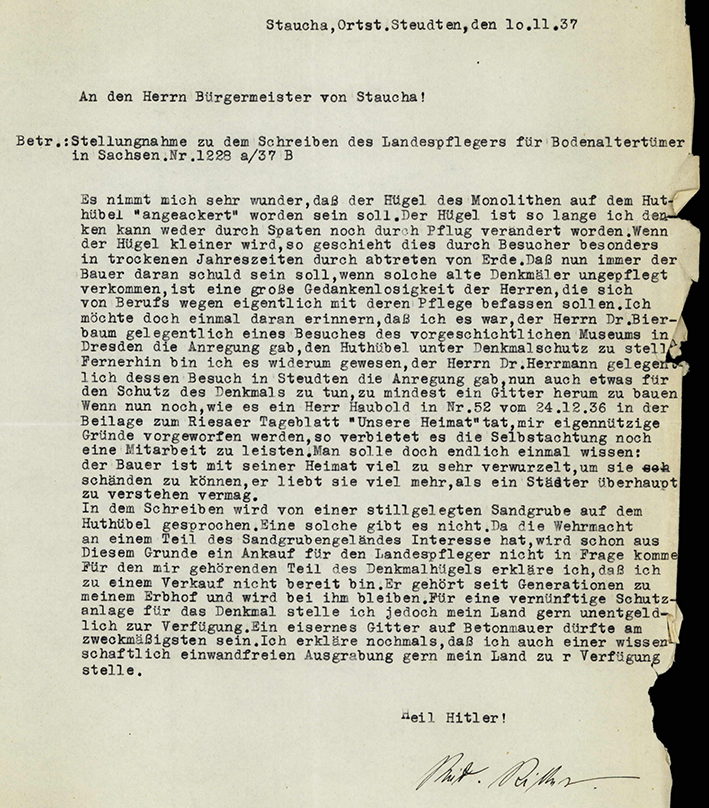
The farmer's perspective
The owner and landowner, of course, saw this quite differently and wrote indignantly to the mayor of Staucha in the fall of 1937 that "neither the spade nor the plough" had changed anything, but rather "the removal of soil". "The fact that it is always the farmer's fault when monuments fall into disrepair is a great thoughtlessness on the part of gentlemen who are supposed to be professionally concerned with their care."
Michael StrobelImage Source OA 71800, 60 ©LfA 1937.
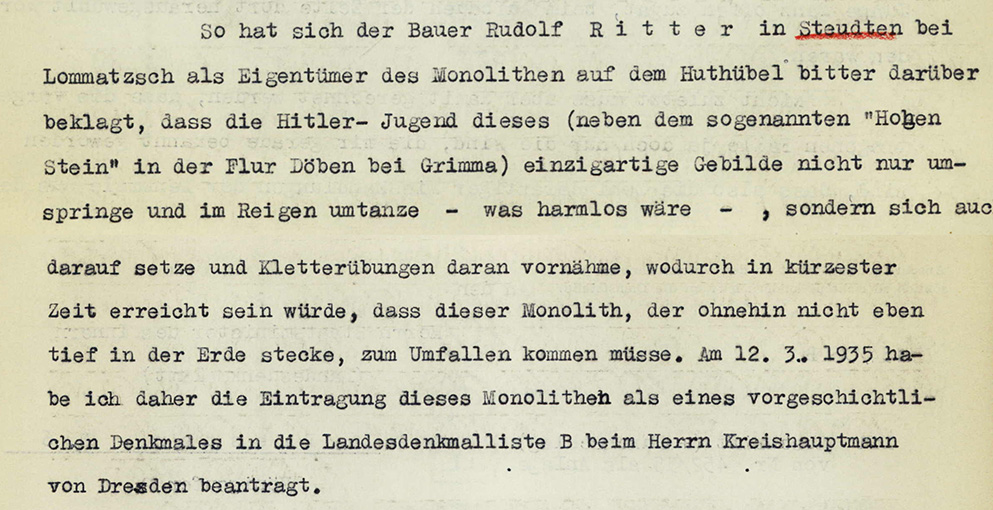
The menhir as an HJ climbing stone
As much as these developments should have worried the regional curator, in March 1935 he was moved by the activities of the Hitler Youth (HJ), who had discovered the Huthübel as a dance venue and the menhir as a climbing wall. The stability of the stone soon proved to be a problem. A multi-page letter from Bierbaum to the Saxon State Ministries of the Interior and for National Education, in which all cases of "mistreatment of monuments" by the HJ or children and young people throughout Saxony were compiled and more respect and "unconditional respect" for "prehistoric monuments" was demanded, however, touched on a core aspect of National Socialist cultural policy. Prehistoric archaeology had risen to become one of the leading ideological sciences of National Socialism.
Michael StrobelImage Source OA 71800, 50-51 ©LfA 1935.
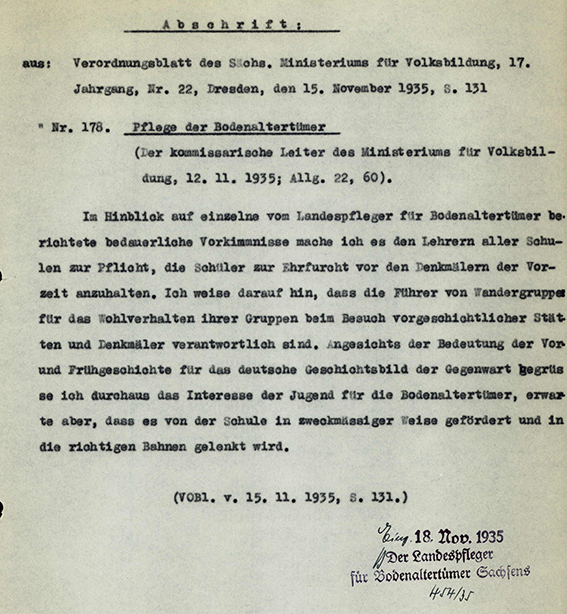
Respect and "protection of honor" for monuments
In November 1935, the Ministry of Education responded with a decree that required teachers to "urge their pupils to show reverence for the monuments of the past" and to ensure good behavior on school trips. Of course, these regulations only applied to school lessons. It was therefore some time before the Hitler Youth took over the "protection of honor" of prehistoric monuments in 1938/39.
Michael StrobelImage Source OA 71800, 47 ©LfA 1935.
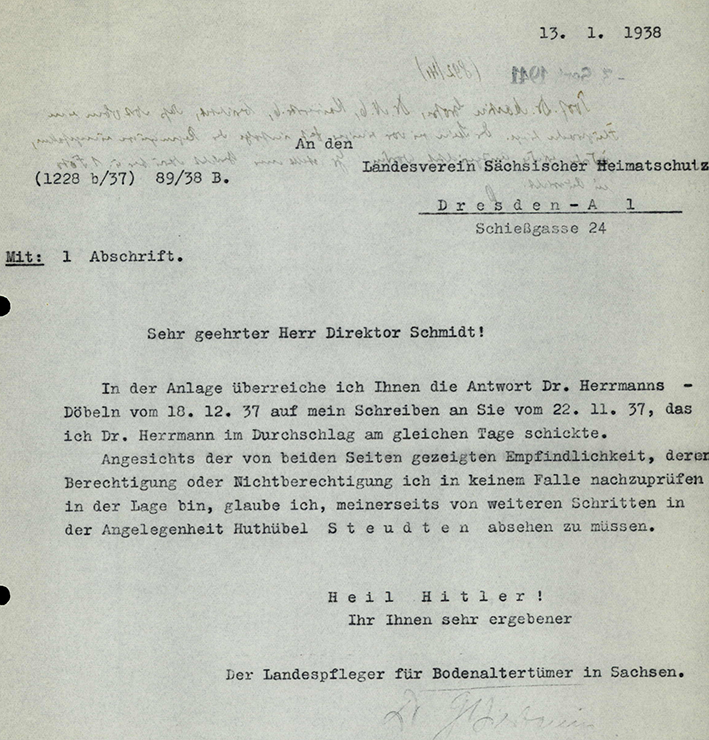
Failure to take protective measures
It is not entirely clear from the files why the state curator did not pursue the suggestions of his representative. The protective measures could probably even have been implemented with the support of the Saxon Heritage Society. Bierbaum, however, refrained from taking any further steps at the beginning of 1938 because he apparently no longer believed that they could be implemented in view of the tensions between farmer Ritter and shop steward Herrmann. In the end, he seems to have lost sight of the Huthübel altogether.
Michael StrobelImage Source OA 71800, 47 ©LfA 1938.
Without archaeological observation
He was all the more surprised to learn in 1941 that an aerial observation post had already been built on the hill at the edge of the gravel pit in 1938. The construction must have involved excavation work that would have merited archaeological monitoring. After all, a large distance was maintained from the mound and menhir. Incidentally, it is also not known that excavations ever took place during sand extraction, although surface finds from the surrounding area, including a stone axe and sherds, suggest a settlement.
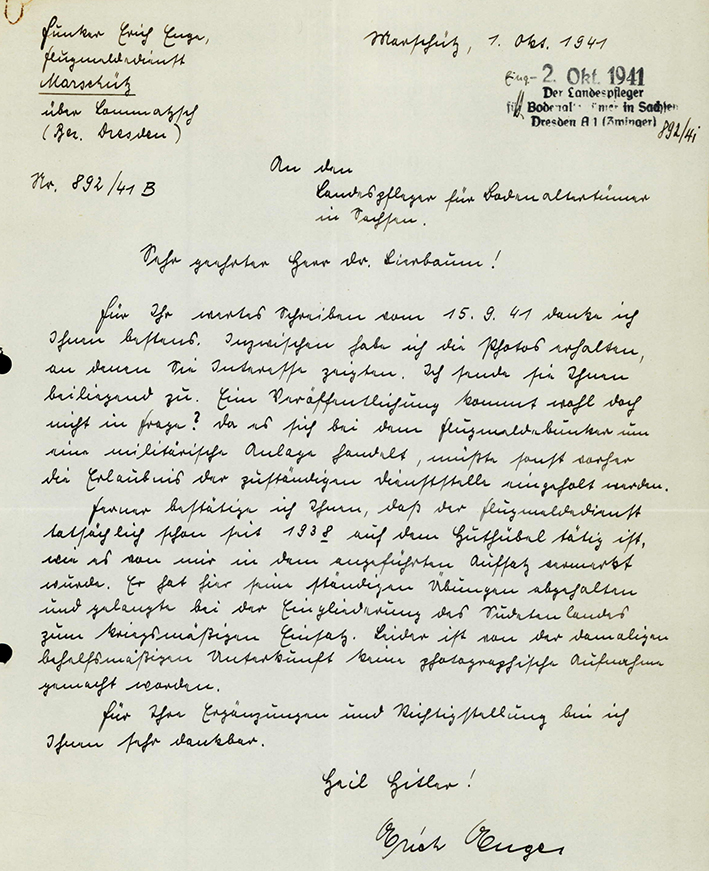
Michael StrobelImage Source OA 71800, 92 ©LfA 1941.
Fall and recovery
Bierbaum only found out about these construction measures because the menhir had fallen over in March 1941 and had since been re-erected with the help of the farmer. Without the report from the attentive, dedicated and archaeologically interested radio operator Erich Enge from the air traffic reporting service in Marschütz, neither of these events would have reached the state archaeologist in the first place.
Michael StrobelImage Source OA 71800, 73 ©LfA 1941.
From landfill to biotope
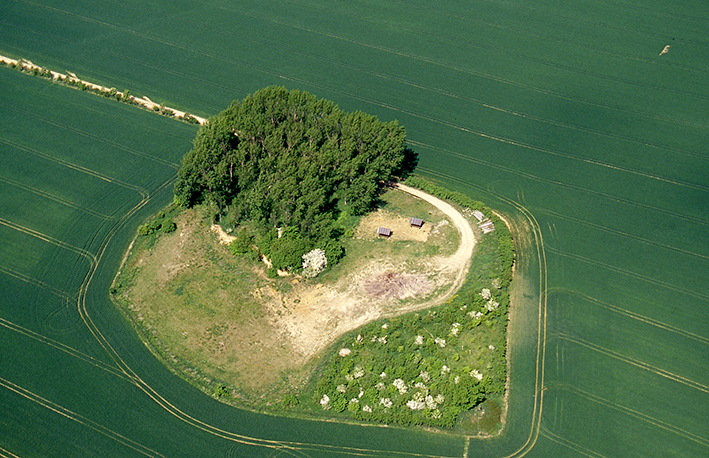
The wild landfill site was decommissioned in 1991 and rehabilitated from 1998 to 2001. Today, a small, species-rich biotope island of 0.4 hectares lies in the middle of an almost 34-hectare site, with hills and a menhir integrated into its south-eastern corner. This popular excursion destination is maintained with a great deal of voluntary commitment. Of course, the border to the field runs directly at the foot of the hill. The monument is therefore still within reach of the ever larger tillage equipment.
Michael StrobelImage Source R. Heynowski, Foto ©LfA 2003.
Acutely endangered
The problem that was already worrying monument conservators 90 years ago has still not been solved. Time and again, tillage equipment interferes with the mound fill. This creeping mechanical destruction could only be halted by a permanent green buffer, which in turn requires the acquisition of land. Voluntary compliance with a protective distance always depends on the good will of the farmer and is subject to changing, sometimes inconsistent, but rigorous EU agricultural funding regulations. The preservation of one of Saxony's rare relics of late Neolithic megalithic architecture is always in the public interest.
Michael StrobelImage Source M. Strobel, Foto ©LfA 2021.
Note on monument protection
Archaeological monuments are protected by the Saxon Monument Protection Act. A permit under monument law is required for ground interventions or construction measures.
Permalink
https://archaeo-sn.de/en/ort/huthuebel/
Citation
Michael Strobel, Huthübel. In: Landesamt für Archäologie Sachsen, Website archaeo | SN (29.11.2024). https://archaeo-sn.de/en/ort/huthuebel/ (Stand: 29.09.2026)
