

Linear Pottery settlements Nickern and Prohlis
| Place: | Prohlis (Dresden, Dresden City) |
|---|---|
| Type: | Settlement |
| Dating: | Linear Pottery culture | Linear Pottery culture | ca. 5100 - 4600 BC. |
Description
In the course of road and urban construction projects in the early 1990s and 2000s, large-scale excavations were carried out in the south of Dresden. The most unusual features discovered during these excavation campaigns include the Linear and Linear Pottery settlements of Nickern and Prohlis. They date back to the first two farming cultures of the Neolithic period, which settled on the fertile loess soils of the Elbe valley extension. Since 2020, the cultural-historical circular hiking trail along the Gerbersbach stream, the "Archaeo-Pfad Dresden“with eleven information steles in today's urban area through the extraordinary archaeological cultural landscape in the south of Dresden.
Annemarie ReckLink https://www.dresden.de/de/rathaus/stadtbezirksaemter/prohlis/geschichte/archaeo-pfad.php
Neolithic settlement chamber
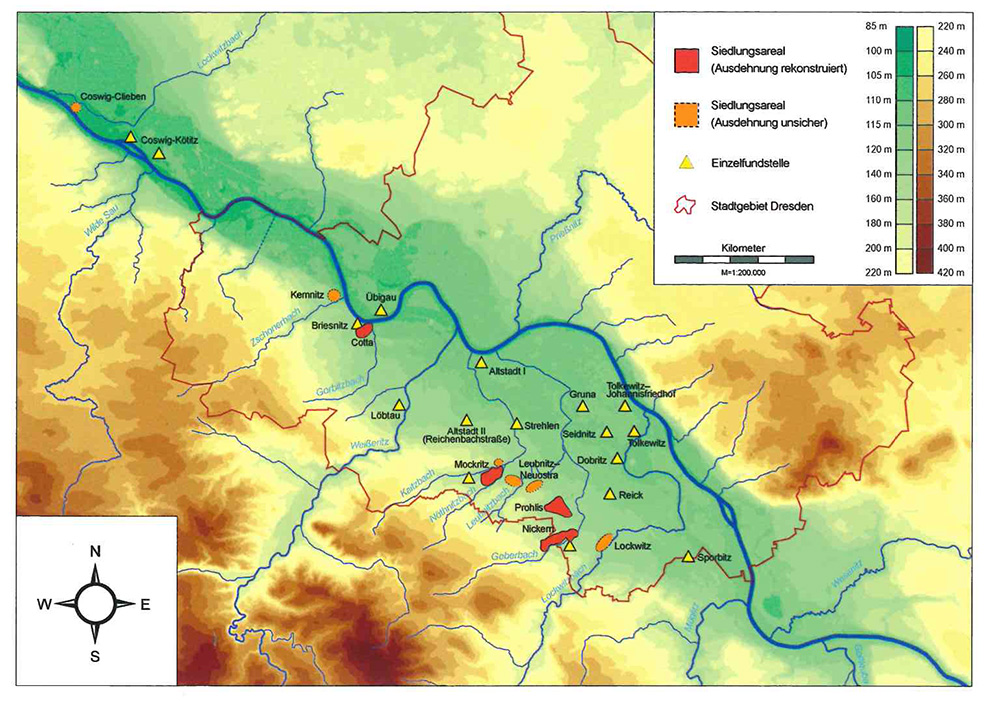
While people in the Mesolithic period still lived mainly from hunting and fishing, the Neolithic culture of the Linear Pottery, which first migrated to Saxony from the south-east around 7500, brought with it cereals and plants for agriculture as well as domesticated animals such as cattle, sheep, pigs and goats. Their sedentary way of life was also new. In any case, large areas had to be cleared and the dense vegetation cleared for agriculture. They used the felled trees to erect rectangular longhouses, which could be up to 40 and 60 meters long. For their settlements, they preferred loess soils that were well suited to the cultivation of cereals and crops, such as the Dohnaer Lössplatte south of Dresden. In this area, up to seven settlements have been found in close proximity to each other, some of which were only a few hundred meters apart. These include the settlements of Nickern and Prohlis.
Annemarie ReckImage Source T. Link, Kartierung ©LfA 2012.
Settlement
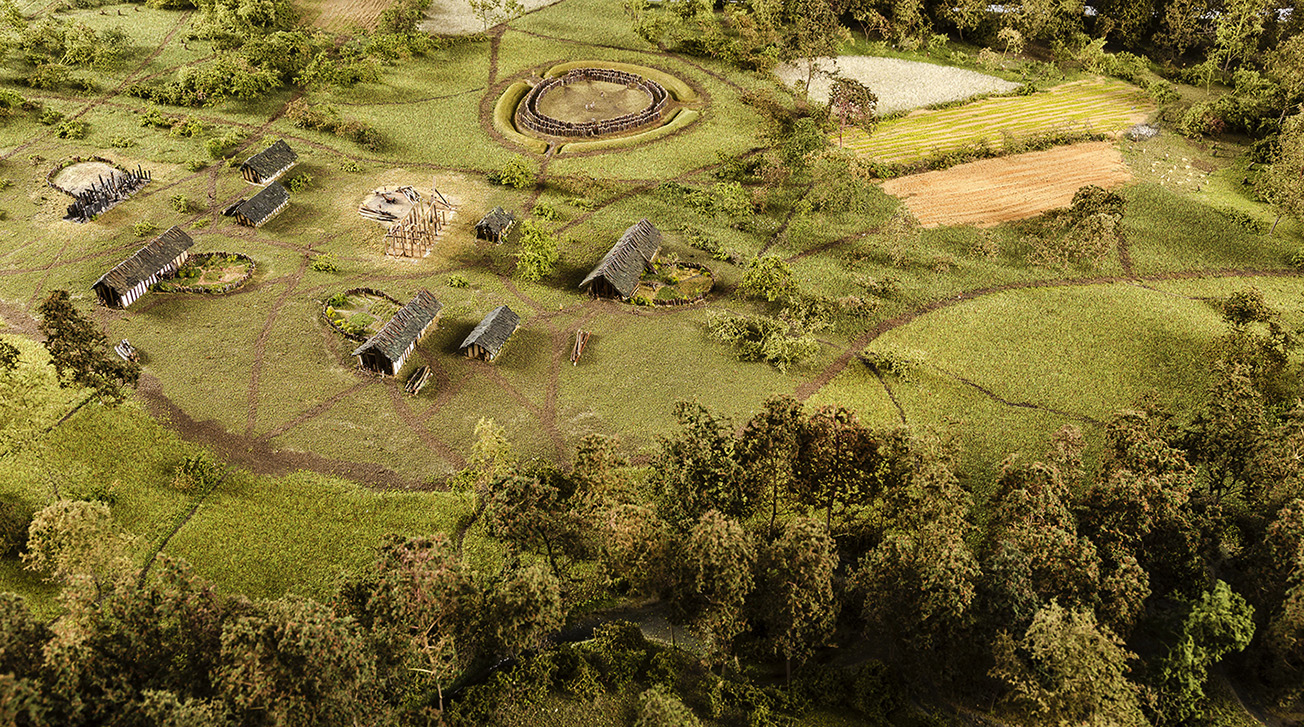
Typical for the houses of these cultures are their massive posts, which are set in a certain arrangement, their north-south orientation and a north end bordered by a wall trench. Usually, especially the houses of the early Linear Pottery are accompanied by numerous settlement and clay extraction pits. Clay was extracted from these pits and used as a wall covering for plastering the wattle and daub walls. In the Linear Pottery culture, which emerged from the Linear Pottery, the ground plans of the houses are trapezoidal to aisle-shaped. They are often accompanied by smaller outbuildings or fence-like structures. The latter can cover areas of between 250 and 500 square meters. Although fences occasionally occur during the older Linear Pottery, they become more common during the Linear Pottery.
Annemarie ReckImage Source L. Farkas, Foto Rekonstruktion Stichbandkeramische Siedlung, smac ©LfA 2014.
House construction
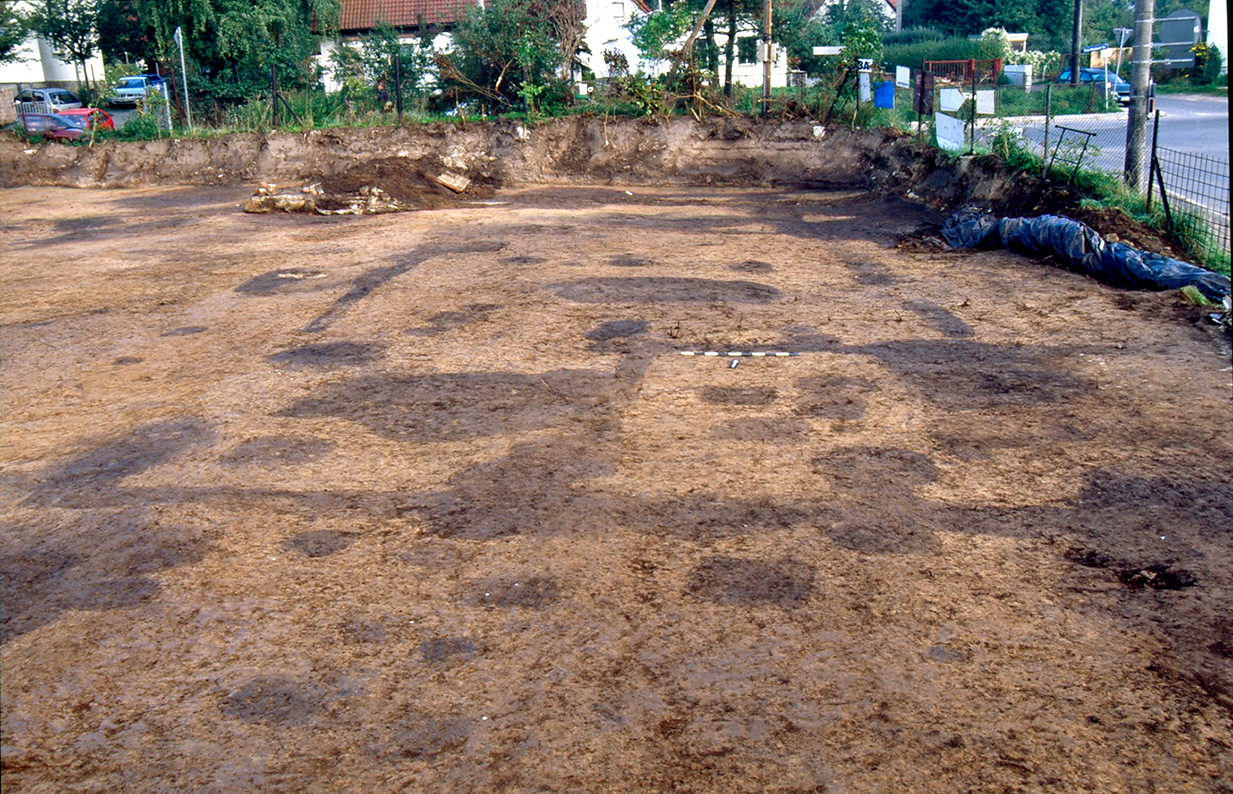
The Neolithic settlements of Nickern and Prohlis are both located on the Gerberbach stream and apparently existed for several centuries, as can be seen from the density of the ground plans visible in the soil. In Prohlis, there are both older Linear Pottery longhouses and much younger ones from the Linear Pottery period. In some cases, the floor plans even overlap. A building usually only existed for a few generations before it was abandoned and usually rebuilt in the vicinity of the old farmstead. The floor plans often overlap. As only sections of both settlements could be examined, their former extent is unclear.
Annemarie ReckImage Source R. Bartels, Foto Grundriss aus Nickern ©LfA 2002.
Prohlis housing estate
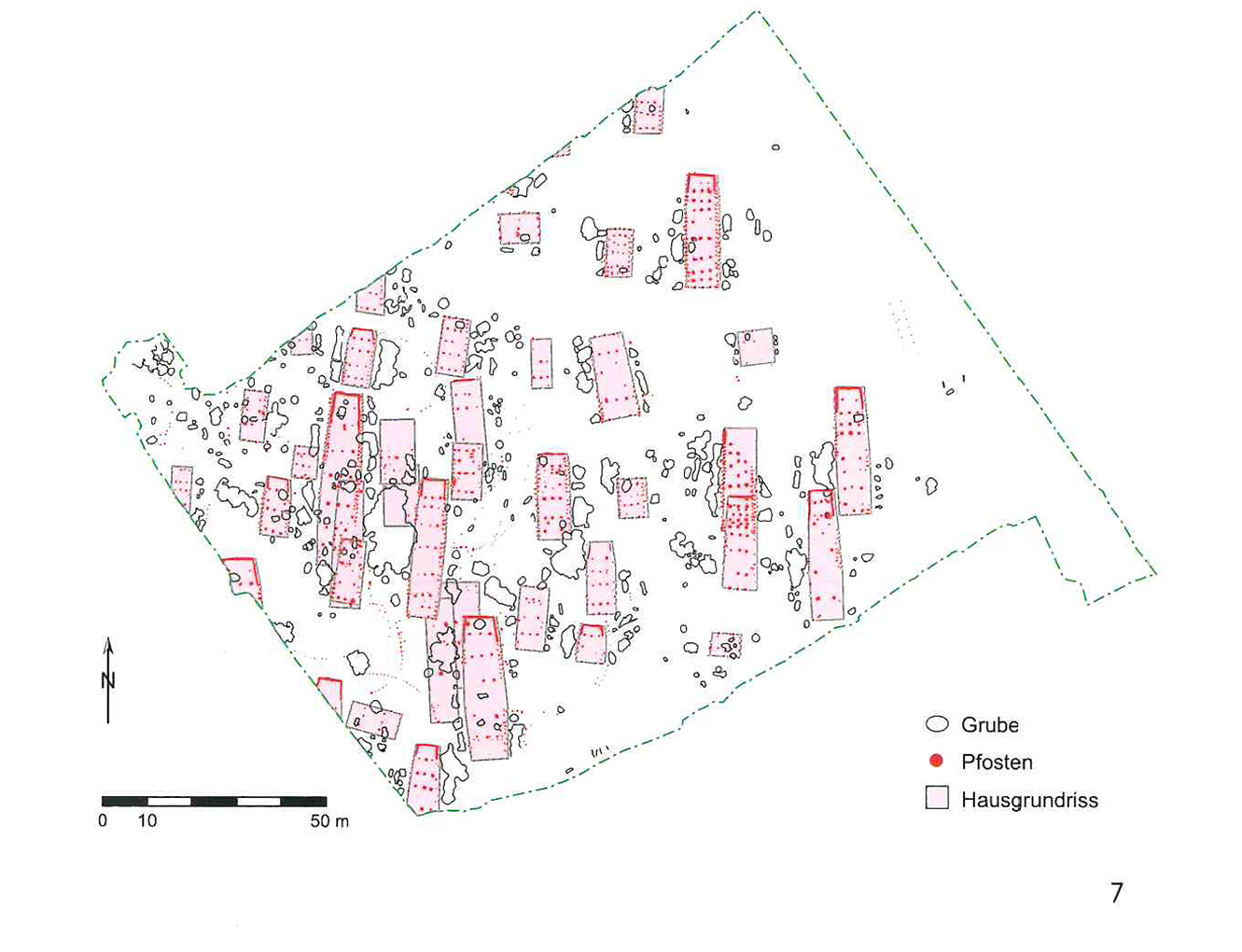
The Dresden-Prohlis settlement was investigated in 1993-1994 as part of an emergency excavation and under great time pressure. A total area of 2 ha was uncovered. Particularly in the southern edge area of the site, the features had already been destroyed by clay extraction in the first half of the 20th century. The brickworks was once located there. Between 1924 and 1953, glacial gravel and sand were mined there. Nevertheless, the visible pits and postholes made it possible to reconstruct a development plan of around 40 building layouts, which had been erected over several decades or centuries and had not existed at the same time. In terms of time, the Dresden-Prohlis settlement covers the period of the Late Linear Pottery and Early Linear Pottery. The pottery found at the site clearly shows the close stylistic relationship to Bohemia. In absolute chronological terms, the settlement can be dated to the period between 5100 and 4900 BC.
Annemarie ReckImage Source T. Link, Plan Prohlis ©LfA 2012.
Settlement Nickern
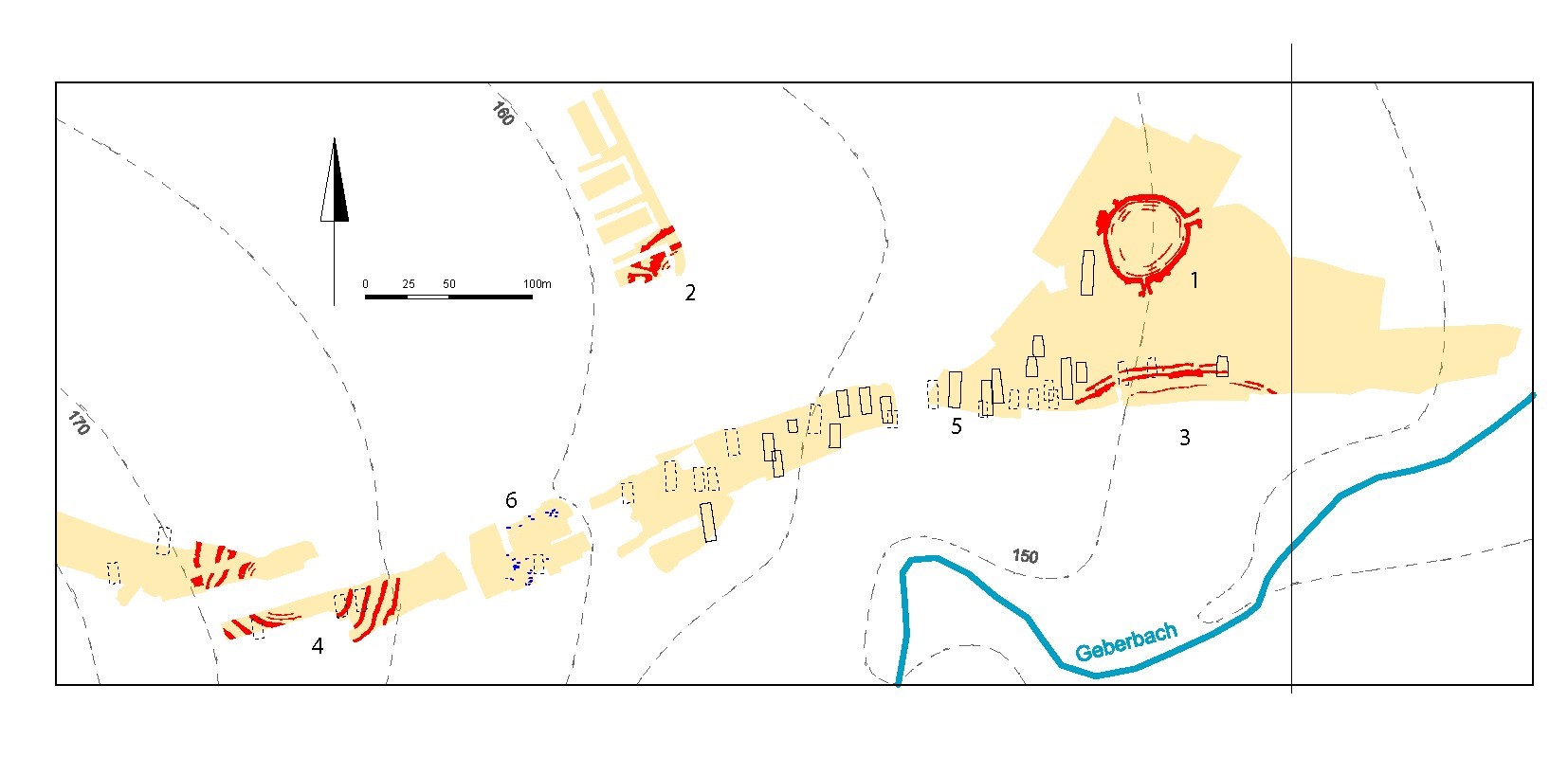
In Dresden-Nickern in particular, only a small section of the settlement was excavated that was specifically affected by the planned road construction project. The construction of the S 191 feeder road from Dohnaer Straße to the A17 (Dresden - Prague) was planned. The settlement was located in the immediate vicinity of up to four circular ditches and a contemporary cemetery. In total, a Linear Pottery settlement area of up to 19 ha over a length of approx. 750 m was uncovered. Nevertheless, this is only a section of the former settlement area. A total of approx. 17 building footprints were confirmed and a further 15 were suspected.
Annemarie ReckImage Source H. Stäuble, Plan Nickern ©LfA 2020.
Discovery of a clay figurine
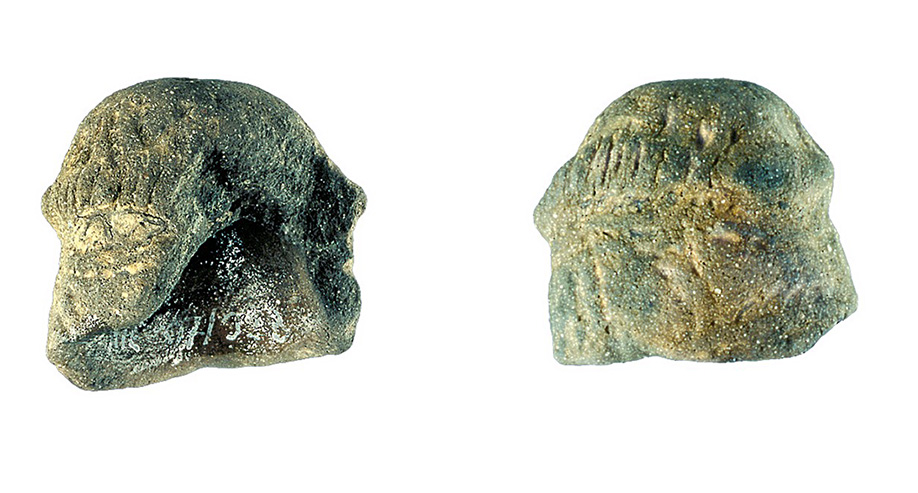
In addition to numerous ceramic remains, some of which were decorated with the line and stitch bands that gave the two cultures their names, unusual finds also came to light, such as the fragment of a small clay figurine from the Dresden-Nickern settlement. It is approximately 2.8 cm in size and shows the upper part of a human head. Notches can clearly be seen on it as a hairline, the right, almond-shaped eye and a tonsure-like hairstyle or headdress.
Annemarie ReckImage Source U. Wohmann, Foto ©LfA 2004.
Link archaeo | 3D
Stone tools and botany
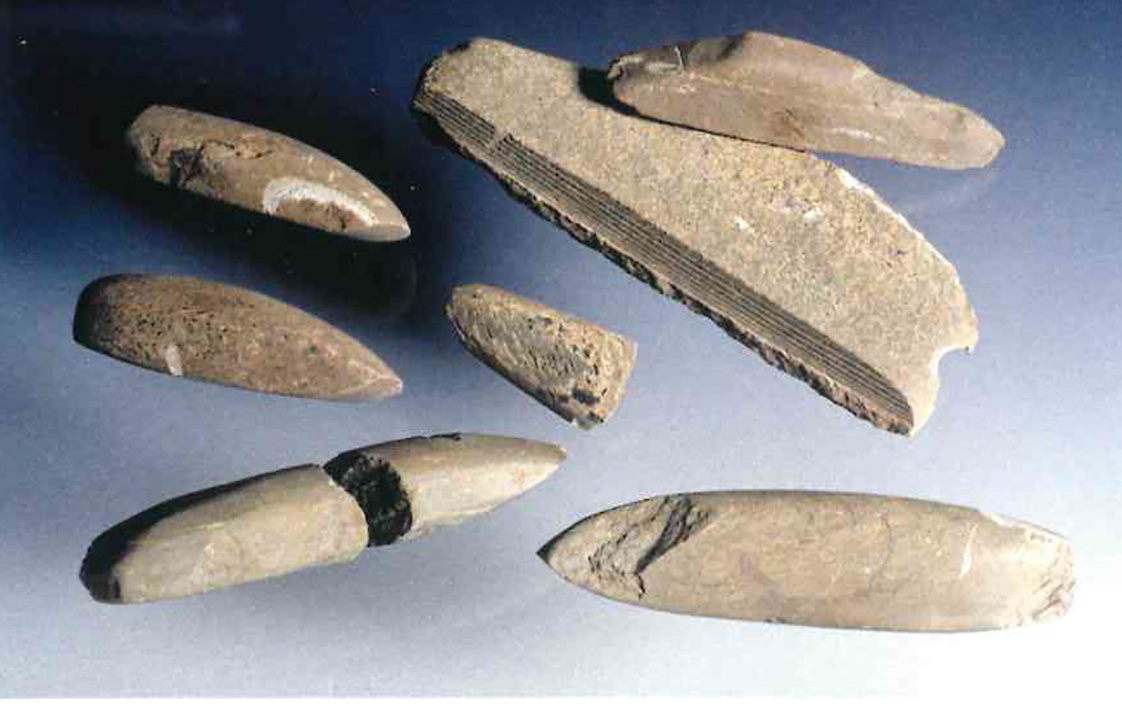
Dresden-Prohlis has a remarkably high occurrence of silices with 2580 objects. This makes the site one of the most flint-rich Linear Pottery settlements. However, only 13.1 % of these show clear modifications. Only these were clearly prepared as tools. 99% of the raw materials were boulder flint, as found in the local glacial end moraines. 1% of the pieces are freshwater quartzite from the North Bohemian region and a single piece consists of West Hungarian radiolarite. On the other hand, the occurrence of only 18 rock axes appears to be too small for the size of the settlement uncovered. According to Thomas Link, this results in an average of only 0.5 tools per house. In Dresden-Nickern, the excavation team came across a stone axe depot with finished tools and semi-finished products in the middle of the settlement. As early as 1961, further deposits containing between three and eight stone tools were unearthed just 150 m from the site. This accumulation of deposits is unusual for a single settlement. In another pit find in the Dresden-Nickern settlement, the excavation team came across a large stock of charred peas that were still recognizably preserved in the soil. Occasional finds like this give an indication of what the Linear Pottery people ate. Their diet also included cereals such as emmer, barley and einkorn or pulses such as lentils.
Annemarie ReckImage Source U. Wohmann, Foto Steinbeildepot Nickern ©LfA 2012.
Literature
Rainer Bartels/Wolfgang Brestrich/Patricia de Vries/Harald Stäuble, Ein neolithisches Siedlungsareal mit Kreisgrabenanlagen bei Dresden-Nickern. Eine Übersicht. Arbeits- und Forschungsberichte zur sächsischen Bodendenkmalpflege 45, 2003, 97–133.
Richard Funke/Margit Georgi/Bettina Heger/Florian Innerhofer/Anja Kaltofen/Peter Neukirch/Thomas Westphalen, Nickern und Prohlis – Archäologie und Geschichte am Gerberbach in Dresden. Archaeonaut 13 (Dresden 2020).
Thomas Link, Die linien- und stichbandkeramische Siedlung von Dresden-Prohlis: eine Fallstudie zum Kulturwandel in der Region der oberen Elbe um 5000 v. Chr. In: Veröffentlichungen des Landesamtes für Archäologie Sachsen 60.
Note on monument protection
Archaeological monuments are protected by the Saxon Monument Protection Act. A permit under monument law is required for ground interventions or construction measures.
Permalink
https://archaeo-sn.de/en/ort/linear-pottery-settlements-nickern-and-prohlis/
Citation
Annemarie Reck, Linear Pottery settlements Nickern and Prohlis. In: Landesamt für Archäologie Sachsen, Website archaeo | SN (24.10.2024). https://archaeo-sn.de/en/ort/linear-pottery-settlements-nickern-and-prohlis/ (Stand: 29.09.2026)
