

Mass graves near Podelwitz
| Place: | Podelwitz (Rackwitz, North Saxony) |
|---|---|
| Type: | Mass grave |
| Dating: | Thirty Years' War | 1631 AD. |
Description
The construction of a new Beiersdorfer AG Hamburg plant prompted the Saxony State Office for Archaeology to investigate an 11-hectare area south of the village of Podelwitz from February to August 2020. First of all, the area was archaeologically surveyed by excavating a 4 m wide strip every 16 m in order to clarify the density of features on site. The density of findings and finds quickly showed that the entire area had to be surveyed and examined. The planned development area was located in the middle of a battlefield from the Thirty Years' War (1618-1648), as evidenced by several mass graves containing human and animal skeletons. This was apparently the site of the battle, which is referred to in written sources as the "Battle of Breitenfeld“ the famous clash of two great armies in 1631. It ended in the first major defeat of the imperial army after 13 years of war.
Annemarie ReckInitial situation in the late summer of 1631
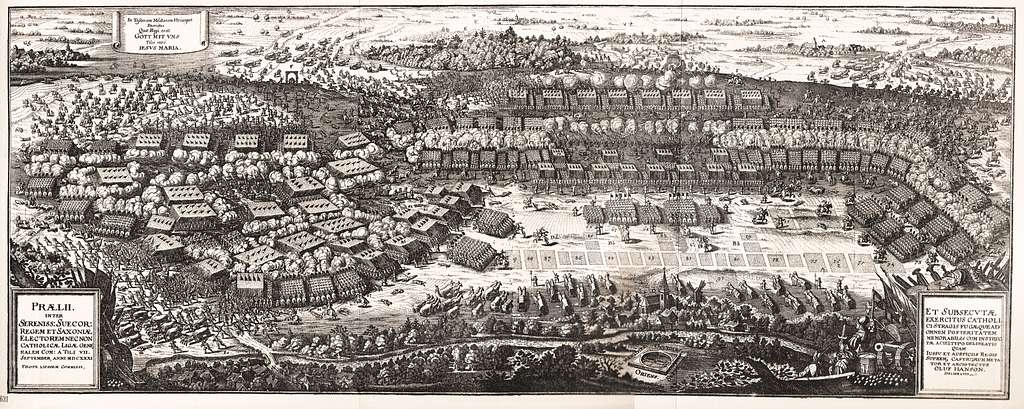
In the late summer of 1631, the conflict that had been devastating the lands for 13 years, which would later go down in history as the "Thirty Years' War", had the whole of Europe firmly in its grip. What began in 1618 with the Defenestration of Prague as a religious war expanded over the years into a territorial war. The result was the devastation of entire regions and an extreme population decline, which was also aided by famine and epidemics. Most of the battles took place on the territory of the Holy Roman Empire at the time. In the encounter known in historical sources as the "Battle of Breitenfeld", the army of the Catholic League met the united army of the Swedish King Gustav II Adolf (1594-1632) and the Saxons under Elector Johann Georg I (1585-1656), which was around 7,000 men stronger. Three days earlier, on September 14, 1631, the League army of 35,000 soldiers under Johann T'Seracles von Tilly (1559-1632) and Gottfried Heinrich von Pappenheim (1594-1632) had conquered Pleißenburg Castle and subsequently plundered the city of Leipzig.
Annemarie ReckImage Source O. Hansen, Slaget vid Breitenfeld (1631), (0CC).
Before the battle
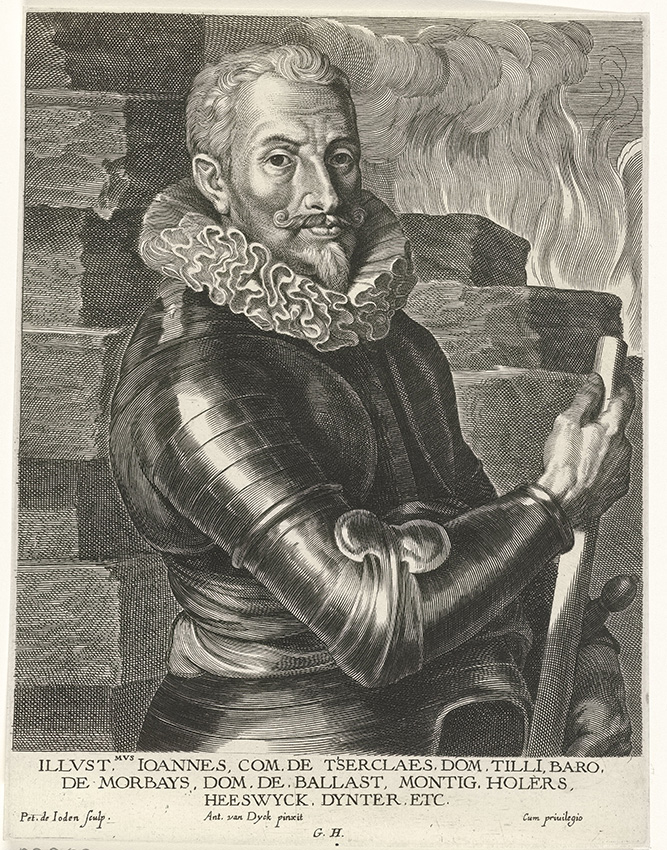
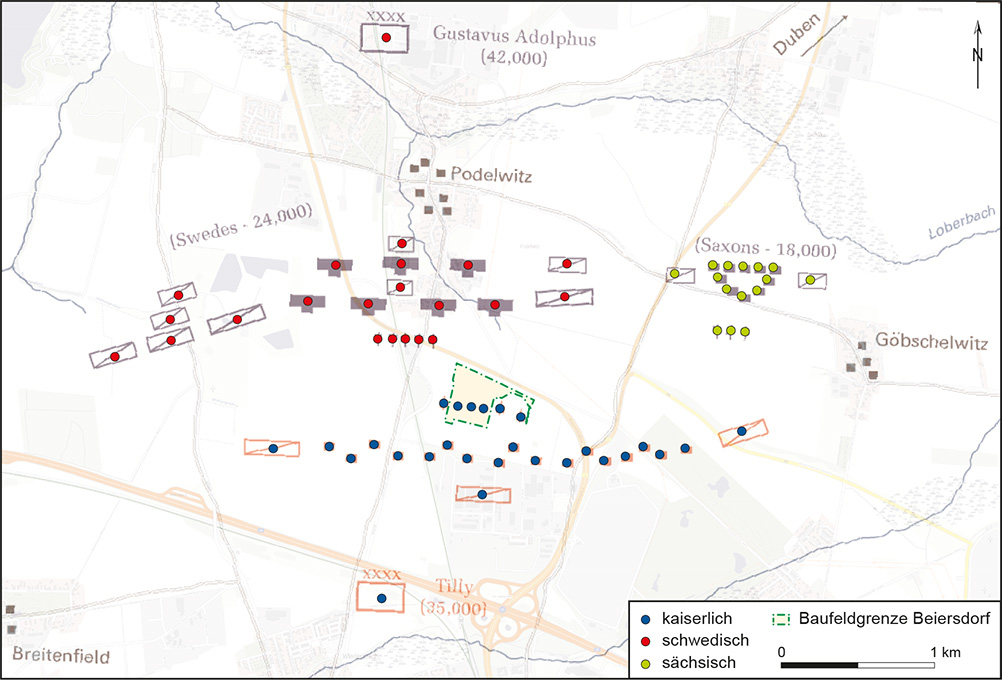
When Tilly heard about the approach of the enemy army and moved north, he initially assumed that it was only the soldiers of the Saxon Elector. But in fact, only a few days earlier, on September 12, 1631, an alliance agreement had been concluded between the Elector and King Gustav II Adolf, uniting the 18,000-strong Saxon army with the 24,000-strong Swedish army. After Tilly received the news that the Swedes were also approaching, he wanted to avoid a field battle against the numerically superior opponents and wait for reinforcements. The much more impulsive Field Marshal Pappenheim was dissatisfied with his hesitation and therefore set off on September 16, 1631 on his own authority with his cavalry unit on a reconnaissance ride to the north. He initially encountered Saxon cavalry, which he was able to put to flight. He then told Tilly that they were only up against the Saxons and did not comply with the army commander's request to withdraw. Shortly afterwards, Pappenheim met the main army and asked for reinforcements, as a full retreat was now too dangerous. Although Tilly knew that he was trying to force the battle, at this point he had no choice but to lead his troops north.
Annemarie ReckImage Source P. de Jode d. Ä. nach A. van Dyck, Stich, Porträt Johann T’Serclaes von Tilly (um 1630), (0CC).
Course of the battle
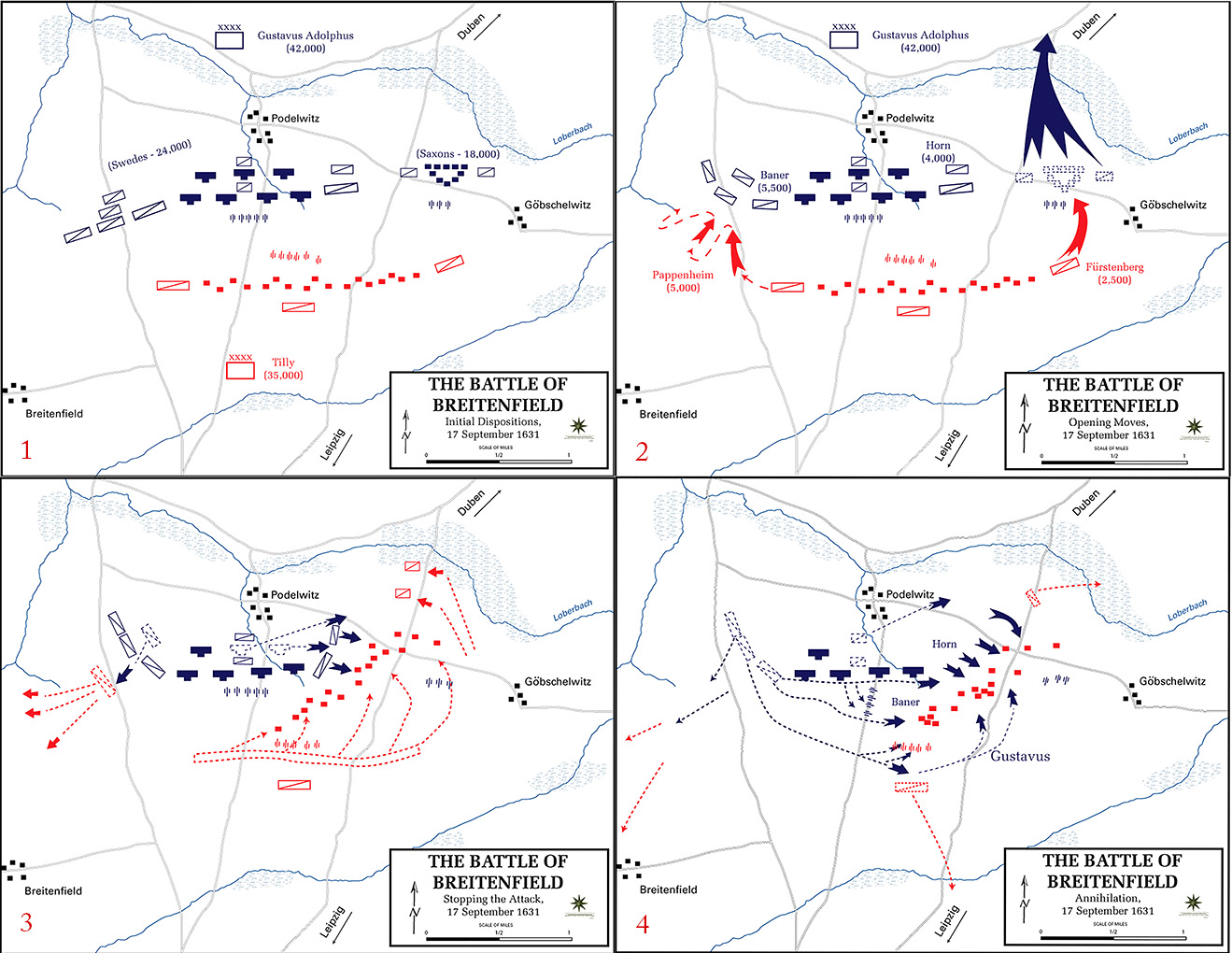
The commander of the Catholic League had his troops take up position near the village of Podelwitz. Strategically positioned on a slight ridge with the sun behind him, he awaited the arrival of the Swedes and Saxons approaching from the north. The morning began with several hours of artillery fire from both sides, with the League army suffering considerably greater losses. The Imperial forces then opened the attack on both wings, an unusual maneuver for the time. It is still debated today whether Pappenheim dared to make another advance on his own initiative or was actually acting on Tilly's orders. However, they did not succeed in breaking through the enemy's ranks, as King Gustav II had also equipped the pikemen's hedges used against cavalry with musketeers and light regimental cannons. Pappenheim carried out seven unsuccessful attacks with his cavalry until the Imperial left wing had disintegrated. The situation was different with the right wing led by Egon VIII von Fürstenberg-Heiligenberg (1588-1635), who succeeded in breaking through and dispersing the Saxon ranks. After these initial successes, however, the Swedish army managed to encircle the enemy on the left. After almost 13 years of war, the Imperial League army was defeated for the first time in a major field battle.
Annemarie ReckImage Source Department of History, U. S. Military Academy, Battle of Breitenfeld 1631, (2014), (0CC).
After the battle
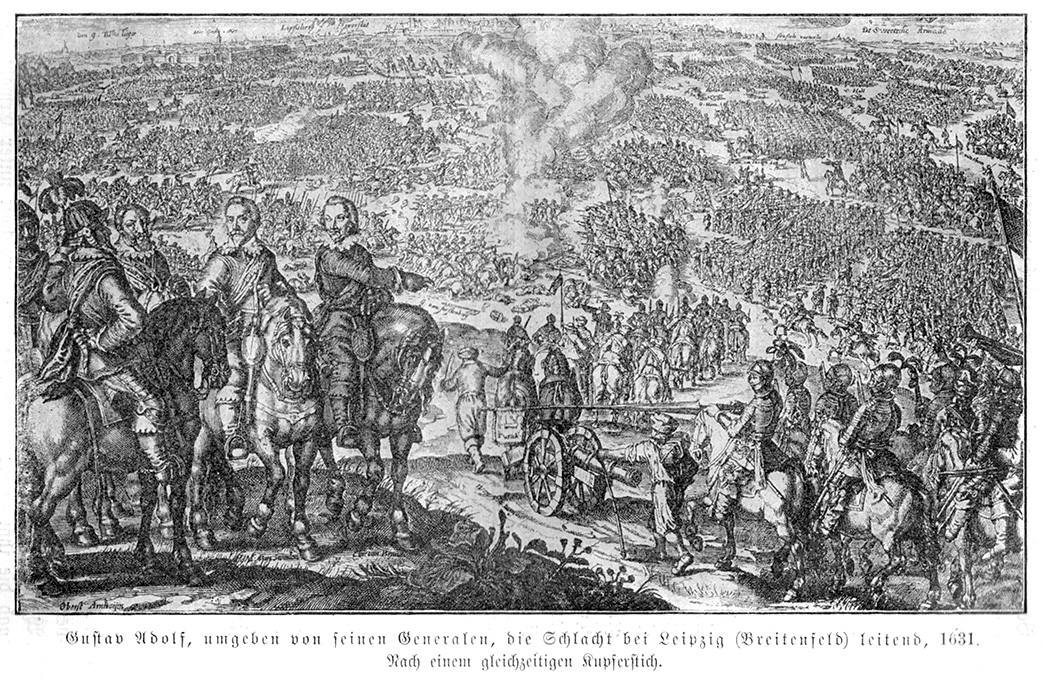
The Battle of Breitenfeld is considered the bloodiest of the Thirty Years' War with around 5,500 dead on the side of the Swedes and Saxons and 12,000 on the side of the Catholic League. 7,000 more Imperial soldiers were taken prisoner. The victorious Swedes spent the night on the field and buried their fallen. The surviving, deserted mercenaries of the League army were often slain by the local population in revenge for previous looting and atrocities. The soldiers and horses from the Imperial army that remained on the battlefield probably had to be buried by the villagers. In view of the late summer temperatures and dryness mentioned in the sources, it is not surprising that attempts were made to squeeze as many bodies as possible into the shallow pits, although this contradicted the usual burial custom.
Annemarie ReckImage Source K. Sturmhöfel 1908, S. 281. Kupferstich Gustav Adolf bei der Schlacht von Breitenfeld 1631 (0CC).
Archaeological excavation
389 years after this historically significant battle, which broke the nimbus of Tilly's invincibility and undoubtedly marked a turning point in the Thirty Years' War, a new Beiersdorf AG Hamburg plant was to be built in the middle of the former battlefield. From early February 2020 to August 2020, a team from the Saxony State Office for Archaeology therefore carried out a scientific investigation of the approximately 11-hectare construction site. The aim was to document or recover the archaeological substance in the ground before it was destroyed and to secure it for later evaluation. In order to obtain an overview of the findings to be expected, approximately 4 m wide sondage strips were laid out at intervals of 16 m, scanning the entire area. Due to the density of the emerging features and finds, however, it quickly became clear that the entire area had to be uncovered and professionally examined. In total, two mass graves, one multiple burial, two single graves and six animal graves as well as some prehistoric features were uncovered.
Annemarie ReckImage Source Archæo 17, 2020, 16, Abb. 1.
The mass graves
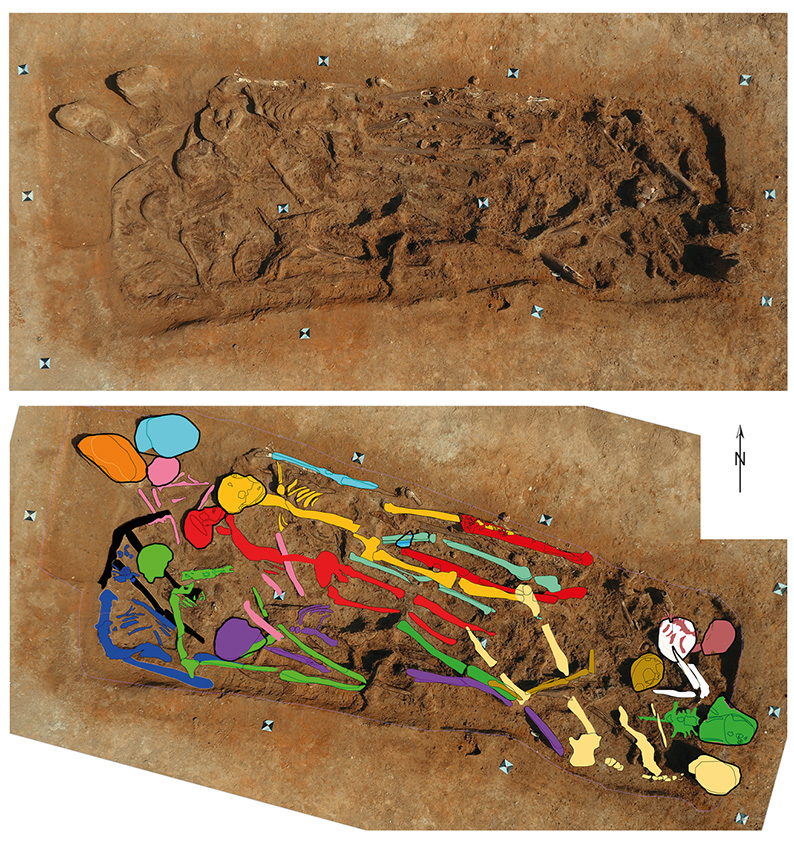
Unfortunately, the preservation of the bones on site was extremely poor. For example, the joint ends of the long bones were heavily decomposed and the surfaces were weathered, which made it difficult to assign the skeletal elements to individual individuals. It was also no longer possible in all cases to reconstruct the position of all skeletal elements within the grave. During an anthropological examination of the bones, a total of 29 individuals were identified in the graves based on the skull remains and long bone fragments. There were 4 individuals in grave 15, at least 9 individuals in grave 49 and the remains of at least 15 individuals in grave 57. Due to the poor preservation, the further results of the investigation were limited. The probability that the deceased were male skeletons is very high. Anthropologically, however, only 4 of the deceased could be identified as male on the basis of gender-specific characteristics. The approximate age at death could still be determined for 12 individuals, mainly based on the wear of the tooth enamel. The majority of the deceased reached an age between 25-30 years. In contrast, the oldest individual was between 35-40 years old, while the youngest was just 14-20 years old.
Annemarie ReckImage Source Archæo 17, 2020, 17, Abb. 2.
Diseases of the dead
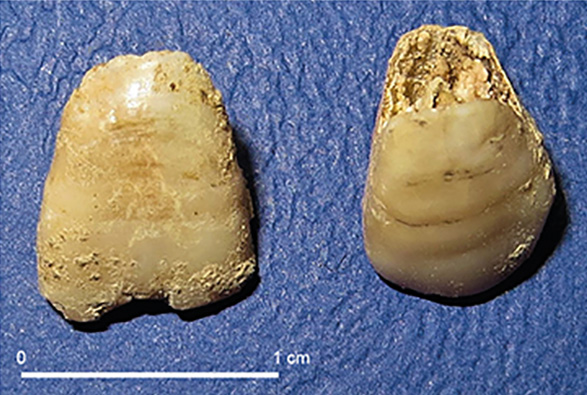
During the examination of the dead, particular attention was paid to the visible injuries and diseases. Pathological changes were particularly evident in the teeth and jaw skeleton, which were present in 16 of the individuals. Carious defects were detected in three cases. Enamel hypoplasia was far more common and was detected in eight of the 16 individuals. These are stress markers that often develop as a result of severe infectious diseases or temporary malnutrition in childhood. In the case of individual 5 from grave 57 (image), this enamel change can be seen as horizontal grooves in the incisor.
Annemarie ReckImage Source Archæo 17, 2020, 18, Abb. 4.
Injuries to the dead
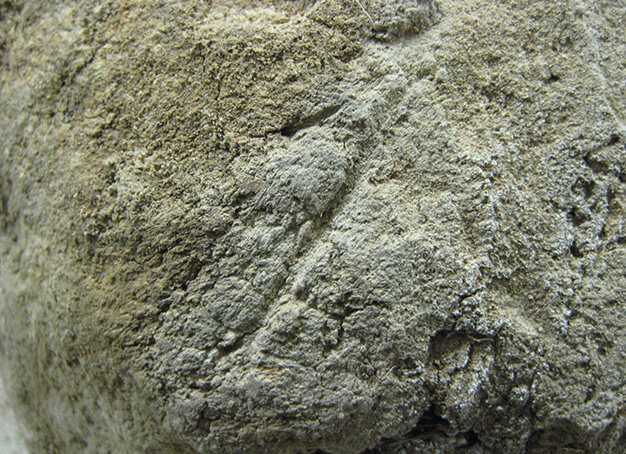
A total of four of the individuals still had traces of injuries on their bones. In two cases, these were unhealed traumas that were presumably inflicted during the battle. For example, a 4 cm long indentation can be seen on the back of the head of an individual from grave find 49, which according to the analysis was probably caused by a low-force sword blow (image). A second slash wound elsewhere in the area of the back of the head was of significantly greater intensity and penetrated the individual's bone.
Annemarie ReckImage Source Archæo 17, 2020, 18, Abb. 5.
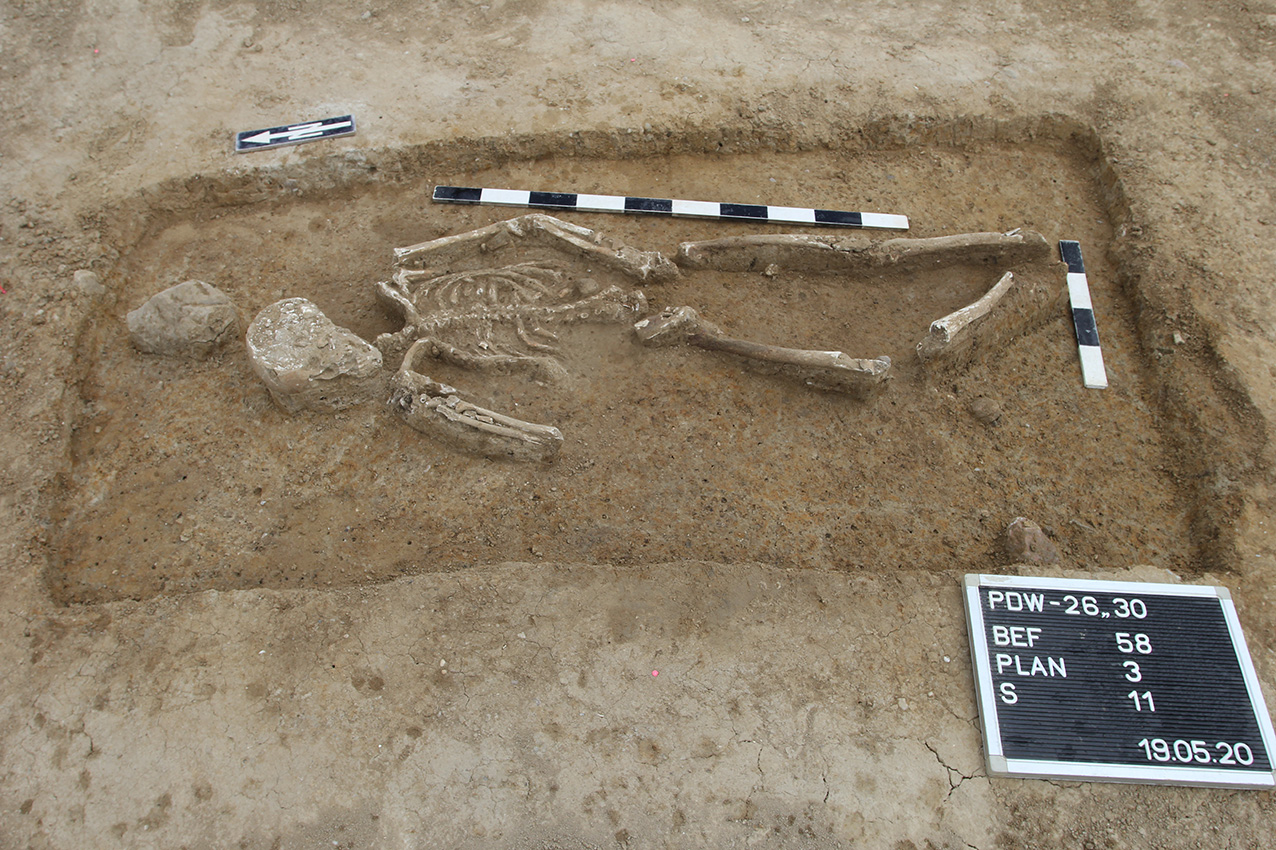
Single grave find 58
Feature 58, one of the two individual graves, was located in the southwest of the area. Despite the visibly porous condition of the bones, it was the best preserved and most complete skeleton in the excavation. The male individual was between 25-35 years old, his bones comparatively delicate. The individual was buried in a north-south orientation, facing west. The slightly bent right leg of the deceased and his strongly bent right arm were striking. There in the shoulder area was a small lead ball, which presumably caused the soldier's death. There was also a fracture in the collarbone area, although it had already healed.
Annemarie ReckImage Source K. Pleger, Befund 58 ©LfA 2020.
Hidden nest egg
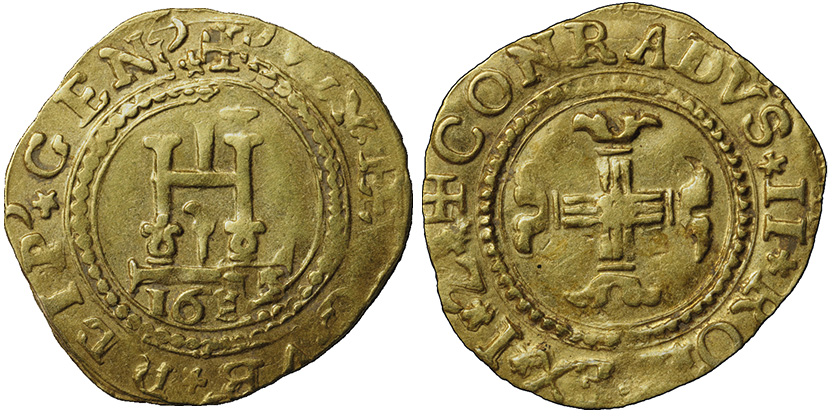
A gold coin in the area of the left kneecap of the individual from grave 58 was one of the big surprises for the excavation team. It was a ½ doppia, which had been minted in Genoa in 1615. By the standards of the time, it had a purchasing power of around €500. The deceased had presumably sewn this "nest egg" into his underwear - not an unusual practice at the time. The coin was probably overlooked during the customary looting of the corpses after the battle, when they were stripped of their valuables, clothing and equipment. However, it remains unclear how this valuable coin came into the possession of the deceased.
Annemarie ReckImage Source Archæo 17, 2020, 18, Abb. 4.
Animal burials
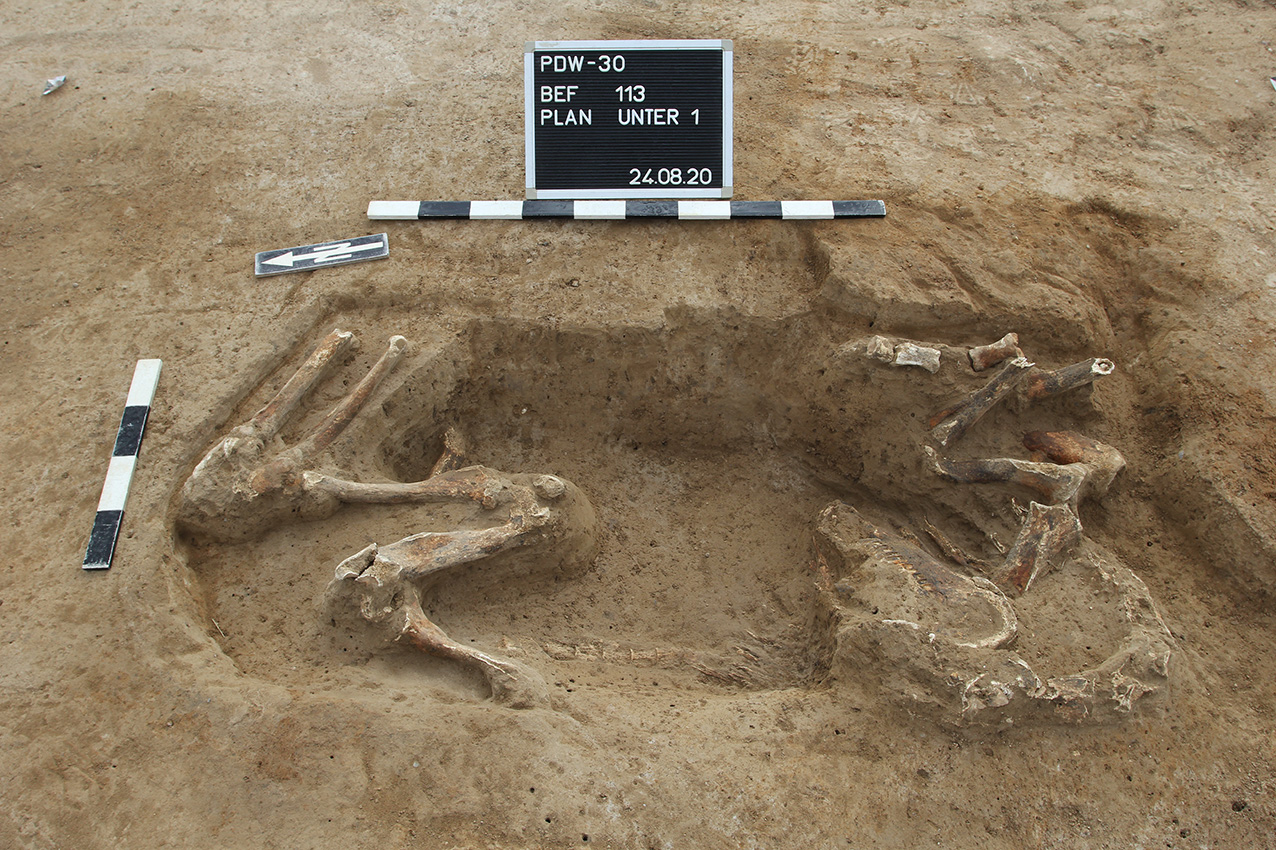
Horses were often among the first casualties of a battle, as the cavalry often carried out the first attacks at that time. They were repelled by the pikemen and musketeers. Both individual animal burials and multiple burials with up to five horses were found on the excavation site. A not insignificant role in the recovery of the numerous metal finds on the battlefield, such as musket and pistol balls, was played by the volunteers who searched the excavation area with a metal probe.
Annemarie ReckImage Source K. Pleger, Tierbestattung ©LfA 2020.
Literature
Bettina Jungklaus, Sonderbestattungen aus dem Dreißigjährigen Krieg in Norddeutschland und ihr Kontext. Beiträge zur Mittelalterarchäologie in Österreich 35, 2019, 67–84.
Yvonne Heine/Bettina Jungklaus/Knut Pleger/Harald Stäuble, Tod auf dem Schlachtfeld. Opfer des Dreißigjährigen Krieges in Podelwitz. Archæo 17, 2020, 16–19.
Münkler, Der Dreißigjährige Krieg. Europäische Katastrophe, Deutsches Trauma, 1618–1648 (Berlin 2017) 491–526.
Roland Sennewald, Das Kursächsische Heer im Dreißigjährigen Krieg (Berlin 2013).
Note on monument protection
Archaeological monuments are protected by the Saxon Monument Protection Act. A permit under monument law is required for ground interventions or construction measures.
Permalink
https://archaeo-sn.de/en/ort/mass-graves-near-podelwitz/
Citation
Annemarie Reck, Mass graves near Podelwitz. In: Landesamt für Archäologie Sachsen, Website archaeo | SN (14.11.2024). https://archaeo-sn.de/en/ort/mass-graves-near-podelwitz/ (Stand: 29.09.2026)
