

Mesolithic graves near Schöpsdorf
| Place: | Schöpsdorf (Boxberg, Görlitz) |
|---|---|
| Type: | Cremation and inhumation graves with unknown grave structure |
| Dating: | Mesolithic groups | 6200 - 5500 BC. |
Description
South of the village of Schöpsdorf, which was completely devastated by the Bärwalde open-cast lignite mine in 1981, archaeological prospections were carried out in 1984 in the run-up to further excavations. During the explorations, archaeological finds from the Late Neolithic, Bronze Age and High Middle Ages came to light. Most remarkable, however, was the discovery of up to five graves from the Mesolithic period, which were characterized by the heavy use of red chalk. They show similarities to a Middle Stone Age grave only 20 km away near Nadelwitz, OT. Bautzen, on.
Annemarie ReckLocation of the sites
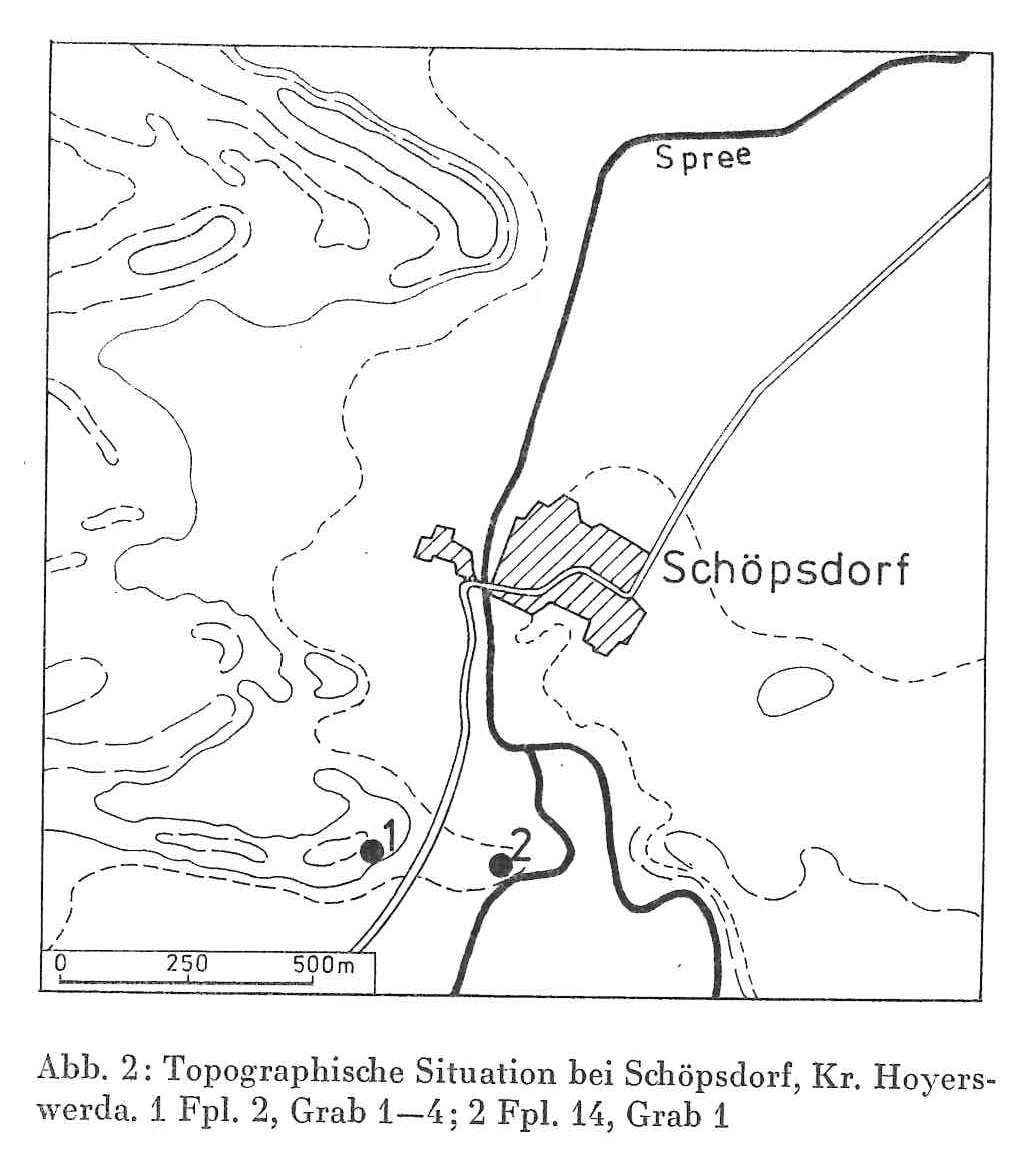
Both sites are located in the flat undulating Lusatian glacial valley, on a dune tongue extending from west to east onto the Spree. Site 14 reaches up to the former course of the Spree like a spur and rises 4 m above the terrain at this point. The surrounding lowlands were subject to regular flooding. The dune rises towards the west. In the area of an approximately 8 m high dune crest, 300 m to the west, was site 2. In the open-cast profile, a buried humus soil containing charcoal could be recorded at a depth of 2.30 m, which yielded a 14C age of 6260±70 BC. The graves buried in the sand dune above must therefore be younger and date from the end of the Mesolithic period between 6200 and 5500 BC.
Annemarie ReckImage Source K.-P. Wechler 1989, 41, Abb. 2.
Reference 14
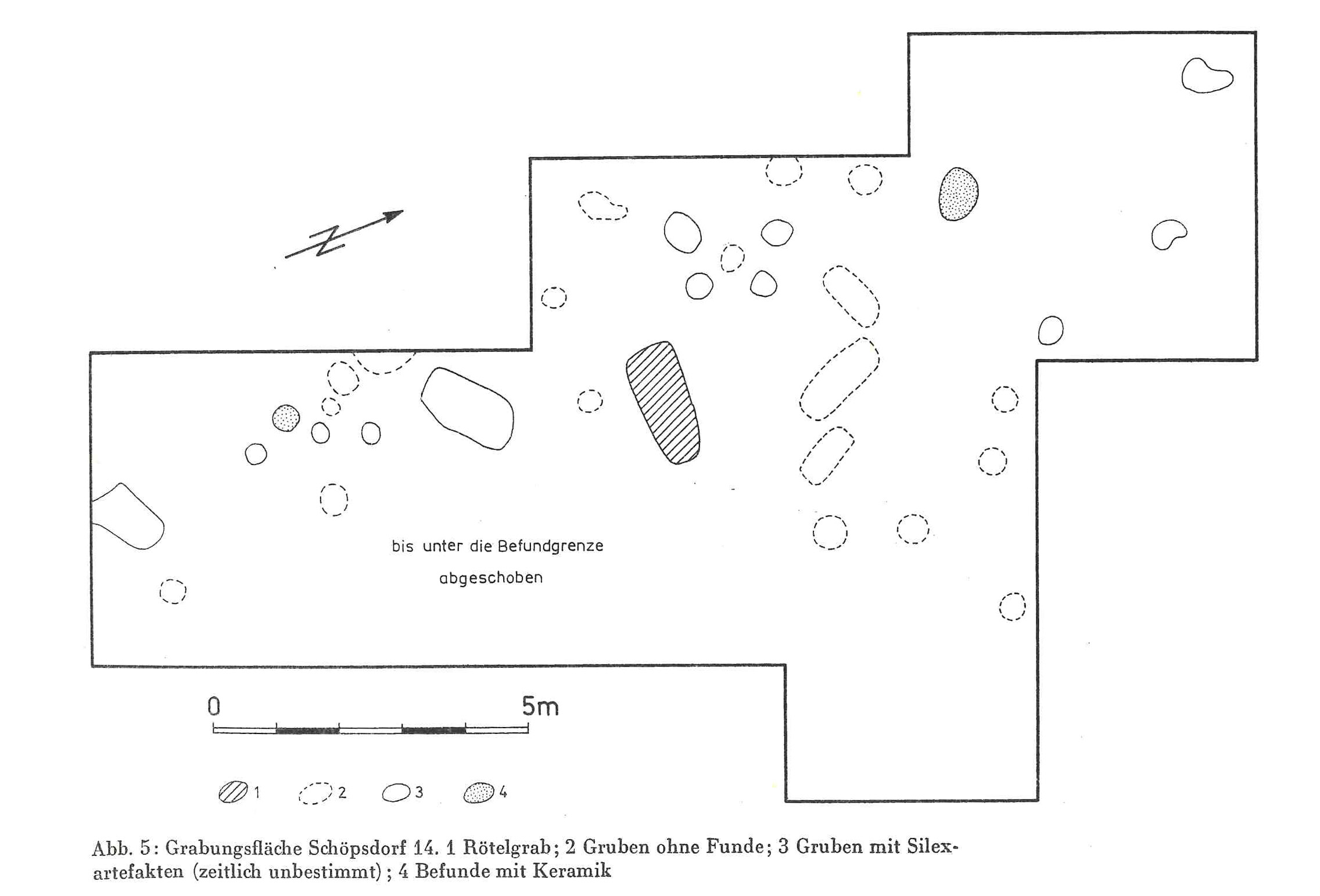
The single grave at site 14, which was heavily interspersed with red chalk, was discovered by the monument conservator Heinz Trost as a result of the initial leveling work that preceded the excavation of the site. He secured the find, which was already visible in the upper areas with slight reddish discoloration and animal corpse burns. Shortly afterwards, district soil conservationist Günter Wetzel began a two-week excavation of the burial pit and the adjacent area.
Annemarie ReckImage Source K.-P. Wechler 1989, 44, Abb. 5.
The grave findings
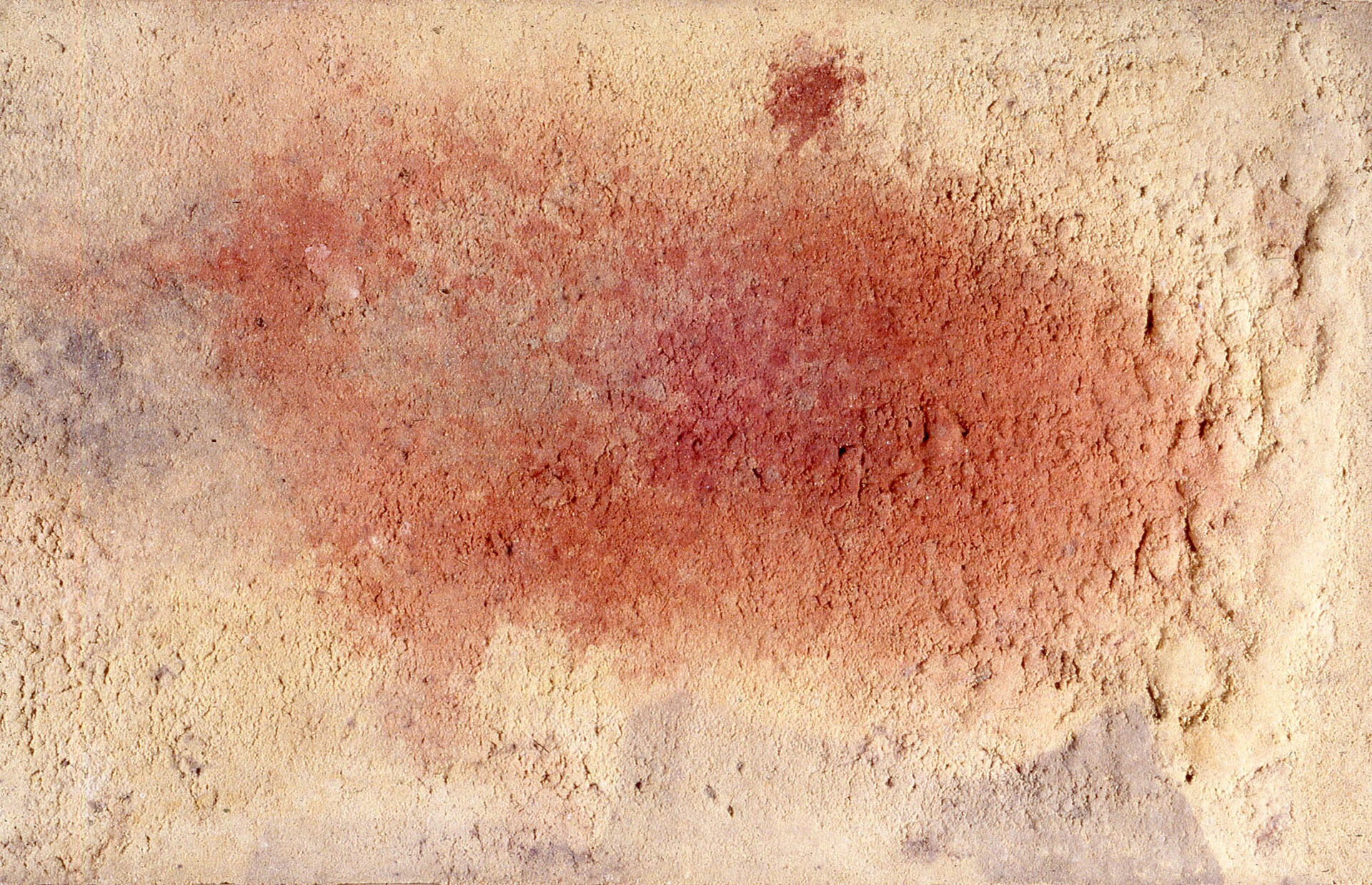
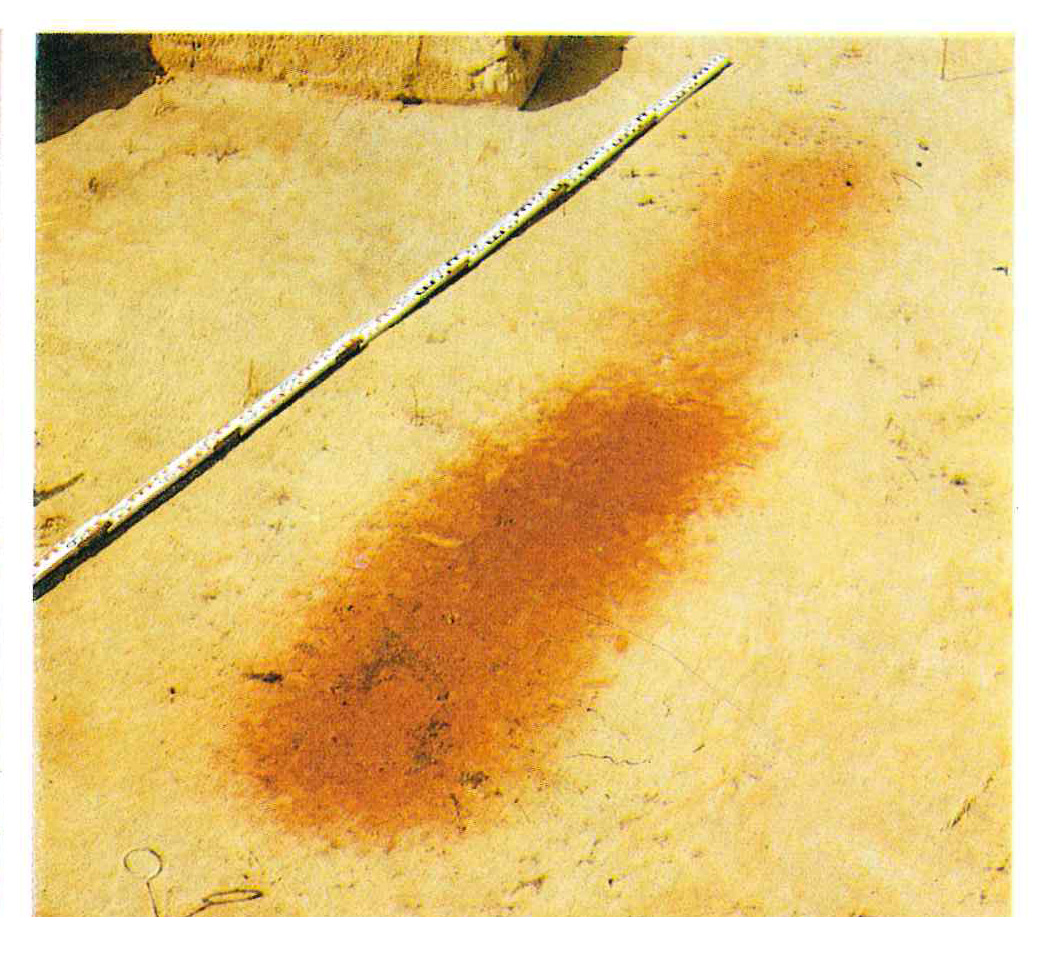
The grave pit was oriented in an east-west direction and had a shallow base. The actual grave fill of gray sand was only found under a thick layer of animal corpse fire. The sand became intensely red in color with increasing depth due to scattered red chalk particles. Beneath this, a thin scattering of cremated remains came to light. In the western part of the pit, several pieces of unburnt but poorly preserved teeth were recovered. No other bone remains had survived in the soil.
Annemarie ReckImage Source K.-P. Wechler, Foto ©Museum für Ur- und Frühgeschichte Potsdam/LfA 1989).
Site 2 (grave 1 and grave 2)
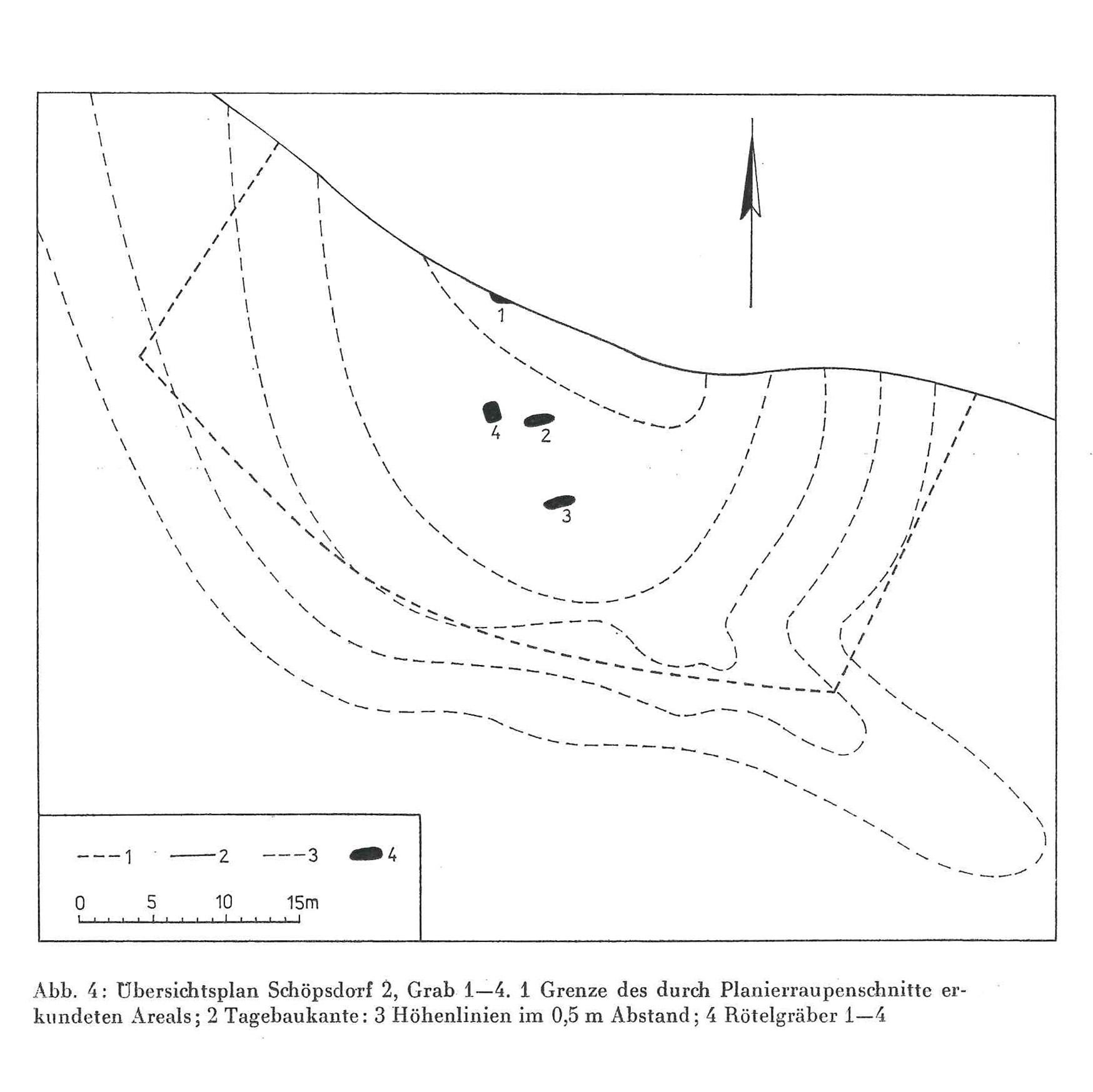
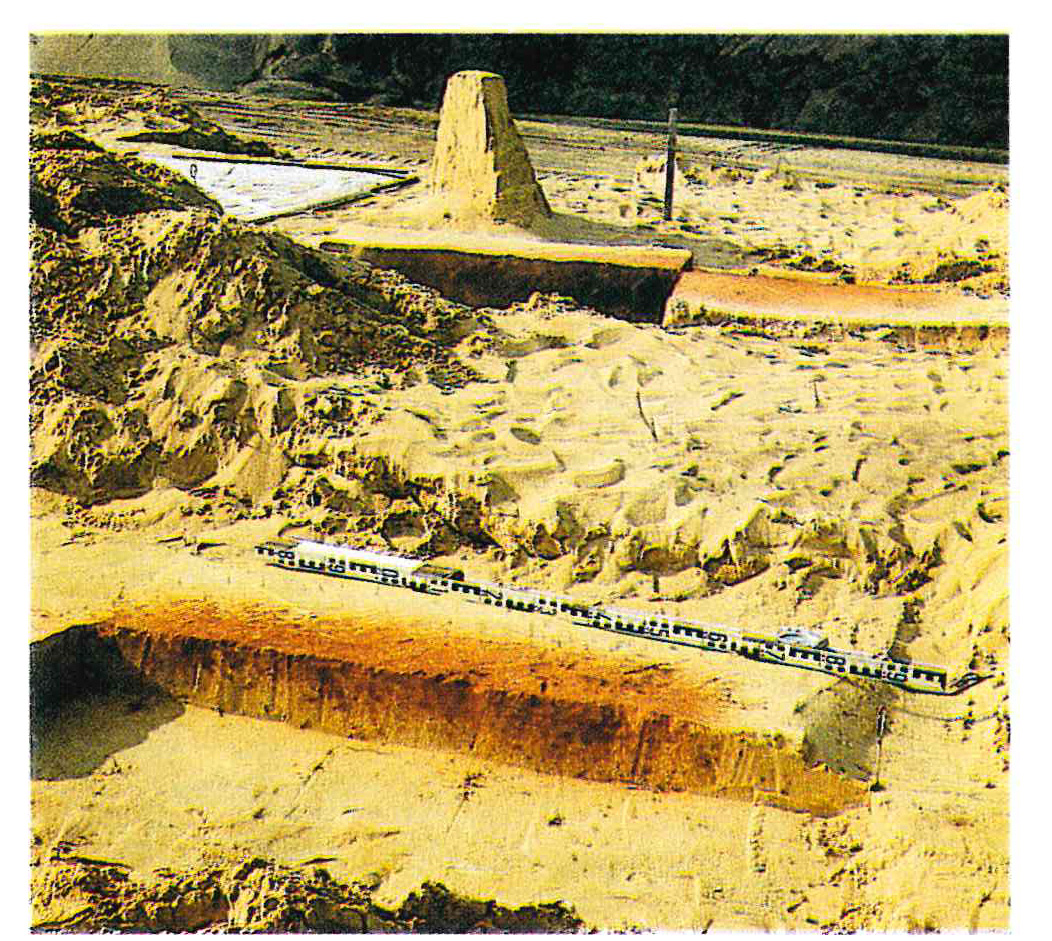
Just under a month later, Heinz Trost discovered another red chalk grave in the profile of the edge of the opencast mine. Grave 1 from site 2 was still preserved with a length of 0.86 m and a width of 0.46 m. The red chalk appeared here from a depth of 1.14 m and became very intense in the further course, especially in the east of the grave. In this area, as in the grave of site 14, unburnt tooth remains were found. In the west, cremated remains were found in places. Otherwise, there was no bone preservation here either.
Annemarie ReckImage Source K.-P. Wechler 1989, 43.
Site 2 (grave 3 and grave 4)
Grave 3 (image) was only preserved to a depth of 0.11 m after leveling The proportion of red chalk was particularly high in the eastern part of the pit. The pit of grave 4 had a rectangular shape with rounded corners. The pit was only visible approx. 1.25 m below ground level and was only 0.16 m deep. The red chalk concentration was strongest in the north-western part above the floor.
Annemarie ReckImage Source K.-P. Wechler 1989, Taf. 1,2.
Stone tools site 14
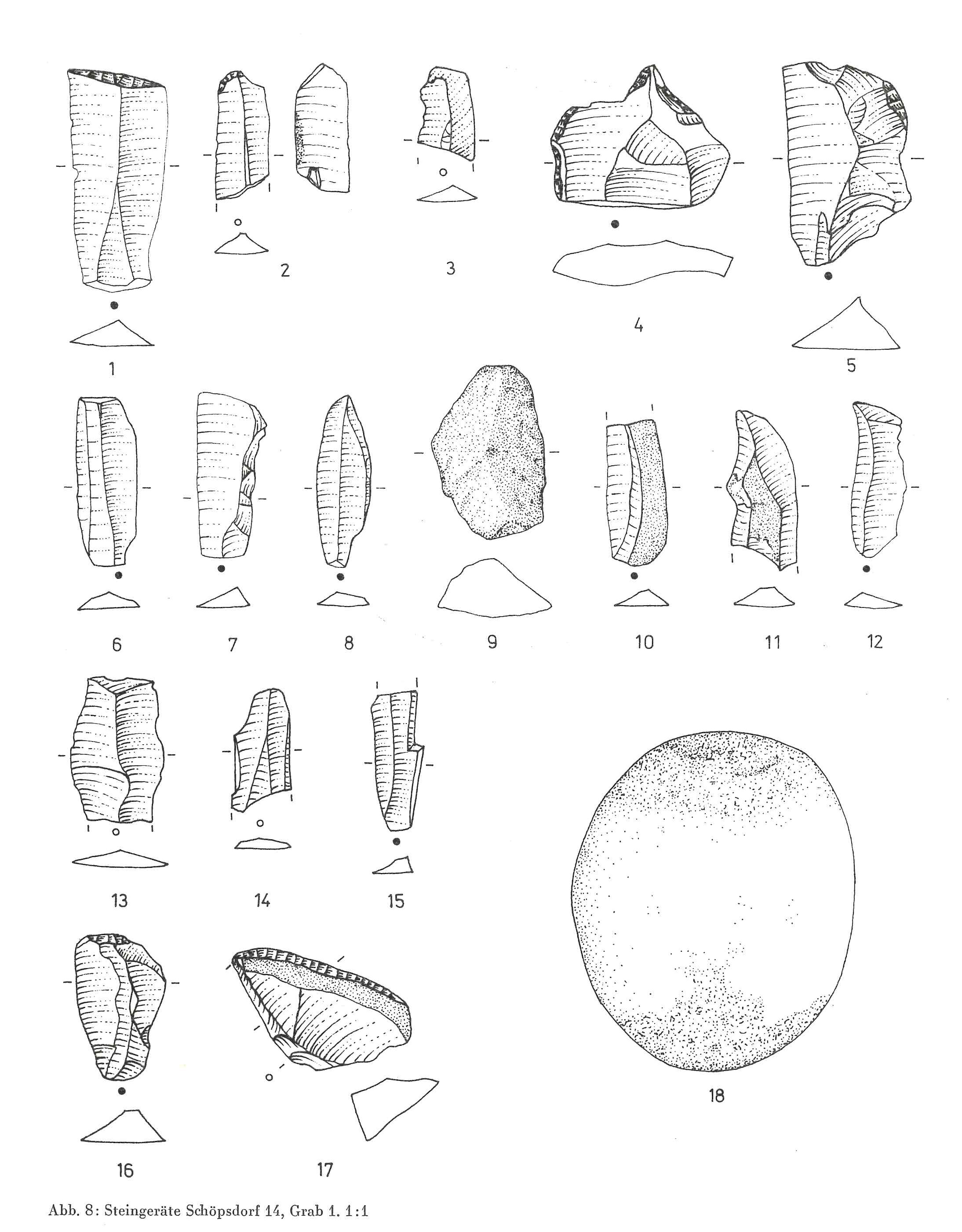
Other smaller pits and hollows were found in the vicinity of the grave at site 14, some of which contained notched remains, microlithic points and triangles. These shapes are typical of flint tools from the Mesolithic period. A total of 31 stone artifacts were recovered from site 14, 29 of which were flint artifacts and two of which were rock artifacts. Two pits at Site 14 also yielded pottery remains of a more recent date.
Annemarie ReckImage Source K.-P. Wechler 1989, 48, Abb. 8.
Stone tools site 2
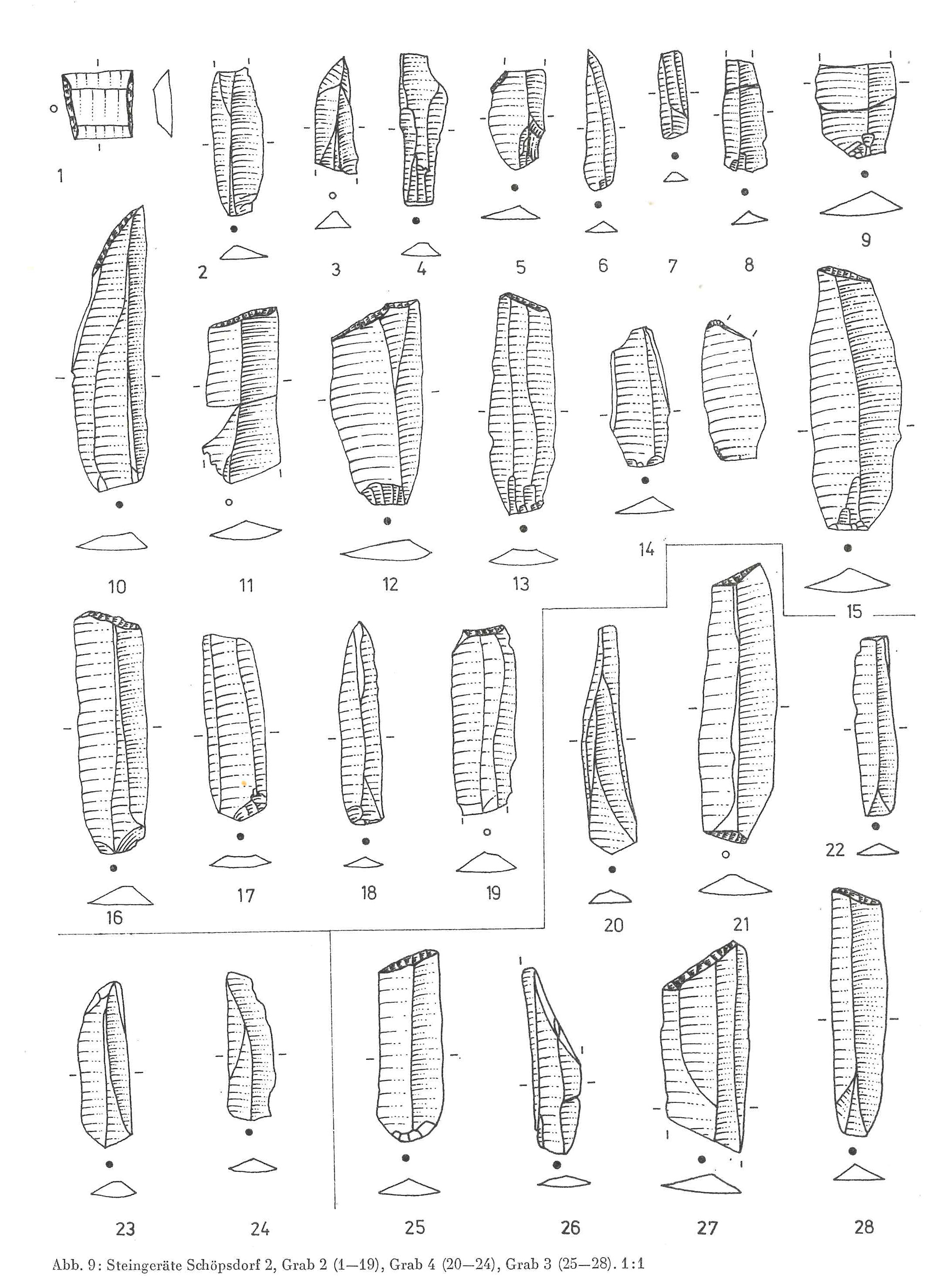
In the area of site 2, microliths had already been collected above ground prior to the discovery of further graves, which suggested further Middle Stone Age features. While the remaining pit of grave 1 was empty, a total of 21 flint artefacts were unearthed in grave 2, four more from grave 3 and five from grave 4, including a striking number of blades with bevel retouch. They were almost all found in the lower areas of the grave fills and were all unburnt. Their distribution appeared to be random.
Annemarie ReckImage Source K.-P. Wechler 1989, 49, Abb. 9.
Graves without bones?
The tooth remains found in two of the burial pits indicate that these really were graves. Sediment samples from four of the five graves examined show a significantly higher phosphate content in the pits compared to the surrounding area. This supports the interpretation that the bodies of the buried were merely completely decomposed in the low-lime sandy soil. The heavy use of red chalk in Middle Stone Age graves is now known from numerous sites. From the Danish burial grounds of Vedbæk and Skateholm, however, the great variety of Middle Stone Age graves is also known: in addition to elongated graves for lying burials, squatting burials in shorter or rounded graves also occur. There is also evidence of the burial of human cremated remains. It is conceivable that age, gender or status played a role in the type of burial.
Annemarie ReckImage Source K.-P. Wechler 1989, Taf. 1,5.
Literature
Klaus-Peter Wechler, Steinzeitliche Rötelgräber von Schöpsdorf, Kr. Hoyerswerda. Veröffentlichungen des Museums für Ur- und Frühgeschichte Potsdam 23, 1989, 41–54.
Note on monument protection
Archaeological monuments are protected by the Saxon Monument Protection Act. A permit under monument law is required for ground interventions or construction measures.
Permalink
https://archaeo-sn.de/en/ort/mesolithic-graves-near-schopsdorf/
Citation
Annemarie Reck, Mesolithic graves near Schöpsdorf. In: Landesamt für Archäologie Sachsen, Website archaeo | SN (19.02.2024). https://archaeo-sn.de/en/ort/mesolithic-graves-near-schopsdorf/ (Stand: 29.09.2026)
