

Outdoor station near Dresden-Plauen
| Place: | Plauen (Dresden, Dresden City) |
|---|---|
| Type: | Station/camp/rest area |
| Dating: | Moustérien | 115000 - 60000 before today |
Description
In 1922 and 1923, workers in Dresden-Plauen came across a total of seven stone artifacts and bone remains of several Ice Age animals during the construction of station buildings and the associated removal of the slope embankment. It was the first site in Saxony where tools made by humans were found together with the remains of their hunting prey. Although the find complex is too small to be able to assign the flint tools to known form groups, a stratigraphic classification of the finds indicates a Middle Palaeolithic age. Together with a site in Zwickau, this is one of the few known Palaeolithic Neanderthal sites outside the Leipzig lowland bay.
Annemarie ReckDiscovery of the site
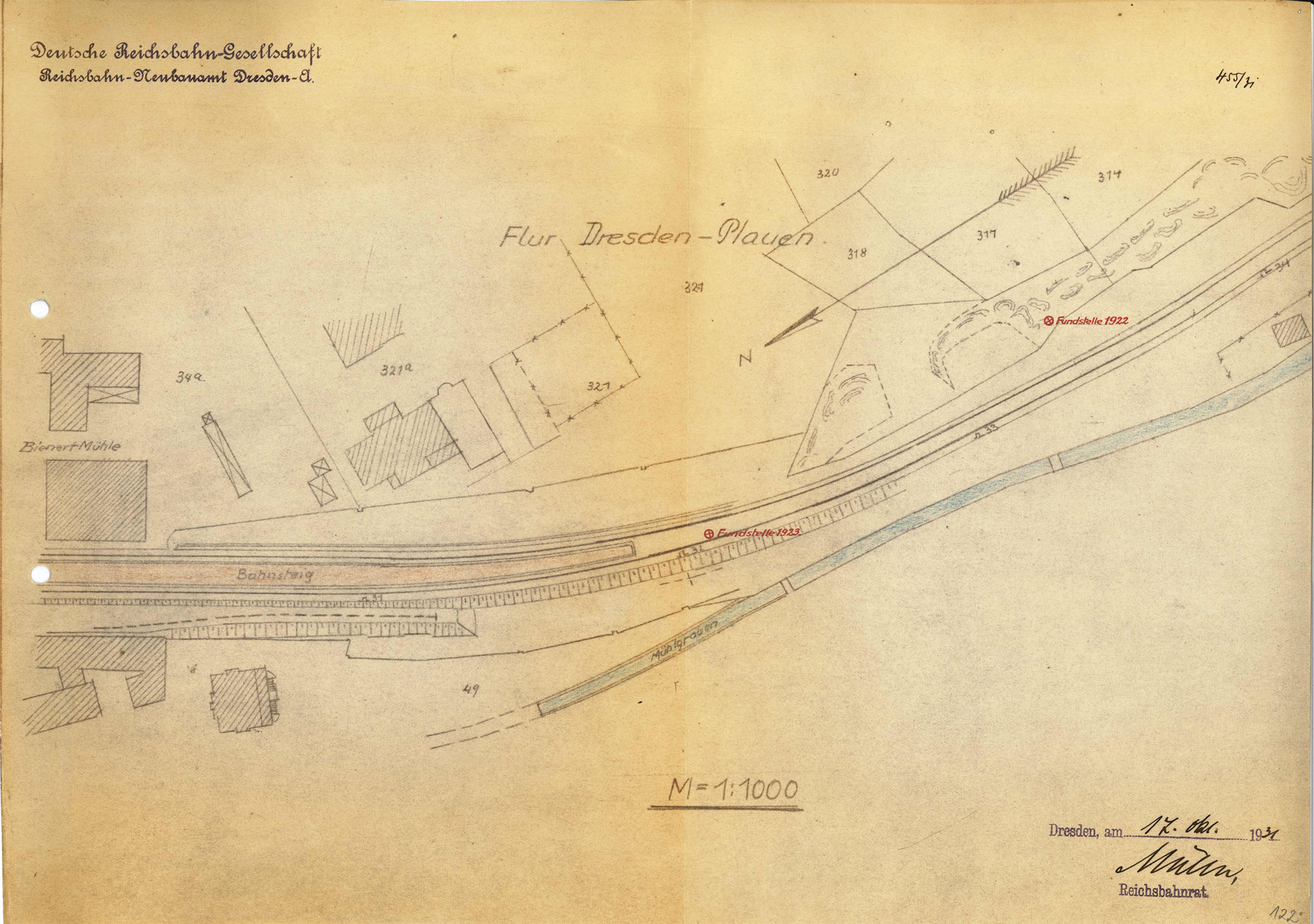
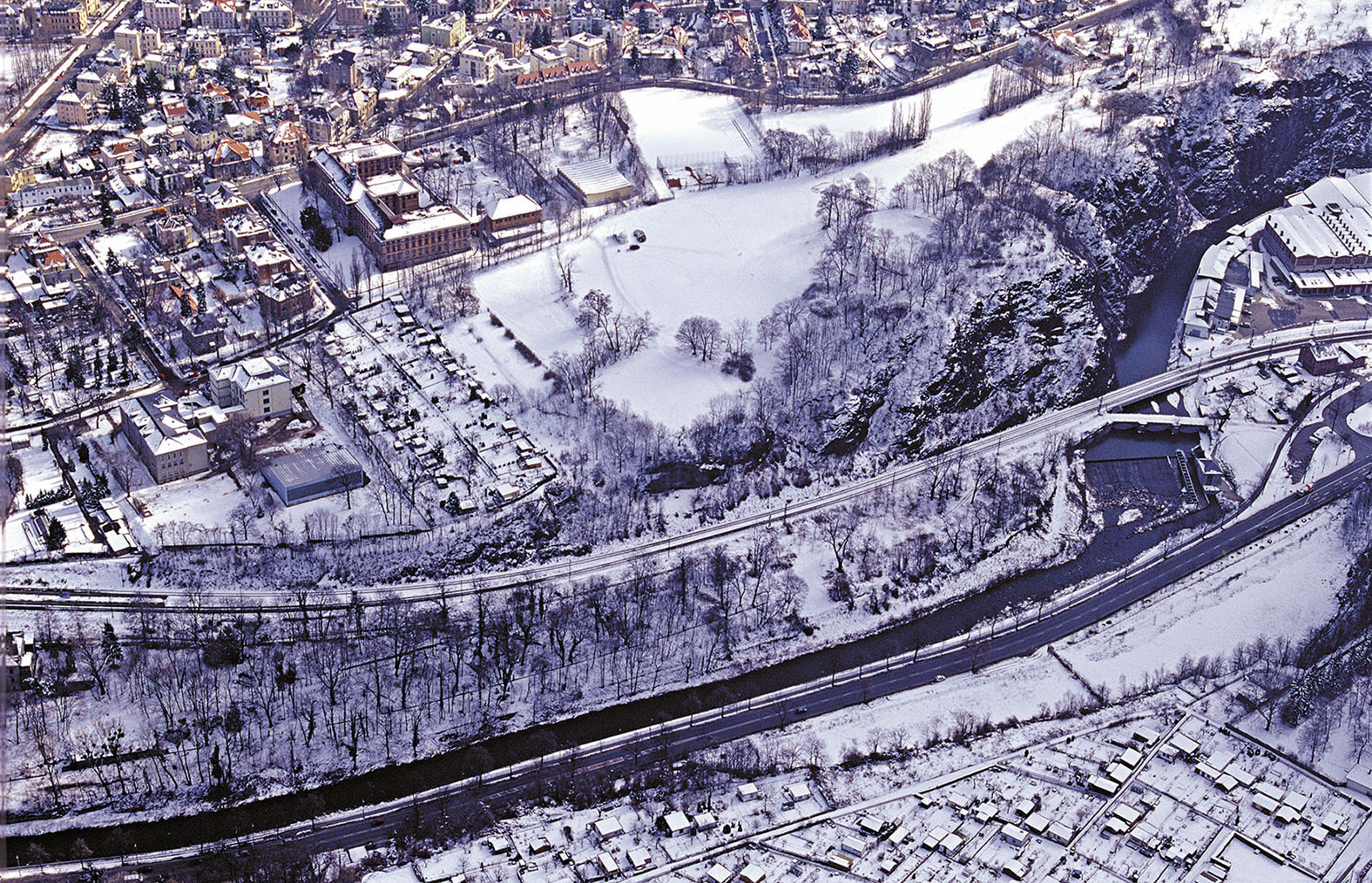
The site is located in the south-western part of Dresden on the eastern bank of the Weißeritz and along the railroad line towards Chemnitz. The discovery of the finds is due to the attentive Reichsbahnrat Otto Müller, who handed the finds over to the then State Museum of Mineralogy, Geology and Prehistory in Dresden. Probably due to inflation and excessive costs, construction work at the station was not interrupted in favor of an excavation. The director at the time, Johannes V. Deichmüller drew up a profile sketch, but no measurements were taken. As he retired shortly afterwards, it took almost ten years for his successor to rediscover the finds in the archive, which were important for Saxony's history. He contacted Müller, who, according to his own statement, still remembered them well. Together with his measuring assistant at the time, Martin Tienelt, he subsequently drew up a plan of the discovery site. The finds from Dresden-Plauen were first published by Georg Bierbaum in 1932 and then reworked by Volker Toepfer in 1960.
Annemarie ReckImage Source O. Müller, OA 02490, 122 ©LfA 1931.
Dating
On the basis of the profile recorded by Johannes V. Deichmüller, the site can be classified geologically. Above the syenite rock in the slope area was a layer of loam, which was overlaid by a loess loam with loess cobbles in it. The finds are thought to have come from the separating layer between the two, possibly an old surface. V. Toepfer interpreted the profile to mean that the loess layer is the soil deposit between the last warm period and the peak phase of the Weichselian cold period. The finds from the lower part of the loess layer could therefore be roughly dated to the beginning of the Weichselian Ice Age.
Annemarie ReckImage Source R. Heynowski, Foto ©LfA 2006.
Finds
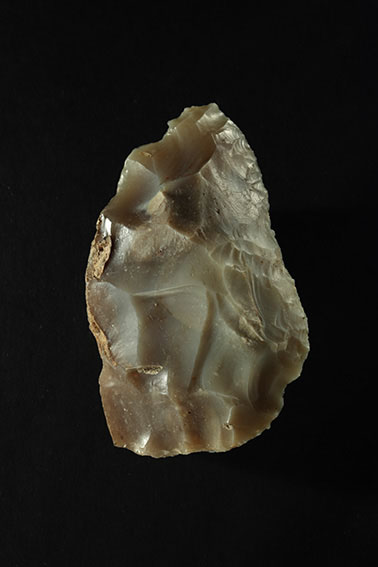
Among the four stone tools are two worked core stones, four flakes and a dorsally surface-retouched scraper. One of the flakes fits securely to a core stone. In addition to light to dark gray Baltic flint, reddish-brown chalcedony and white-gray quartz were also used to make the stone artifacts. Among the prey remains were two molars and a lower jaw remnant from the woolly rhinoceros as well as bones from wild horses and mammoths. The latter is an open tibia bone, the narrow side of which has been worked to produce a shovel-like implement.
Annemarie ReckImage Source A. Kaltofen, Foto ©LfA 2019.
Literature
Georg Bierbaum, Dresden-Plauen (Bienertmühle), die erste paläolithische Fundstelle Groß-Dresdens. Sitzungsberichte der naturwissenschaftlichen Gesellschaft ISIS in Dresden 1931 (1932) 171–175.
Volkmar Geupel, Mittelpaläolithische Fundstelle Dresden-Plauen. In: Heinz-Joachim Vogt (Hrsg.), Archäologische Feldforschungen in Sachsen. Arbeits- und Forschungsberichte zur sächsischen Bodendenkmalpflege, Beih. 18 (Berlin 1988) 29–31.
Volkmar Toepfer, Die paläolithischen Funde von Dresden-Plauen. Arbeits- und Forschungsberichte zur sächsischen Bodendenkmalpflege 7 (1960) 66–85.
Note on monument protection
Archaeological monuments are protected by the Saxon Monument Protection Act. A permit under monument law is required for ground interventions or construction measures.
Permalink
https://archaeo-sn.de/en/ort/outdoor-station-near-dresden-plauen/
Citation
Annemarie Reck, Outdoor station near Dresden-Plauen. In: Landesamt für Archäologie Sachsen, Website archaeo | SN (01.02.2024). https://archaeo-sn.de/en/ort/outdoor-station-near-dresden-plauen/ (Stand: 26.09.2026)
