

Paganism near Löbsal
| Place: | Löbsal (Diera-Zehren, Meissen) |
|---|---|
| Type: | Shallow grave/flat grave field with cremation graves |
| Dating: | Later Bronze Age | Lusatian culture | 1350 - 750 BC. |
Description
The "Paganism" cemetery“ lies south to southwest of the village of Löbsal and north of the Golkwald forest. It covers an area of around 3 hectares. The Bronze Age necropolis is a cremation burial ground with urn graves or cremation mounds. However, there is also a reference to a body grave . The burial ground was used at around the same time as the Löbsal castle hill. It is therefore assumed that "paganism“ the site was a cemetery for the inhabitants of the castle hill.
Annemarie ReckDiscovery
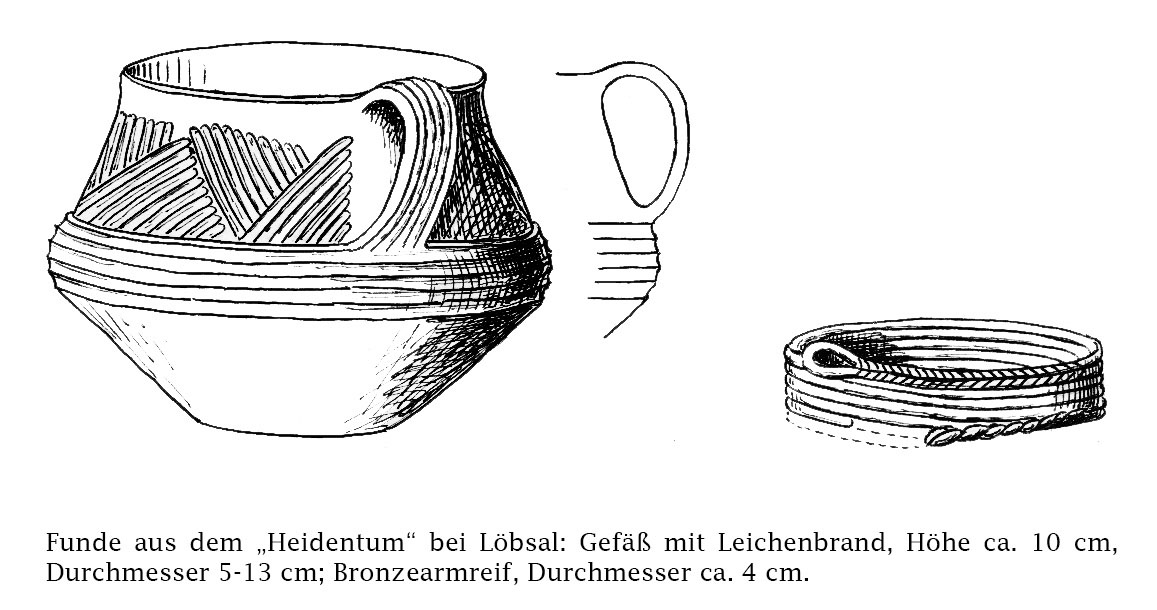
The site was discovered in 1826 during field work. The peculiar name of the site probably dates from this time. Some of the finds were presented to Karl Preusker from Großenhain. He described the finds in detail and added them to his collection. Today he is regarded as the "father of Saxon archaeology". In the following hundred years, new finds continued to come to light on the "Heidentum", such as ceramic vessels, bracelets and robe needles.
Annemarie ReckImage Source O. Kleemann, Zeichnung/A. Reck, Bearbeitung, OA 59190, 48 ©LfA 2023.
Reference to metal trade
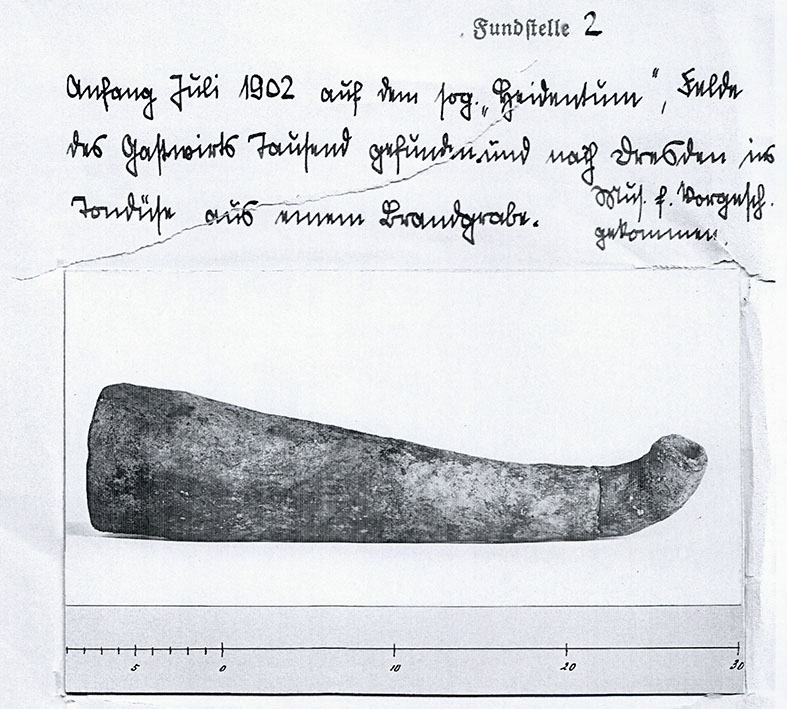
A find report from 1901 also mentions "ancient clay rings, children's toys and bronze lances". A special find is a complete clay nozzle (picture) recovered in 1902, which is unfortunately lost today. Such nozzles were used in bronze processing. The find therefore indicates that bronze was processed in the nearby settlement on Löbsaler Burgberg. It is possible that the person buried with the clay nozzle was engaged in metalworking there.
Annemarie ReckImage Source OA 59190, 384 ©LfA 1902.
Lost property report from a pupil
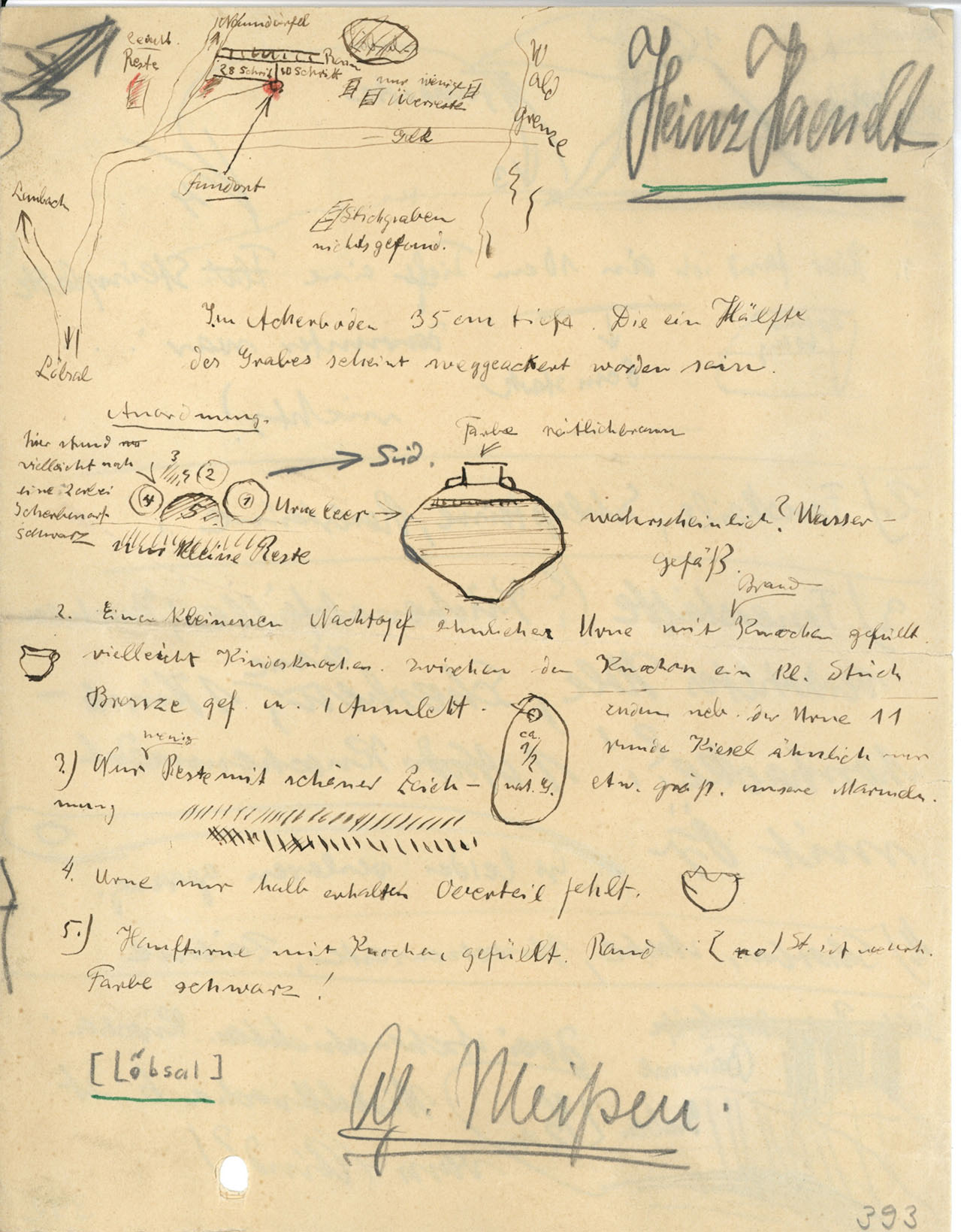
In 1921, schoolboy Heinz Haenelt came across a grave that had been partially destroyed by the plow in the area of today's playground. He recovered a well-preserved amphora, two urns with cremated remains and bones and a stone amulet. His handwritten description of the find is kept in the local file.
Annemarie ReckImage Source OA 59190, 393 ©LfA 1921.
Emergency excavation 1996
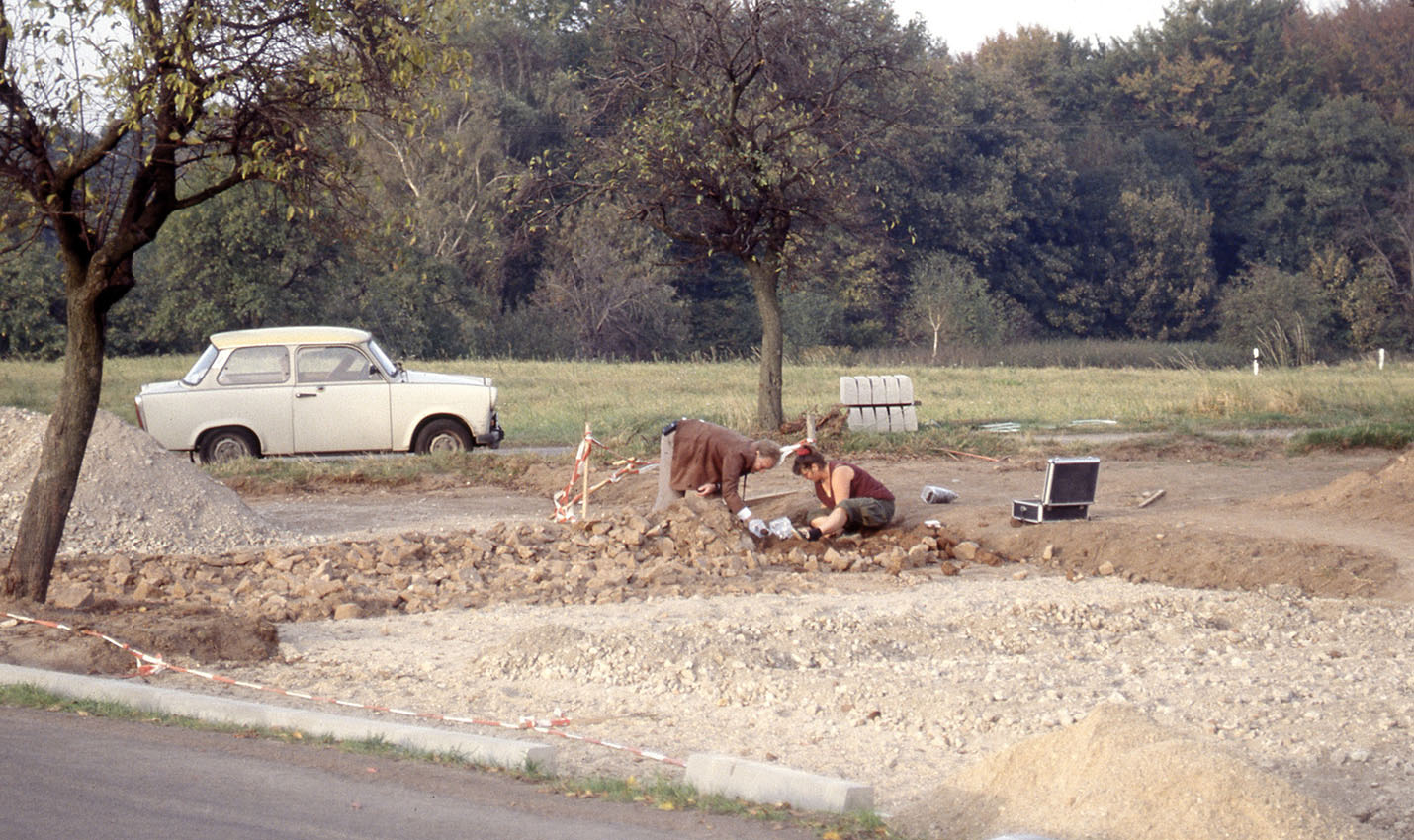
During the construction of a parking lot in 1996, three more vessels were discovered not far away, which were recovered during an emergency excavation. As none of them contained cremated remains, they were probably grave goods.
Annemarie ReckImage Source Foto ©LfA 1996.
Literature
Karl B. Preusker, Blicke in die vaterländische Vorzeit, Sitten, Sagen, Bauwerke und Geräthe, zur Erläuterung des öffentlichen und häuslichen Volkslebens im heidnischen Alterthume und christlichen Mittelalter der sächsischen und angrenzenden Lande (Leipzig 1841).
Henning Stilke, Der erste archäologische Lehrpfad in Sachsen. Archäologie Aktuell 6, 1998–1999 (2000) 220.
Note on monument protection
Archaeological monuments are protected by the Saxon Monument Protection Act. A permit under monument law is required for ground interventions or construction measures.
Permalink
https://archaeo-sn.de/en/ort/paganism-near-lobsal/
Citation
Annemarie Reck, Paganism near Löbsal. In: Landesamt für Archäologie Sachsen, Website archaeo | SN (01.02.2024). https://archaeo-sn.de/en/ort/paganism-near-lobsal/ (Stand: 29.09.2026)
