

Palaeolithic site at Markkleeberg
| Place: | Markkleeberg (Markkleeberg, Leipzig) |
|---|---|
| Type: | Station/camp/rest area |
| Dating: | Acheuléen | Moustérien | after 280000 │about 160000 before today |
Description
The Palaeolithic open-air site at Markkleeberg marks the first verifiable appearance of humans in Saxony and is therefore also the oldest archaeological site in the state. Its great importance for research stems not only from its age, but also from the special design of the stone tools found there, which were "ahead of their time"“ seem to be. The early dating of the finds was therefore discussed and doubted by experts for a long time. This was accompanied by the question of whether the people who made these devices were Homo neanderthalensis (around ca. 130000 before today) or even Homo heidelbergensis (around ca. 280000 before today) were.
Annemarie ReckLocation of the site
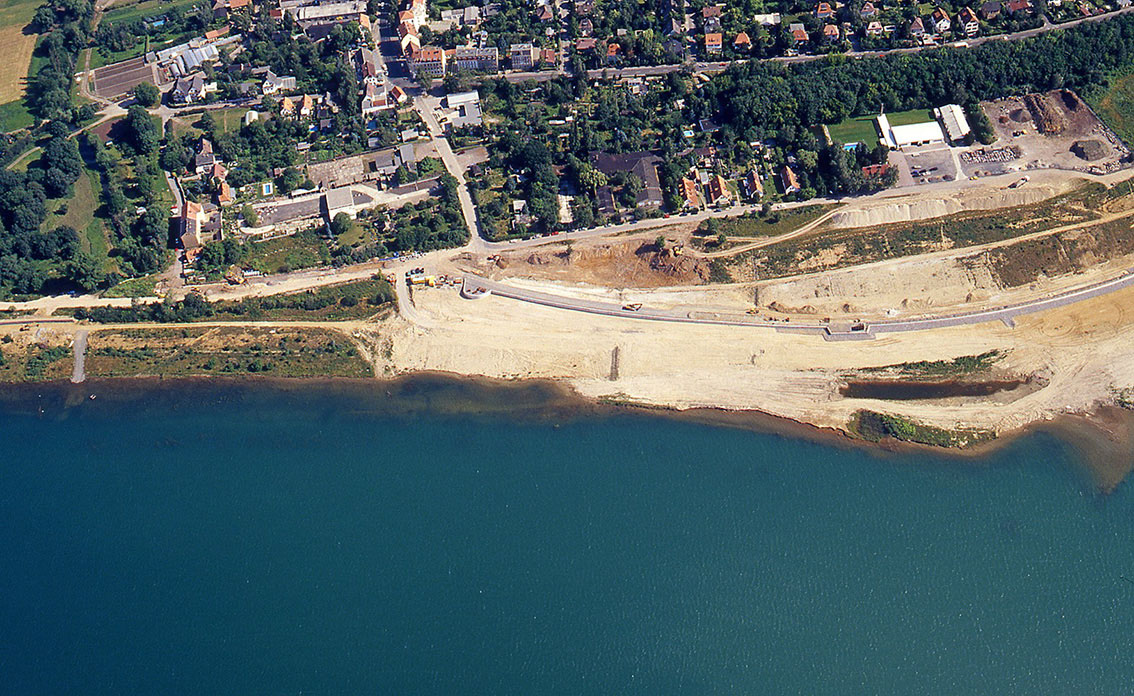
The site is located directly south of the town of Markkleeberg (Leipzig district) on the northern edge of the now flooded "Espenhain" open-cast lignite mine. The original extent of the site and how much of it was lost due to open-cast mining is unclear. Especially as pits for gravel extraction were already being operated there towards the end of the 19th century.
Annemarie ReckImage Source R. Heynowski, Foto ©LfA 2004.
Find story
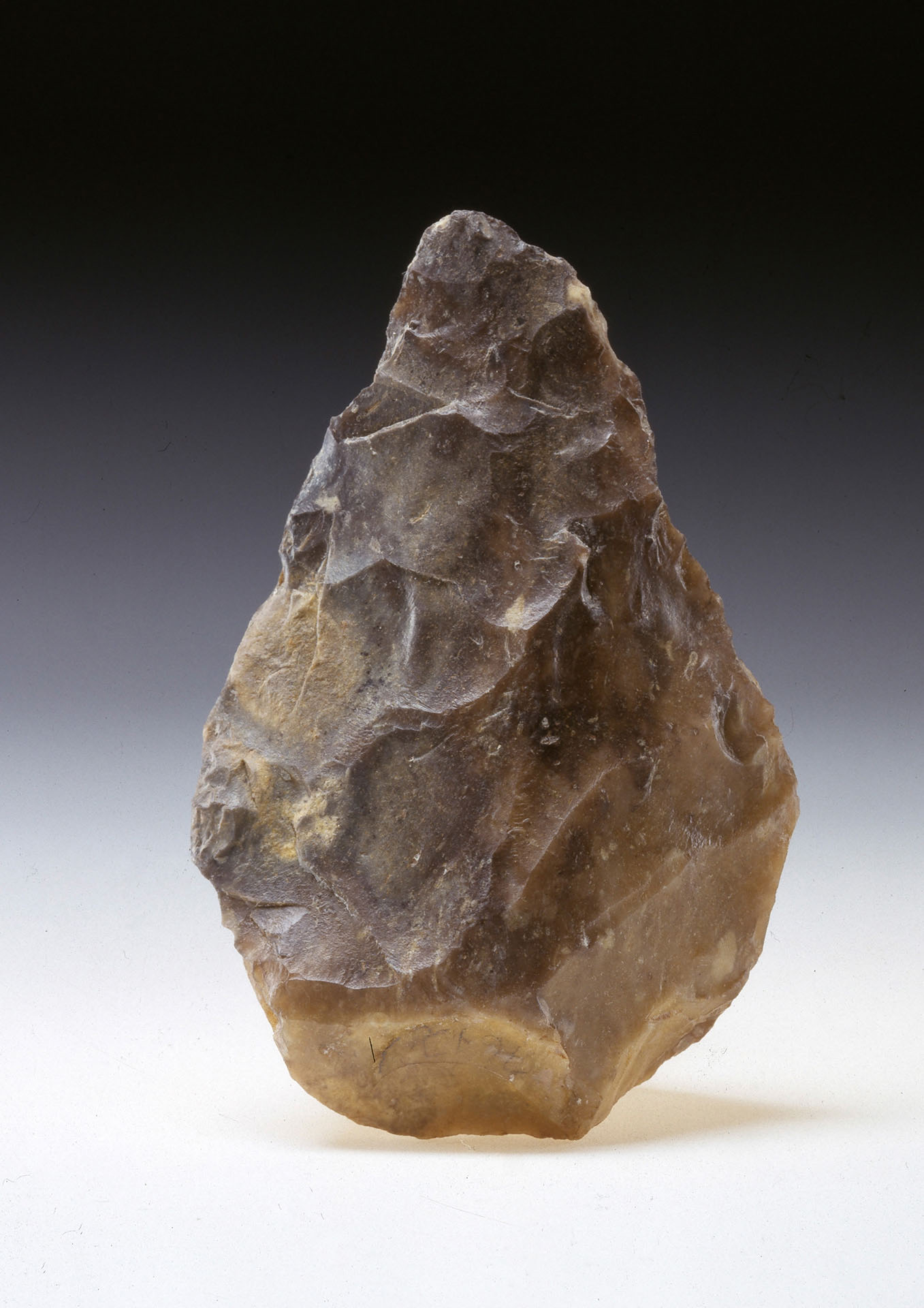
The first finds caught the eye of geologist Franz Etzold as early as 1895. While digging in the gravel pit, he came across a mammoth skull and a strikingly shaped piece of flint that looked like it had been fashioned into a tool. However, he did not publicize his find. In 1905, Karl Hermann Jacob (1884-1960), later known as Jacob-Friesen, visited the gravel pit. He had been commissioned by Hugo Obermaier, a co-founder of European Palaeolithic research, to search for eoliths. Eoliths are naturally broken stones that resemble man-made artifacts, but are not. He wanted to present them as counter-evidence to the theory of early human settlement in Europe. To his own astonishment, however, he discovered that the stones sent to him by Jacob were in fact man-made tools.
Annemarie ReckImage Source J. Lipták, Foto ©LfA 2000.
Research by R. Grahmann
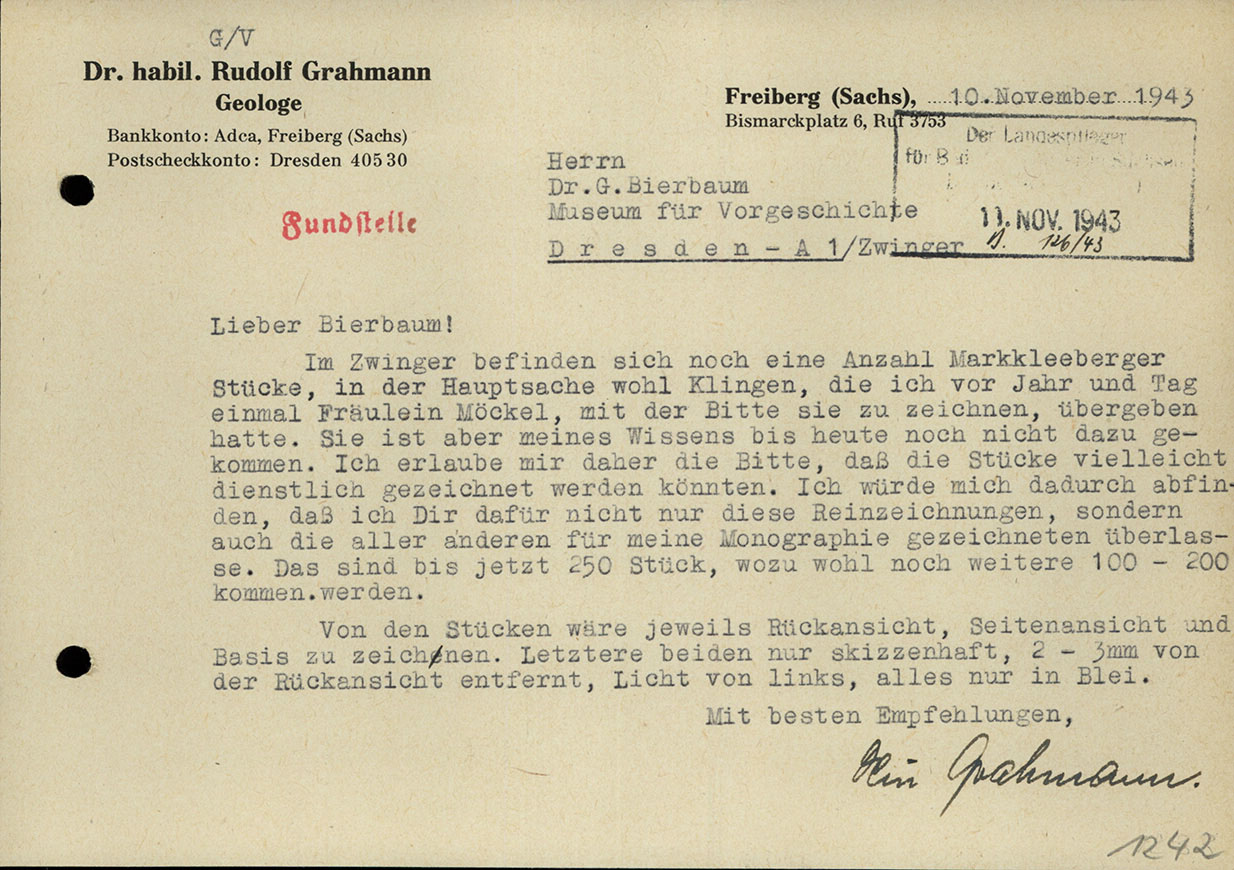
Between 1930 and 1950, the Saxon geologist Rudolf Grahmann was particularly interested in the finds from Markkleeberg. He began to record the finds from Markkleeberg from various collections in a card index and published numerous papers on the site. He was convinced that ancient Palaeolithic sites could not be reliably dated on the basis of tool characteristics, but only on the basis of stratigraphic sequences in geology. Based on his investigations at the Markkleeberg site, he assumed a date at the beginning of the Saale glacial period, 150000 years earlier than previously assumed. He thus contradicted previous Palaeolithic research and triggered a decades-long dispute among experts about the age of the Markkleeberg finds. He defended his thesis for over 30 years.
Annemarie ReckImage Source OA 55800, 1242 ©LfA 1942. Landesamt für Archäologie Sachsen 1942.
First attempts at dating
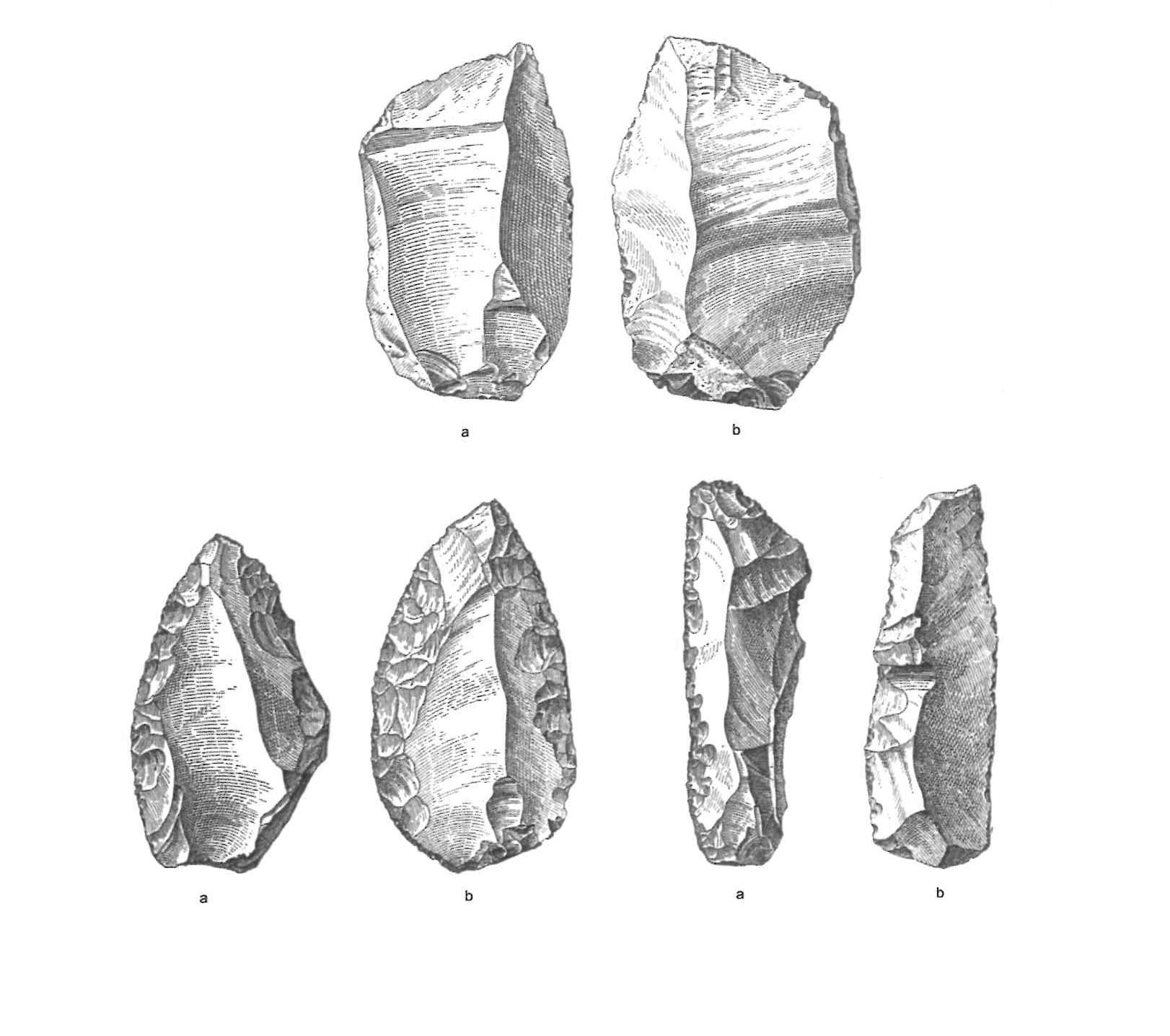
In 1914, Jacob published the Markkleeberg site together with Carl Gäbert. He compared the finds from Markkleeberg (b) with the blades and scrapers made using the Levallois technique from Le Moustier in France (a). The Moustérien culture stage (ca. 120000-40000 BC), named after the site of the find, is considered to be the epoch of the Neanderthals.
Annemarie ReckImage Source I. Kraft 2014, 42, Abb. 5.
Excavations 1977-1980
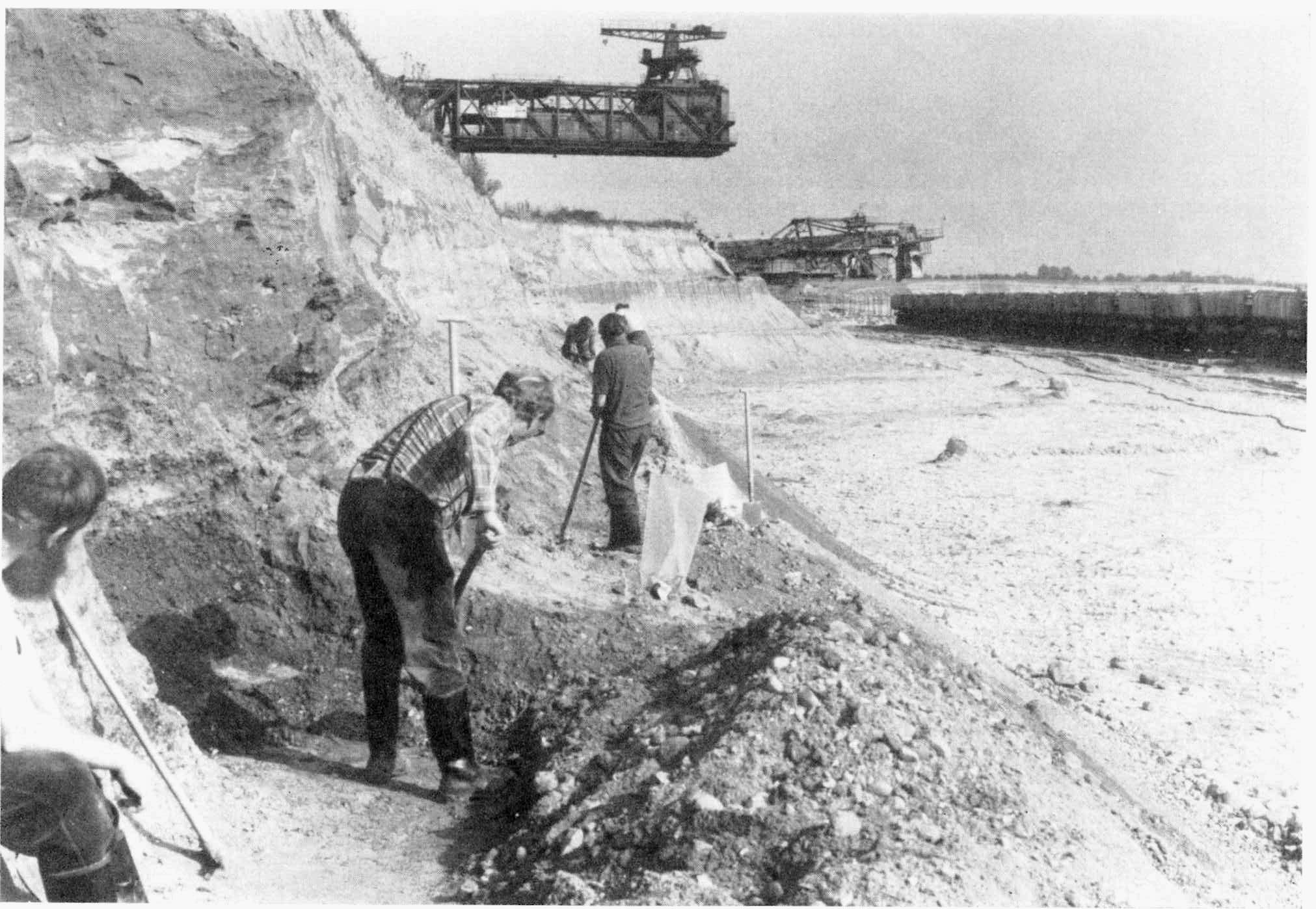
Between 1977 and 1980, when open-cast lignite mining south of Leipzig reached the site, the Dresden and Halle State Museums, under the direction of Willfried Baumann and Dietrich Mania, carried out several small rescue excavations and monument conservation inspections. Whereas previously only the occasional collection had resulted in an unconscious selection of particularly beautiful pieces or blades, it was now possible to observe a wider range of finds. The excavators were particularly struck by the numerous flakes, preparation pieces and unfinished products. Whereas the site had previously been regarded merely as a hunting ground, they associated it with the supply of raw flint.
Annemarie ReckImage Source W. Baumann/D. Mania 1982, 261, Taf. 14.
Geology and post-excavation
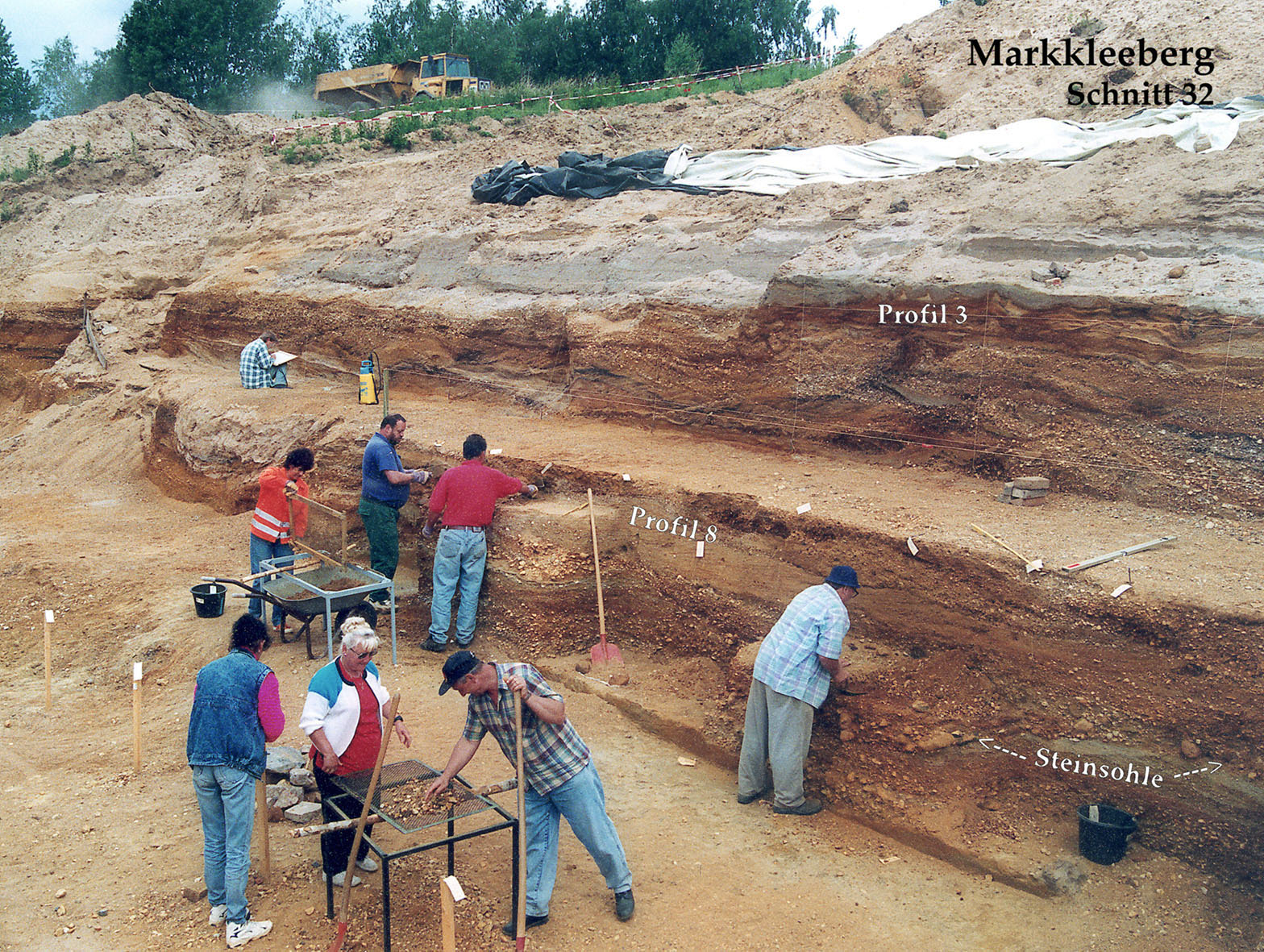
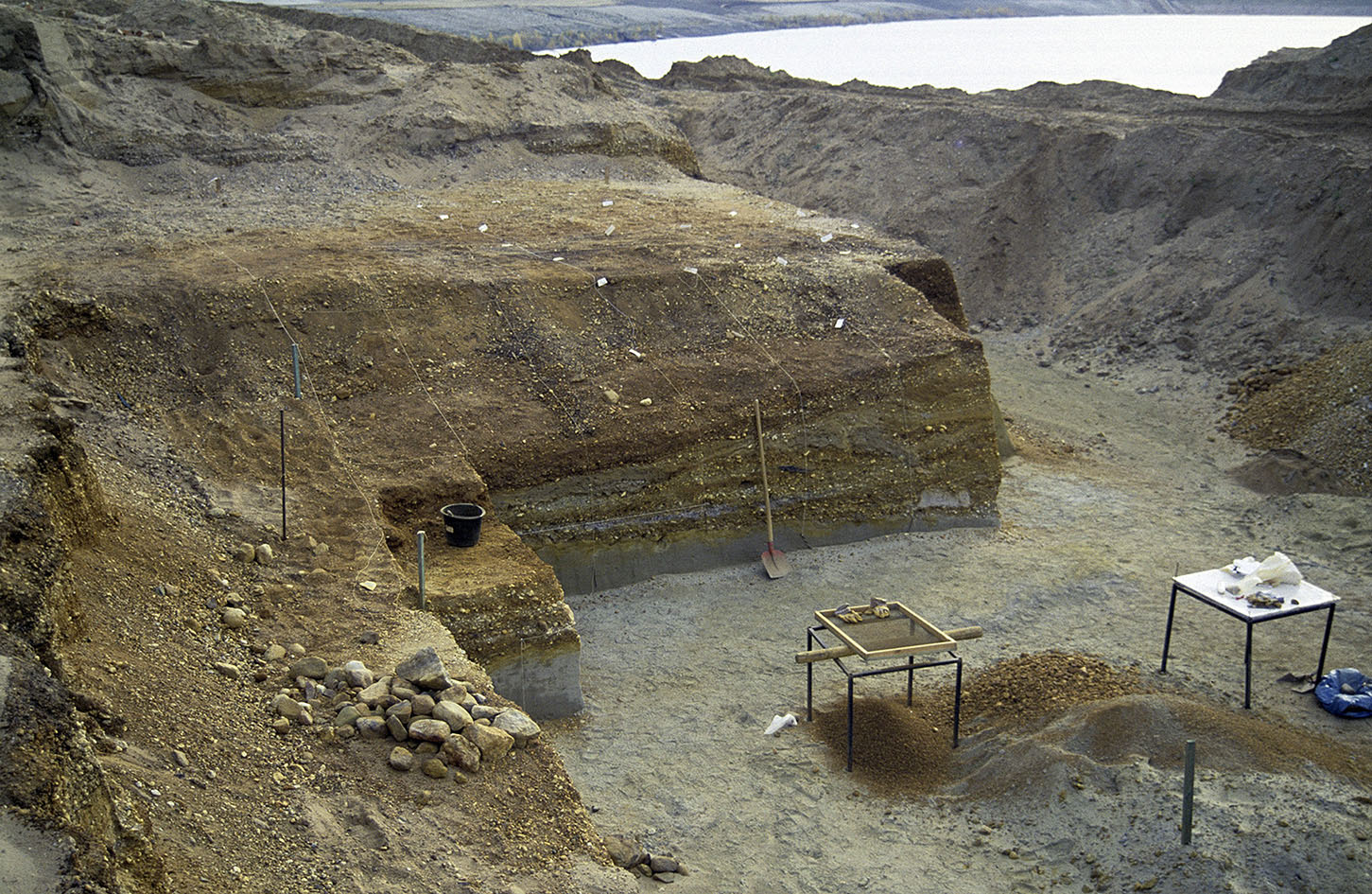
New geochronological investigations were also carried out by Lothar Eißmann on the large open-cast mining profiles. This showed that, in addition to the main discovery layer at the "Steinsohle", there were even higher, younger discovery layers. Jacob had already observed this. Without assigning layers, the Markkleeberg finds cannot be dated across the board to the oldest find section, as several temporal horizons, between which there may be around 100,000 years, can in fact be defined. Before the Espenhain open-cast mine was flooded, the Saxony State Office for Archaeology was able to carry out further excavations in the northern edge area of the site between 1999 and 2001. The previously observed sequence of layers was confirmed and better understood.
Annemarie ReckImage Source J. Schäfer, Foto ©LfA 1999.
Stratigraphy
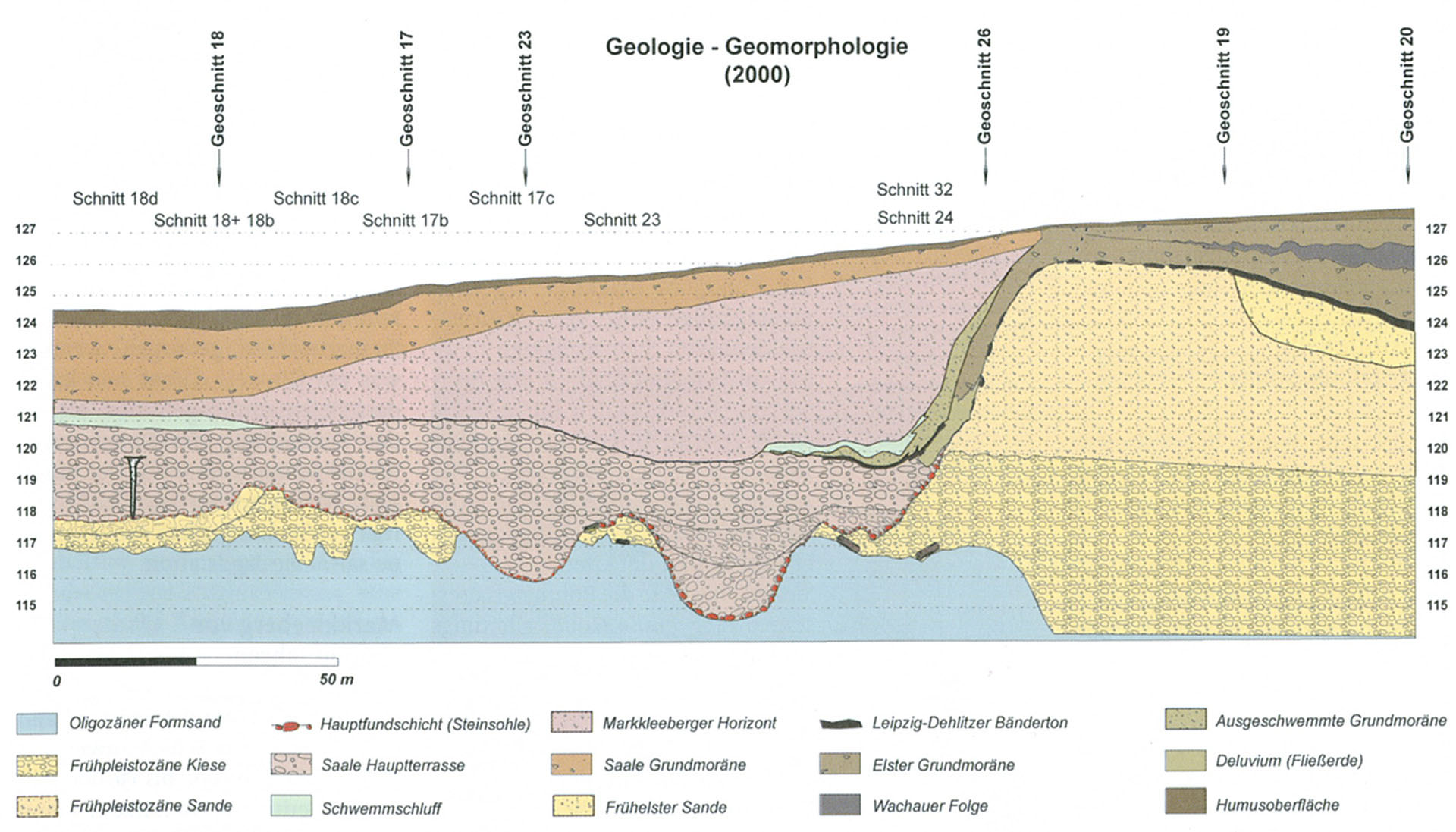
The main layer (approx. 280000 years ago) was located on a former river terrace in a valley that the Pleiße and Gösel rivers had washed through the gravel deposits of the Elster Ice Age. In the process, many Nordic flints were deposited, which the ice-age glaciers from Scandinavia had brought with them. The river system resulted in a thick layer of sand and gravel, in which only isolated finds can be found. In the upper areas, these transition into alluvial sands and silt. The gravel-rich lenses and gullies of this "Markkleeberg horizon" form the upper find layer (approx. 160,000 years ago). Above this are the remains of the Saalian glacial moraine deposited 150000 years ago.
Annemarie ReckImage Source J. Schäfer/T. Laurat/J. F. Kegler 2003, 24.
Bone finds
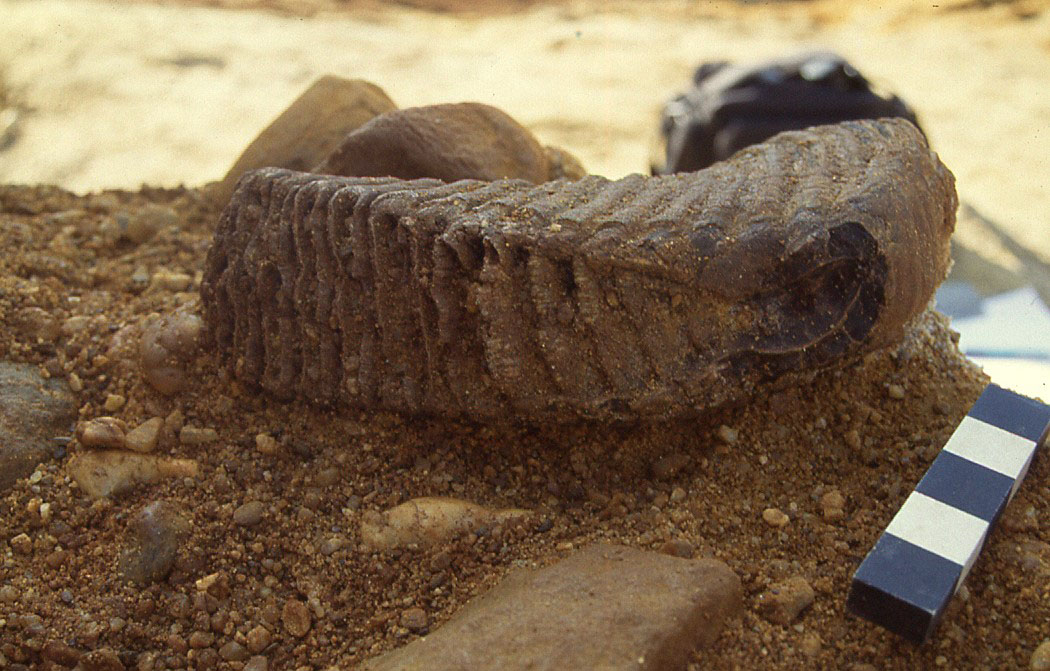
There were only a few bone remains among the excavated finds due to the limestone-poor soil. Most of these were from very large animals such as mammoths, rhinoceroses, deer or wild forms of cattle and horses. Remarkable is the discovery of a collection of fossilized sea urchins in the area of the "stone sole". As they have no practical use, they were probably only picked up by early humans 28,000,000 years ago for their beautiful appearance.
Annemarie ReckImage Source J. Schäfer, Foto ©LfA 2000.
Link smac 360° archaeo | 3D
The flint inventory
Today, there are an estimated 15,000 finds from Markkleeberg in various collections. However, only very few of these are classic tools such as blades, scrapers or blade tips. The majority of the finds are waste from chipping and flaking stone tools. It is therefore assumed that early humans searched the river gravels specifically for flint nodules, some of which they prepared into tools on site to take with them to the actual storage site.
Annemarie ReckImage Source J. Schäfer, Foto ©LfA 2000.
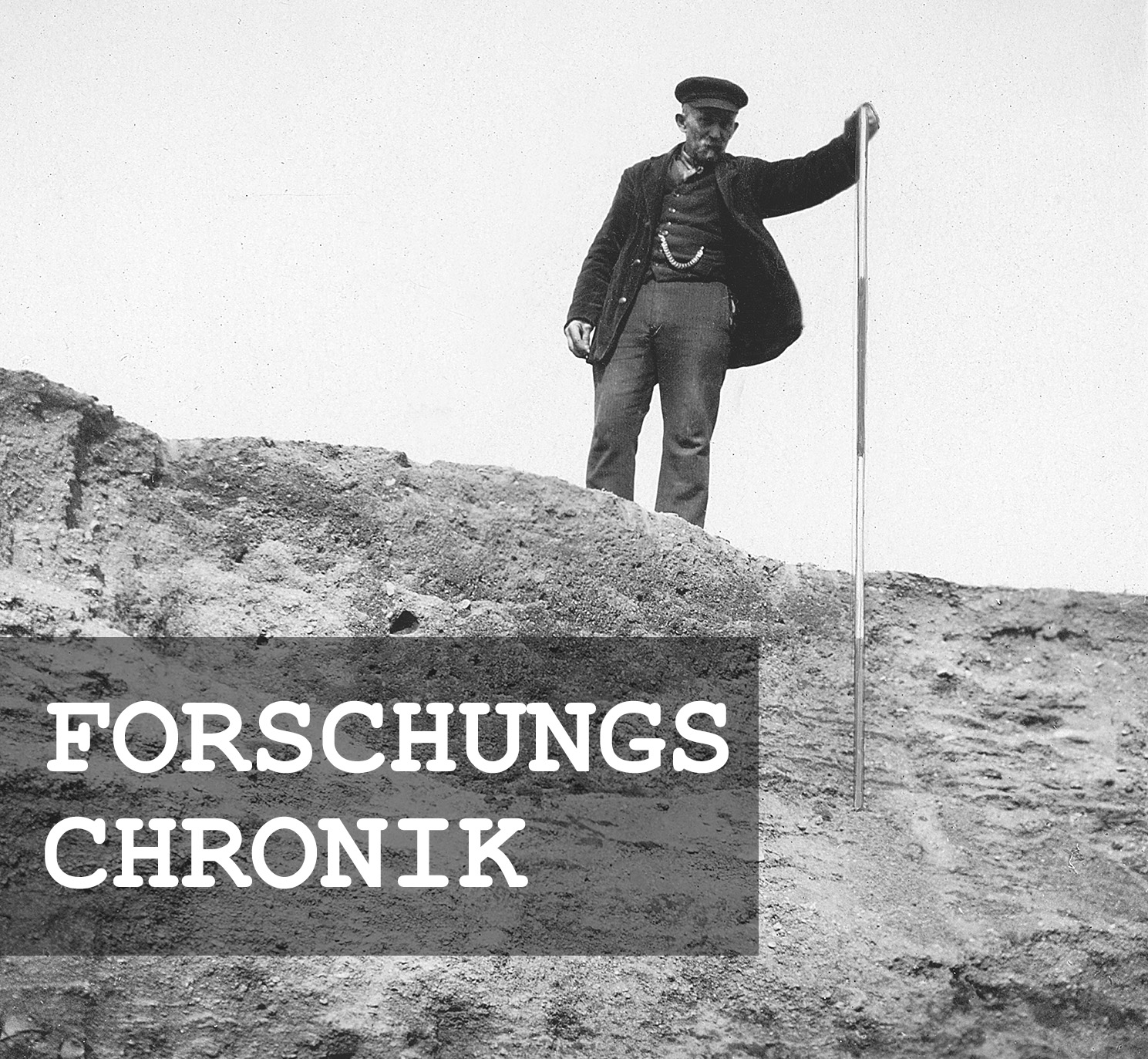
Research chronicle
Image Source Foto ©LfA 2024.
Literature
Willfried Baumann/Dietrich Mania, Die paläolithischen Neufunde von Markkleeberg bei Leipzig. Veröffentlichungen des Landesmuseums für Vorgeschichte Dresden 16 (Berlin 1983).
Volkmar Geupel, Frühmittelpaläolithische Fundstelle Markkleeberg. In: Heinz-Joachim Vogt (Hrsg.), Archäologische Feldforschungen in Sachsen. Arbeits- und Forschungsberichte zur sächsischen Bodendenkmalpflege, Beih. 18 (Berlin 1988) 19–26.
Ingo Kraft, Markkleeberg. In: Sabine Wolfram (Hrsg.), In die Tiefe der Zeit, 300.000 Jahre Menschheitsgeschichte in Sachsen, Buch zur Dauerausstellung (Dresden 2014) 40–44.
Joachim Schäfer/Thomas Laurat/Jan F. Kegler, Bericht zu den Ausgrabungen am Altsteinzeitlichen Fundplatz Markkleeberg 1999 bis 2001. In: Judith Oexle (Hrsg.), Arbeits- und Forschungsberichte zur sächsischen Bodendenkmalpflege 45, 2003, 13–47.
Note on monument protection
Archaeological monuments are protected by the Saxon Monument Protection Act. A permit under monument law is required for ground interventions or construction measures.
Permalink
https://archaeo-sn.de/en/ort/palaeolithic-site-at-markkleeberg/
Citation
Annemarie Reck, Palaeolithic site at Markkleeberg. In: Landesamt für Archäologie Sachsen, Website archaeo | SN (01.02.2024). https://archaeo-sn.de/en/ort/palaeolithic-site-at-markkleeberg/ (Stand: 29.09.2026)
