

Poor Clares Convent and Seußlitz Castle
| Place: | Seußlitz (Nünchritz, Meißen) |
|---|---|
| Type: | Monastery complex | Castle complex |
| Dating: | Late Middle Ages | Modern times | since 1268 AD. |
Description
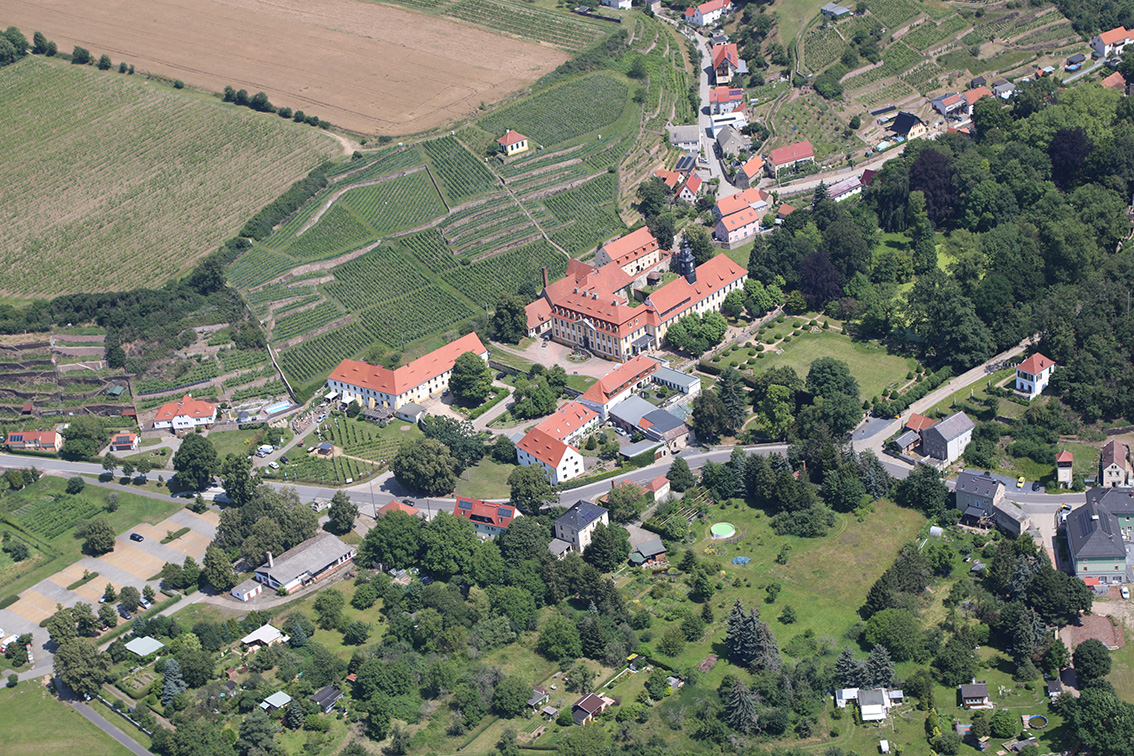
Margrave Henry III. of Meissen founded Saxony's first convent of Poor Clares in Seußlitz in 1268 at the request of his deceased wife Agnes, a daughter of the Bohemian king. The monastery was destroyed during the Hussite Wars and secularized in 1541. Only a few of the originally numerous medieval gravestones of the nobles buried in the monastery are still preserved today. From 1722, Georg Bähr converted the manor house into a baroque palace with a park, which temporarily housed the Wittenberg University Library. Large parts of the former monastery complex were demolished or rebuilt in the process. Today, the castle is privately owned.
Annemarie ReckThe monastery in the Middle Ages
Today's castle was a Poor Clare monastery in the Middle Ages. The order, which was founded in 1215, is the second, female branch of the Franciscan religious family. It goes back to St. Clare of Assisi (ca. 1193 - 1253), who wanted to found a female community based on the teachings of St. Francis of Assisi (ca. 1181 - 1226). The order quickly gained popularity and spread far and wide. The first nuns moved from the Swabian town of Söflingen near Ulm to the Elbe in 1268 with their abbess Mechthild. Several great women of the Middle Ages joined the convent, such as Gertrud, Duchess of Austria and Styria, whom even Emperor Frederick II had unsuccessfully courted as a bride, or Helene, Margravine of Landsberg. Even at the time of its foundation, the monastery had a rich basic endowment, with property in over 17 villages and income from up to nine outbuildings, which was actually contrary to the principles of the Klarrissen.
Annemarie ReckImage Source A. Reck, Foto ©LfA 2024.
The end of the monastery
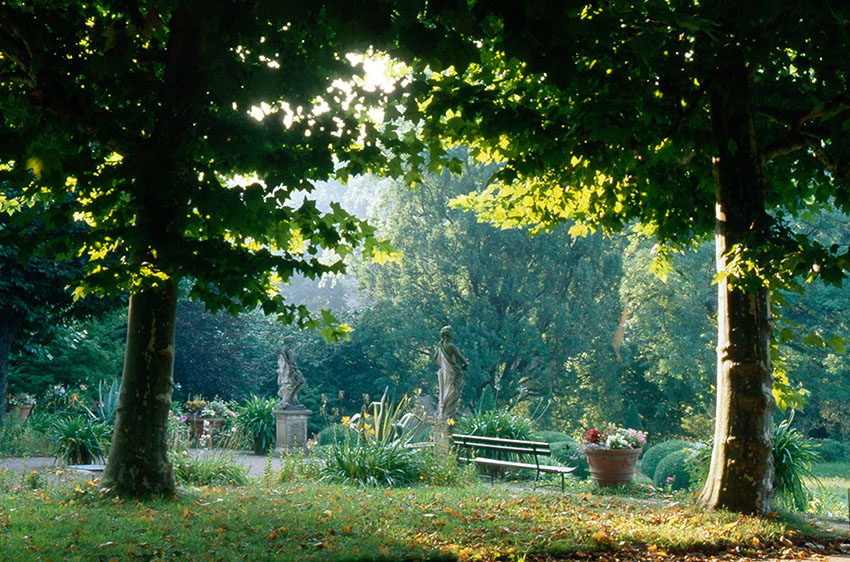
The monastery was destroyed during the Hussite Wars. Nevertheless, the convent remained intact for around a hundred years longer, until the Reformation. From 1524 onwards, nuns were repeatedly taken from the convent by Martin Luther and his like-minded followers. After the convent was dissolved in 1541, it was sold to the ducal chancellor Simon Pistoris. At the beginning of the 18th century, the manor was bought by Heinrich von Bünau, Chancellor of Augustus the Strong. He commissioned Georg Bähr, the builder of Dresden's Frauenkirche, to redesign the palace and park in the Baroque style.
Annemarie ReckImage Source O. Spitzner, Foto ©LfA 2002. Landesamt für Archäologie Sachsen/Spitzner 2002.
Remains of the monastery complex
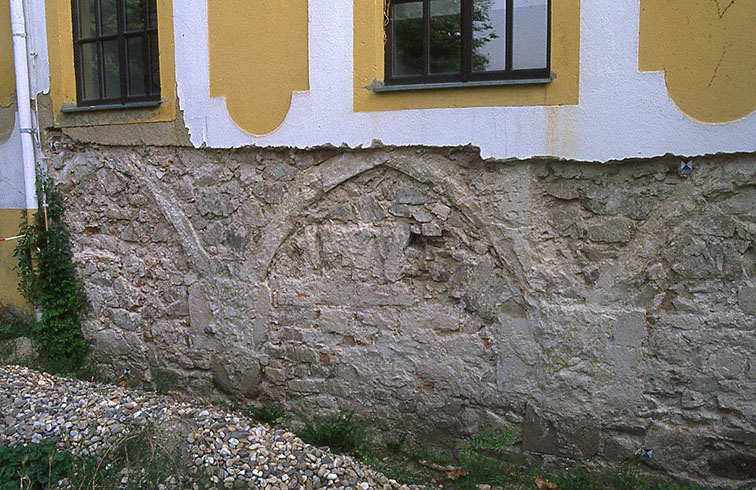
The monastery church was integrated into the castle during the renovations, while all other previous buildings were demolished or altered. As a result, not much of the original monastery complex remains. In 2002, however, during drainage work on the south wall of the church, individual arcades of the former cloister were archaeologically documented.
Annemarie ReckImage Source O. Spitzner, Foto ©LfA 2002.
Literature
Werner Coblenz, Die Wehranlage Goldkuppe – Heinrichsburg bei Diesbar-Seußlitz. In: Heinz-Joachim Vogt (Hrsg.), Archäologische Feldforschungen in Sachsen. Arbeits- und Forschungsberichte zur sächsischen Bodendenkmalpflege, Beih. 18 (Berlin 1988) 137–138.
Reinhard Spehr, Gana – Paltzschen – Zehren. Eine archäologisch-historische Wanderung durch das Lommatzscher Land (Dresden 2011) 163–175.
Rebecca Wegener, Diesbar-Seußlitz und die Goldkuppe. Bei gutem Wein Geschichte entdecken. Archæo 4, 2007, 74–79.
Note on monument protection
Archaeological monuments are protected by the Saxon Monument Protection Act. A permit under monument law is required for ground interventions or construction measures.
Permalink
https://archaeo-sn.de/en/ort/poor-clares-convent-and-seuslitz-castle/
Citation
Annemarie Reck, Poor Clares Convent and Seußlitz Castle. In: Landesamt für Archäologie Sachsen, Website archaeo | SN (01.02.2024). https://archaeo-sn.de/en/ort/poor-clares-convent-and-seuslitz-castle/ (Stand: 29.09.2026)
