

Riesa ditch works
| Place: | Riesa (Riesa, Meißen) |
|---|---|
| Type: | Irregular trench work 3-fold |
| Dating: | Middle Neolithic | Baalberg culture | 4000 - 3500 BC. |
Description
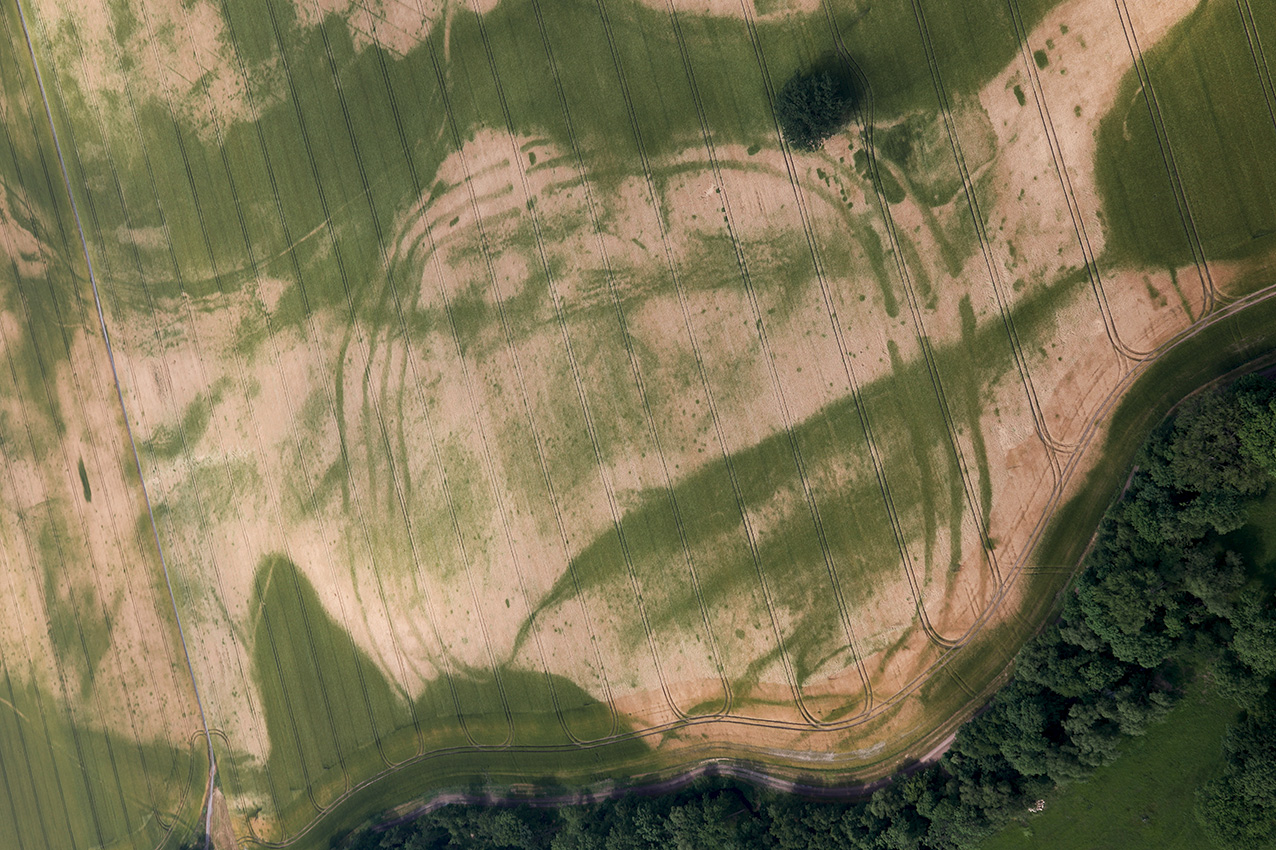
One of Saxony's largest ditch works is located on a flat gravel ridge in the Jahna floodplain south of Riesa. The site dates from the Middle Neolithic period and consists of three to four ditches in places with an irregular oval shape. The earthwork was discovered in 1993 during the first aerial archaeological surveys in the Free State of Bavaria. As a result of the discovery, several inspections of the site were carried out by a volunteer collector in the following years. Apart from a few flint fragments, however, the pottery found dated from more recent periods, such as the late Roman imperial period, the Slavic period or the Middle Ages. Only a research project of the LfA Saxony and the TU Freiberg in 2005 made it possible to assign the find to the Middle Neolithic on the basis of some vessel fragments of the Baalberg culture from the bottom area of the trenches.
Dana Mikschofsky/Annemarie ReckDimensions and structure
The Riesa ditch system measures up to 320 m in a west-east direction and has an internal area of 6.5 ha. To the east, north and west, the multiple ditches, up to 5 m wide, are interrupted by gate openings. In the south of the complex, the ditches are lost in the old stream bed. It is unclear whether there was another passageway here. Numerous pits can be seen in the interior as vegetation features. However, there are no clear signs of a house. Due to the veil of sherds from more recent periods, it is also likely that some or all of the pit features could date back to the Iron Age, the Slavic period or the Middle Ages.
Dana Mikschofsky/Annemarie ReckGeophysics and sounding
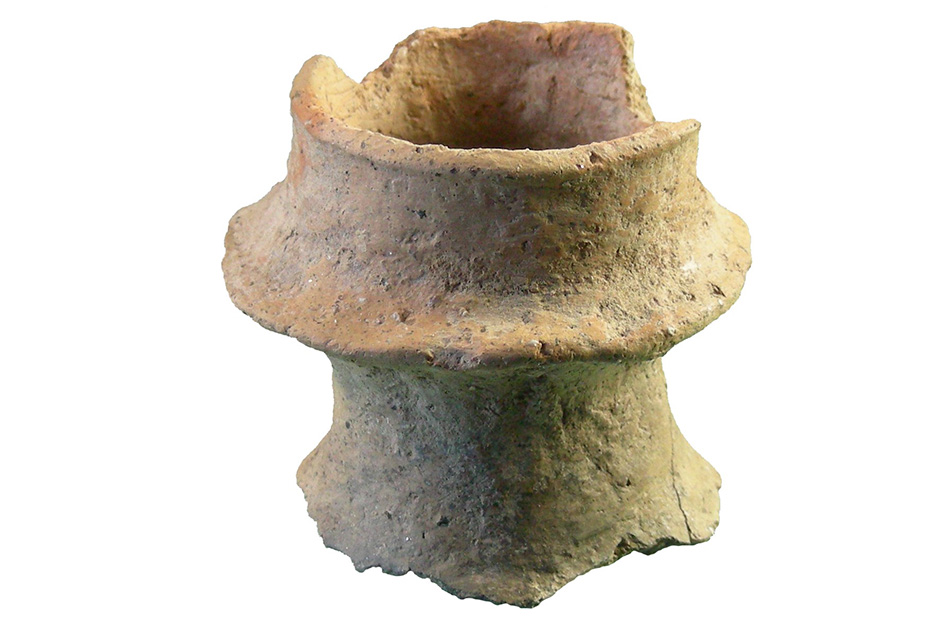
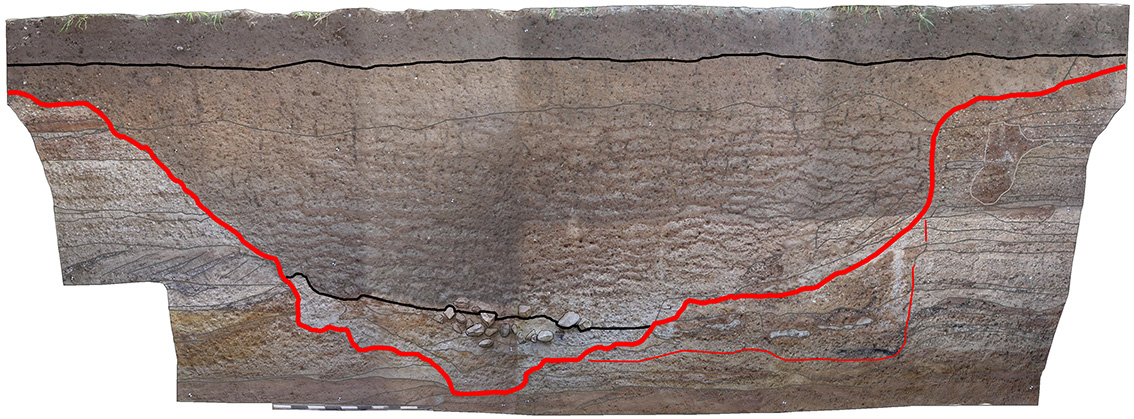
In the summer of 2005, the Geophysical Institute of the TU Bergakademie Freiberg and the LfA Sachsen carried out geophysical measurements and an archaeological sondage in the eastern area of the site. The sounding concentrated on the trench heads of the central trench at the eastern entrance. The ditch proved to be a sloping-walled ditch, the backfill of which consisted mainly of silty-gravelly sand. Debris on the eastern wall of the ditch presumably fell into it when it was abandoned. Concentrations of sherds at the base of the ditch and in a large funnel-shaped pit in the base area show clear evidence of Middle Neolithic forms. Two fragments of collar-necked bottles can be safely identified as forms of the Baalberg culture.
Dana Mikschofsky/Annemarie ReckImage Source U. Wohmann, Foto ©LfA 2007.
Interpretation of the system
The excavation findings could indicate that the Riesa ditch was built out of a need for protection. The debris could have been used to fortify the ditch or the now eroded ramparts. If the numerous settlement pits also turned out to be Neolithic, the dense settlement of the inner area could support this assumption. The particularly convenient location near the mouth of the Jahna into the Elbe, which connected the North German Plain with Bohemia, may also have played a role. The sandbanks washed in from the Jahna may have been used as a ford across the Elbe. In an east-west direction, the long-distance route known from medieval sources as the via regia also passes Riesa, which may have played a role in prehistoric times. However, in order to be able to make a reliable statement about the function of the complex, more detailed investigations would be necessary.
Dana Mikschofsky/Annemarie ReckImage Source Archæo 4, 64, Abb. 6.
Literature
Dana Mikschofsky, Grabenwerk im Jahnatal. In: Regina Smolnik/Ronny Zienert (Hrsg.), Höhenflüge. Luftbilder und Archäologie in Sachsen (Dresden 2024) 58–59.
Volker Donner/Wolfgang Ender/Bernhard Forkmann/Rolf Käppler/Michael Strobel, Geophysikalische und archäologische Untersuchungen in einem Grabenwerk der Trichterbecherkultur bei Riesa. Archæo 4, 2007, 60–66.
Pavla Ender/Wolfgang Ender/Mike Huth/Günter Kavacs/Michael Strobel, Stadt und Kloster Riesa – Archäologie und frühe Geschichte. Archaeonaut 7 (Dresden 2007).
Note on monument protection
Archaeological monuments are protected by the Saxon Monument Protection Act. A permit under monument law is required for ground interventions or construction measures.
Permalink
https://archaeo-sn.de/en/ort/riesa-ditch-works/
Citation
Dana Mikschofsky/Annemarie Reck, Riesa ditch works. In: Landesamt für Archäologie Sachsen, Website archaeo | SN (19.02.2024). https://archaeo-sn.de/en/ort/riesa-ditch-works/ (Stand: 29.09.2026)
