

Row cemetery Schmorkau
| Place: | Schmorkau (Oschatz, North Saxony) |
|---|---|
| Type: | Shallow grave/flat grave field with inhumation graves |
| Dating: | Early Middle Ages | Late Migration Period | Merovingian Period | 400 - 600 AD. |
Description
In 2009, a previously unknown burial ground was discovered during an aerial archaeological survey on the north-eastern outskirts of Schmorkau. The site is not far from a gravel pit in which a late imperial urn burial from the 3rd century AD was discovered in 1938. until early 4. Century and several metal finds came to light. Due to its structure and the arrangement of the inhumation graves, however, the row cemetery shows the typical characteristics of a Merovingian cemetery, as it was known from the second half of the 5th century BC onwards. Use in the 21st century.
Dana Mikschofsky/Annemarie ReckThe terraced cemetery
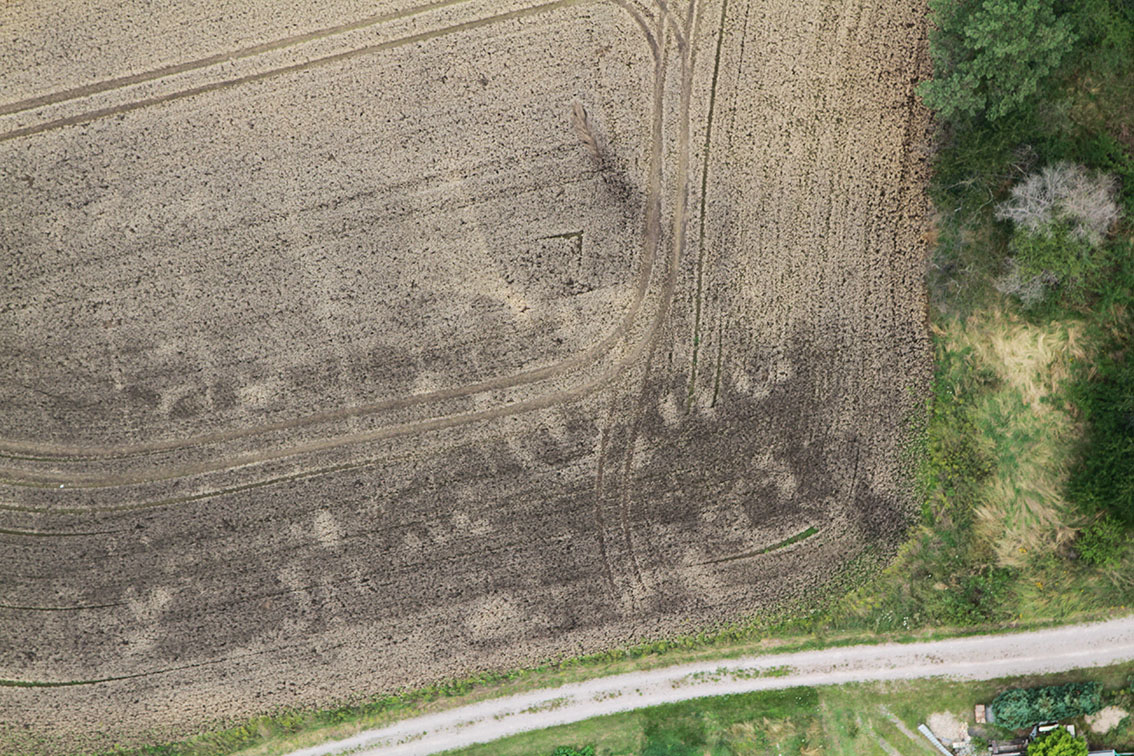
Based on the vegetation features, up to 30 rectangular structures or discolorations about 2.5 m long and 1 m wide can be identified. The inhumation graves are oriented in a west-east direction and arranged in irregular rows running from north to south. This burial custom is particularly widespread in southern and western Germany, whereas only a few comparable sites are known in Saxony, such as Liebersee near Torgau. The west-east rows of graves found there alongside the Merovingian graves originate from an earlier Late Migration Period context. Due to the similarities to the former, a similar chronological classification of the Schmorkau burial site seems conclusive even without excavation.
Dana Mikschofsky/Annemarie ReckImage Source R. Heynowski, Foto ©LfA 2021.
A single burial mound
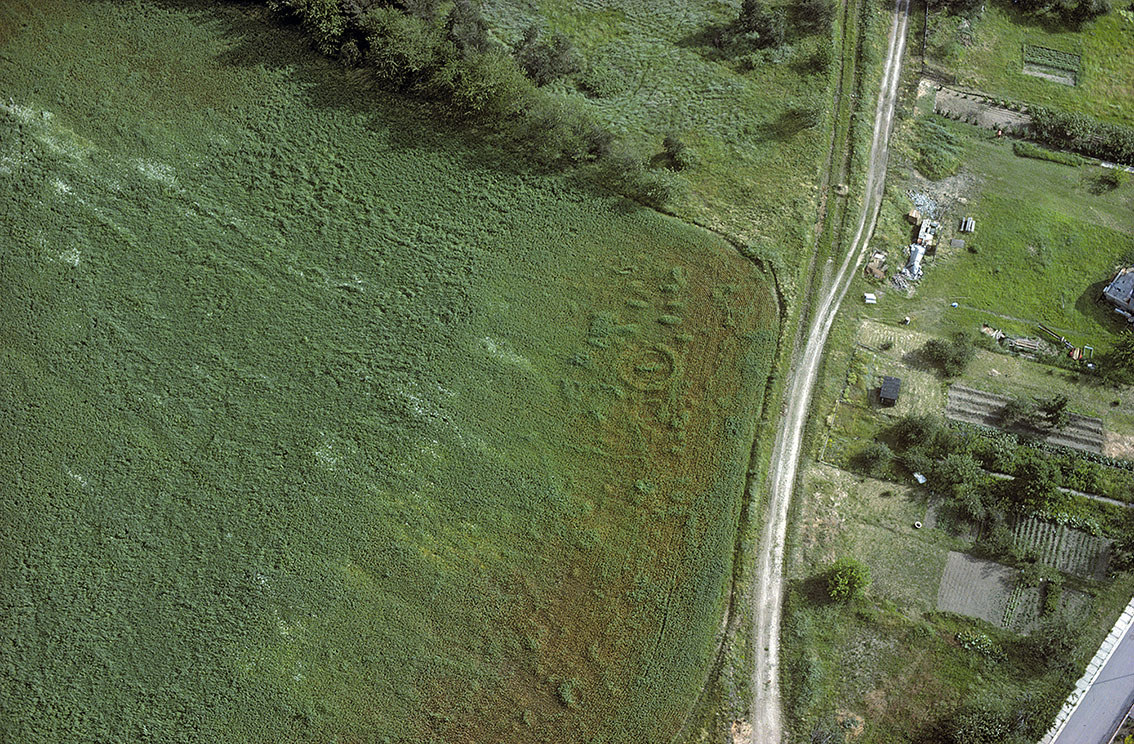
Between the rows of graves, a grave surrounded by an approximately 8 m wide, slightly oval circular ditch stands out in particular. On closer inspection, a further enclosure of the grave can be seen within the ring ditch, which may have been a palisade ring that enclosed the actual burial pit. Originally, the ring ditch probably enclosed a mound that has now been leveled. Such mounded graves, usually located centrally in the cemetery, usually serve to emphasize the importance of the buried person. In the Merovingian period, mounds were often erected over the graves of the oldest or most important personalities.
Dana Mikschofsky/Annemarie ReckImage Source O. Braasch, Foto ©LfA 1993.
An urn grave
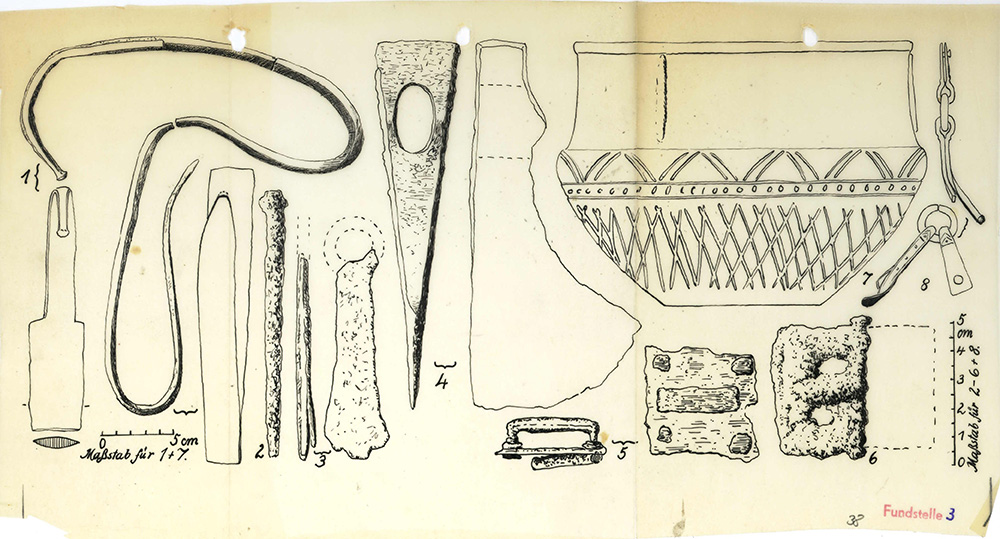
In the nearby gravel pit, not far from the terraced cemetery, a late imperial urn grave was discovered in 1938 during sand extraction. During subsequent re-excavations by Alfred Mirtschin, the representative for archaeological archaeology in the Oschatz area, further related finds were recovered, including an iron belt buckle, a pin and an inlaid sword. With its design and shape, it corresponds to swords from the 3rd and early 4th centuries. This means that the site had already been used for burials before then.
Dana Mikschofsky/Annemarie ReckImage Source OA 66750, 38 ©LfA 1938.
Literature
Klaus Kroitzsch, Die Rettungsgrabung auf dem Gräberfeld bei Liebersee. Ausgrabungen und Funde 24, 1979, 14–18.
Elmar Meyer, Ein tauschiertes Schwert aus einem spätkaiserzeitlichen germanischen Brandgrab von Schmorkau, Kr. Oschatz. Ausgrabungen und Funde 20, 1975, 87–90.
Dana Mikschofsky, Ein Reihengräberfeld. In: Regina Smolnik/Ronny Zienert (Hrsg.), Höhenflüge. Luftbilder und Archäologie in Sachsen (Dresden 2024) 74–75.
Judith Oexle, Am Rand des Merowingerreiches: das 5. und 6. Jahrhundert n. Chr. in Sachsen. In: Judith Oexle (Hrsg.), Sachsen archäologisch. 12.000 v. Chr. – 2.000 n. Chr. (Dresden 2000) 69–70.
Note on monument protection
Archaeological monuments are protected by the Saxon Monument Protection Act. A permit under monument law is required for ground interventions or construction measures.
Permalink
https://archaeo-sn.de/en/ort/row-cemetery-schmorkau/
Citation
Dana Mikschofsky/Annemarie Reck, Row cemetery Schmorkau. In: Landesamt für Archäologie Sachsen, Website archaeo | SN (22.02.2024). https://archaeo-sn.de/en/ort/row-cemetery-schmorkau/ (Stand: 28.09.2026)
