

Settlements near Zschernitz
| Place: | Zschernitz (Wiedemar, North Saxony) |
|---|---|
| Type: | Settlement |
| Dating: | Early Neolithic | Middle Neolithic | Late Neolithic | Early Bronze Age | Early Pre-Roman Iron Age | Roman Imperial Age | 5500 - 2000 B.C. | 750 - 350 B.C. | 150 - 350 A.D. |
Description
In 2003, extensive excavations were carried out on the occasion of the construction of a natural gas pipeline from Peißen near Bernburg in Saxony-Anhalt to Leipzig-Wiederitzsch. In the run-up to this linear construction project, the entire route was examined for archaeological features that would otherwise have been irretrievably destroyed, as is customary in Saxony. From the state border to Leipzig, this affected a 15 m wide strip almost 21 km long. The excavations took a year to complete. Thanks to this meticulous method of investigation, the Free State not only discovered 13 new sites, but also the unique find of a 7000-year-old human figurine from the early Neolithic period, the "Adonis von Zschernitz“.
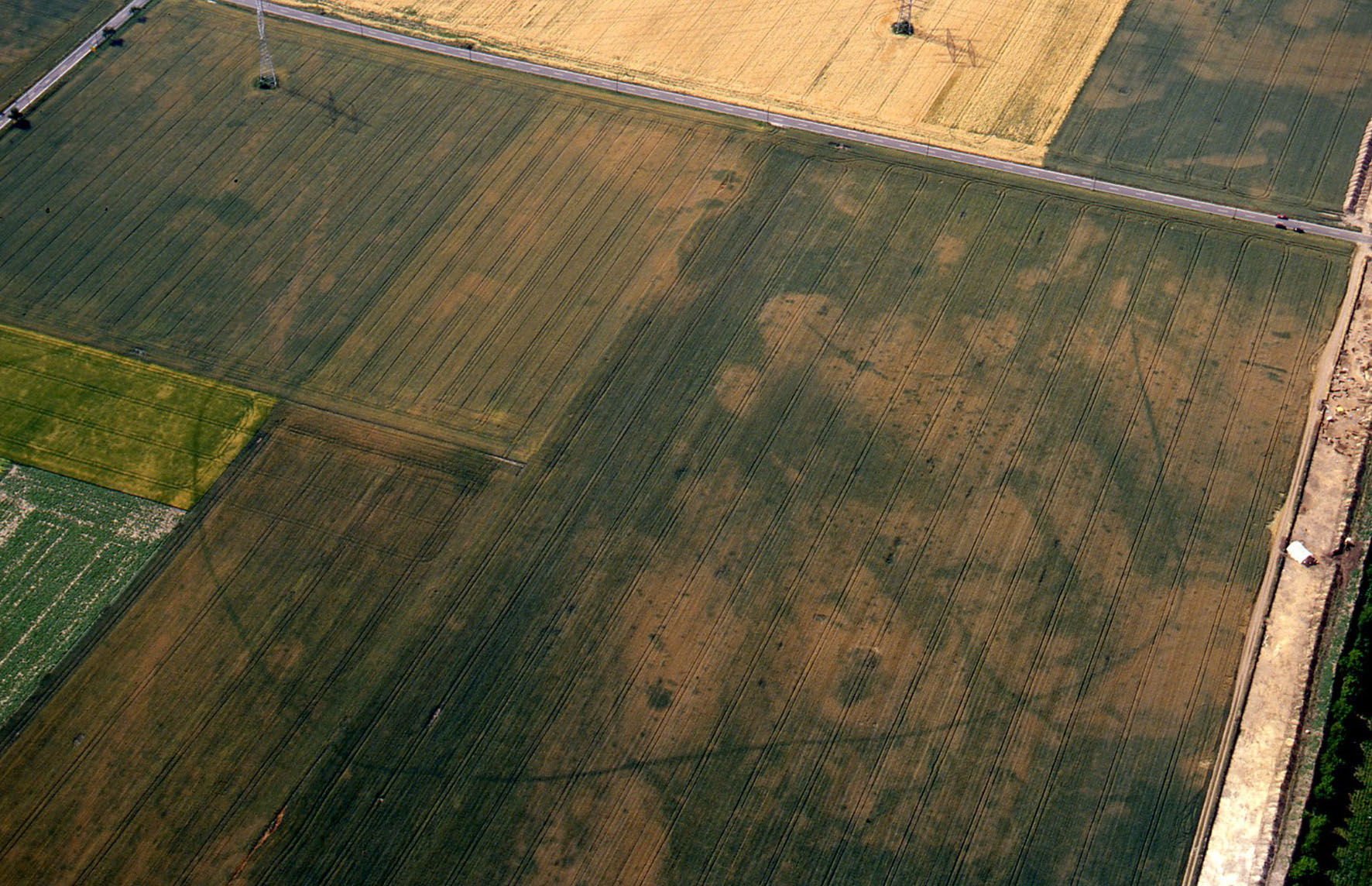
Annemarie ReckSettlement landscape Zschernitz
South of Zschernitz, a veritable landscape of features was already known from aerial archaeology before the start of the excavation accompanying the construction work. Numerous land ditches of unknown function can be seen in the area, as well as a circular ditch and settlements of different periods, whose posts and pits are clearly visible in the aerial photograph. The settlement centrally located in this landscape was directly intersected by the planned natural gas pipeline in excavation section ZNT-08.
Annemarie ReckImage Source R. Heynowski, Foto ©LfA 2003.
Findings
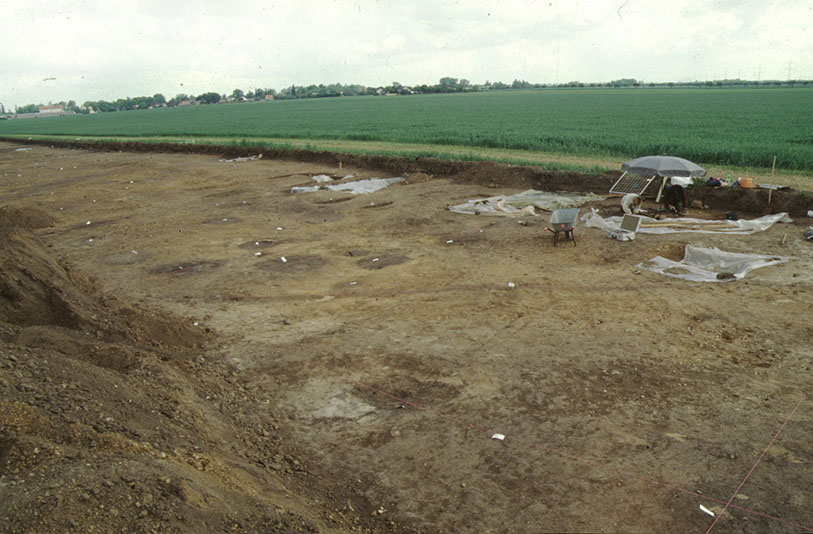
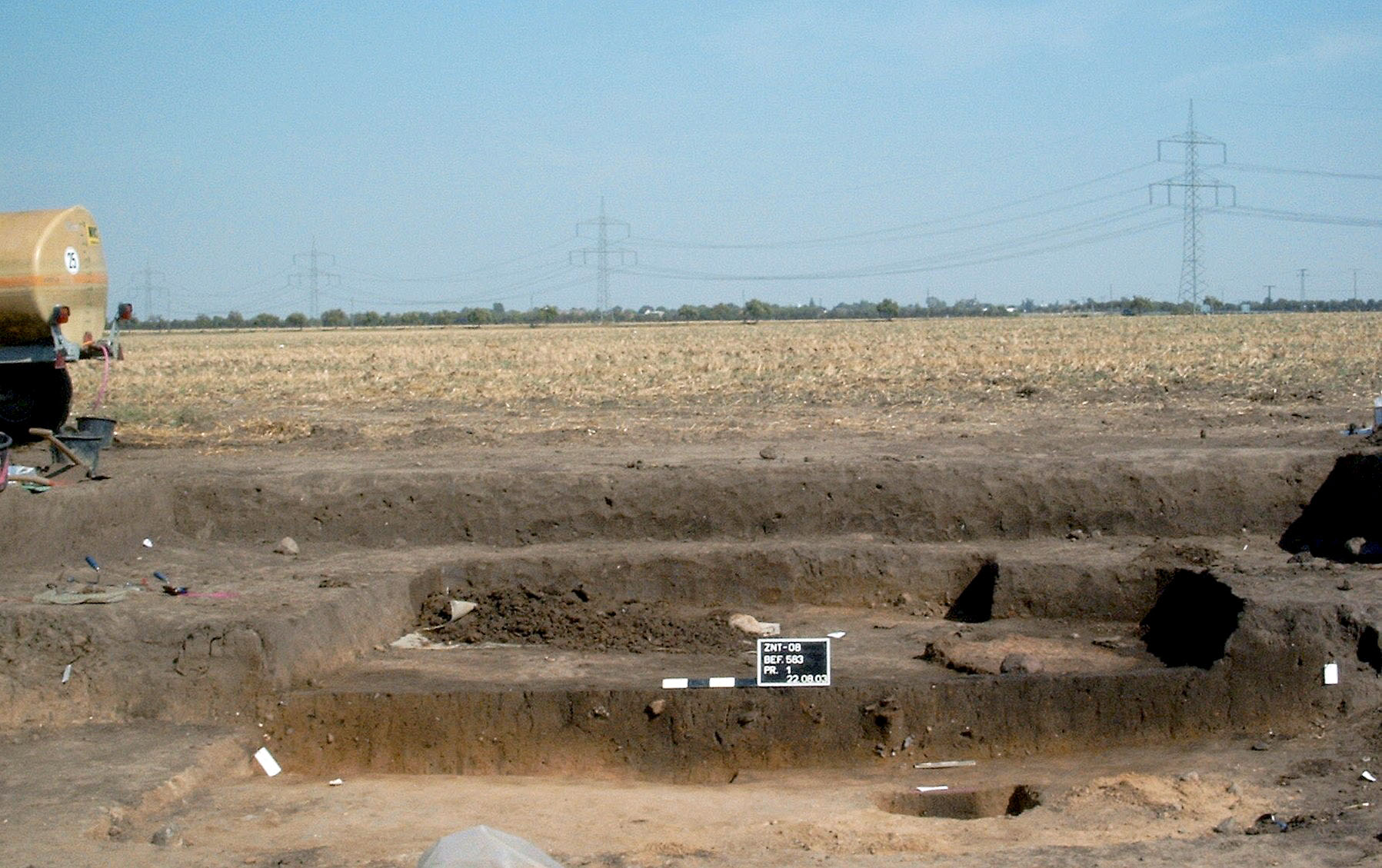
The approximately 500 m long area ZNT-08 had around 600 features, which often overlapped. Since the immigration of the first farming cultures in the Neolithic period, the good soil and climatic conditions have identified the area around the site as a favorable area for agriculture. For this reason, the site was repeatedly visited and settled from 5500 BC throughout prehistory until the High Middle Ages. Between countless settlement pits and house posts, three pit houses from the time of the Funnel Beaker culture (4000-3000 BC) also came to light. This type of house was rarely found at that time and has been little researched.
Annemarie ReckImage Source L. Steguweit, Foto ©LfA 2003.
Pit houses
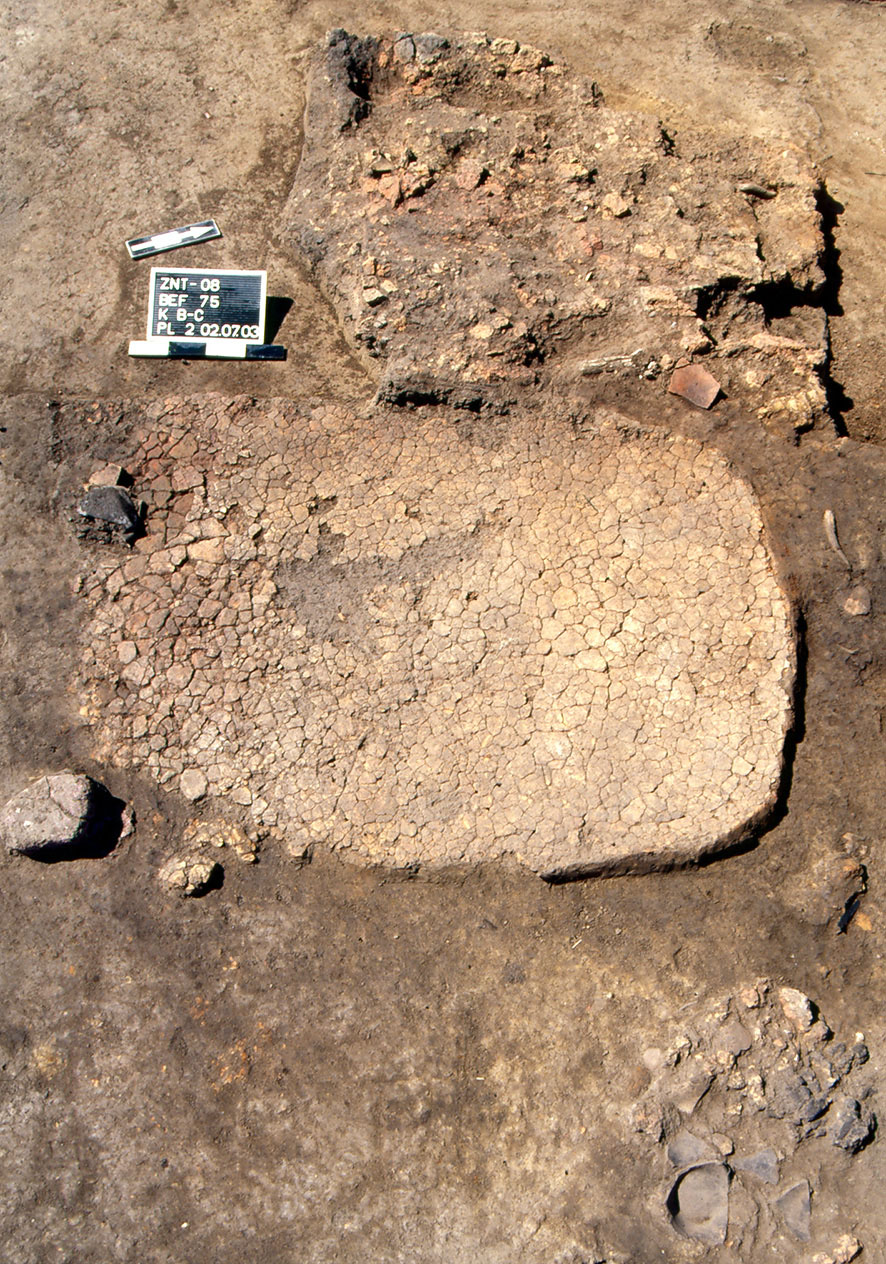
The pit houses were almost completely cut through by route section ZNT-08, which gave the excavation team a good insight into their structure. They measured approx. 12 m x 5 m and were rectangular to slightly trapezoidal in shape. The original floor of the houses was preserved at a depth of around 20 cm to 40 cm. Remains of ovens and fireplaces indicate that they were used as residential buildings in the Neolithic period. Early medieval pit houses, on the other hand, were used almost exclusively as farm buildings.
Annemarie ReckImage Source L. Steguweit, Foto ©LfA 2003.
Special finds
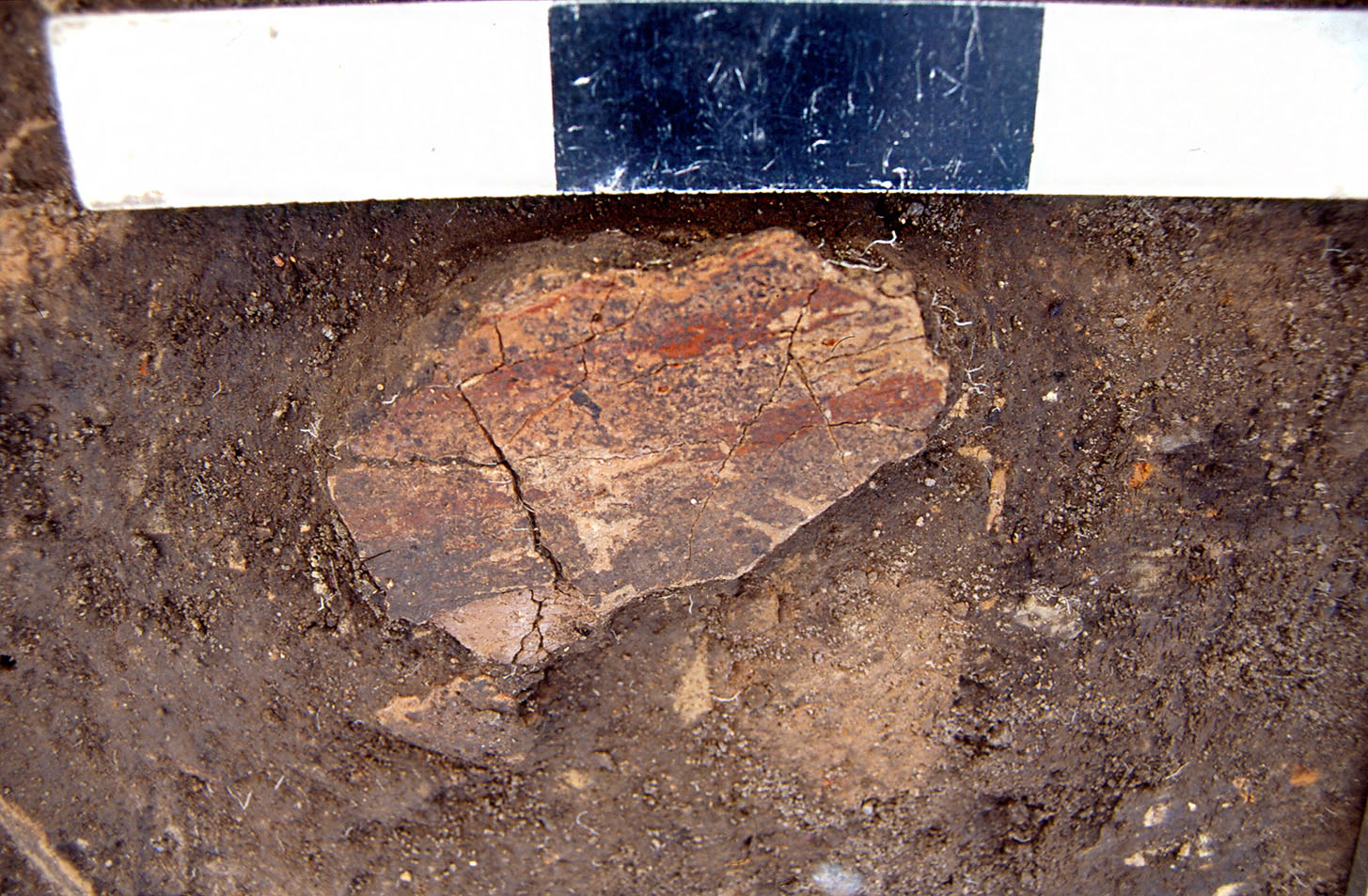
In the surrounding pits, fragments of wall plaster with remnants of red painting were found, but these were dated to the Metal Age. An analysis revealed a primer of white, calcareous material on which a red paint of hematite or red chalk had been painted. Furthermore, lumps of pitch mixed with various fats and oils were discovered in two of the pit houses. The outer imprint of a leaf shows what they were once wrapped in. The handy lumps could have been used as glue or chewing gum. Lumps of pitch with chewing marks are known from wetland settlements in southern Germany.
Annemarie ReckImage Source L. Steguweit, Foto ©LfA 2003.
Adonis von Zschernitz
The discovery of the well-known "Adonis von Zschernitz" is due to a lucky coincidence: the fragment only came to light at the bottom of a circular, 2.5 m wide Linear Pottery settlement pit when the edge of the profile was being straightened at the edge of the excavation cut (photo). In the upper part, it had been disturbed by a Middle Neolithic pit house. If it had been just a few centimetres away, this unique find for the whole of Europe might never have been discovered. The attentive excavation worker Manfred Berger discovered the find in the area of a Linear Pottery settlement pit. His first instinct, that he had found a "stone with an A ...", proved to be (almost) correct when the find was cleaned up.
Annemarie ReckImage Source L. Steguweit, Foto ©LfA 2003.
Find in detail
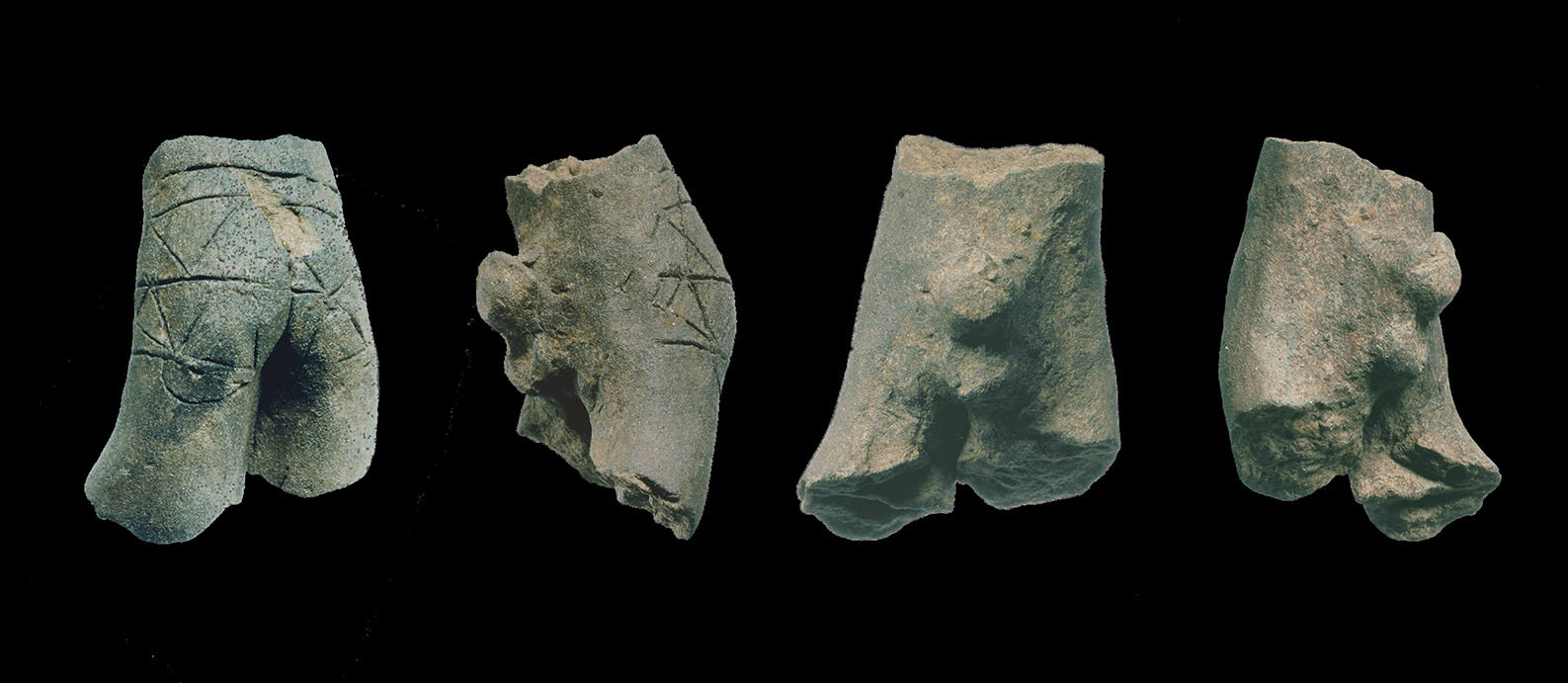
The fragment, which is still about 8 cm high, shows the torso of a male figure with a one-sided incised line decoration in the buttocks area and plastically formed genitals. In the course of the discovery, the excavation area was extended and the topsoil in the area of the find was sieved. This made it possible to find another fragment. It shows the chest and shoulder area of the figurine. Even if the fragment does not fit directly, its design suggests that they belong together.
Annemarie ReckImage Source J. Lipták, Fotos/A. Reck, Bearbeitung ©LfA 2003/2023.
Link smac 360° archaeo | 3D
Another plastic
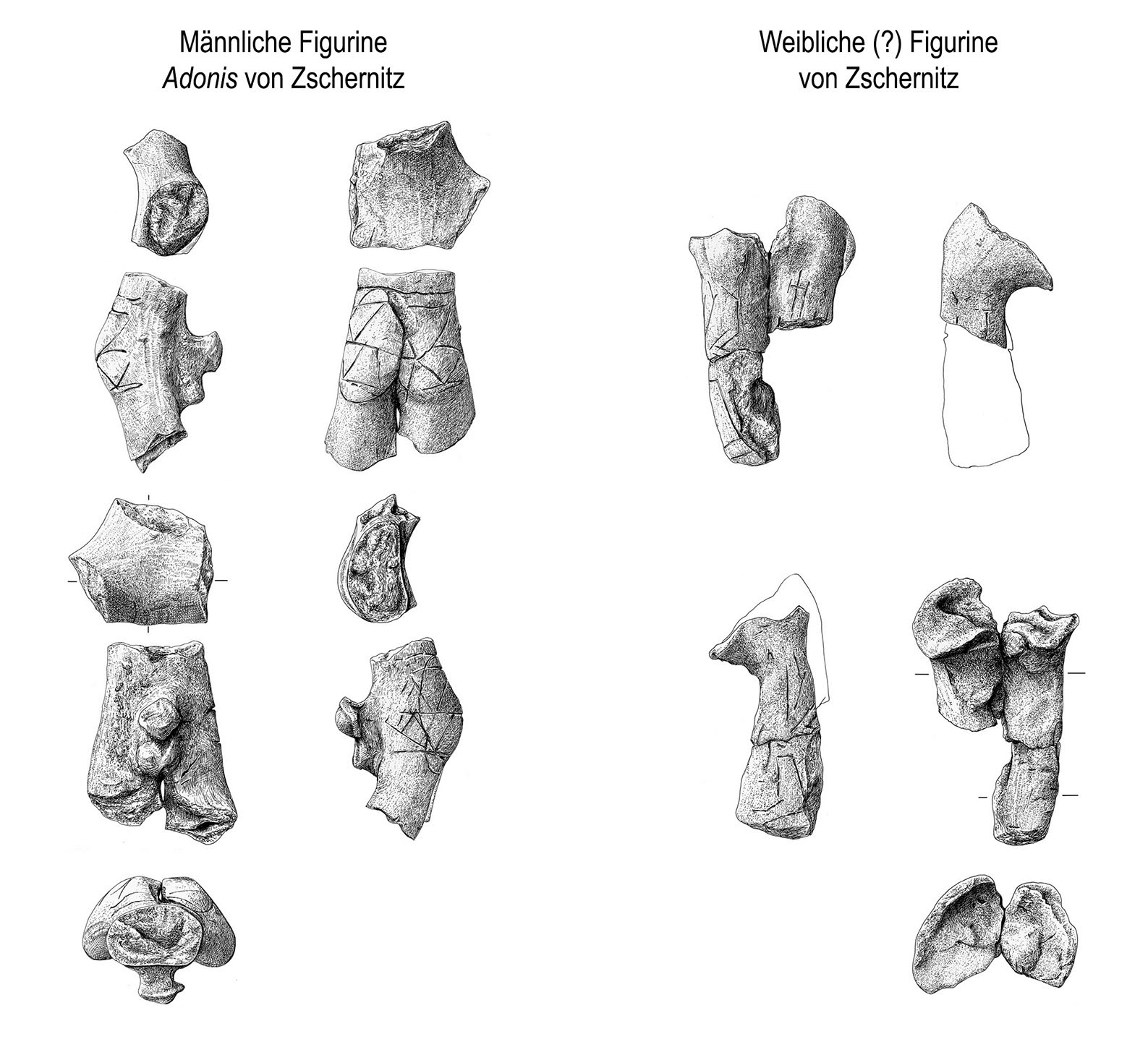
Three other related fragments of a sculpture are similar in style but made of different material. It shows the abdomen of a presumably female figure. This second figure shows the suggestion of the base of a pelvis with unrolled legs, which are also incised on one side. Without comparable finds, it remains to be seen whether the two figures are to be considered separately or whether they belonged together to a composition, perhaps a copulation scene.
Annemarie ReckImage Source Umzeichnung/A. Reck, Bearbeitung ©LfA 2012.
Link archaeo | 3D
Literature
Matthias Conrad, Siedlungsarchäologische Studien zum Endneolithikum in Mittel- und Westsachsen (Dissertation in Vorbereitung).
Marcin Dalidowski/Harald Stäuble, Schöner Wohnen in der Jungsteinzeit. In: Harald Meller et al. (Hrsg.), Von Peißen nach Wiederitzsch, Archäologie an einer Erdgastrasse (Gröbers 2004) 71–74.
Claudia Lehmann, Figürliche Darstellungen des Frühneolithikums in Sachsen. Arbeits- und Forschungsberichte zur sächsischen Bodendenkmalpflege 59, 2017–2022 (2023) 9–107.
Harald Stäuble, Adonis aus der Steinzeit. In: Von Peißen nach Wiederitzsch, Archäologie an einer Erdgastrasse (Gröbers 2004) 64–67.
Harald Stäuble, „Adonis von Zschernitz“, Gde. Neukyhna, Lkr. Delitzsch, Sachsen – ein bemerkenswerter Fund vorgeschichtlicher Figuralplastik. In: Gunter Schölbel (Hrsg.), Plattform, Zeitschrift des Vereins für Pfahlbau und Heimatkunde e.V. 11/12, 2002/2003, 140–143.
Note on monument protection
Archaeological monuments are protected by the Saxon Monument Protection Act. A permit under monument law is required for ground interventions or construction measures.
Permalink
https://archaeo-sn.de/en/ort/settlements-near-zschernitz/
Citation
Annemarie Reck, Settlements near Zschernitz. In: Landesamt für Archäologie Sachsen, Website archaeo | SN (01.02.2024). https://archaeo-sn.de/en/ort/settlements-near-zschernitz/ (Stand: 29.09.2026)
