

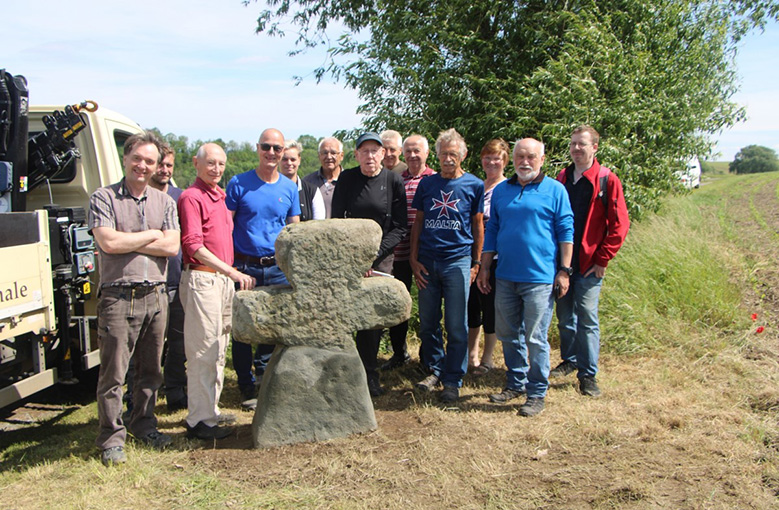
Stone cross from Burkhardswalde
| Place: | Burkhardswalde (Müglitztal, Saxon Switzerland-Eastern Ore Mountains) |
|---|---|
| Type: | Stone cross |
| Dating: | Late Middle Ages | Modern times | 1300 - 1600 AD. |
Description
In early December 1990, two schoolchildren found the remains of a medieval stone cross on a pile of stones near Burkhardswalde (municipality of Müglitztal). The damaged cross was found about 15 km east of the center of Burkhardswalde. It remains unclear when and why the cross was removed from its original location or where it once stood. At the end of May 2024, almost 34 years later, the medieval stone cross, which had long been kept in the depot of the State Office for Archaeology, was finally reinstalled. The project was financed by the Lower Monument Protection Authority of the Lkr. Sächsische Schweiz - Osterzgebirge and the Archaeological Society in Saxony e.V.
Ingo KraftDiscovery story
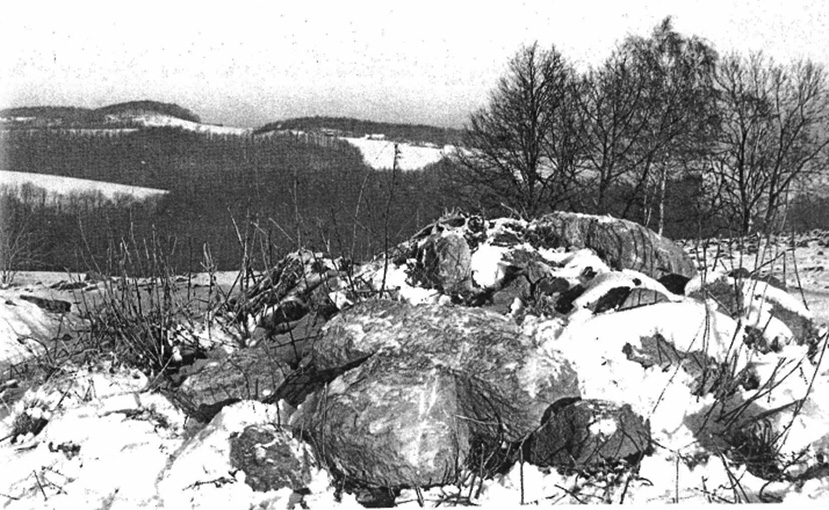
In December 1990, pupils Martin and Thomas Wittig reported the discovery of the stone cross to the Pirna Museum. The museum's employee, archaeologist Sabine Holtermann, immediately passed the news on to the then State Museum of Prehistory, now the State Office of Archaeology of Saxony. The schoolchildren had discovered the damaged cross, the base of which had broken off, on a pile of stones at the "Weinberg", west of Burkhardswalde. The two young finders received a prize of 100 DM for the beautiful find and for reporting it promptly before the Christmas holidays.
Ingo KraftImage Source H. Quietzsch, Foto ©LfA 1990.
Reinstallation
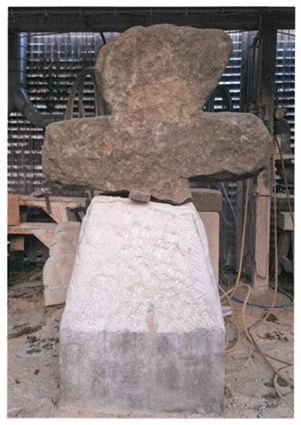
The initiative for the re-erection goes back to Harald Quietzsch, a former employee of the Saxony State Office for Archaeology, and the volunteer archaeologist Peter Bechstedt. Both have been working intensively on this special type of small monument for decades. The stonemason Elmar Vogel from Dresden-Tolkewitz undertook the work to restore the stone cross. The restoration work was time-consuming, as a suitable base had to be found and the preservation order required the new base to match the old broken surface of the cross. Now, many years after its discovery, the cross has found a suitable place again 400 meters east of the site, thanks to the support of the Müglitztal municipal administration and the Burkhardswalde local history association.
Ingo KraftImage Source ©E. Vogel, Foto 2023.
Stone crosses
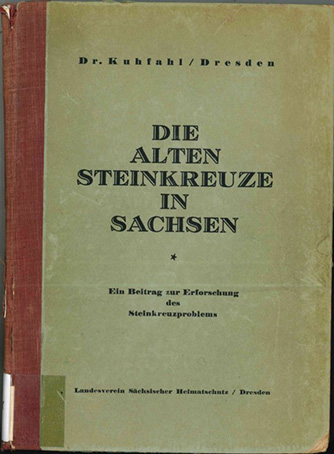
From the Middle Ages to the time of the Reformation and the early modern period, stone crosses were part of the normal landscape. Gustav Adolf Kuhfahl, a lawyer and later director of the Güntz Foundation in Dresden, studied Saxon stone crosses intensively. His book "Die alten Steinkreuze in Sachsen. Ein Beitrag zur Erforschung des Steinkreuzproblems", published by the Landesverein Sächsischer Heimatschutz Dresden in 1928, was a great success. Kuhfahl deals scientifically with the background to the erection of stone crosses and is thus the first person in Germany at least to take on this field of research. Roughly summarizing the results of stone cross research, several motives for erecting them can be identified. Stone crosses are memorial stones, signs of atonement, wayside crosses, boundary crosses, plague crosses and more.
Ingo KraftImage Source G. A. Kuhfahl 1928, Cover.
Customs
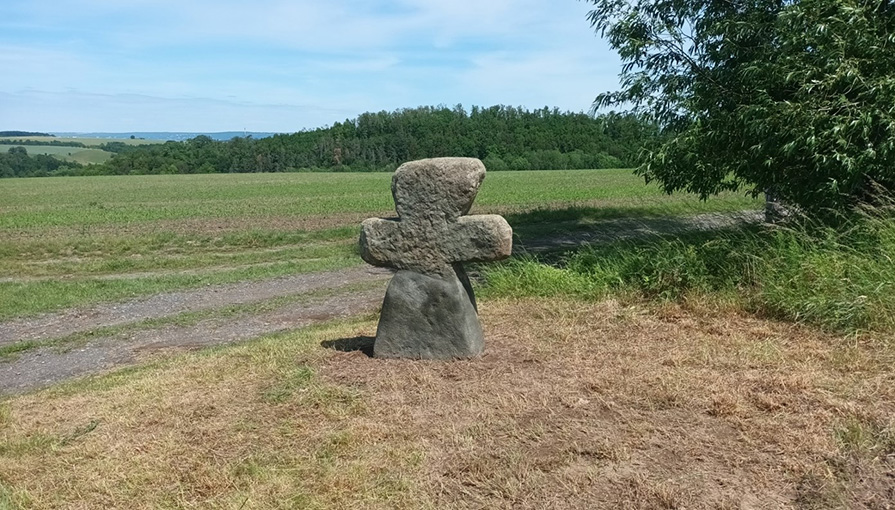
However, two motifs are very clearly in the foreground and are documented by a number of written testimonies: Firstly, stone crosses are monuments to the Christian faith. On the one hand, stone crosses are monuments of Christian faith. At the place where a person died by murder, manslaughter or accident - i.e. unexpectedly - the stone cross was intended to encourage passers-by to offer prayers for the poor souls of those torn from their lives. On the other hand, written evidence from the late 14th to the 15th/16th century shows that stone crosses were mentioned in atonement agreements, i.e. they were erected as a sign of atonement alongside other atonements (food, money, etc. for the bereaved). Around a third of all stone crosses bear symbols such as crosses, daggers, crossbows etc. The one discussed here has no carvings.
Ingo KraftImage Source Ch. Heiermann, Foto ©LfA 2024.
Outlook
In our modern age, building pressure (road construction, construction of industrial estates, but also private building projects) is mainly to blame for the disappearance of stone crosses. However, persistent searches by citizens and the monument authorities concerned do lead to success. Occasionally - as our example shows - there are also new finds. There are currently 436 stone crosses registered throughout the state.
Ingo KraftImage Source Ch. Heiermann, Foto ©LfA 2024.
Literature
Gustav A. Kuhfahl, Die alten Steinkreuze in Sachsen. Ein Beitrag zur Erforschung des Steinkreuzproblems (Dresden 1928).
Harald Quietzsch, Steinkreuze und Kreuzsteine in Sachsen. Inventar Bezirk Leipzig (Berlin 1980).
Harald Quietzsch, Zur Geschichte der sächsischen Steinkreuzforschung. Gustav Adolf Kuhfahl und der Landesverein Sächsischer Heimatschutz. Mitteilungen des Landesvereins sächsischer Heimatschutz 1992, 33–38.
Horst Torke, Alte Steinkreuze zwischen Dresden, Pirna und sächsischer Schweiz. Stadtmuseum Pirna (Pirna 1990).
Note on monument protection
Archaeological monuments are protected by the Saxon Monument Protection Act. A permit under monument law is required for ground interventions or construction measures.
Permalink
https://archaeo-sn.de/en/ort/stone-cross-from-burkhardswalde/
Citation
Ingo Kraft, Stone cross from Burkhardswalde. In: Landesamt für Archäologie Sachsen, Website archaeo | SN (02.12.2024). https://archaeo-sn.de/en/ort/stone-cross-from-burkhardswalde/ (Stand: 29.09.2026)
