


Devil’s Stone
| Place: | Pließkowitz (Malschwitz, Bautzen) |
|---|---|
| Type: | Miscellaneous, Geology |
| Dating: | Paleozoic | 320 million years ago |
Description
Rising from the hilly landscape northeast of Bautzen are numerous, mostly forested hilltops that already appeared on historical maps with evocative names such as “Galgenberg”“, “Schafberg“, “Bauerberg“ or “Lindenberg”“ carry. To this day, these hills are prominent features of the cultural landscape that are visible from afar and also serve important conservation functions. The Teufelsstein has been listed as a natural monument since 1985.
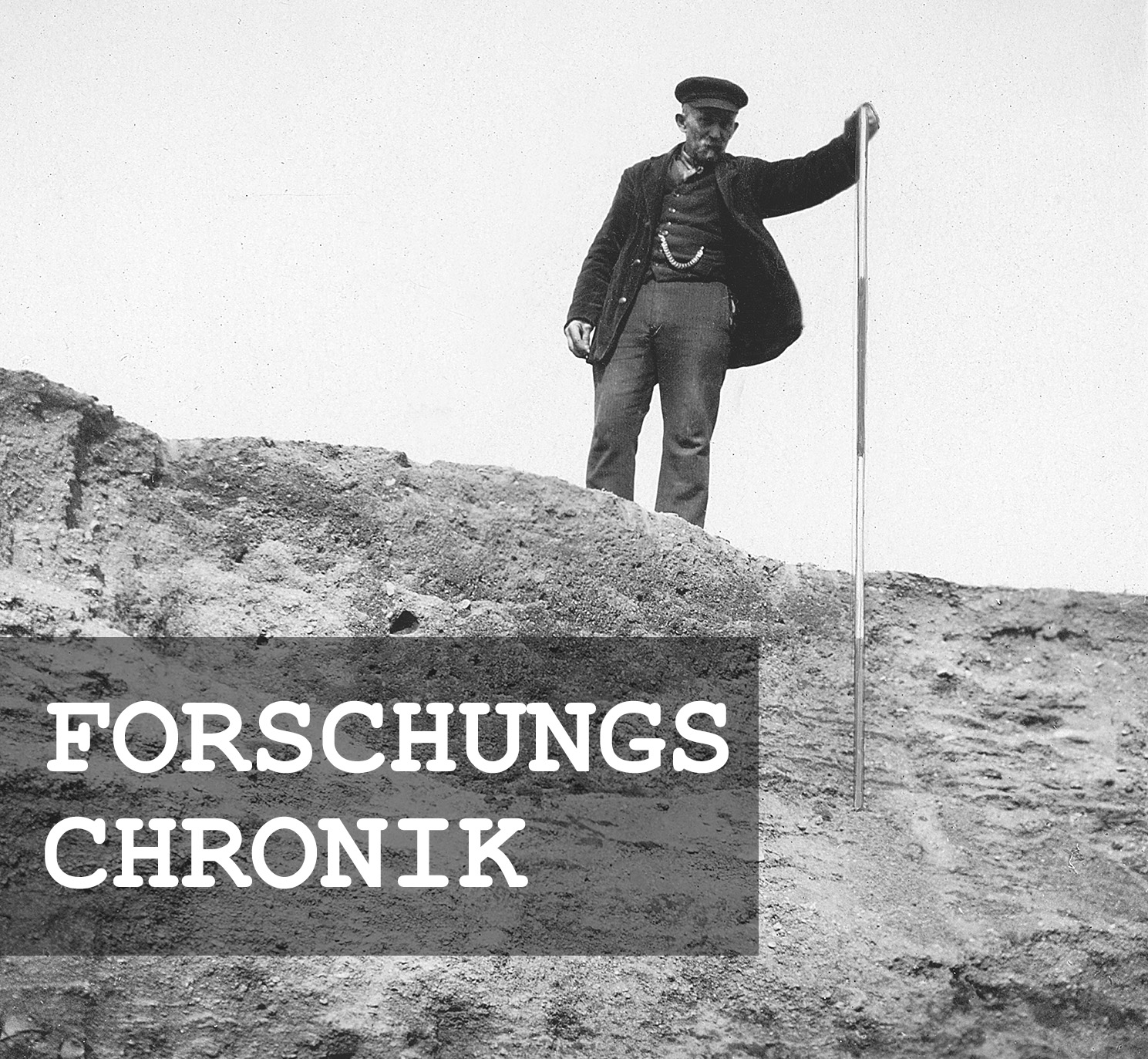
Michael StrobelResearch Chronicle
1797 | Ehregott Friedrich Pannach, the pastor of Malschwitz, describes the Teufelsstein.
around 1800 | The Teufelsstein is listed in the Meilenblatt.
1826 | Karl Benjamin Preusker publishes a detailed and dimensionally accurate description of the Teufelsstein.
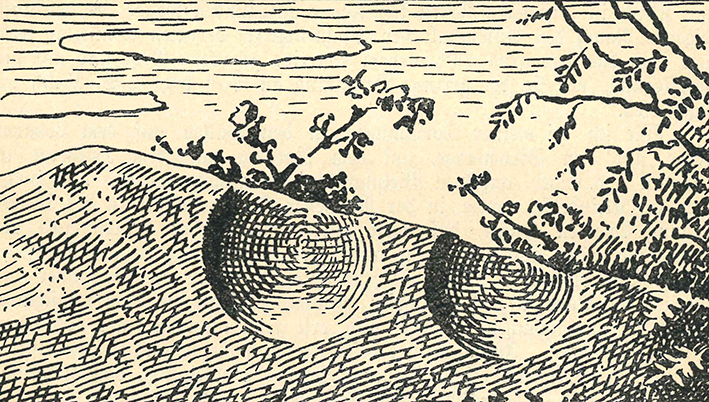
1841 | Preusker’s illustration is the oldest depiction of the Teufelsstein.
1903 | Excavations are largely inconclusive.
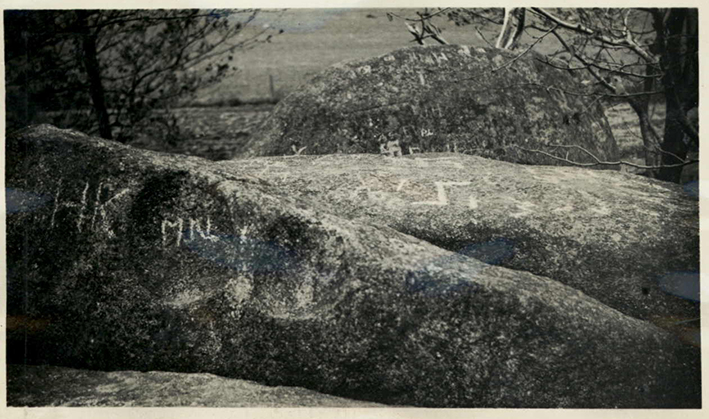
1934–35 | The carving of initials and swastikas violates the “Saxon Heritage Protection Act.”
1936 | The Teufelsstein is designated a natural and archaeological monument.
1985 | The Teufelsstein is designated a natural area monument.
Image Source Foto ©LfA 1929.
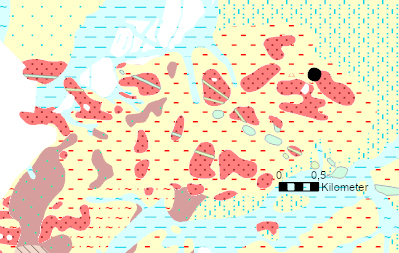
Granite Peaks in the Bautzen "Gefilde"
The Bautzen “Gefilde” owes its high soil fertility to the loess deposits blown in during the last Ice Age. However, this loess layer is unevenly distributed and far from continuous. Wherever trees and shrubs now grow on hilltops, rocky outcrops of the Lusatian Granite Massif pierce through the glacial deposits (red areas marked with a cross; black dot: Teufelsstein). Here, on the weathered debris, the fertile parabraun soils are absent; these soils, which have otherwise developed on loess loam, have been used for agriculture since the late Neolithic period (since ca. 2700 BCE) and continue to allow for intensive cultivation to this day. On one of these granite outcrops, at the border between the municipalities of Pließkowitz and Kleinbautzen, stands a group of rocks that was already referred to as “Teufelsstein” on historical maps.
Michael StrobelImage Source GK50 Eiszeit ©LfULG und GeoSN Sachsen.
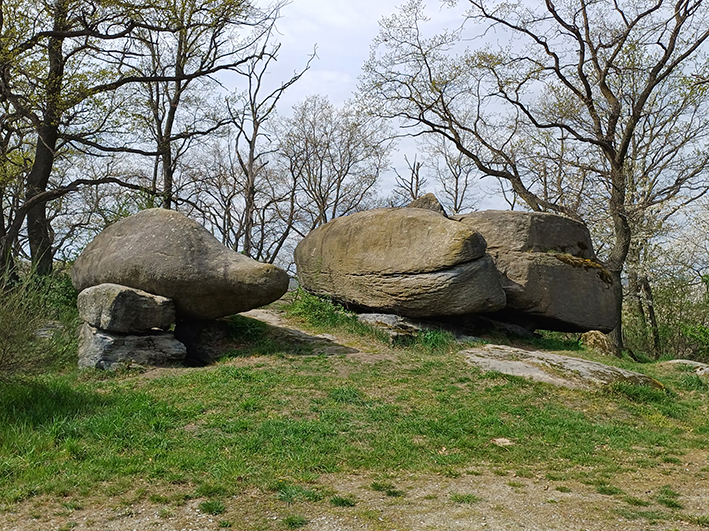
A natural rock formation
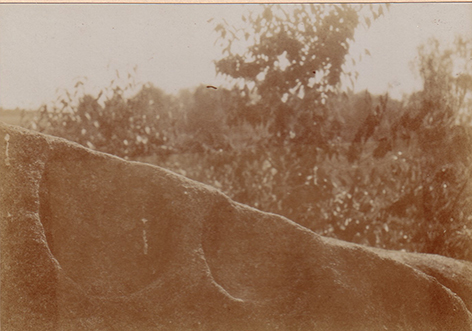
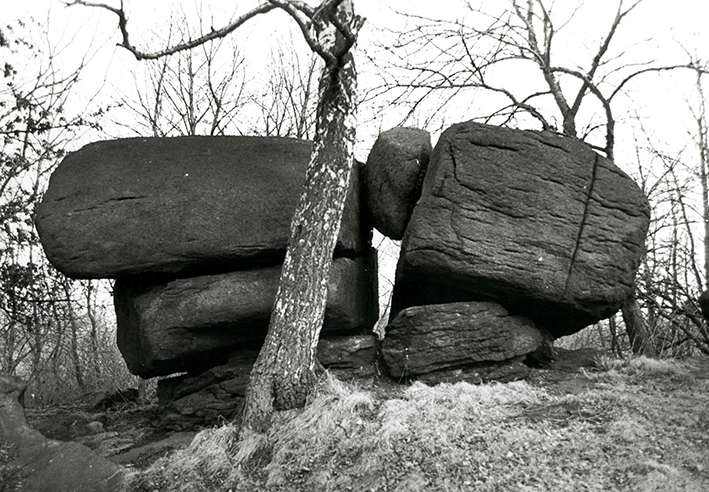
The granite formation consists of three massive, roughly east-west-oriented, weathered and rounded blocks, crisscrossed by fissures, which rest on smaller, sack-shaped slabs. Passages and cavities open up between them. The two northern blocks are separated only by a wedge-shaped crevice, in which a rounded slab is wedged lengthwise. It features two large, round weathering depressions. A few meters away to the northwest, the surface of another slab protrudes from the ground, which also features weathered depressions.
Michael StrobelImage Source M. Strobel, Foto ©LfA PLI-02_0002.
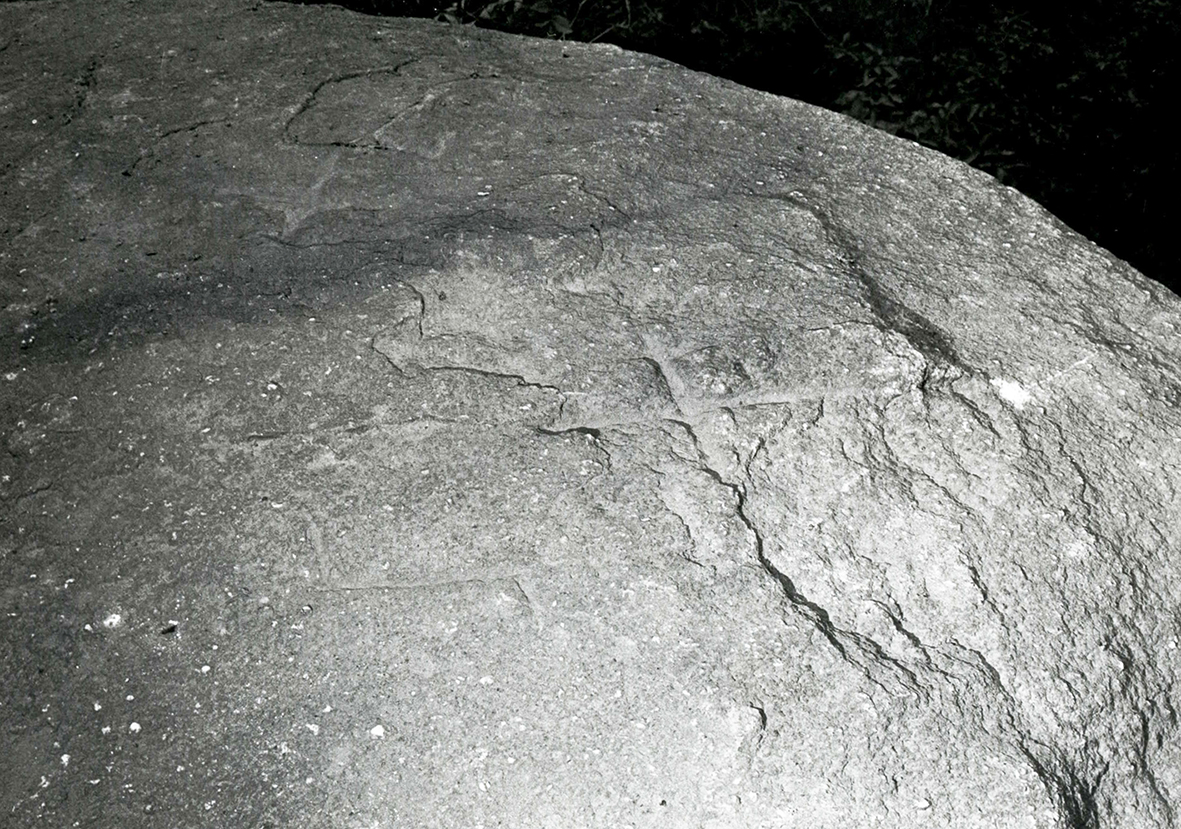
Markings on the rock surface
The two northern rocks, in particular, are covered with symbols that have been scratched or carved into the surface over time. Only a fraction of them are believed to have been added before 1800. These may include a needle, a thimble, and a pair of scissors, as well as a small cross.
Michael StrobelImage Source OA 15420, 66 ©LfA 1983.
Rock Formations of the Lusatian Granite Massif
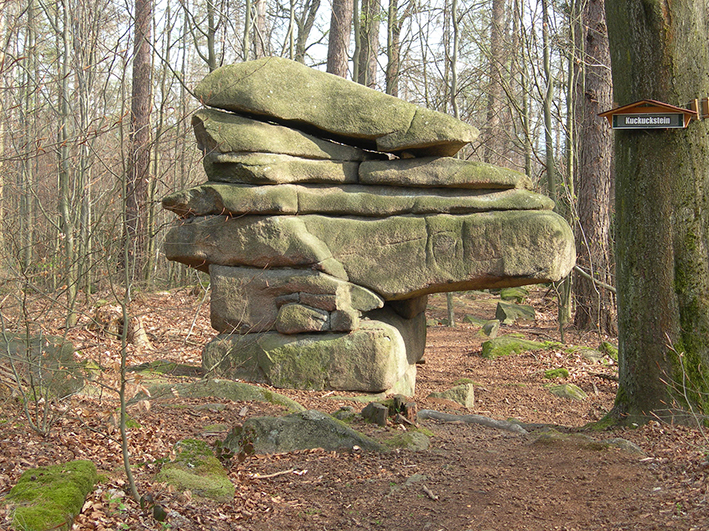
The Teufelsstein is part of the Lusatian Granite Massif, which stretches from the Elbe to the Neisse, covers an area of approximately 4,600 square kilometers, and forms one of the largest granite regions in Central Europe. More than 300 million years ago, during the Variscan orogeny, magmatic granodiorites intruded into the overlying rocks, where they were heated and melted in the contact zone. As the granodiorites solidified, and due to tectonic stresses or later deformations, fissures and cracks formed. As soon as overlying or surrounding rock layers were eroded by geologically younger processes and the granites were exposed, weathering followed the natural parting planes and led—as at the Kuckuckstein in the Königshain Mountains —to rounded blocks resembling “sacks” or “pillows” (“wool sack weathering”). These processes created bizarre rock formations, sometimes described as “turtle-shell-like,” spread across large areas. Steep slopes facilitated the collapse of layered rock groups and the sliding or slipping of entire boulders and slabs over one another.
Michael StrobelImage Source M. Strobel, Foto ©LfA KGH-09_0003.
"On the Natural Sciences in General"
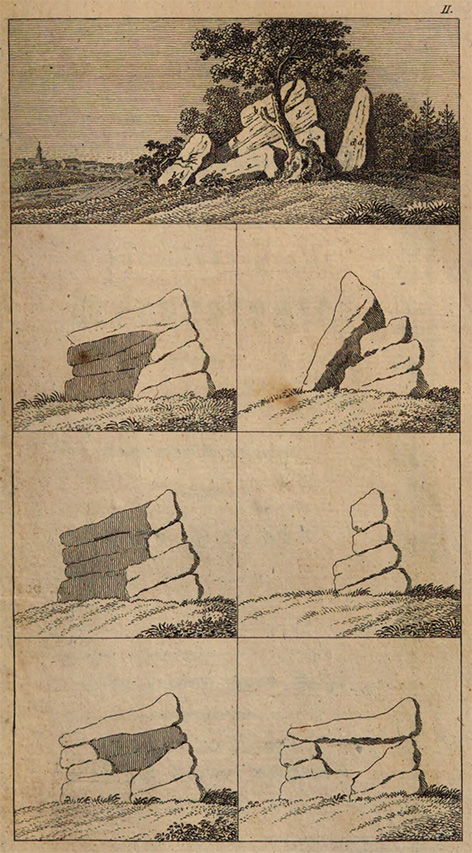
Using the example of the Luisenburg near Bad Alexandersbad in the Fichtelgebirge, Johann Wolfgang von Goethe had already recognized, described, and vividly illustrated the formation and erosion of these natural granite structures as early as 1817. It never occurred to the Weimar Privy Councilor to imagine “pagan sacrificial sites,” “altars,” “seats of the gods,” or even “observatories” within this granite rock labyrinth. He was fully aware that the sun, moon, and stars would eventually shine through any passage or crevice between the boulders that had formed naturally through weathering processes.
Michael StrobelImage Source Goethe 1817, Taf. II.
Not created by human hands, but misused…
It was Ehregott Friedrich Pannach (1761–1826), the pastor of Malschwitz, who wrote the first detailed account of the Teufelsstein in 1797. He had no doubt that “human hands” could not have assembled the “masses of stone” of the Teufelsstein near Pließkowitz, “but rather that they had merely utilized this formation for their own purposes—or rather, misused it”—yet “not the slightest thing” could be said “neither about its actual purpose nor about its violent destruction, which is, however, unmistakable.” This skepticism, however, did not prevent the clergyman from comparing the entire rock formation to an “altar” and describing the two presumed roof slabs as an “altarpiece.”
Michael StrobelImage Source Pannach 1797, 413.
"Sacrificial altars," "idol groves," and "places of worship"
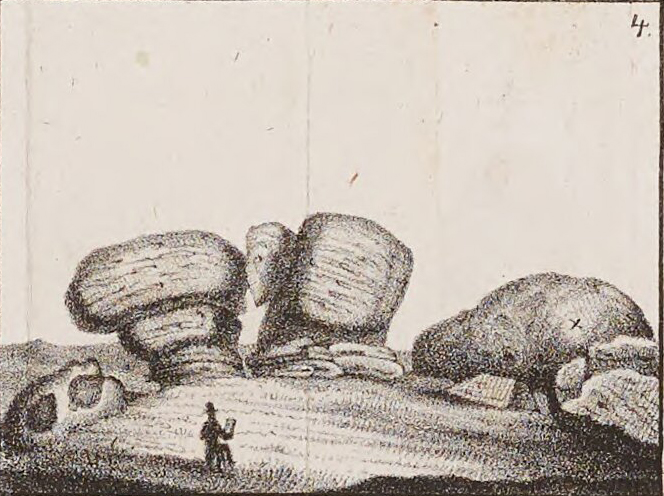
The terms “idolatry” and “altar” provided later generations with the keywords to associate these natural rock formations with “pagan rituals” and “cults.” As rarely as the grand master of Saxon archaeology, Karl Benjamin Preusker (1786–1871), was tempted to attribute these curious granite formations not to the forces of nature but "human hands," he was nevertheless certain that some of the rock formations, shrouded in legends and rural customs, had once been pagan "sacrificial altars," “idol groves,” and “places of worship”—and that they had remained religious sites beyond the Middle Ages, now under Christian auspices, in some cases even into his own time. The illustrated section of the first volume of his *Blicke in die vaterländische Vorzeit* (Glimpses into the Nation’s Ancient Past) features those rock formations that he had already identified as “pagan sacrificial altars” as early as 1826. However, this speculative interpretation cannot be supported by archaeological evidence.
Michael StrobelImage Source Preusker 1841, Taf. 1.
"Enlightened" and "less enlightened" minds
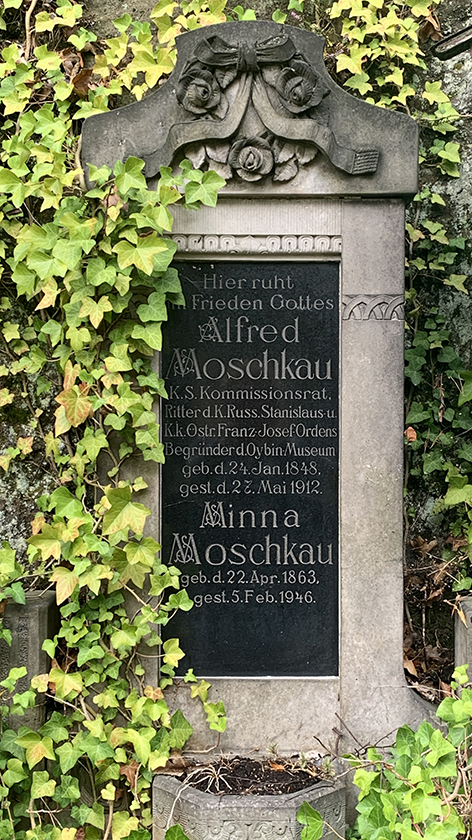
In the 1880s, Otto Carl Alfred Moschkau (1848–1912), a philatelist and local historian from Oybin, merely repeated what Pannach and Preusker had written about the Teufelsstein before him, but he was, at least with regard to some of the boulders, firmly convinced that they could only have been transported from far away and stacked on top of one another through “astonishing human strength.” Evidently, the patriotic desire to prove the existence of “megalithic” monuments in Saxony as well clouded the sober geological view of the natural formation of the granite boulders. Preusker himself had already drawn parallels to the “pagan” stone monuments of northern Germany, thereby falling short of the level of knowledge held by the enlightened and scientifically educated Königshain landowner Carl Adolph Gottlob von Schachmann (1725–1789), who in 1780 had explicitly ruled out “human artifice” as the cause of the granite formations in the Königshain Mountains. Unlike Preusker, he had likely even seen Stonehenge with his own eyes (1746).
Michael StrobelImage Source A. Reck, Foto ©LfA 20240821_AREC_063.
A Fruitless Search for the "Site of the Sacrifice"
Given that the Teufelsstein had already attracted the attention of archaeologists for over a century, it is all the more surprising that an excavation was not carried out until 1903 by members of the “Society for Anthropology and Prehistory of Upper Lusatia” under the direction of Richard Needon (1861–1931), a high school teacher and local historian from Bautzen. The expectation of finding “layers of ash,” “animal bones,” and “sacrificial vessels” was not fulfilled. A few “unremarkable” and undatable prehistoric, medieval, and glazed shards, a fragment of a stone axe, and a “not very large number” of flint tools constituted a meager find. Nevertheless, Needon insisted, almost defiantly, that the “boulders themselves” should be “regarded as a megalithic (dolmen-like) monument from a very ancient time (Stone Age?),” and that “whether a tomb or a place of worship” remained “undecided.”
Michael StrobelImage Source Needon 1913, 22.
Natural Formation and Natural Weathering
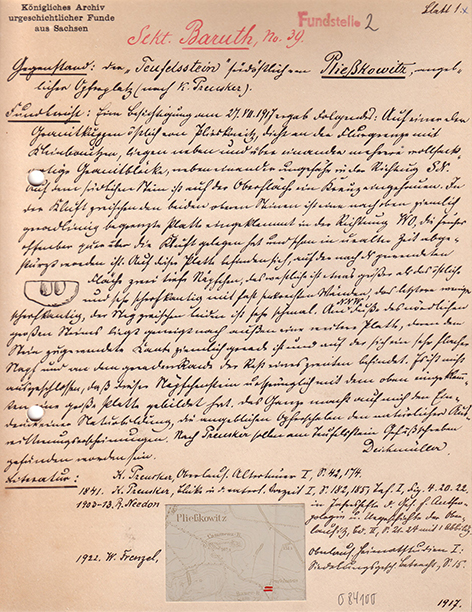
Given this long history of interpretations—some scientifically sound, others fantastically exaggerated—it is probably no coincidence that Johannes Victor Deichmüller (1854–1944), director of the Archive of Prehistoric Finds from Saxony, founded in 1900, took 17 years before he finally paid a visit to the Teufelsstein in the summer of 1917. To the geologist and paleontologist, who had a background in the natural sciences, “the whole thing … gave the impression of a natural formation, and the alleged sacrificial bowls appeared to be the result of natural weathering.”
Michael StrobelImage Source OA 15420, 45 ©LfA 1917.
A "Yes and No" to "Artificial Depressions"
From this perspective, perhaps some “Schälchenstein” stones—and not just those in the Bautzen area—should once again be subjected to critical scrutiny. Not even the Bautzen teacher Walter Frenzel (1892–1941), who certainly had a tendency to put forward far-fetched hypotheses from time to time, was willing in the 1920s to regard “weathering patterns in granite” across the board as ritual bowl stones and “summit cliffs fissured in the shape of a wool sack” as pagan sacrificial altars. However, regarding the hollow shapes of the Teufelsstein, “artificial depressions are likely.”
Michael StrobelImage Source OA 15420, 46 ©LfA 1917.
Vandalism stemming from ideological blindness
As long as the teaching community, in particular, fostered the belief among the general public that this was an “ancient, pre-Christian place of worship that had been destroyed when Christianity took hold,” no local historian should have been surprised that the Teufelsstein became not only a destination for day-trippers but also a target of vandalism: After the Nazis came to power, the temptation was apparently strong to leave “legible” traces of Nazi ideology at the supposedly pagan “prehistoric sanctuary” or even to perform ritual acts there. In February 1935, Oskar Kaubisch (1882–1959), a high school teacher, photographer, and local historian from Bautzen, discovered during an inspection visit that the entire surface of the stones was suddenly covered with a “multitude of swastikas and names.” The perpetrators are believed to have been either students from the surrounding villages or workers from the neighboring quarry.
Michael StrobelImage Source OA 15420, 71 ©LfA 1936.
Natural and Archaeological Landmark
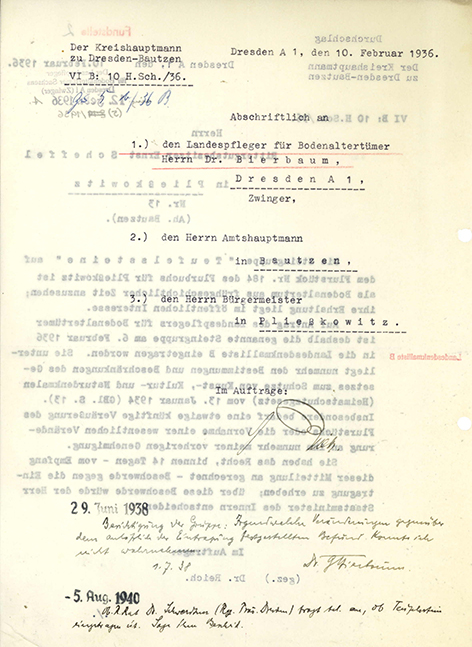
The report of the damage in early 1936 prompted Georg Bierbaum (1889–1953), the State Curator of Archaeological Monuments, to initiate the entry into the B list of monuments (Archaeological Monuments) in accordance with the Saxon Heritage Protection Act of 1934 and to emphatically reference a regulation issued by the Ministry of Public Education on the “Protection of Prehistoric Monuments by Youth” dated November 12, 1935. In it, the acting head of the ministry welcomed “the interest of young people in archaeological artifacts” “in view of the significance of prehistory and early history for the contemporary German view of history,” while at the same time expressing the expectation “that it be appropriately encouraged by the school and guided in the right direction.” The owner, the manorial landowner Ernst Scheffel, had no objections to the registration dated February 16, 1936.
Michael StrobelImage Source OA 15420, 81 ©LfA 1936.
Granite quarrying since the 19th century
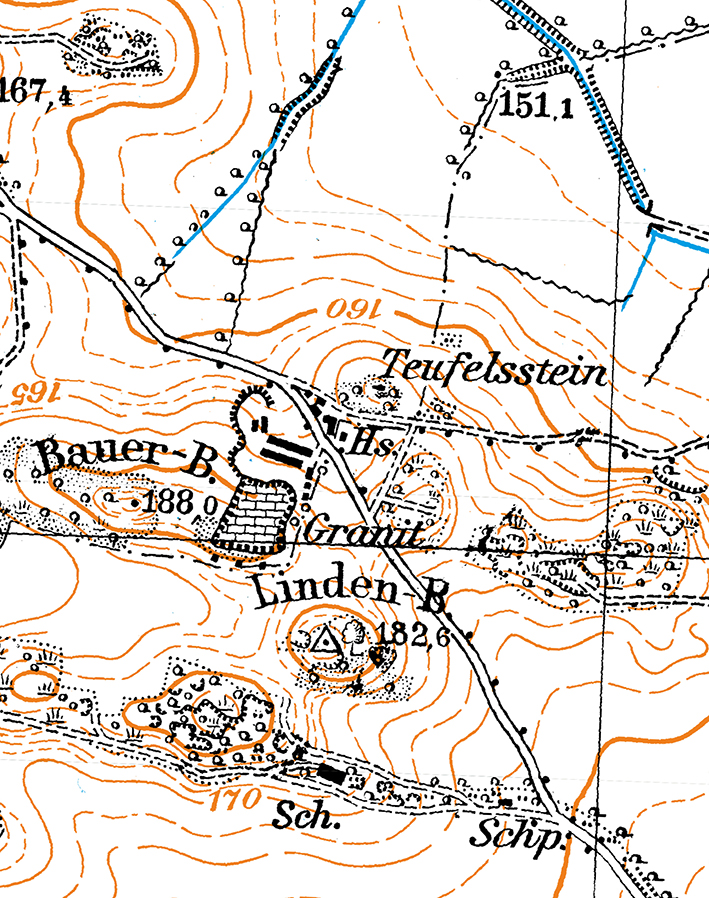
According to the records, the Teufelsstein also appears to have been spared further damage for the time being, as well as any “ritual” appropriation during solstice celebrations or similar activities by the Hitler Youth or other party organizations. Furthermore, no one has since had the questionable idea of conducting further excavations at this natural monument of geological and archaeological significance. As long as the rock formation was not endangered by the neighboring quarries or the expansion of a residential building at the western foot of the hill, there was no reason for the archaeological preservation authorities to take additional measures.
Michael StrobelImage Source TK Weigersdorf 1938 ©SLUB und GeoSN Sachsen.
Here the stones speak: Do not touch us!
Further site inspections in the postwar period (1951) and 20 years later revealed no evidence of significant changes. The site’s protected status also remained unchanged. Throughout its history of interpretation spanning more than three hundred years, scientifically grounded interpretations have been intertwined with fantastical ones. The rock formation has nothing to do with megalithic monuments. During the 4th and early 3rd millennia BCE, no farming communities in Upper Lusatia were dense enough to have erected this type of monumental architecture. Even in the fertile Bautzen region, evidence of settlements from the late Neolithic period is extremely rare. Just as the stone group does not constitute an archaeological monument in this sense, so too would any interventions in the geotope and natural monument “Teufelsstein” be highly questionable.
Michael StrobelImage Source OA 15420, 69 ©LfA 1982.
Literature
Walter Frenzel, Der Forschungsstand der Vorgeschichte in der Oberlausitz (Bautzen 1927).
Johann Wolfgang von Goethe, Zur Naturwissenschaft überhaupt, Erster Band (Stuttgart 1817).
Gottfried Hofbauer, Granit – Geschichte und Bedeutung (Heidelberg 2021).
Karl Hermann Christian Jordan, Die Naturdenkmäler der Sächsischen Oberlausitz (Bautzen 1936).
Günter Möbus, Einführung in die geologische Geschichte der Oberlausitz (Berlin 1956).
Alfred Moschkau, Die prähistorischen Alterthümer der Oberlausitz und deren Fundstätten. Neues Lausitzisches Magazin 61, 1885, 89–131.
Richard Needon, Der Teufelsstein bei Plißkowitz. Jahresh. Ges. Anthr. Oberlausitz 2, 1903–1913 (1913) 21–24.
Ehregott Friedrich Pannach, Kleine Beiträge zur natürlichen und statistischen Beschaffenheit der Oberlausitz. Lausitzische Monatsschr. 1797, 410–422.
Karl Benjamin Preusker, Oberlausitzische Alterthümer. Erster Beitrag. Neues Lausitzisches Magazin 6, 1826, H. 2, 165–180.
Karl Benjamin Preusker, Blicke in die vaterländische Vorzeit. Band I (Leipzig 1841).
Karl Adolf Gottlob von Schachmann, Beobachtungen über das Gebirge bei Koenigshain in der Oberlausitz (Dresden 1780).
Felix Wilhelm, Schalensteine in der Umgegend von Bautzen. Jahresh. Ges. Anthr. Oberlausitz 2, 1903–1913 (1913) 259–273.
Note on monument protection
Archaeological monuments are protected by the Saxon Monument Protection Act. A permit under monument law is required for ground interventions or construction measures.
Permalink
https://archaeo-sn.de/en/ort/teufelsstein/
Citation
Michael Strobel, Devil’s Stone. In: Landesamt für Archäologie Sachsen, Website archaeo | SN (24.04.2025). https://archaeo-sn.de/en/ort/teufelsstein/ (Stand: 29.09.2026)
