

Trapeze system Altranstädt
| Place: | Altranstädt (Markranstädt, Leipzig) |
|---|---|
| Type: | Grave site |
| Dating: | ca. 3800 - 3500 BC |
Description
Southeast of the village of Altranstädt near Markranstädt, a conspicuous trapezoidal ditch was discovered in 1992 during an archaeological aerial survey. It was apparently surrounded by a Stone Age settlement landscape, as indicated by numerous surrounding settlement and burial pits and another oval ditch. Furthermore, the parcel name Klein Glasau indicated the possible location of the deserted village of Glasau. As the municipality of Großlehna had designated an industrial estate at this location, large-scale excavations were carried out in 1993 to mid-1994, which preceded the construction work. A further excavation campaign began in 1995 to 1996. In this way, the features and possible objects found in the ground could be professionally recovered before final destruction and documented for later scientific analysis.
Dana Mikschofsky/Ronald Heynowski/Annemarie ReckThe trapeze
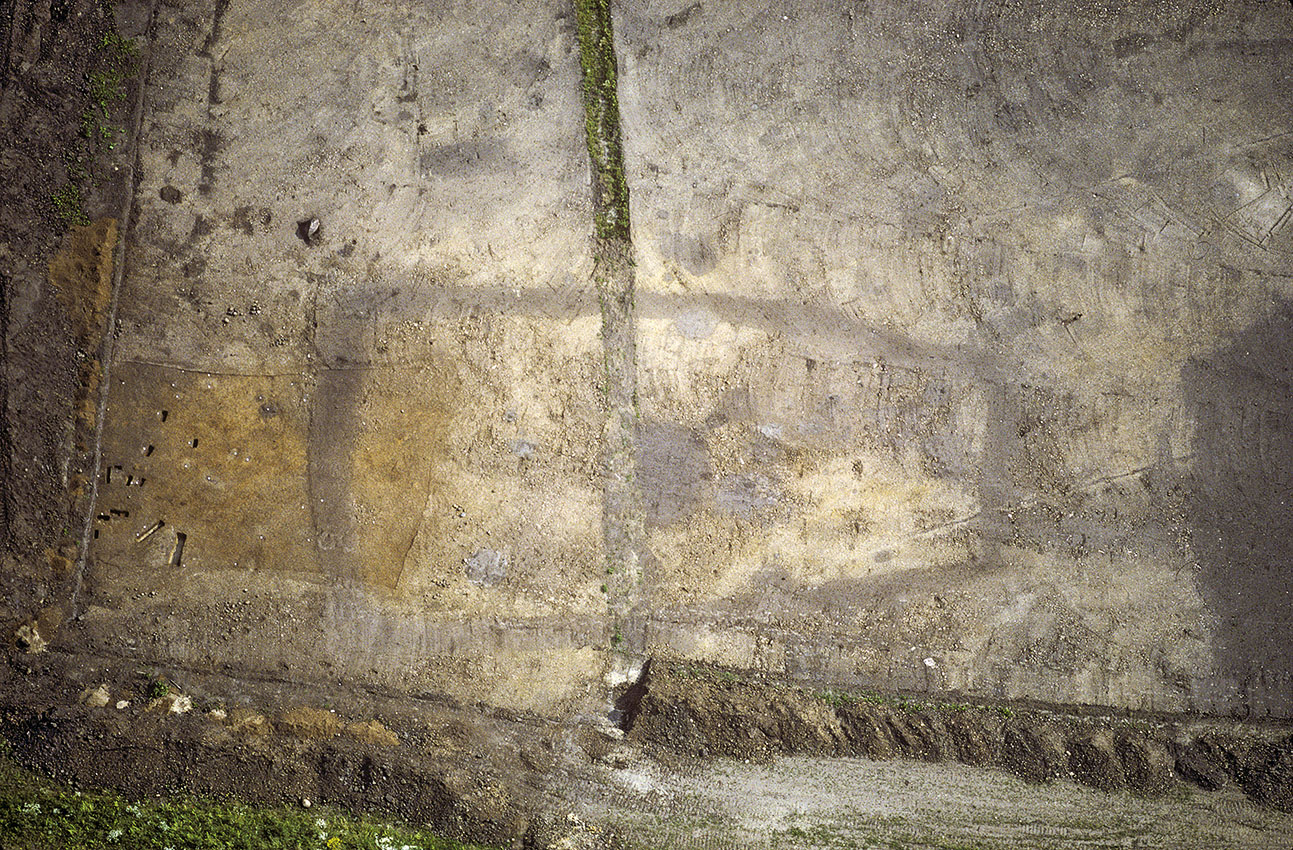
The excavation campaign around the trapezoidal earthwork was carried out from 1995 by the Saxony State Office for Archaeology. As soon as the topsoil had been removed, the trapezoid, which had already become conspicuous in the aerial photograph, became visible. The ditch system showed a west-east orientation. On the long sides it measured 34 m to the south and 33 m to the north. The wider eastern side was 20 m long, while the narrower western end was only 12 m long. The ditch was between 1 m and 2.3 m wide and still about 0.8 m to 1 m deep in the ground. The pit floor was about 40 cm deep. The ditch was probably used to construct a palisade of wooden logs, while the inner surface was probably filled with earth and covered over.
Dana Mikschofsky/Ronald Heynowski/Annemarie ReckImage Source O. Braasch, Foto ©LfA 1995.
Central pit
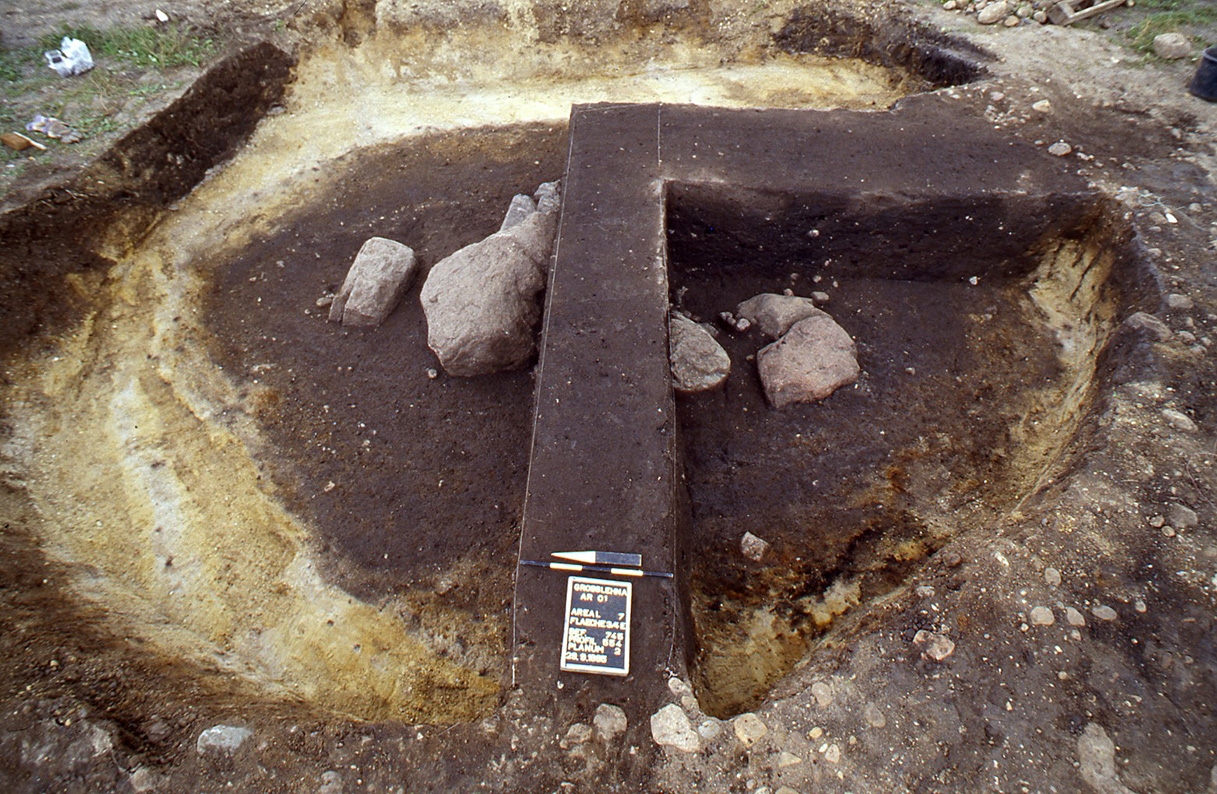
A search cut was made as early as 1993, which cut the trapezoidal ditch and also the round pit in the center. It had a diameter of 5 m and was approximately round. It was filled with humic material. In comparable trapezoidal features, there is usually a burial in the central pit. However, this was not the case in Altranstädt. On the other hand, a north-south running stone packing of six up to 1.3 m long field stones could be uncovered in the pit, which bordered the stone-free center of the group.
Dana Mikschofsky/Ronald Heynowski/Annemarie ReckImage Source H. Szédeli, Foto ©LfA 1993.
Burial or cenotaph?
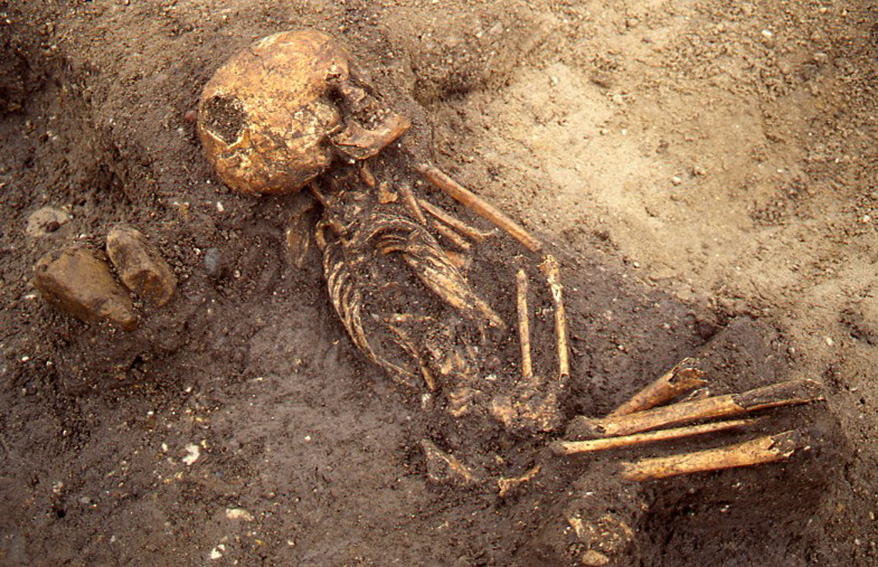
If there really was never a burial in the trapezoidal ditch complex at Altranstädt, the finding would represent a first-time observation. It may then have been a cenotaph, i.e. a mock tomb that was architecturally constructed like a burial complex but remained empty. It is possible that a burial that once existed in the central pit was removed at a later date and replaced by the large fieldstones. However, it is unlikely that the bones would have been buried in the ground at this point. In the immediate vicinity of the trapezoid, to the north and north-east of the complex, several stool burials were uncovered during the excavations. As far as they could be dated, however, they could be assigned to the Late Neolithic period. This would make them around 1000 years younger than the trapeze complex.
Dana Mikschofsky/Ronald Heynowski/Annemarie ReckImage Source H. Szédeli, Foto Hockerbestattung ©LfA 1994.
Dating
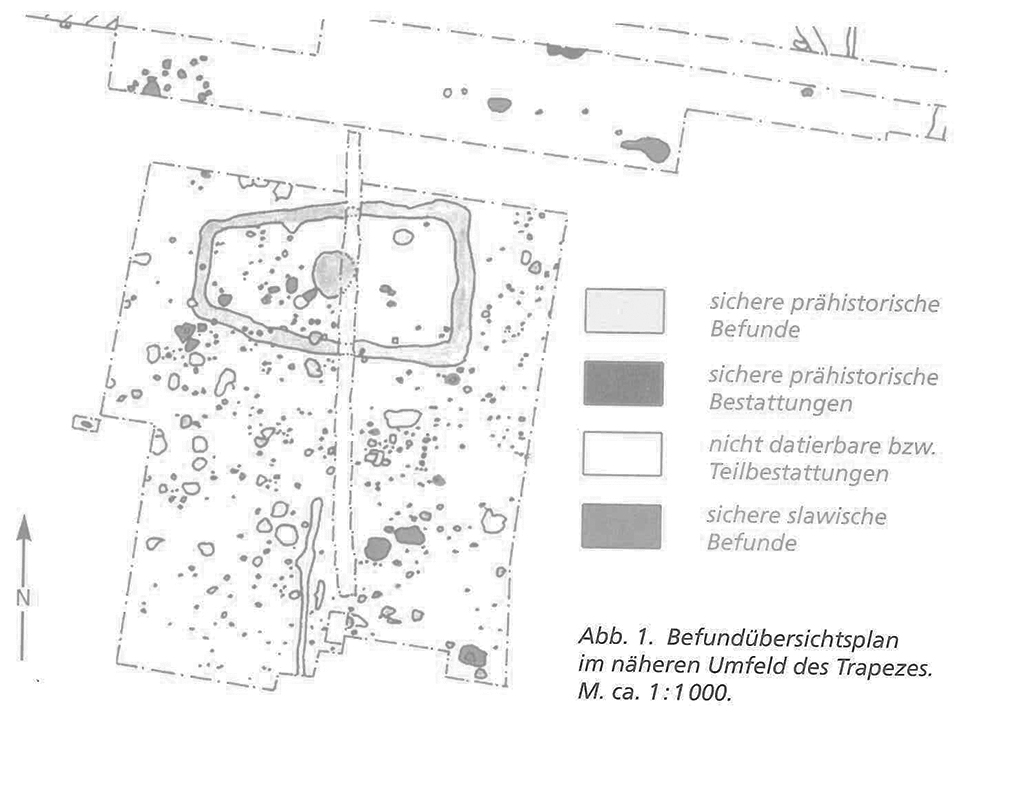
The trapezoidal ditch cut through one of the settlement pits in the south, in which pottery sherds from the Middle Neolithic period were found. This means that the ditch must have been built after 3800 BC. The few finds from the pit inside the complex are quite unspecific and can therefore only be roughly assigned to the Neolithic period. There are several architecturally comparable features in Saxony, such as the so-called "Street of Trapezoidal Graves" in Roitzsch. On the basis of such comparable finds, a chronological classification of the site in the Middle Neolithic is obvious.
Dana Mikschofsky/Ronald Heynowski/Annemarie ReckImage Source H. Szédeli/I. Kraft, Befundübersicht M. 1:1000 ©LfA 1996.
Literature
Dana Mikschofsky/Ronald Heynowski, Grabanlage in Luftbild und Ausgrabung. In: Regina Smolnik/Ronny Zienert (Hrsg.), Höhenflüge. Luftbilder und Archäologie in Sachsen (Dresden 2024) 206–207.
Hans Szédeli, Ausgrabungen in Großlehna-Altranstädt, Lkr. Leipziger Land. Archäologie aktuell Freistaat Sachsen 2, 1994, 59–64.
Hans Szédeli/Ingo Kraft, Neues zum trapezoiden Erdwerk in Großlehna-Altranstädt. Archäologie aktuell Freistaat Sachsen 4, 1997, 18–22.
Note on monument protection
Archaeological monuments are protected by the Saxon Monument Protection Act. A permit under monument law is required for ground interventions or construction measures.
Permalink
https://archaeo-sn.de/en/ort/trapeze-system-altranstadt/
Citation
Dana Mikschofsky/Ronald Heynowski/Annemarie Reck, Trapeze system Altranstädt. In: Landesamt für Archäologie Sachsen, Website archaeo | SN (06.11.2024). https://archaeo-sn.de/en/ort/trapeze-system-altranstadt/ (Stand: 29.09.2026)
