

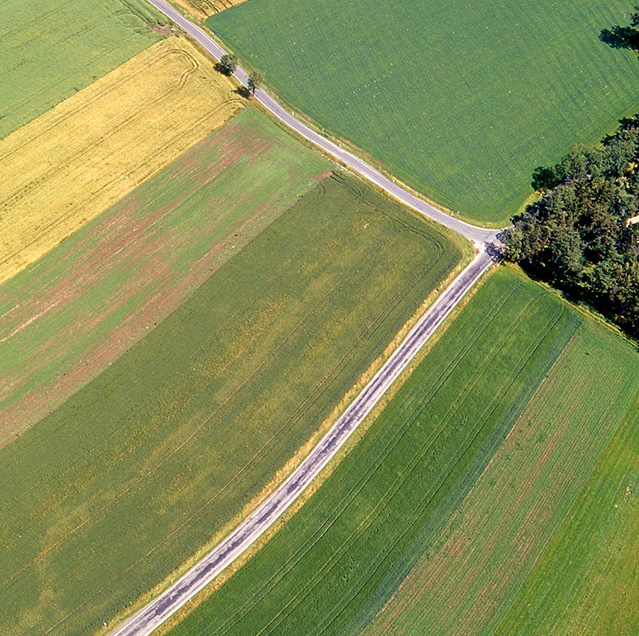
Tumulus of Stenn
| Place: | Stenn (Lichtentanne, Zwickau) |
|---|---|
| Type: | Mound grave/mound burial ground |
| Dating: | Lusatian Culture | Vogtland Group | ca. 1200 BC. |
Description
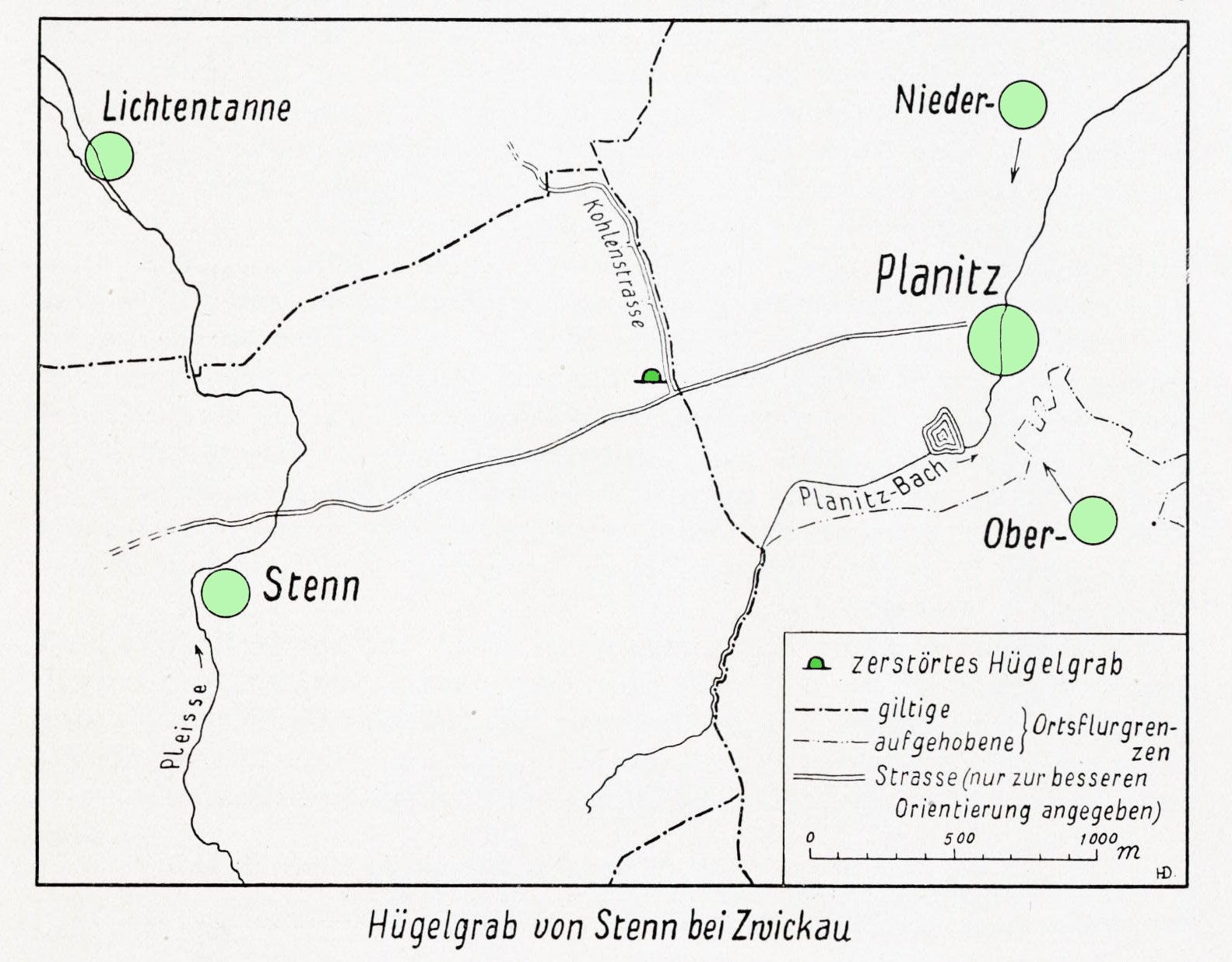
At the beginning of the 19th century. At the beginning of the 20th century, in the district of Stenn about 120 steps northwest of the turnoff "Zur Kohlenstraße“ from the Planitzer or. Stenner Straße in the field a conspicuous mound of stones. In 1839, the land was bought by the owner of the Weißenbrunn manor and the hill was cleared in search of archaeological finds. In fact, the excavators came across bronze weapons, jewelry and parts of ceramic vessels, which were published by August von Larisch in 1840. Today, however, the original finds are all lost. Based on his drawings, the objects found can be typologically assigned to the Late Bronze Age. The remains of a burial were not mentioned in the excavation report, but could possibly have been overlooked.
Annemarie ReckFind story
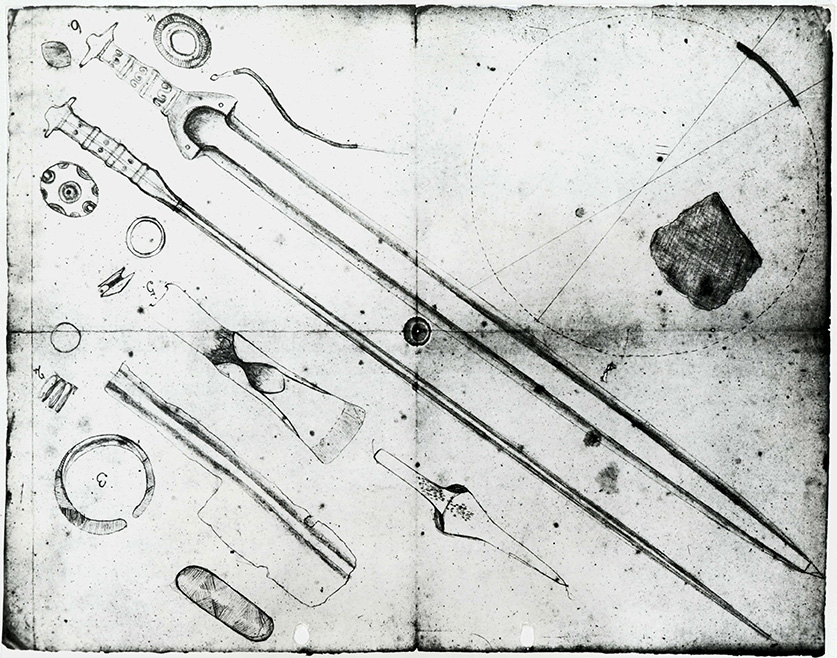
In 1839, the owner of the manor in Weißenbrunn, a certain Mr. Pelz the Younger, bought the mound from a farmer in Stenn after the shape of the elevation caught his attention. He suspected at the time that the hill had served as a redoubt during the Swedish War or another war. In the same year, he arranged for the mound, which was covered by a crust of earth, to be removed. Pelz encouraged the workers to pay particular attention to any finds that might come to light. Their attention was rewarded: the workers came across various bronze weapons, jewelry and ceramic vessels. In 1840, August von Larisch published an excavation report and sketches of the finds. Today, only two of his drawings of the finds and a plaster relief of the sword have survived; the finds themselves are considered lost.
Annemarie ReckImage Source W. Grünberg 1938, 3, Plan.
The sword
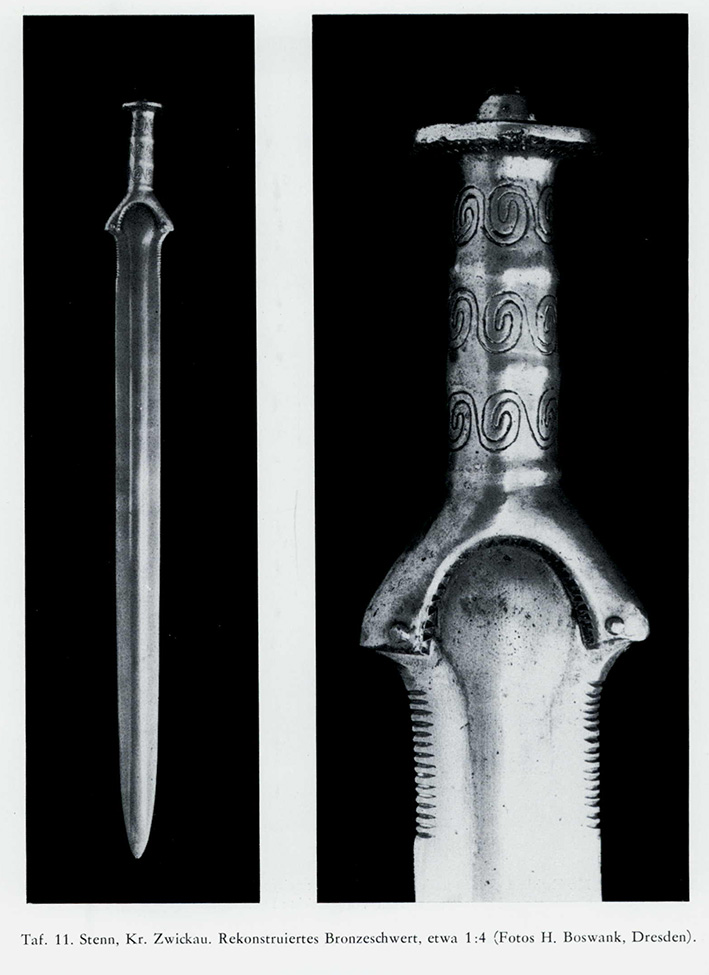
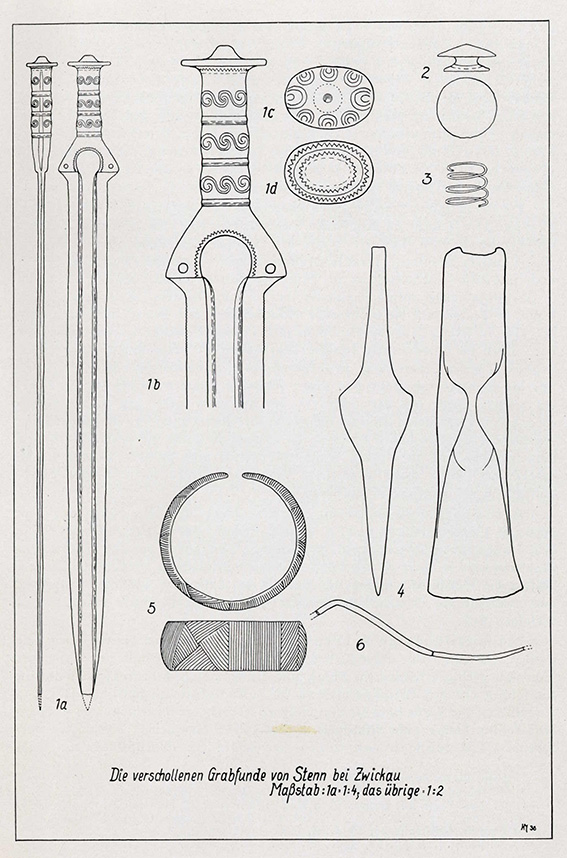
The finds were a bronze full-handled sword with a conical pommel and an oval pommel plate. The upper side of the plate is decorated with an arched pattern that opens outwards, while the underside shows two rows of notched triangles. The handle bar, which becomes increasingly narrower towards the top, is divided by three thickenings. The narrow sections are each divided by two spiral band patterns consisting of two lines. The shoulders of the hilt end straight and are each held by a rivet. A row of triangular notches can be seen on the hilt bow. The double-edged sword blade has a serrated ricasso and a broad central rib. Detlef Liebel produced a reconstruction of Stenn's bronze sword in 1985 as part of a dissertation, which is now in the Zwickau Municipal Museum.
Annemarie ReckImage Source U. Lappe 1988, 559, Tafel 11, Rekonstruktion des Schwertes.
Further finds
A medium-sized flap axe with broad blades and a slightly cut neck, a small bronze spiral with four coils, an undecorated double knob with a conical top and a bent fragment of a bronze needle shaft were also recovered. The burial mound also contained two similar bracelets with a c-shaped cross-section, decorated with a braided band pattern in a metope arrangement. According to Larisch's report, the excavators also came across "whole urns", but these broke during the excavation and were therefore only partially lifted. Another object found, which presumably did not come directly from the burial mound, is a piece of iron with an edge rib showing a square perforation.
Annemarie ReckImage Source W. Grünberg 1938, S. 5.
The dating
A grave find with a sword is unique for the distribution area of the Lusatian culture in Saxony. The shape of the weapon is similar to the three-beaded swords of the Erlach type from south-eastern Bavaria, which are also common in the Franconian region. There, this type of sword is found in rich graves of the older Urnfield Culture (Hallstatt A1). However, the Stenn sword also shows differences, such as the continuous central rib, a slightly twisted pommel disk and the lack of a hole in the pommel plate, which is typical of Erlach swords. According to Ursula Lappe, this gives the sword ancient features reminiscent of the Riegsee swords of the early Urnfield period (Bronze Age D). The medium-sized Lappe axe also points in this direction. Although it is still frequently found during the older Urnfield Period in eastern Central Europe, it was more common as an addition to sword graves at the end of the Middle Bronze Age. The weapon finds thus point to the beginning of the Southern German Urnfield Period.
Annemarie ReckImage Source A. v. Larisch, Zeichnung, OA 89440, 21.
Interpretation
In contrast to the sword, the bracelets can be attributed to the local Lusatian culture and fit very well into the chronological framework of Bz D/Ha A1 given by the weapon finds. Moreover, while the decorative pin and the double button are typical of male burials, paired bracelets are actually characteristic of female burials of this period. Although paired arm rings have also been found in rich weapon graves in southern Germany, possibly to emphasize the prominent position of the deceased. However, it cannot be ruled out that several people may have been buried in the Stenn burial mound or that it may even have been a woman. The burial mound itself was erected in an exposed location at the end of a ridge 375 m above sea level, which also suggests an important person. According to von Larisch, it was a single large and clearly visible monument. Its exact dimensions can only be guessed at today. In his excavation report, von Larisch writes that "100 loads of stones" had to be removed, which in Saxony at the time corresponded to around 100 tons in weight.
Annemarie ReckImage Source R. Heynowski, Foto Fundstelle ©LfA 2004.
Literature
Georg Bierbaum, Das reiche Hügelgrab von Stenn bei Zwickau. Sachsens Vorzeit 2, 1938, 45–51.
Ursula R. Lappe, Das jungbronzezeitliche Hügelgrab von Stenn, Kr. Zwickau. In: Heinz-Joachim Vogt (Hrsg.), Archäologische Feldforschungen in Sachsen. Arbeits- und Forschungsberichte zur sächsischen Bodendenkmalpflege, Beih. 18 (Berlin 1988) 171–173.
Note on monument protection
Archaeological monuments are protected by the Saxon Monument Protection Act. A permit under monument law is required for ground interventions or construction measures.
Permalink
https://archaeo-sn.de/en/ort/tumulus-of-stenn/
Citation
Annemarie Reck, Tumulus of Stenn. In: Landesamt für Archäologie Sachsen, Website archaeo | SN (30.09.2024). https://archaeo-sn.de/en/ort/tumulus-of-stenn/ (Stand: 29.09.2026)
