

Lost in the turmoil of the postwar months—the Early Bronze Age hoard from Niederjahna
| Place: | Niederjahna (Käbschütztal, Meissen) |
|---|---|
| Type: | Deposit Fund |
| Dating: | Early Bronze Age / Aunjetitz Culture | 1800 B.C. |
Description
The Kleine Jahna Valley is one of the smaller river basins on the left bank of the Elbe that drain the loess plateaus west of the Elbe Valley. The Jahnabach rises near Löthain and initially flows through a relatively wide valley floor flanked by loess ridges; north of Niederjahna, the valley’s cross-section transitions into a steep-sided, almost V-shaped profile with numerous protrusions and recesses. Surface water flows from the “Seilitz Plateau Edge” through short, notched valleys, into which numerous depressions and gullies in turn flow“ carried into the Jahn Valley. Why, of all places, in one of these side valleys during the Early Bronze Age around 1800 BC. Chr. Where the hideout was established remains a great mystery.
Michael StrobelResearch Chronicle
April 3, 1932 | Farm workers discover bronze rings while digging a trench.
April 5, 1932 | The landowner, Günther Freiherr von Bischoffshausen, reports the discovery to the Archive of Prehistoric Finds in Saxony.
October 13, 1933 | Alfred Mirtschin, a teacher from Riesa, documents the hoard.
1932–1945 | Baron von Bischoffshausen keeps the objects in a display case in the manor house.
May–November 1945 | The finds disappear from the display case.
Since 1945 | The objects have been missing ever since.
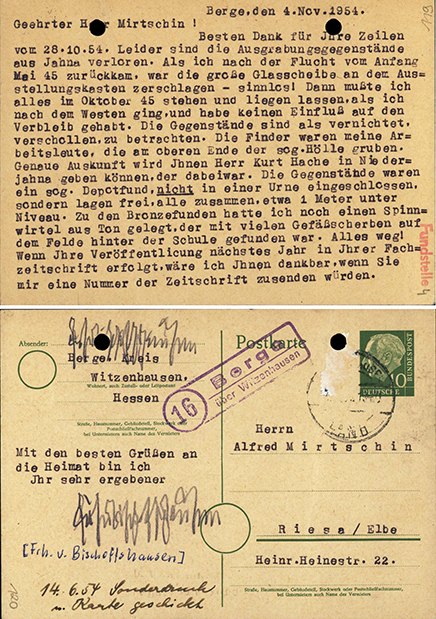
October 20, 1954 | Alfred Mirtschin conducts on-site research into the whereabouts of the hoard.
1956 | and publishes his findings based on his notes.
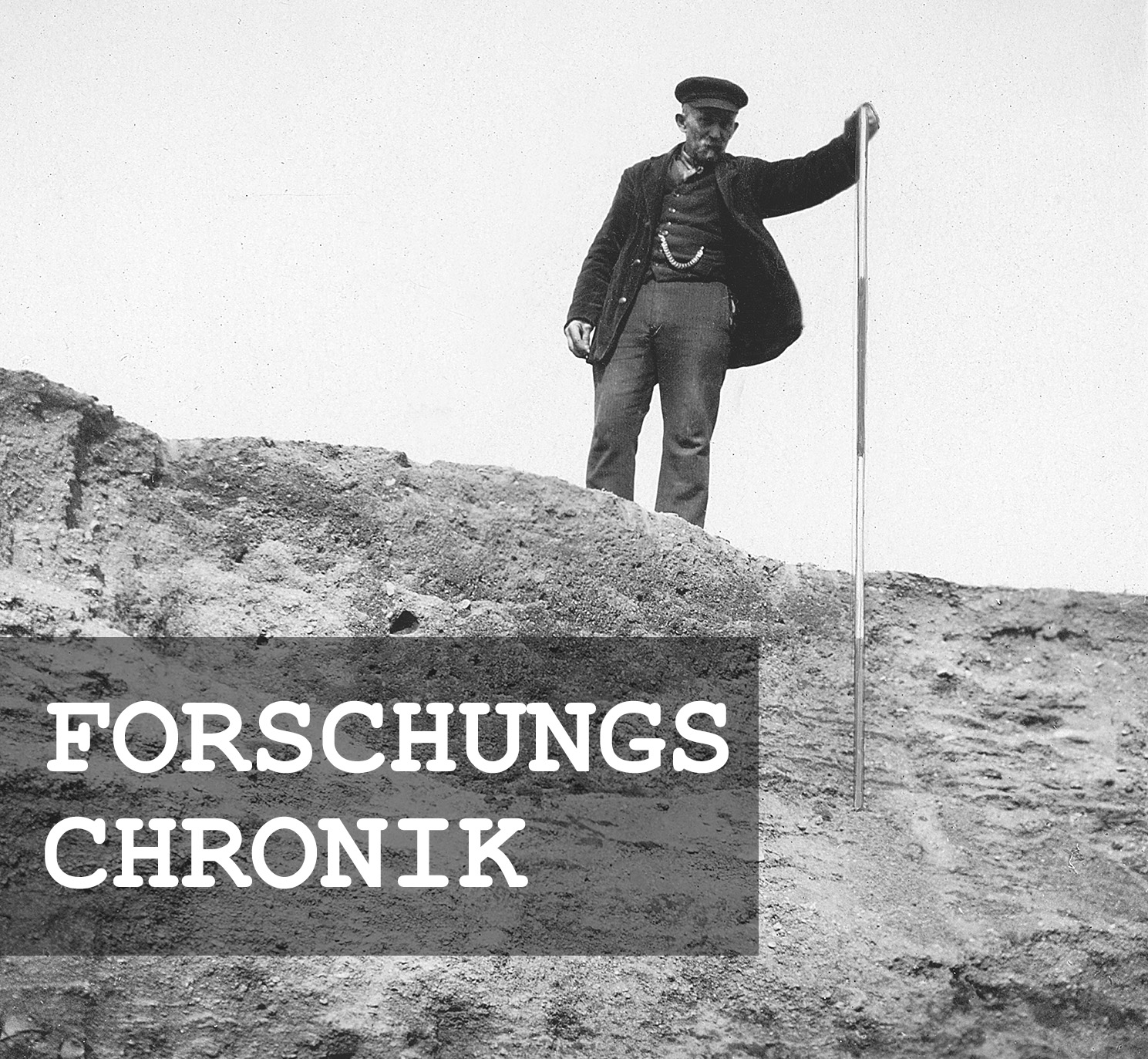
Image Source Foto ©LfA 1929.
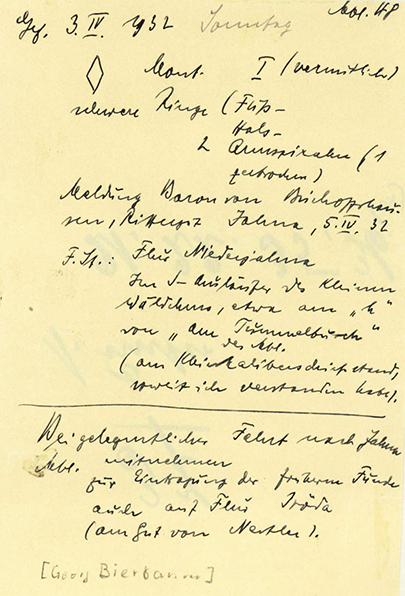
A Sunday Find
In the spring of 1932, the curator of the prehistoric collection at the Dresden Museum of Mineralogy, Geology, and Prehistory, Georg Bierbaum (1889–1953), noted that one week after Easter, on Sunday, April 3, a hoard from the Early Bronze Age had been unearthed in the Niederjahna field. The report was received on Tuesday, April 5—just two days after the discovery—and was thanks to the manorial landowner Günther Freiherr von Bischoffshausen (1890–1971), who had presumably contacted the Archive of Prehistoric Finds in Saxony by telephone. His workers had stumbled upon the metal objects while digging a trench.
Michael StrobelImage Source OA 59490, 112 ©LfA 1932.
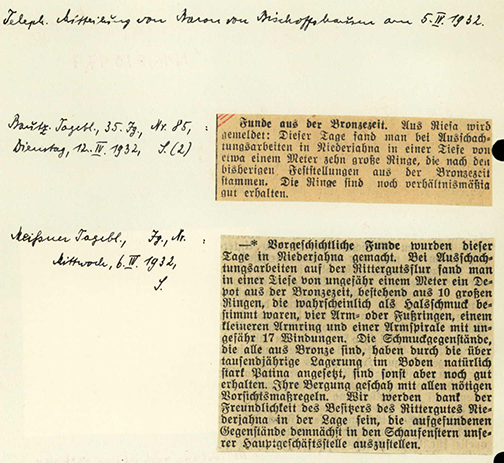
From the slaughterhouse to the newspaper
Just one day later, on April 6, 1932, the *Meißner Tagblatt* reported on the remarkable discovery, and a week later, the *Bautzener Tageblatt* did the same. It is no longer possible to determine exactly who informed the press. The announcement of an exhibition in the display window of the newspaper’s “headquarters” suggests local sources rather than a press release from the museum.
Michael StrobelImage Source OA 59490, 113 ©LfA 1932.
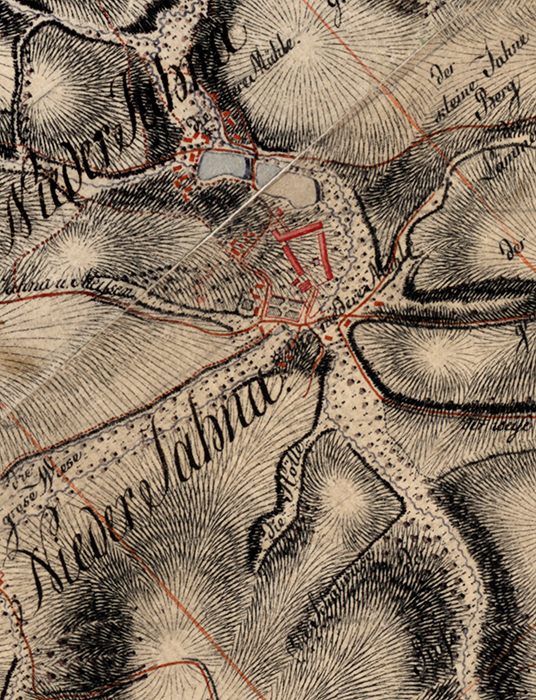
A hoard found in “Hell”
The site is located less than 500 m south of the estate settlement at the southern end of a ravine—now forested—that flows into a side valley of the Jahnabach and is listed in the Meilenblatt under the field name “Die Hölle.” The notation indicates grassland. Eighty years later, the designation had disappeared from the maps and been replaced by “Am Tummelbusch,” which is likely derived from “tumulus” (mound) and likely refers to the adjacent hill to the south, as there is currently no trace of a prehistoric burial mound.
Michael StrobelImage Source Berliner Meilenblatt, Auszug ©LfA/SLUB 2026.
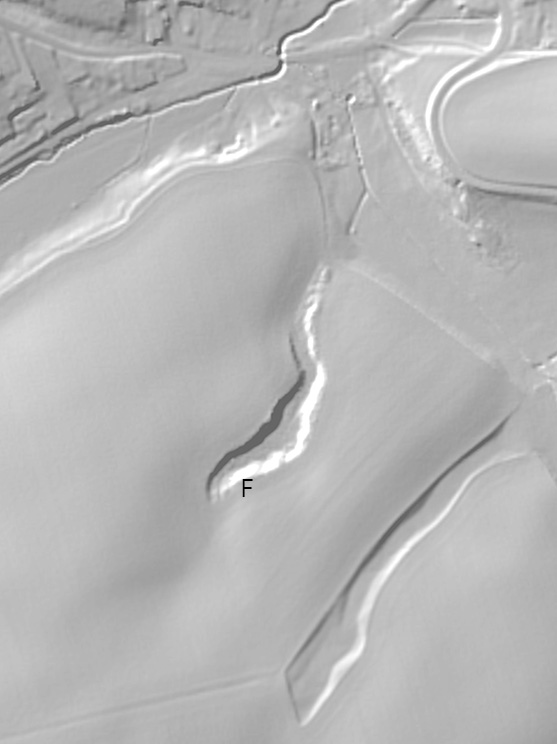
"Hell's Gorge"
This ravine-like valley, which is only about 100 m long and up to 25 m wide, has a slightly trough-shaped cross-section; it may have formed as early as the Late Glacial period and carries water only after heavy rain events or extensive precipitation. Today, shrubs and trees grow on the valley floor and the short, steep slopes. The “F” marks the presumed location of the find.
Michael StrobelImage Source DGM ©LfA/GeoSN.DGM ©LfA/GeoSN.DGM ©LfA/GeoSN.
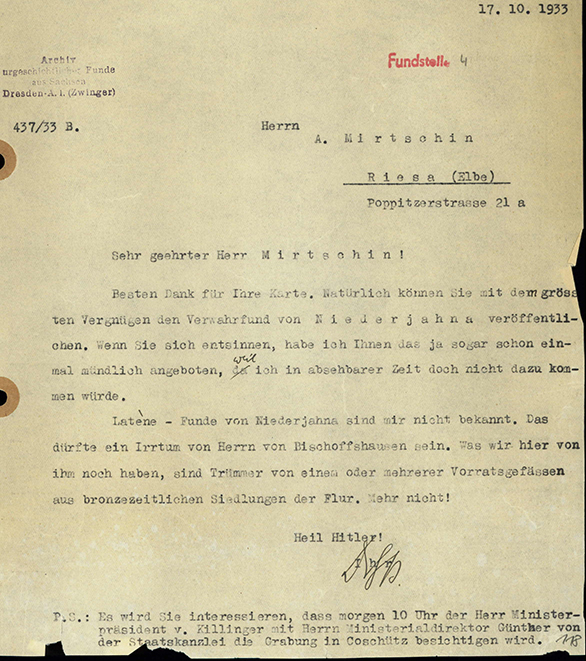
Archaeological Preservation at a Low Point
Starting in 1931, State Archaeologist Bierbaum was largely confined to his desk. He could only undertake business trips on weekends using his private car. After the outbreak of the Great Depression, financial and staffing constraints pushed Saxony’s archaeological heritage preservation efforts to the limits of their capacity to act. “An occasional trip to Jahna,” a visit to the manor, and “taking along” the finds were never to come to pass. Bierbaum entrusted the processing and publication of the finds to one of his most loyal volunteers, the Riesa teacher and museum director Alfred Mirtschin (1892–1962), who had already spent considerable time in the area documenting Iron Age finds and was also acquainted with Baron von Bischoffshausen. However, his assumption that “La Tène urns” had also been found in Niederjahna was not confirmed.
Michael StrobelImage Source OA 59490, 118 ©LfA 1932.
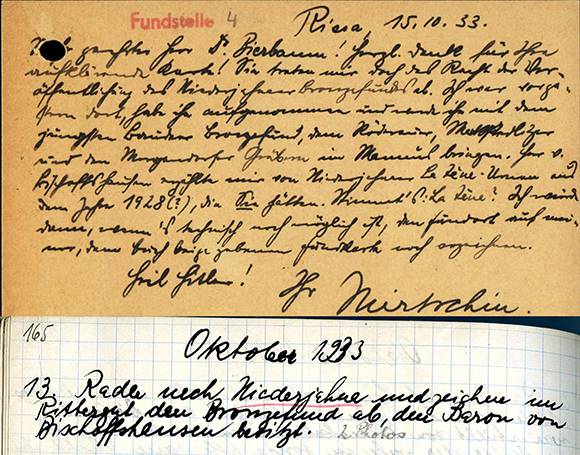
Initial Documentation
A little over a year after the discovery, on October 13, 1933, Mirtschin did indeed cycle to Niederjahna to sketch and photograph the bronze hoard at the “Rittergut.” However, the plan to publish the rings in the journal “Mannus” as part of a compilation of other finds from Aunjetitz—primarily from the Riesa area—never came to fruition. In 1941, the journal did publish a catalog of Early Bronze Age finds from what was then known as the “Northern Saxon Elbe Region,” which, with minor additions, was to represent the state of research for over 40 years (Mirtschin 1941); but the Riesa teacher chose not to publish the few sites from the “Meissen-Dresden Elbe Valley” at that time—perhaps in part because they lay outside his area of responsibility as the local representative for archaeological finds.
Michael StrobelImage Source OA 59490, 116 und Tagebuch Mirtschin ©LfA/Museum Riesa 1932/1933.
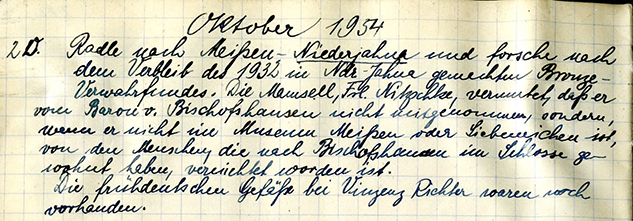
Review 1
It was not until the early 1950s, when Mirtschin began studying Early Iron Age finds in the Riesa area, that he claims to have rediscovered his nearly 20-year-old notes. The hoard, it seems, had been completely forgotten. On October 20, 1954, he cycled once again to Niederjahna to investigate the whereabouts of the cache. There he learned that Baron von Bischoffshausen, while fleeing to the West in the fall of 1945, had not taken the finds with him but had left them behind. If the hoard had not been transferred to the Meissen City Museum or to Siebeneichen Castle, it would have to be considered lost. After the end of the war, refugees and displaced persons had been housed in the manor house, and the estate had been expropriated as part of the land reform.
Michael StrobelImage Source Tagebuch Mirtschin ©LfA/Museum Riesa 1954
Review 2
Just a few days later, the baron—who was now living with his family in Berge, in northern Hesse (today a district of Homberg [Efze], Schwalm-Eder district), confirmed in a postcard his suspicion that the objects were to be considered “destroyed or lost.” Upon his return from his first escape in early May 1945, he had already noticed that the glass pane of the “display case”—presumably a wall-mounted display case—had been smashed. However, he leaves open whether the pieces had already been stolen at that time or only disappeared without a trace after his second escape to the West. Mirtschin’s notes from 1933, which form the basis of the publication that appeared in 1956 (Mirtschin 1956), proved all the more valuable. The baron apparently received a special print of the article.
Michael StrobelImage Source OA 59490, 120 ©LfA 1954.
Ambiguities in the Documentation
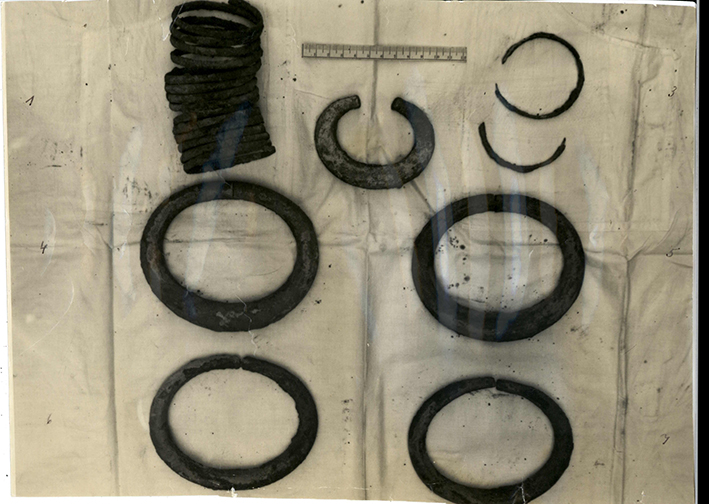
It is no longer possible to determine who might have taken the photographs of the complex that have been preserved in the files. They may also have been taken by Mirtschin, whose essay, however, is based exclusively on drawings and descriptions. Even though the improvised photographs were not suitable for publication, they do at least document the condition of the objects, presumably shortly after their recovery. Traces of corrosion are unmistakable even in the blurry, poorly exposed images. There is no indication that the hoard was ever subjected to any professional conservation or restoration measures—such as those performed in the Dresden Museum’s workshop—prior to its disappearance.
Michael StrobelImage Source OA 59490, 110 ©LfA 1933?.
A great loss
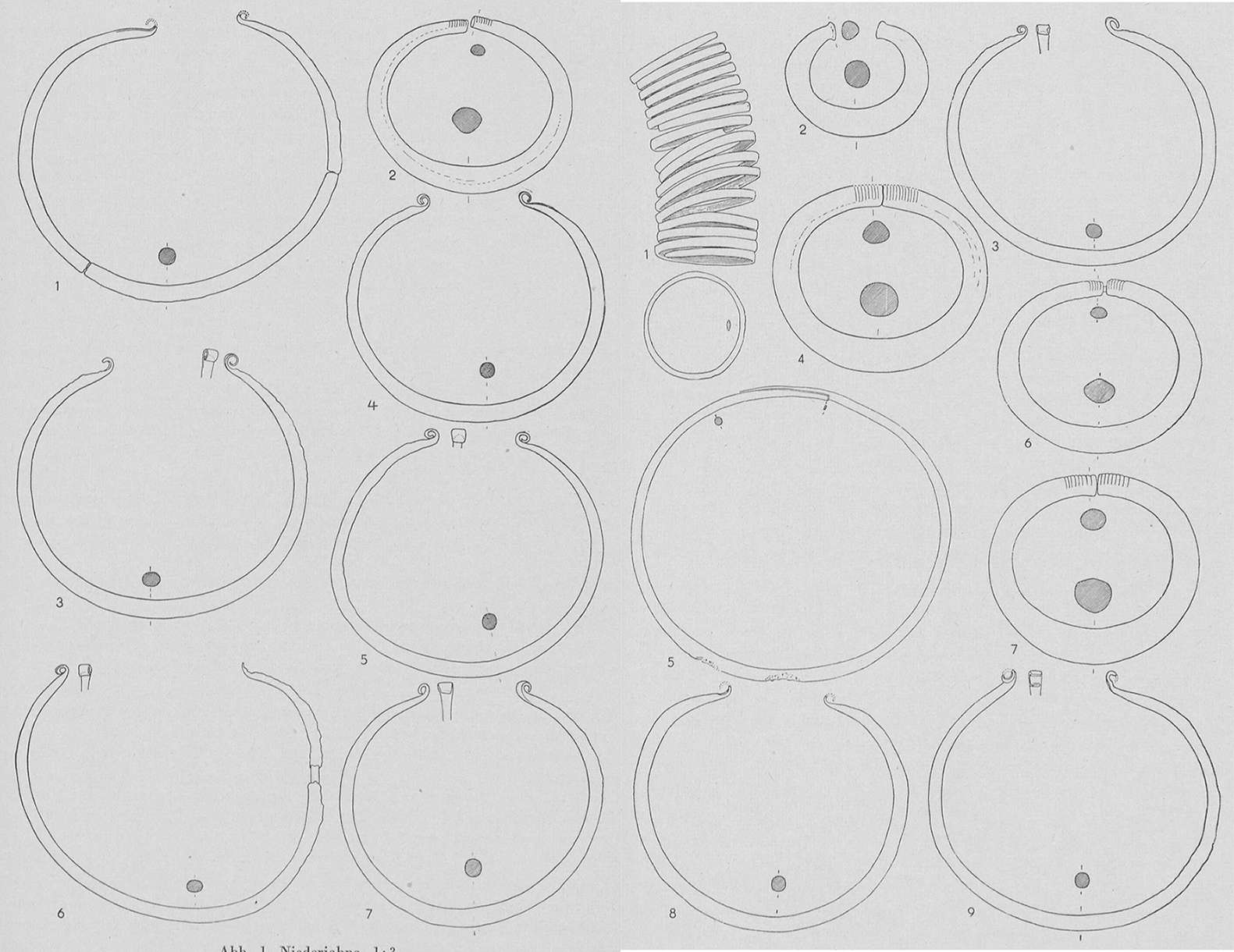
The complex consisted of 10 round-barred eyelet neck rings with flat-hammered, tapered ends, five round-barred arm rings with grooved ends, and a spiral arm ring with 16 coils. Since the objects were not found inside a clay vessel, they were most likely deposited in a container made of organic material. Despite all the twists and turns in its history of transmission and loss, this lost ensemble remains a significant testament to the intensity of Early Bronze Age settlement activity in the region and can be dated to around 1800 BCE.
Michael StrobelImage Source Mirtschin 1956, Abb. 1-2.
The Landowner as an Archaeologist
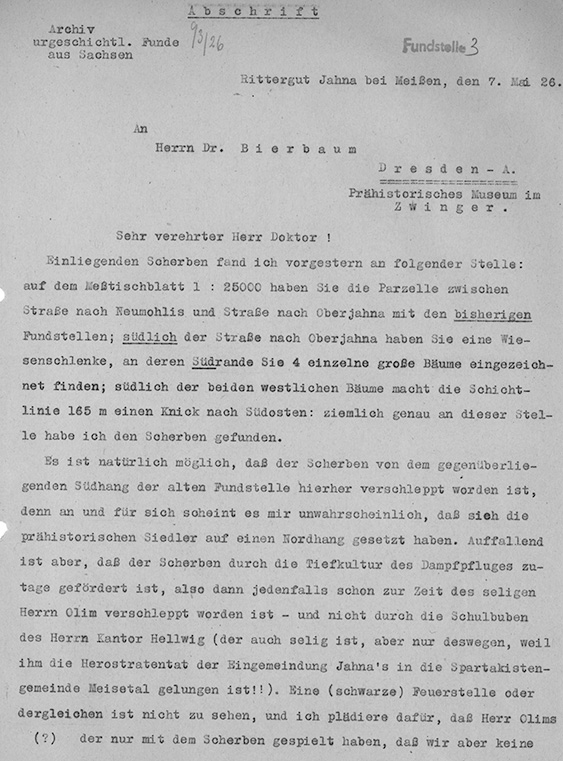
The cache was not the baron’s first report of a discovery. As early as 1926, he had informed Bierbaum about surface finds that had come to light in his fields southwest of the village while a steam plow was being used—and thus from deeper soil layers. The correspondence with the then-scientific collection assistant reveals not only a certain personal closeness but also, presumably, a political affinity between the two men, both of whom would likely have viewed the “incorporation of Jahna into the Spartacist municipality of Meisatal” with equal suspicion.
Michael StrobelImage Source OA 59490, 76 ©LfA 1926.
The Early Bronze Age Settlement Landscape
However, since the two sites in Niederjahna cannot yet be dated to the Early Bronze Age, a settlement located about 1.2 kilometers away—which was documented in 2004–2005 prior to the construction of the B101 bypass south of the Rothen Gut—is currently the closest to the hoard site. Silo pits preserved to a depth of up to 1.8 meters and typical pottery attest to a significant village settlement of the Aunjetitz Culture between 2000 and 1600 BCE.
Michael StrobelImage Source U. Wohmann, Foto ©LfA 2007.
Literature
Matthias Donath, Das Rittergut Jahna in Niederjahna. Sächsische Heimatblätter 64/4, 2017, 353-376.
Hans-Jürgen Hardtke/Sarah Jacob/Karl Mannsfeld/Haik Thomas Porada/Michael Strobel/André Thieme/Thomas Westphalen (Hrsg.), Zwischen Lommatzsch und Wilsdruff. Eine landeskundliche Bestandsaufnahme. Landschaften in Deutschland 83 (Köln 2022).
Alfred Mirtschin, Funde der ältesten Bronzezeit im nordsächsischen Elbgebiet. Mannus 33, 1941, 1-48.
Alfred Mirtschin, Ein verschollener Verwahrfund der ältesten Bronzezeit von Niederjahna bei Meißen. Arbeits- und Forschungsberichte zur sächsischen Bodendenkmalpflege 5, 1956, 147-152.
Michael Strobel, Ein Leben für die Archäologie – der Riesaer Lehrer und Museumsleiter Alfred Mirtschin (1892–1962). Archaeo 11, 2014, 38-45.
Note on monument protection
Archaeological monuments are protected by the Saxon Monument Protection Act. A permit under monument law is required for ground interventions or construction measures.
Permalink
https://archaeo-sn.de/en/ort/verschollen-in-den-wirren-der-nachkriegsmonate-der-fruehbronzezeitliche-hortfund-von-niederjahna/
Citation
Michael Strobel, Lost in the turmoil of the postwar months—the Early Bronze Age hoard from Niederjahna. In: Landesamt für Archäologie Sachsen, Website archaeo | SN (02.07.2026). https://archaeo-sn.de/en/ort/verschollen-in-den-wirren-der-nachkriegsmonate-der-fruehbronzezeitliche-hortfund-von-niederjahna/ (Stand: 29.09.2026)
