

Westewitz ski jump
| Place: | Westewitz (Großweitzschen, Central Saxony) |
|---|---|
| Type: | Station/camp/rest area | settlement |
| Dating: | Magdalenian | Mesolithic | Neolithic | 14000 B.C. | 8000 B.C. | 5000 - 4500 B.C. |
Description
On the Westewitzer Schanze, also known as the "Burgstadel“ is said to have been the site of a presumably medieval fortification. Apart from the name, which already appears on old ordnance survey maps, there is no evidence or significant finds today that point to a prehistoric or medieval fortification. Instead, a large number of flint artifacts came to light in the 1960s in the course of a targeted search for datable finds by the volunteer archaeologist Richard Diecke. This made it possible to identify the mountain spur with certainty as a Late Palaeolithic and Middle Stone Age camp site. In addition, numerous scratches indicate that the loess-covered high bank terrace, which was favorable for settlement, could also have been frequented by humans during the Neolithic period.
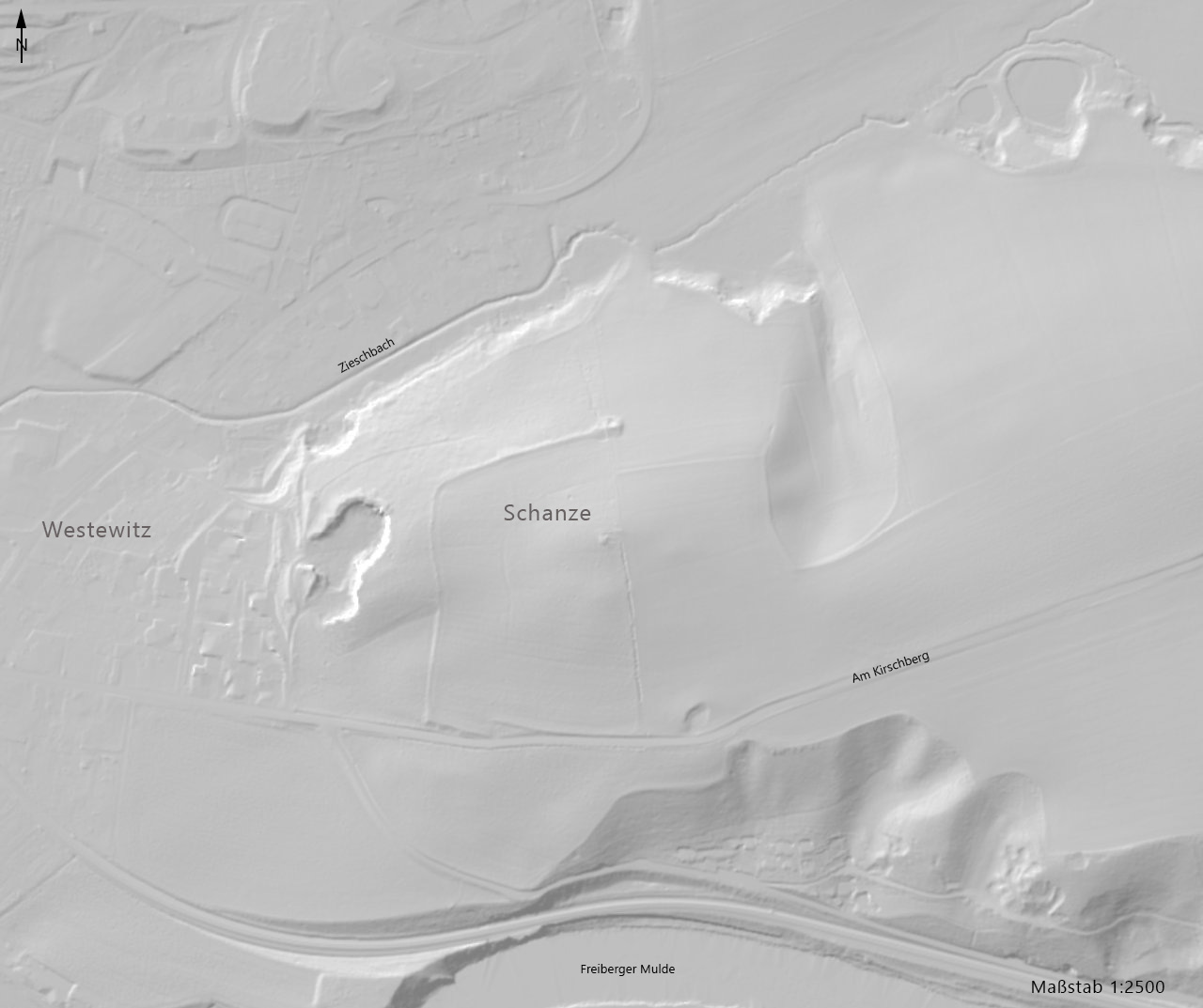
Annemarie ReckA rampart on the hill?
The redoubt is located east of the village on the high bank of the tongue-shaped, spur-like Kirschberg, which is around 231 m high. The rocky ridge, covered with a thick layer of loess, is bordered to the north by the Zieschbach stream and to the south by the Freiberg hollow. The western spur was used as a quarry for Leisnig quartz porphyry. Despite the very early mention of a rampart or castle complex in the local records, it can no longer be detected in the laser scan today. It is rather unlikely that a rampart structure is still concealed beneath the rectangular slope visible in the DTM. If it was only a section of rampart in the area of the spur, it could have been destroyed in the course of quarrying work in the quarry. It may also have been completely leveled by the arable use of the plateau.
Annemarie ReckImage Source A. Reck, DGM ©LfA/GeoSN 2024.
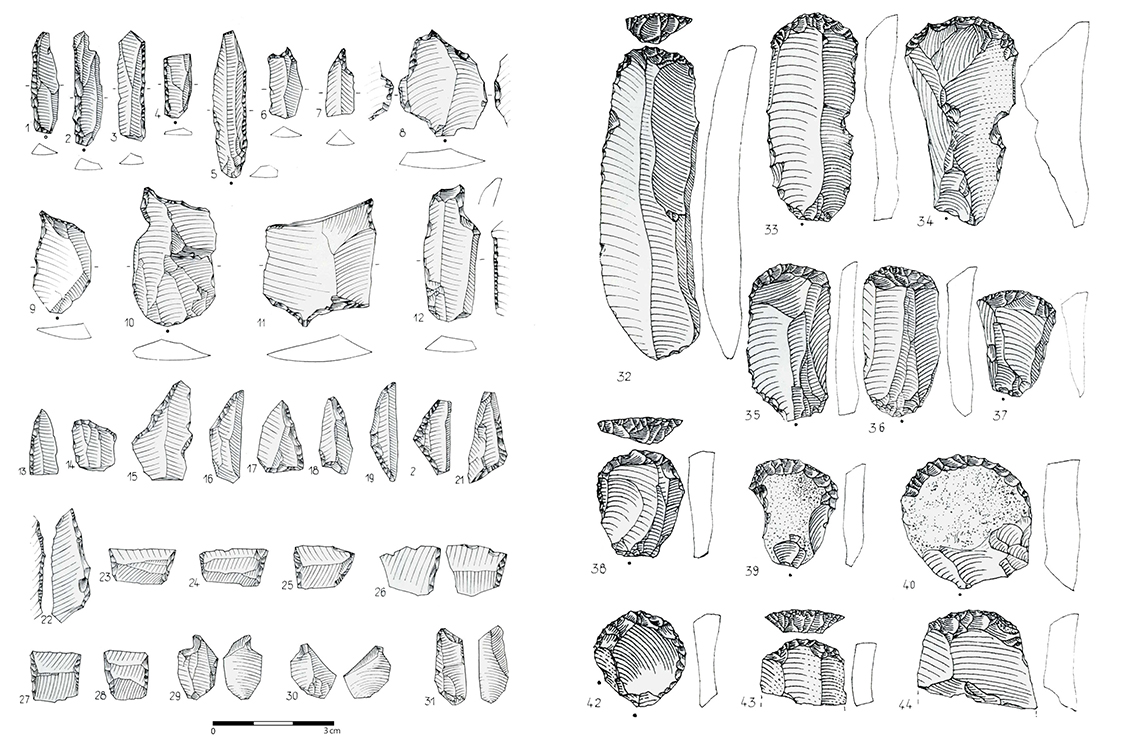
Flint artifacts
The finds collected by Richard Diecke from Döbeln, a volunteer at the State Museum of Prehistory, mainly included Late Palaeolithic flint tools such as back knives (1-5) and drills (6-11) or burins. They date back to the so-called Magdalenian period at the end of the last Ice Age around 14,000 BC. The back knives were inserted into the end of throwing spears with birch pitch and represent the typical hunting weapon of this period. The blade craters (32-44), on the other hand, were also found in the Palaeolithic period, but were also widely used tools in the Neolithic period. Other finds such as microlithic points (13-16), Tardenois points (17.18), triangles (19-22), trapezoids (23-28) and notched remains (29-31) point to a Middle Stone Age camp around 7000 BC. They were also used as inserts and in some cases as points for arrows and javelins.
V. Geupel 1976, Abb. 2, 5./A. Reck, Bearbeitung ©LfA 2024.Image Source Annemarie Reck (18.07.2024)
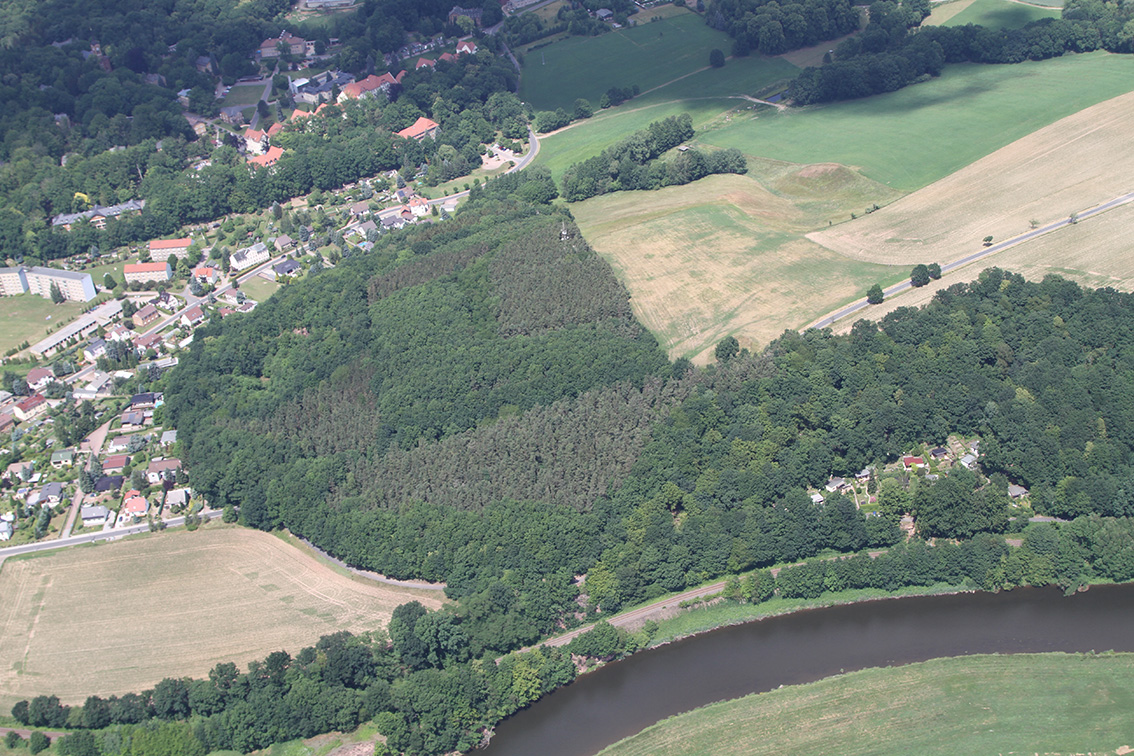
Choice of location
The location of the Kirschberg was the main reason for choosing the high terrace as the site for a hunting camp. From there, there is a view of the Mulde valley as well as a clear view of the surrounding hilltop landscape, which was still largely unwooded at the end of the Ice Age. This made it possible to spot passing herds of animals at an early stage. In the Mesolithic period, the landscape changed along with the climate. The herds of large animals migrated northwards. In the expanding forests, it was mainly standing game that was hunted. The throwing spear was also increasingly replaced by the bow and arrow, which were more suitable for this type of hunting.
Annemarie ReckImage Source P. de Vries, Foto ©LfA 2015.
Literature
Volkmar Geupel, Die spätsteinzeitlichen und mittelsteinzeitlichen Feuersteingeräte von der „Schanze“ in Westewitz, Kr. Döbeln. Arbeits- und Forschungsberichte zur sächsischen Bodendenkmalpflege 20/21, 1976, 15–26.
Angelika Salmen/Michael Strobel/Anna D. Uschner/Johanna Wegner/Thomas Westphalen, Archäologisch-heimatkundliche Fahrradtour durch das Muldental zwischen Döbeln und Kloster Buch. Dienstag 1. Mai 2018. Ungedr. Heft, Archäologische Gesellschaft in Sachsen e.V. (Dresden 2018) 31–46.
Note on monument protection
Archaeological monuments are protected by the Saxon Monument Protection Act. A permit under monument law is required for ground interventions or construction measures.
Permalink
https://archaeo-sn.de/en/ort/westewitz-ski-jump/
Citation
Annemarie Reck, Westewitz ski jump. In: Landesamt für Archäologie Sachsen, Website archaeo | SN (18.07.2024). https://archaeo-sn.de/en/ort/westewitz-ski-jump/ (Stand: 29.09.2026)
